“Get your Black ass out of my station.”
A cop in full uniform said it to a woman alone in the lobby. Her first day. She stayed calm. “I have a meeting here.” “A meeting? The stray dog says it owns the house.” “I have every right to be here.” That killed the laugh. He grabbed her arm and pulled her toward the door. “That is a kid assault. Take your hands off me.” Slap. The sound cut through the lobby like a whip crack. He leaned down, looked at her holding her burning face, and said, “You’re nothing but a cockroach trying to crawl into my station.” Four people right there. Not one moved. He thought that was the end of it—just another nobody he put in her place. But that woman was hiding a secret, one that was about to destroy everything he’d built.
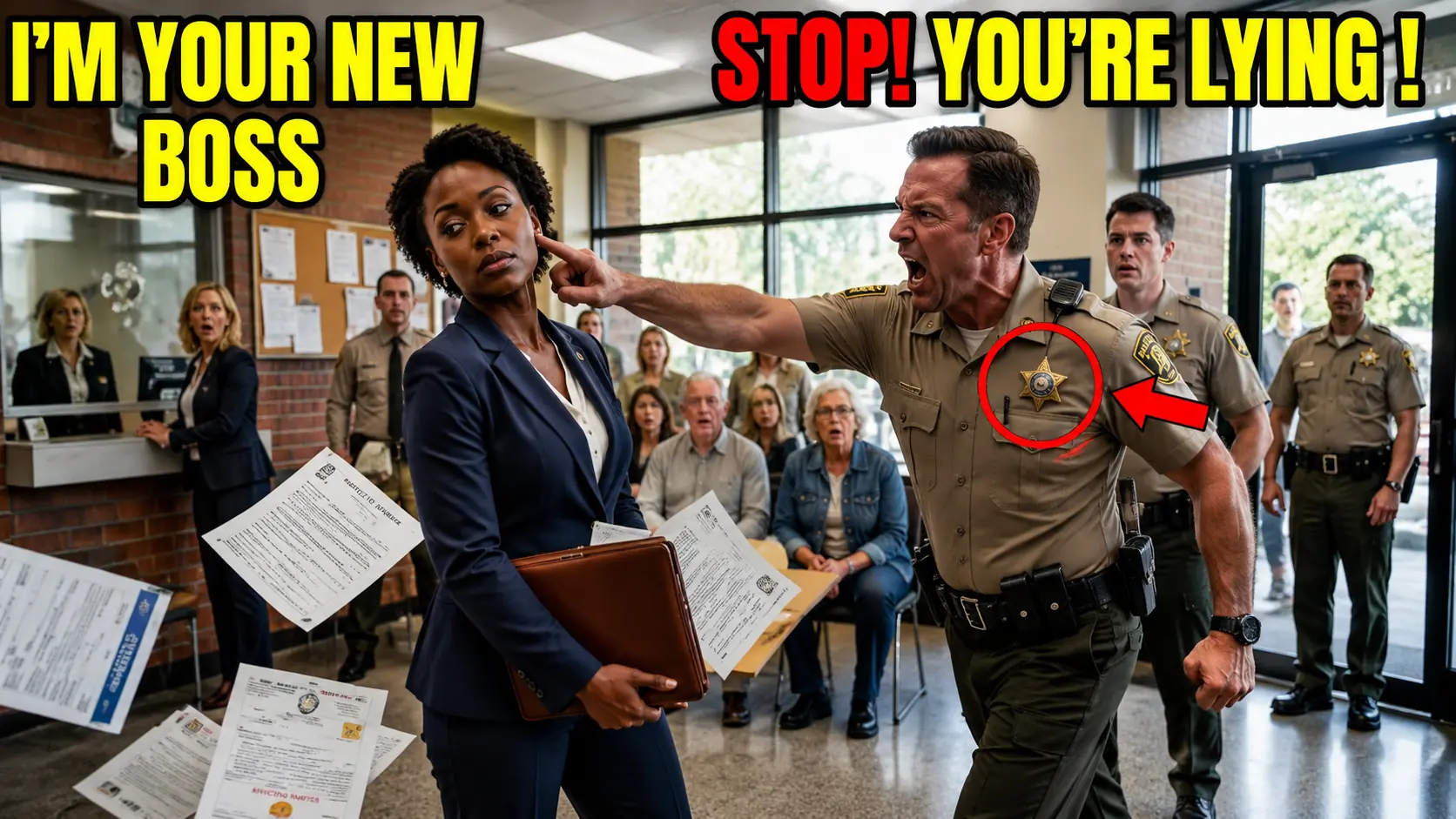
To understand what really happened that day, you need to know who was standing in that lobby. Her name was Olivia Foster, forty-two years old, eighteen years in law enforcement across two states, a master’s degree in criminal justice from Howard University. She’d worked narcotics. She’d worked internal affairs. She’d built community-policing programs from the ground up. This was not a woman who wandered into a police station by accident. This was a woman who had spent her entire career inside them. But the precinct she just walked into was a different story. Ridgemont County Sheriff’s Department. A mid-size department in the South. And it was rotting from the inside.
Over the past three years, civilian complaints had spiked. Excessive-force incidents up forty percent. A state audit flagged a pattern of racial profiling so obvious it made the evening news. Officers complained. Citizens protested. Nothing changed. The previous captain, Raymond Ellis, saw the writing on the wall and retired early before any of it could land on his desk. That left a hole at the top, and the pressure to fill it was enormous. Mayor Patricia Coleman was up for re-election. The community was furious. The department’s reputation was in freefall. She needed someone who wasn’t part of the old guard, someone who wouldn’t cover for the people already there, someone from the outside with an internal-affairs background who knew how to clean house. She found Olivia Foster.
But Coleman didn’t just hire her. She made a decision that would change everything. She told Olivia, “I don’t want you walking in there with a title on your first day. I want you to walk in like a civilian. See how they treat people when they don’t know who’s watching.” That’s why Olivia showed up in plain clothes, no badge, no uniform. She parked in the public lot, not the staff lot. Walked through the front entrance, not the staff door. Every detail was deliberate. She wasn’t visiting the precinct. She was testing it. And nobody knew. The appointment was confidential. The only person inside the department who was told was Raymond Ellis, the outgoing captain. He was supposed to meet Olivia in the lobby that morning and walk her through. But Ellis never showed up. He came in late. At the time it seemed like bad luck. Later it would look like something much worse.
Now the cop who slapped her. His name was Derek Sullivan, twelve years on the force, four excessive-force complaints filed against him, zero sustained. Every single one closed out as unfounded. Sullivan wasn’t just aggressive. He was protected. And the man protecting him was Sergeant Nathan Moore. Twenty years on the job. Moore had supervised Sullivan for most of his career, and every complaint that came in went through Moore’s desk. Every one disappeared. Sullivan had a partner too, Officer Craig Benson, younger, less experienced, but he followed Sullivan’s lead on everything—how to talk, how to handle calls, who to push around. Benson wasn’t the one giving orders, but he was always standing right there when things went wrong. Together the three of them—Sullivan, Benson, Moore—had built a system. Sullivan acted. Benson backed him up. Moore made it go away. It had worked for years. No one had ever challenged it. Until now.
The night before her first day, Olivia sat in her hotel room. She video-called her teenage daughter. Her daughter could tell something was off. “You nervous, Mom?” Olivia paused. “Not nervous. Just tired of proving I belong in rooms I built.” After she hung up, she opened her leather portfolio. Inside was the appointment letter signed by Mayor Coleman. She read it once, closed it, set it on the nightstand. She had no idea what was coming the next morning, but in a way she’d been preparing for it her entire life. When Olivia walked through that front door, she wasn’t just showing up for work. She was walking into a test, one she designed herself. The only question was what kind of department she’d find on the other side. She got her answer in under sixty seconds.
Olivia arrived at the Ridgemont County Sheriff’s Department at 7:43 a.m. Early, on purpose. She wanted to see the building before it filled up. She wanted to watch how the front desk operated, how officers moved through the space, how civilians were treated when they walked in. She pushed open the glass doors. The lobby was exactly what she expected. Scuffed linoleum. Fluorescent lights buzzing overhead. A bulletproof reception window with a clerk sitting behind it, barely looking up. A row of plastic chairs along the wall, half of them cracked. One civilian, a woman named Denise Harper, sat on the far end waiting to file a noise complaint. That was it. Quiet. Unremarkable. Olivia walked toward the reception window. She didn’t get there.