“Get this animal on the ground now.”
“Sir, please. This is my home.”
“Shut your mouth. Did I say you could speak?”
“I’m just asking why.”
“Because I said so. You people always got something to say. Cuff her.”
“My wrists. I have arthritis.”
“Do I look like I care? Drag her up.”
“You’re going to regret this.”
He laughed.
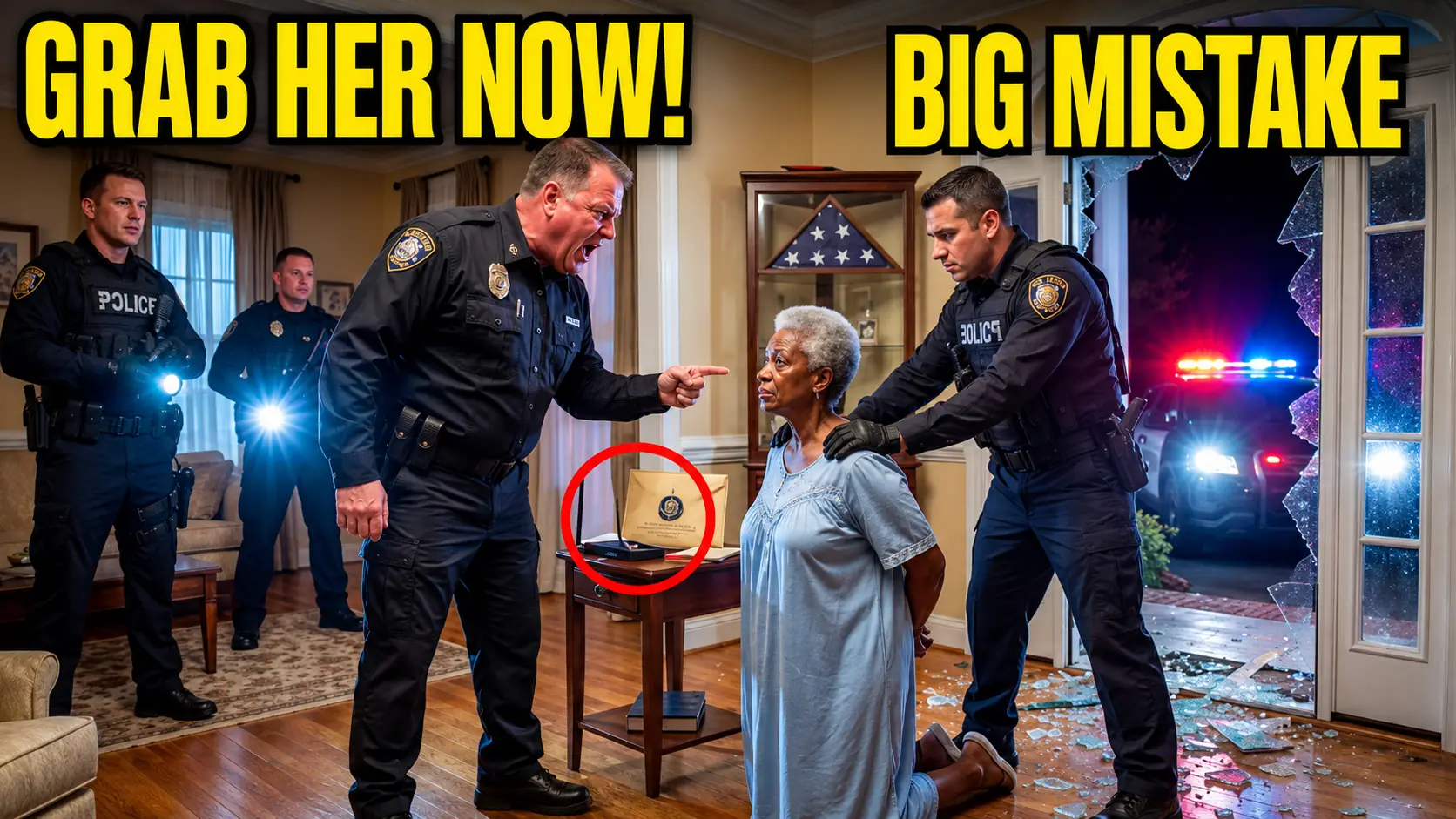
But somewhere in this house, behind a door Hargrove never bothered to open, sat something that would put him on his knees and end his career forever.
To understand what happened that night, you need to know who Dorothy Anderson really was. Not who Captain Hargrove thought she was. Who she actually was.
Dorothy lived alone in a two-story colonial house on Maple Lane. White shutters. A porch with two rocking chairs. Flower beds she planted herself every spring—yellow marigolds along the walkway, red geraniums under the front windows. An American flag hung by the door. Beneath it, a gold star banner, the kind given to families who lost a soldier in service.
Her husband, Colonel James Anderson, served thirty-one years in the United States Army. Three combat deployments. Two Bronze Stars. He died three years ago in that house, in the bedroom upstairs, with Dorothy holding his hand. She never moved. Never sold. Never changed a thing.
Every morning, Dorothy woke at six. She made coffee in the same pot James bought her in 1996. She watered her flowers. She swept the porch. At noon she ate lunch at the kitchen table with the radio playing low. Always Motown. Always soft.
On this particular afternoon—the day before everything fell apart—Dorothy was baking a sweet potato pie for her church group’s Saturday fundraiser. The kitchen smelled like cinnamon, brown sugar, and warm butter. Flour dusted her hands. The oven light glowed amber through the glass door. She hummed along to Marvin Gaye while the pie cooled on the counter.
Her phone rang. Her granddaughter calling from college.
“Grandma, don’t forget Sunday dinner. I’m bringing my roommate.”
Dorothy laughed.
“Baby, when have I ever forgotten Sunday dinner? Tell your friend I’m making my greens.”
That laugh—warm, slow, unhurried—was the last peaceful sound in that house for a long time.
Maple Lane was a quiet street. Mostly white families. Big lawns. Sprinklers on timers. The kind of neighborhood where people smiled and waved but never really talked. Dorothy had lived there for twenty-two years. She was the only Black homeowner on the block. Most neighbors kept their distance. Polite, but hollow. The woman across the street moved in eight months ago and never once said hello. Dorothy waved the first week. The woman looked right through her and walked inside.
But there was Elaine Crawford. Seventy-one. White. Lived next door for fifteen years. She and Dorothy shared tomatoes from the garden, borrowed sugar, sat on the porch on summer evenings talking about nothing important.
That afternoon, Elaine came over with a basket of cherry tomatoes.
“Dorothy, these are the last good ones before the heat kills them.”
“Thank you, Elaine. You want a slice of pie? Just came out.”
They sat in the kitchen and ate warm sweet potato pie off paper plates. Two old women in a quiet house on a quiet street.
Elaine mentioned something before she left.
“You know, there’s been a strange car parked at the end of the block. Silver sedan. Tinted windows. Seen it three times this week.”
Dorothy’s eyes shifted just for a second. An old habit. The kind you develop after thirty years in intelligence work.
“Probably nothing,” she said. “But thank you for telling me.”
Elaine went home. Dorothy locked her doors at nine. She checked every window—ground floor first, then upstairs. She filled a glass of water, set it on her nightstand, and read four pages of a novel before turning off the lamp.
The house went dark. Maple Lane was silent.
Twelve miles away, Captain Wade Hargrove stood in a briefing room at the police station. A whiteboard behind him showed Dorothy’s address, a blurry photo of her house printed from Google Maps, and one sentence written in red marker:
Anonymous tip. Possible narcotics.
Hargrove pointed at the board.
“The resident is a sixty-something Black female. Lives alone. No known weapons registered. No criminal record. We go in fast. We go in hard. We’re out in twenty minutes.”
Officer Trent Buckley leaned back in his chair.
“At three in the morning, she’ll be too scared to move.”
Hargrove smiled.
“Exactly.”
No one in that room asked a single question. No one asked to see a warrant. No one asked if the tip had been verified. Because to them, this wasn’t a real operation. It was an easy hit on an easy target.
They were so sure about that.
At 2:47 a.m., three patrol cars rolled out of the station lot with their headlights off. No sirens. No flashing lights. Just engines humming low through empty streets.
Captain Hargrove rode in the lead vehicle. He had the windows down. Cool Virginia air moved through the cab. He drummed his fingers on the steering wheel like he was heading to a barbecue, not a raid.
Behind him, Officer Trent Buckley drove the second car with the canine unit in the back seat. The dog paced and whined behind the cage partition. Buckley kept one hand on the wheel and picked at a gas-station sandwich with the other.
Officer Neil Swanson rode in the third car. He was the youngest on the team. Two years on the force. He kept checking his body-camera mount, adjusting the angle.
Hargrove had told them all the same thing in the briefing room.
Cameras stay off until I say otherwise.
Swanson turned his off. But his mount was loose. And when he clipped it back onto his vest, something clicked. A small red light blinked once, then held steady.
The camera was recording.
Swanson didn’t notice. Nobody did.