"Out of the car. Hands where I can see them."
The command came through the open window of a twelve-year-old Bentley while the last of the Sunday traffic rushed past on Highway 64. Lennox Hargrove had already put both hands on the steering wheel.
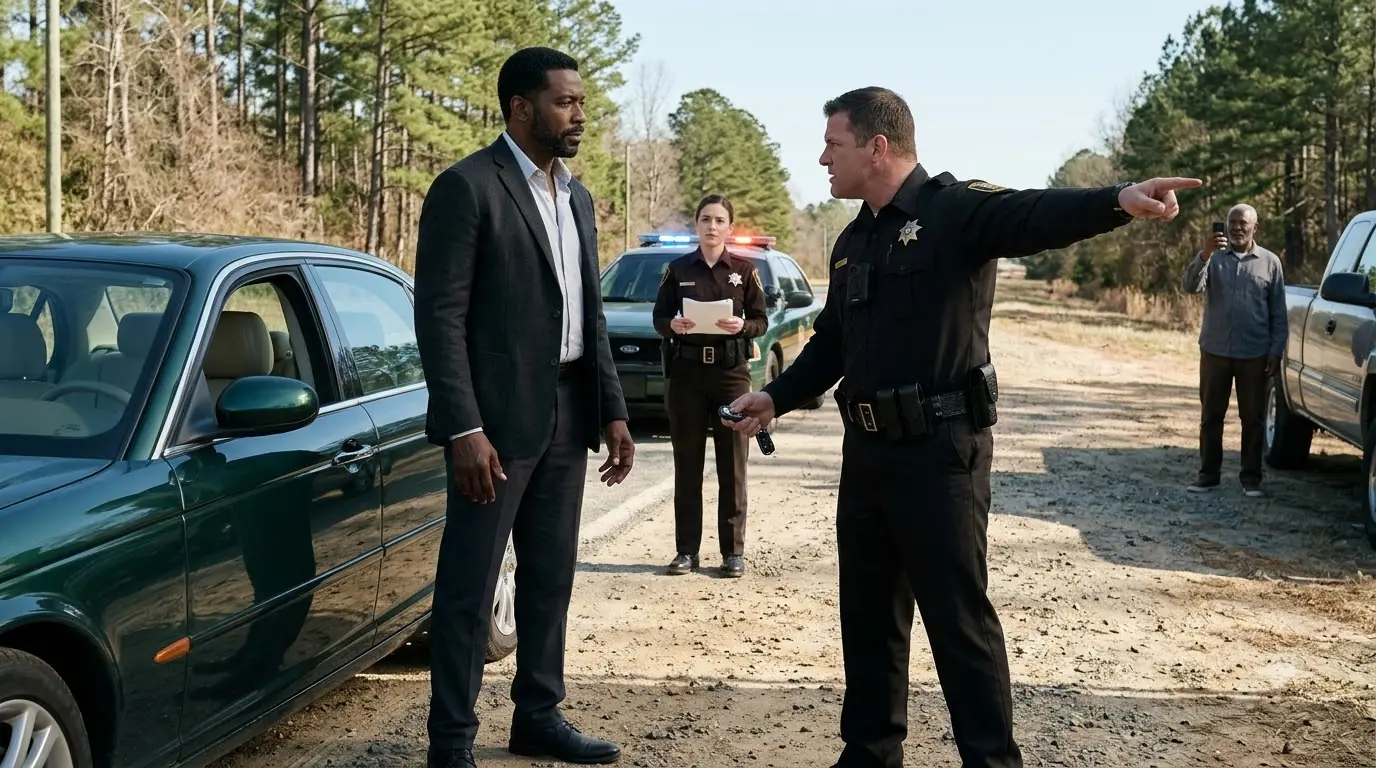
He was fifty-four years old, dressed in a dark wool coat over a white shirt, and had followed every instruction the deputy had given him. The man beside his door looked as though obedience disappointed him.
"Your kind always moves too slow," Deputy Wade Toiver said.
Lennox stepped onto the shoulder and pressed his remote once. Four locks answered with a soft, orderly click, a sound so harmless that he would remember it later with absurd clarity. The deputy heard it too. His head turned toward the Bentley as though the car had insulted him.
"Did I tell you to lock it? Open the car. Hand me the key."
"I am complying with your instruction to stand outside," Lennox answered. "I do not consent to a search."
Toiver's smile was neither friendly nor amused. "A man like you in a car like that, on my road? You just gave me a reason."
"You are exceeding your authority, Deputy."
"Say one more word."
Lennox looked at the road, at the white line separating the shoulder from passing traffic, and at the patrol car reflected in the Bentley's paint. His father had once told him that the most dangerous moment of an unfair stop was often the one in which an officer realized a frightened person was not going to become frightened in the expected way. Lennox knew that lesson better than he wished. He also knew there was a difference between refusing unlawful consent and daring an angry man to prove his strength.
He said nothing. Toiver drew his baton anyway.
The first blow broke the driver's window. Glass burst inward across the leather seat, and a passing motorist braked so abruptly that another car sounded its horn behind him. Lennox did not move toward the deputy. His hands remained visible, open at his sides.
"There," Toiver said, breathing hard. "Now we can see what you're hiding."
He struck another window. Then another. He moved around the car with the grim determination of a person who had already crossed a line and hoped that crossing it several more times might somehow erase the first crossing. By the time a second patrol unit stopped behind his cruiser, the Bentley's interior glittered with broken glass.
Lennox looked down at the shards near his shoes. "You have just created a property-damage report you will need to explain," he said.
"Shut your mouth."
The deputy swung again. A ragged piece of the rear window dropped into the footwell, leaving the car open to the late-summer wind. Lennox felt the old instinct to make himself smaller, to step aside and surrender anything that might shorten the encounter. He also felt an equally old certainty that shrinking would not teach this man where the boundary lay.
Some men spend decades preparing to meet the worst moment of their lives. Lennox had spent decades working in places where the wrong report could imprison a stranger and the right piece of evidence could bring that stranger home. Yet when the glass broke, he was not thinking about his federal career. He was remembering his father's knees on this same highway, forty-five years earlier, and a nine-year-old boy in the passenger seat who had been too frightened even to cry.