The buzzing neon lights above Rusty’s Travel Plaza flickered against the Texas sky like a warning no one had bothered to read.
The station sat alone beside State Road 87, thirty miles from the nearest interstate interchange and just beyond the faded county-line sign welcoming travelers to Ridgefield County.
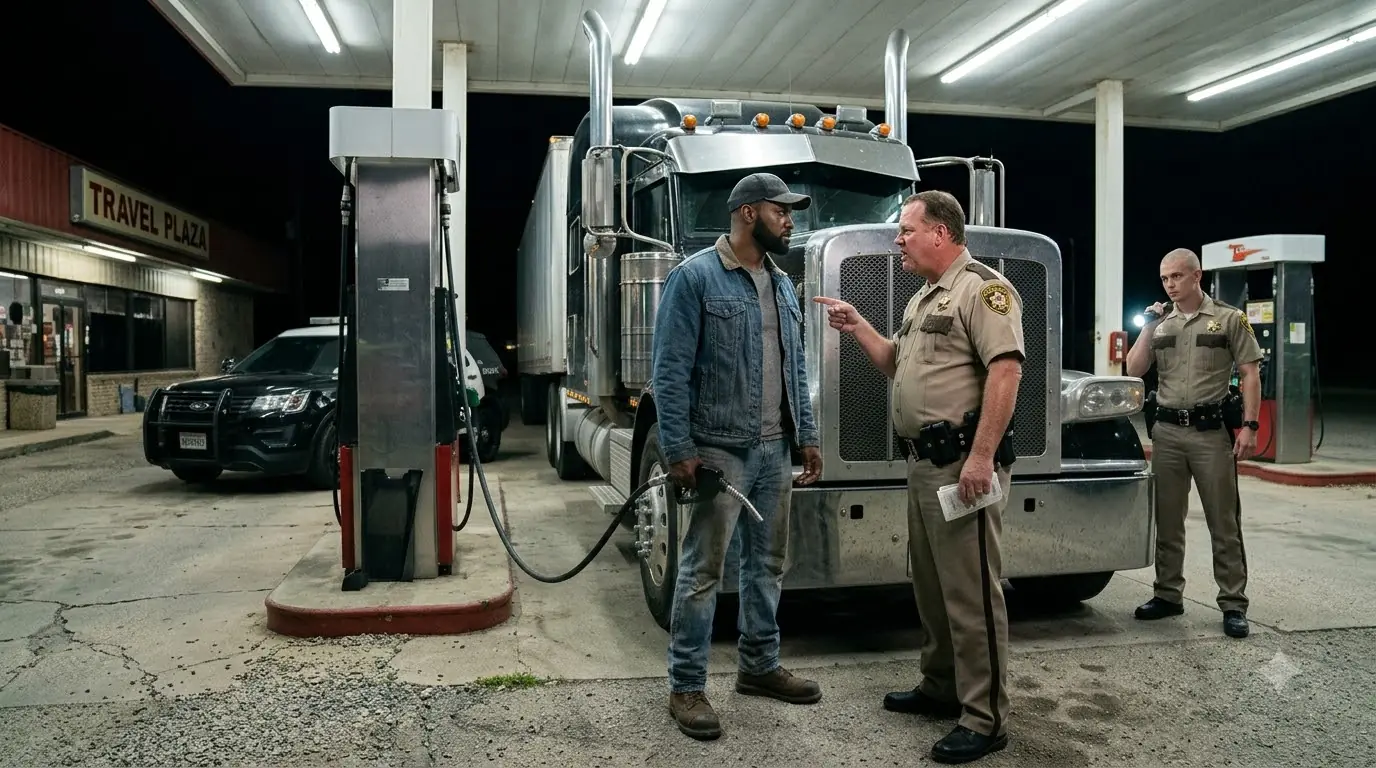
At that hour, shortly after eleven on a humid Thursday night in June, the place looked almost abandoned. Two diesel pumps worked. Three did not.
A red OPEN sign buzzed weakly in the window, fighting moths that repeatedly struck the glass. Somewhere beyond the parking lot, crickets chirped inside an overgrown drainage ditch while heat rose from asphalt that had spent all day beneath a ninety-eight-degree sun.
Then the stillness broke.
A custom Peterbilt 389 came rolling through the darkness, its engine low and powerful, chrome reflecting the weak canopy lights as it turned into the cracked parking lot.
Behind the wheel sat Marcus Ellington.
To anyone watching from a patrol car, Marcus looked exactly like what he was supposed to look like: a long-haul truck driver approaching the end of an exhausting route.
He wore a faded denim jacket over a gray T-shirt, worn work boots, and a grease-stained baseball cap pulled low. Two days of beard shadow darkened his jaw. His eyes looked tired. His shoulders sagged just enough to suggest ten hours behind the wheel and too much bad coffee.
He was forty-seven years old, six feet two, broad across the chest, with thick forearms and hands that looked as though they had spent years changing tires beside highways.
None of that was entirely fake.
Marcus had spent the previous six weeks learning enough about commercial trucking to pass casual inspection.
He had driven the Peterbilt hundreds of miles under the supervision of professional instructors. He had learned logbook terminology, fuel procedures, weigh-station routines, loading slang, and the thousand tiny habits that separated real drivers from people pretending to be them.
But Marcus Ellington had never earned his living hauling freight.
He had spent fifteen years with the Federal Bureau of Investigation.
For the last nine, he had worked public corruption.
And Ridgefield County had been sitting near the top of his desk for almost eleven months.
Marcus eased the Peterbilt beside diesel pump four and brought the engine down to a low idle.
He did not look toward the tree line two hundred yards beyond the station.
He did not look toward the unmarked utility van parked behind an abandoned feed store across the road.
He did not look at the tiny camera concealed near the convenience-store sign.
He did not need to.
He knew where everyone was.
More importantly, everyone knew where he was.
Inside a mobile command vehicle positioned far enough away not to attract attention, Supervisory Special Agent Adrian Voss watched three monitors simultaneously.
He was fifty-one, thin, sharp-featured, and so disciplined that younger agents joked he could conduct a raid without changing his resting heart rate.
Tonight, however, his right thumb tapped slowly against a paper coffee cup.
Beside him sat Assistant United States Attorney Vanessa Hart, forty-three, dark-haired, composed, and carrying a legal pad crowded with notes from nearly two years of work.
Two FBI agents monitored audio.
A third watched feeds from fixed surveillance positions.
Nobody spoke unnecessarily.
Marcus’s voice came through a speaker.
“Fueling.”
Adrian pressed the transmit key.
“Copy.”
That was all.
No cinematic speeches.
No countdown.
They had done too much work to ruin it by becoming excited now.
The investigation had started with a man named Leonard Price.
Leonard was sixty-one, a retired construction supervisor from Albuquerque who had driven through Ridgefield the previous summer on his way to visit his daughter in Houston.
He was stopped for allegedly drifting across the white shoulder line.
Dash camera later showed his tires never crossed it.
Deputy Travis Boone searched Leonard’s SUV after claiming to smell marijuana.
Leonard did not use marijuana.
No drugs were found.
No weapons were found.
What Boone did find was $8,600 in cash inside an envelope.
Leonard had sold a utility trailer that morning.
He had the bill of sale.
Boone seized the money anyway.
Civil asset forfeiture.
“Possible proceeds associated with narcotics activity.”
Leonard received no criminal charge.
No traffic citation.
Just a seizure receipt.
When he tried to recover the money, he discovered the process would require hiring a lawyer several hours away and potentially spending thousands to fight for money already taken.
His daughter persuaded him to file a complaint.
The complaint went nowhere.
Then Leonard did something most people had stopped doing.
He wrote letters.
State attorney general.
Texas Rangers.
FBI field office.
United States Attorney.
American Civil Liberties Union.
Local newspaper.
County commissioners.
Most produced form responses.
One reached Vanessa Hart.
She almost discarded it.
Not because it lacked emotion.
Because it sounded too familiar.
Every federal prosecutor received complaints accusing local police of corruption.
Most could not be proven.
Some reflected legitimate misunderstandings.
Some came from defendants trying to escape consequences.
Others were painfully real but unsupported by enough evidence to establish a federal case.
Leonard’s letter had something different.
Dates.
Names.
Receipt numbers.
Amounts.
And one sentence:
“I met two other people at the courthouse who said the same deputies took their money the same way.”
Vanessa called him.
That call led to three other victims.
Then seven.
Then nineteen.
The pattern was not subtle once someone bothered to put the incidents beside one another.
Drivers stopped for minor or questionable traffic violations.
Most from outside Ridgefield County.
A disproportionate number or Latino.
Vehicle searches supposedly based on consent, smell, nervousness, inconsistent travel plans, or vaguely described “criminal indicators.”
Cash discovered.
Cash seized.
No narcotics.
No meaningful criminal cases.
The drivers released.
The money retained.
Sometimes the county filed civil forfeiture actions.
Sometimes paperwork became strangely incomplete.
In several cases, the amount listed on the official receipt was lower than what the driver claimed had been taken.