The safety on a service pistol is a sound you never forget. For Zeke Washington, a man who had survived the horrors of Kandahar, that sound didn't trigger fear.
It triggered a cold, calculated rage. He was just trying to eat a slice of cherry pie in a dusty roadside diner.
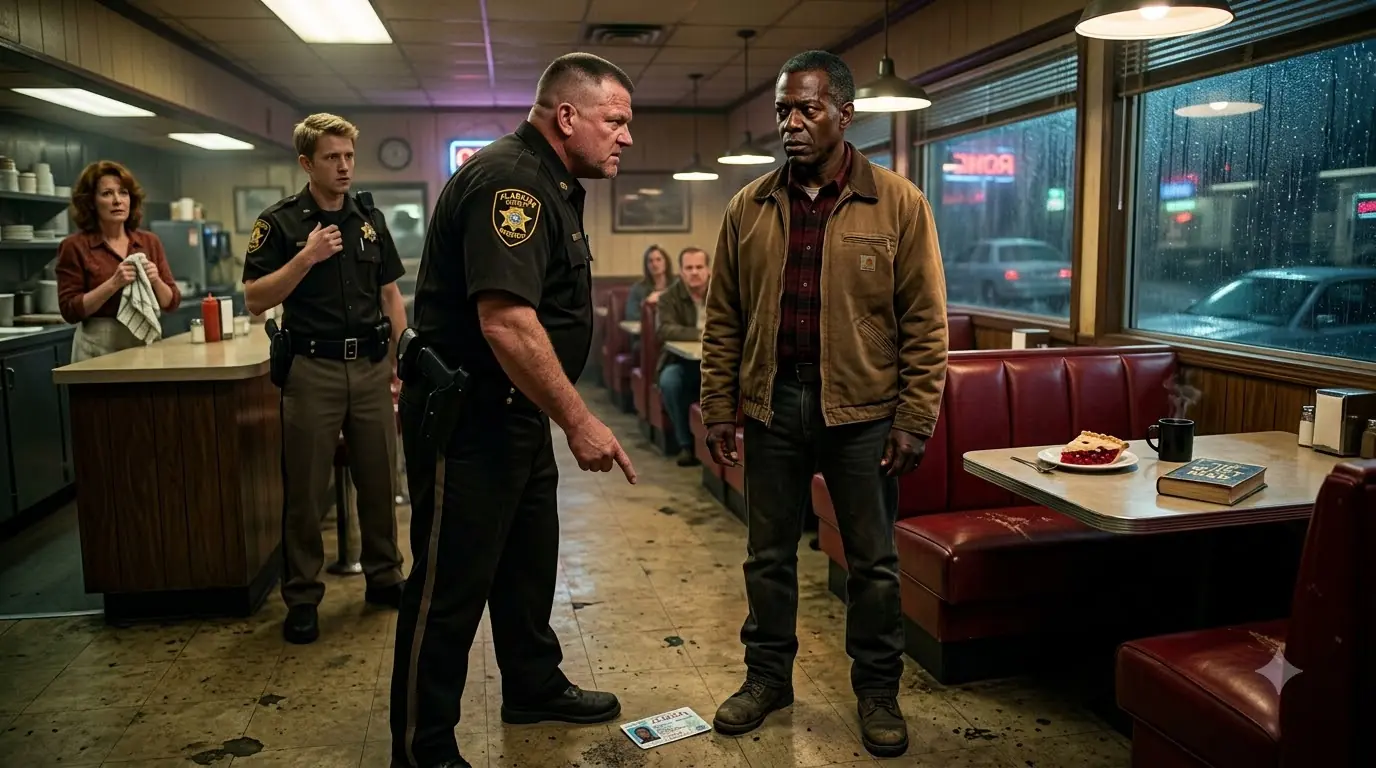
But when two corrupt deputies decided he looked like trouble, they made the biggest mistake of their careers. They thought they had a drifter in cuffs.
They didn't know they were holding a ghost, a man with a clearance level higher than their sheriff's pay grade. And they certainly didn't expect the one phone call that would freeze the entire county in its tracks.
The neon sign above Sal's Stop and Go flickered with a dying buzz, casting an intermittent, sickly red glow over the wet asphalt of Route 66. Inside the air smelled of stale coffee, bacon grease, and floor wax. It was a sanctuary for the weary. And right now, the only patron that mattered was the man sitting alone in booth four.
Zeke Washington didn't look like a threat. At 52, his hair was dusted with the gray of hard years, close-cropped in a style he hadn't abandoned since discharge. He wore a faded Carhartt jacket that had seen better decades, flannel underneath, and work boots that were scuffed but meticulously laced. To the casual observer in Oak Haven, he looked like a mechanic or maybe a truck driver passing through on a long haul to nowhere.
He wasn't.
Zeke stared at the black coffee in his mug, watching the steam rise in curling ribbons. His hands, resting on the Formica table, were steady. There was a small scar running from his left eyebrow to his temple, a souvenir from shrapnel burst in the Helmand province.
But the people of Oak Haven didn't know about Helmand. They didn't know about the Distinguished Service Cross tucked away in a drawer in DC, or the consulting work Zeke now did for the Defense Intelligence Agency. To them, he was just a black man in a predominantly white town sitting in a booth that the locals usually save for their own.
More coffee, hon? The waitress, a woman named Beverly with hair teased high enough to brush the doorframe, hovered over him with a pot. She had a kind face worn down by double shifts and cigarette breaks. Zeke looked up and offered a soft, genuine smile.
Please, ma'am.
And if that cherry pie is still fresh, I'll take a slice. Fresh out of the oven, sugar, Beverly said, pouring the dark liquid. You're not from around here, are you? Just passing through, Zeke said, his voice a low baritone.
Heading up to visit my daughter in Chicago.
The radiator on my Ford started hissing about 10 miles back. Figured I'd let it cool down and get some sugar in my system. Well, you picked the right spot. But Beverly lowered her voice, her eyes darting toward the front window.
Don't linger too long after dark.
Sheriff's boys, they get bored on weeknights. And when they get bored, they get mean. Zeke nodded slowly. He knew the type.
Every small town had them. The high school bullies who peaked at 18 and were handed a badge and a gun to validate their insecurities. I appreciate the warning, Beverly. I'll eat and run.
She scurried off to the kitchen, leaving Zeke to the silence. He took a sip of the coffee. It was bitter, but hot. He pulled a worn paperback book from his jacket pocket intending to read a few chapters.
The peace lasted only minutes.
The bells above the front door jingled violently announcing an entrance that was less about arriving and more about invading. A gust of cold wind swept through the diner killing the warmth. Two uniformed officers stepped inside. The first was a towering slab of meat named Sergeant Royce Dalton.
He was thick in the waist, his uniform straining against a gut built on donuts and entitlement.
His buzz cut was severe. His eyes hidden behind mirrored aviators despite the fact that the sun had set. He walked with a swagger that demanded space. Trailing him was Officer Lane Carver.