Daily’s Recovery After Losing Her Owner at Age 11
Daily is now staying in a quiet medical foster home while our veterinary team completes her testing and develops a treatment plan. Her condition is stable, but several findings from her first examination require careful follow-up. At 11 years old, we expected her to have some age-related health concerns. The abdominal mass, however, has become our most urgent priority.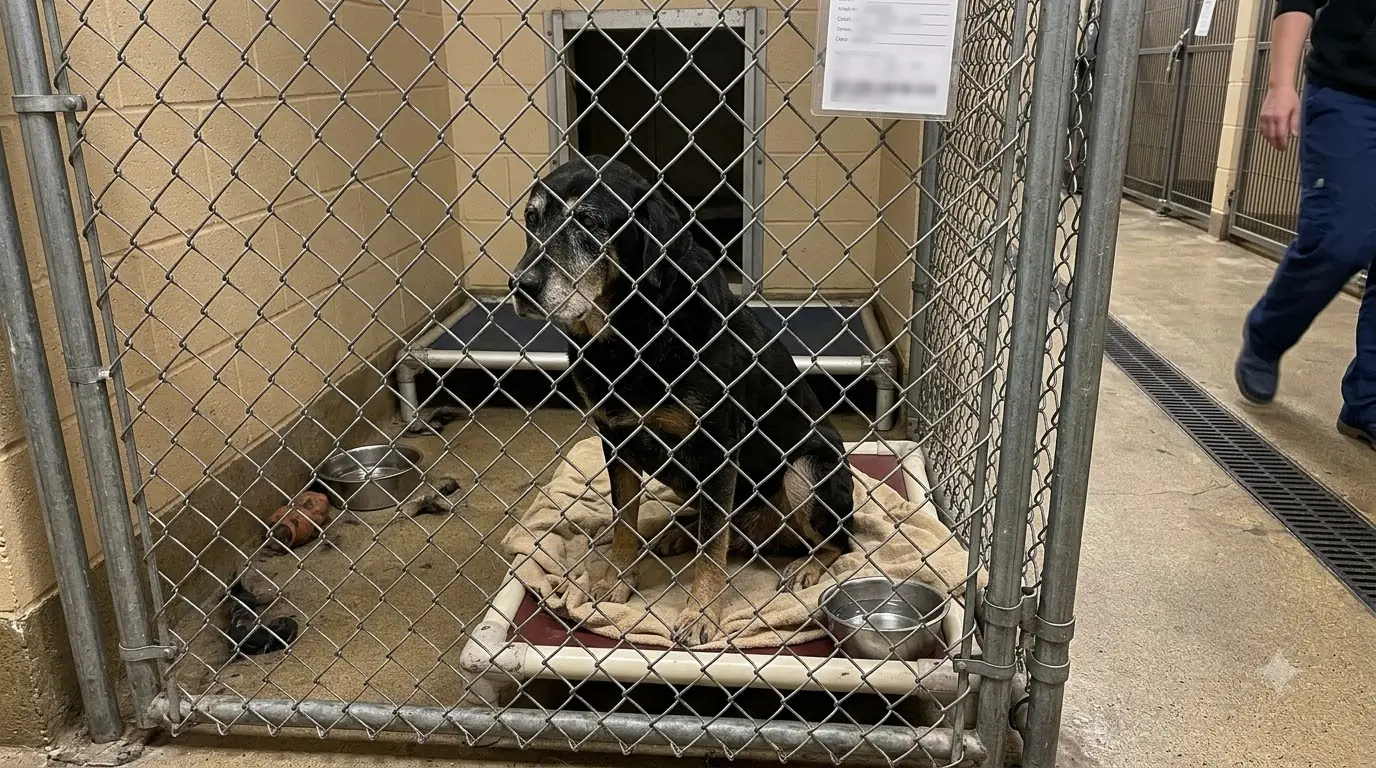
An ultrasound confirmed that the mass is connected to Daily’s spleen. It is approximately the size of a small orange and appears contained within the organ. There was no visible free fluid in her abdomen, which means there was no evidence of active internal bleeding at the time of the scan. That was reassuring because some splenic masses can rupture unexpectedly and become life-threatening emergencies.
Ultrasound alone cannot determine whether the growth is benign or malignant. Some splenic masses in older dogs are harmless nodules or blood-filled growths, while others can be aggressive cancers. Daily’s chest X-rays did not reveal obvious masses in her lungs, and the ultrasound did not show clear abnormalities in her liver or nearby lymph nodes. Those findings are encouraging, but they cannot provide a final diagnosis.
The most reliable next step will likely be surgery to remove the spleen, followed by laboratory testing of the mass. Before Daily can safely undergo anesthesia, the veterinary team must first address her dehydration, evaluate her kidney function more closely, and complete a cardiac assessment. Because of her age, we do not want to rush her into a major procedure without understanding the risks.
Daily’s initial bloodwork showed mildly elevated kidney values and urine that was less concentrated than expected. These changes could indicate early chronic kidney disease, though dehydration and recent stress may also have influenced the results. She has been encouraged to drink frequently, and extra water is mixed into her meals. Her blood and urine tests will be repeated after she has had time to settle and receive consistent nutrition.
She is not receiving aggressive intravenous fluids because she is eating, drinking, and maintaining hydration with support. Her foster caregiver monitors the amount of water she consumes and records how often she urinates. So far, Daily has not shown vomiting, severe lethargy, or a sudden loss of appetite. Those would be important warning signs, especially while the splenic mass remains in place.
A heart murmur was also detected during her examination. It is mild, and Daily is not coughing or struggling to breathe. Still, the veterinarian has recommended an echocardiogram before surgery. This will show whether the murmur is caused by an age-related valve change and help the anesthesia team choose the safest medications and monitoring plan.
Daily’s hips and knees show signs of chronic arthritis. X-rays revealed degenerative changes in both hip joints and along the lower portion of her spine, but no fractures or recent traumatic injuries. The muscle loss around her hindquarters likely developed because she had gradually become less active. She can walk independently, although she rises slowly and occasionally slips on smooth flooring.
Her foster home has been adjusted to make movement easier. Nonslip rugs now create a path between her bed, water bowl, and the back door. A lightweight support sling is available for difficult mornings, though she has needed it only once. Her walks are limited to several slow trips outside each day instead of one long outing that could leave her sore.
Pain management must be chosen carefully because of the changes in her kidney values. For now, Daily is receiving a kidney-conscious medication plan along with an approved joint supplement. The veterinary team will reconsider additional arthritis medicine after reviewing her repeat laboratory results. Gentle movement remains important because complete inactivity would cause further muscle loss and stiffness.
Dental disease is another concern. Daily has heavy tartar, inflamed gums, and at least two damaged teeth that may eventually need to be removed. Her mouth is uncomfortable, but there is no facial swelling or sign of an urgent dental abscess. A dental procedure will wait until the splenic mass and anesthesia risks have been addressed.
To make eating easier, Daily receives softened senior food in three smaller portions. She ignored her first meal in the foster home and spent much of that evening lying beside the front door. Later that night, after the house became quiet, she ate a few bites and drank some water. By the third day, she was finishing most of her breakfast and accepting small pieces of plain chicken from her caregiver.
Her weight is slightly below the ideal range, but the veterinarian does not want her to gain too quickly. The immediate goal is steady nutrition with enough high-quality protein and calories to preserve muscle without placing unnecessary strain on her kidneys. Her weight is checked every few days, and she has already gained a small amount since leaving the shelter.
Emotionally, Daily’s adjustment has been slow and deeply tied to routine. During her first two nights, she slept near the entryway instead of using the padded bed prepared for her. Whenever a car stopped outside, she lifted her head and listened. She sometimes walked toward the door, waited briefly, and then returned to the same spot.
We cannot know exactly what Daily understands about losing her owner. Her behavior does show that she is searching for familiarity and struggling with the sudden change. She does not panic when left alone for short periods, but she becomes restless if the household routine changes unexpectedly. Calm voices, predictable meal times, and the same caregiver handling most of her needs have helped her feel more secure.
There are already several quiet signs of progress. Daily now lifts her head when her foster caregiver enters the room, and her tail makes a slow sweep across the blanket. She has started sleeping on her side instead of remaining curled tightly with her head raised. Yesterday, she followed her caregiver into the kitchen without being called and rested on the rug while dinner was prepared.
Physical contact is becoming easier for her as well. At first, Daily tolerated only a few seconds of petting before turning away. She now leans gently against a familiar hand and has allowed her ears and paws to be examined without pulling back. One evening, she placed her chin on her caregiver’s knee and remained there until she fell asleep.
Outside, Daily prefers a quiet yard to a busy sidewalk. She takes time to smell the grass and watch nearby movement before choosing where to walk. Her pace is slow, but she has become more willing to explore. On her latest outing, she walked to the far end of the yard and returned without assistance, then waited beside the door to be let inside.
Daily’s care team has provided the foster family with emergency instructions while surgery is being considered. Pale gums, sudden weakness, collapse, rapid breathing, a swollen abdomen, or an abrupt refusal to eat could indicate internal bleeding and would require immediate veterinary treatment. She is never left without an adult nearby for an extended period.
If her repeat kidney tests and cardiac evaluation show that anesthesia is reasonably safe, Daily will be scheduled for a splenectomy. The removed mass will be sent to a pathology laboratory, and those results will determine whether she needs additional treatment. If testing indicates that surgery presents too much risk, the team will discuss careful monitoring and comfort-focused care instead.
Daily is not medically cleared for adoption, and no permanent decisions will be made until we understand the nature of the mass. For now, her foster placement gives her something she desperately needed after leaving the shelter: a quiet room, a dependable routine, and one familiar person who returns every time they walk out the door.
Her medical future remains uncertain, but Daily is no longer waiting behind a kennel fence with only a note telling visitors how she came to be there. She is sleeping beneath a warm blanket, eating regular meals, and receiving the careful veterinary attention every senior dog deserves. Whatever the next tests reveal, she will face them surrounded by people committed to keeping her safe and comfortable.