Daisy Finally Left the Kennel Door—Then Her X-Rays Revealed Why She Moved So Slowly
PART 2 — CURRENT CONDITION UPDATE
Daisy is now living with Robert and Linda under a medical foster-to-adopt agreement while our veterinary team completes her treatment plan. She is no longer sleeping against a metal kennel door, but her transition into the couple’s home has involved far more than simply giving her a quiet bed.
Her initial examination identified several separate medical problems. Some are common in senior dogs and can be managed over time. Others required more urgent investigation because they could affect both her comfort and her long-term prognosis.
The most concerning finding was the abnormal shadow seen on Daisy’s first chest X-rays. The image showed a rounded area near the front portion of her chest, close enough to the heart and major blood vessels that its exact location could not be determined from ordinary X-rays alone.
A shadow in that region can have several explanations. It may represent an enlarged lymph node, a mass arising from the lungs or surrounding tissue, a change involving the heart, or even the overlap of normal structures on a two-dimensional image.
The veterinary team avoided telling Robert and Linda that Daisy definitely had cancer. An X-ray can raise suspicion, but it does not always provide a final diagnosis.
Additional imaging was recommended.
Daisy underwent a chest ultrasound performed by an experienced veterinary specialist. The test helped determine that the abnormal structure was not growing from the heart itself. There was no significant fluid around her heart, and the heart muscle continued contracting effectively.
The ultrasound identified a soft-tissue mass positioned close to the front of the chest. Because of its location, the veterinarian recommended advanced imaging to understand whether it was attached to a lymph node, lung tissue, or another structure.
A CT scan was scheduled after Daisy’s bloodwork and heart function were reviewed. The team selected sedation and anesthesia protocols appropriate for an older dog with a cough and possible chest disease.
Robert and Linda understood that anesthesia carried risk. They also understood that making treatment decisions without knowing the size and location of the mass could expose Daisy to unnecessary procedures.
The CT scan revealed that the abnormality was an enlarged lymph node located within the chest. Several smaller nearby lymph nodes also appeared mildly enlarged, while the lungs themselves did not contain a large primary tumor.
This information narrowed the possibilities but did not answer every question. Lymph nodes may enlarge because of infection, inflammation, immune activity, or cancer.
The team collected a carefully guided needle sample from the most accessible abnormal node. The procedure was planned to avoid the heart, lungs, and major blood vessels.
The sample showed reactive inflammatory cells but did not clearly identify malignant cells. This was encouraging, though not completely conclusive.
Needle samples collect only a small number of cells. If a mass contains different areas, the needle may not reach the portion responsible for the enlargement.
The veterinarians compared the sample with Daisy’s other test results. She had a persistent cough, mild anemia, inflammation in her bloodwork, and evidence of a previous respiratory infection.
A specialized infectious disease panel was performed based on the region where Daisy had lived. Additional tests evaluated fungal disease and several organisms that can affect the lungs and lymph nodes.
One result suggested exposure to a fungal organism found in soil, but the test did not prove active disease by itself. Daisy had no obvious skin lesions, bone pain, or eye changes commonly associated with widespread infection.
A urine antigen test and repeat blood analysis provided stronger evidence that an active fungal respiratory infection was the most likely cause of the enlarged lymph nodes.
This diagnosis was serious, but it offered a treatment path. It also meant that the abnormal shadow was not currently believed to be an untreatable heart mass or an obvious aggressive lung tumor.
Daisy began prescription antifungal medication under close veterinary supervision.
Antifungal treatment often lasts for many months. Stopping after the first improvement can allow the infection to return, and some medications can affect the liver.
Before Daisy received her first dose, the team documented her liver measurements. Repeat bloodwork was scheduled to identify changes before they caused severe symptoms.
Robert and Linda give the medication at the same times each day. They record every dose and never double the next dose if one is accidentally delayed without first contacting the veterinary team.
Daisy accepts the medicine inside a small portion of canned food. Her full meal is offered afterward so the family can confirm that she received the medication before mixing it into a larger bowl.
During the first several days, Daisy’s appetite became slightly inconsistent. She approached the bowl, smelled it, and sometimes walked away.
Because appetite loss can result from medication, stress, pain, nausea, or progression of disease, the family reported the change rather than assuming she was being picky.
The veterinarian prescribed medication to control nausea and adjusted the timing of her antifungal dose. Her meals were divided into smaller portions offered throughout the day.
Warm water was added to increase the food’s aroma and support hydration. Robert sat several feet away while Daisy ate, but he did not hand-feed every bite or pressure her to finish.
Her appetite gradually improved. Daisy now eats most meals without encouragement and has begun waiting in the kitchen when Linda prepares breakfast.
She remains slightly underweight. Her ribs are easier to feel than they should be, and she has significant muscle loss along her back and hindquarters.
The veterinary team wants her to regain weight slowly. Rapid weight gain from excessive treats would add strain to her arthritic joints without rebuilding the muscle she needs.
Her food provides complete nutrition, and portions are measured according to her current condition. High-fat table scraps are avoided because they may cause digestive illness and interfere with the balance of her diet.
Fresh water is always available. Daisy’s drinking and urination are monitored because changes may indicate medication effects, infection, kidney disease, diabetes, or another developing problem.
So far, she drinks a consistent amount and urinates without visible discomfort.
The fungal infection appears to explain much of Daisy’s cough. Before treatment, she coughed several times each day, particularly after rising, drinking, or becoming excited.
The cough was dry and brief, but its persistence made chest imaging necessary.
Robert and Linda record the frequency and circumstances of every episode. They also count Daisy’s breathing rate while she is asleep.
A sleeping respiratory rate provides more useful information than counting immediately after activity or stress. Daisy’s numbers have remained within the range established by her veterinary team.
Her cough has not disappeared completely, but it has become less frequent. She sometimes goes an entire day without an episode.
A sudden increase in breathing effort, open-mouth breathing at rest, pale or blue gums, collapse, severe weakness, or an inability to settle would require emergency care.
The couple keeps written instructions beside the refrigerator and has the contact information for both the regular clinic and the nearest emergency hospital.
Repeat imaging will determine whether the enlarged lymph nodes are shrinking. Improvement in outward symptoms is encouraging, but it cannot replace objective monitoring.
If the nodes become smaller and her fungal antigen level declines, treatment will continue until the veterinary team believes the infection has been adequately controlled.
If the lymph nodes enlarge despite appropriate medication, another sample or surgical biopsy may be necessary. The team would then reconsider cancer, resistant infection, or a different inflammatory condition.
Robert and Linda understand that the initial sample did not provide an absolute guarantee. They have chosen to move forward one step at a time rather than allowing uncertainty to prevent Daisy from having a home.
Her anemia is being monitored alongside the respiratory disease. Daisy’s red blood cell count was below the normal range at intake but not low enough to require a transfusion.
The pattern appeared consistent with chronic inflammation rather than sudden blood loss. Her stool was normally colored, her abdomen did not contain free blood, and no bleeding mass was found.
A repeat blood count showed that the anemia had stabilized. As the underlying inflammation is treated and her nutrition improves, the team hopes her red blood cell count will gradually rise.
If it worsens, further testing may be required to evaluate bone marrow function, gastrointestinal bleeding, immune-mediated disease, or another source of chronic blood loss.
Daisy’s mobility problems are separate from the chest infection, although illness and inactivity likely made them more noticeable.
X-rays showed moderate to advanced arthritis in both hips, both knees, and several sections of her lower spine. Her right knee also showed evidence of an old ligament injury that had healed with chronic instability.
There was no recent fracture. The changes had developed over years.
Daisy rarely vocalizes when she is uncomfortable. At the shelter, she walked slowly and often chose to remain near the kennel door, but she still stood whenever someone approached.
Her willingness to rise for people may have hidden how difficult the movement was.
During her first examination, Daisy shifted her weight forward before pushing herself upright. Her hind feet occasionally slipped apart on the smooth floor.
When the veterinarian extended her hips, she tightened her abdomen and turned her head toward the examiner. These subtle reactions were treated as meaningful signs of pain.
Pain management required careful planning because Daisy was beginning long-term antifungal treatment. The veterinary team wanted to minimize unnecessary medication interactions and monitor her liver closely.
She receives a multimodal pain-control plan selected for her medical circumstances. No medication is added, removed, or increased without veterinary direction.
Robert and Linda had previously cared for an older dog and still had unused medicine in a cabinet. They brought it to the clinic instead of giving it to Daisy.
The veterinarian confirmed that medication prescribed for another animal should never be reused without approval. Even dogs of similar size may have different diseases, laboratory values, or drug interactions.
Daisy’s current medication has reduced her stiffness. She still needs time to stand, especially in the morning, but she no longer pauses after every few steps inside the house.
The couple installed nonslip runners over the hardwood floors. A wide path now connects her bed, food bowls, back door, and the room where Robert and Linda spend most of the day.
Before the runners were placed, Daisy moved cautiously across the floor. Her front feet remained planted while her hind legs took short, uncertain steps.
Once she slipped, she immediately lowered herself and refused to continue. Robert sat nearby until she relaxed, then used a towel beneath her abdomen as temporary support.
No one dragged her by the collar or forced her upright.
The family completed the nonslip path that afternoon. Daisy now crosses the room without freezing.
Two steps lead from the back door into the yard. A low ramp with a textured surface was installed so she would not need to jump or place her full weight on one hind leg.
At first, Daisy stood at the edge and looked toward the grass without stepping onto it. Linda placed a few pieces of measured food along the ramp and walked beside her.
Daisy moved slowly and stopped halfway. Linda waited without pulling.
After several attempts, Daisy reached the yard. She now uses the ramp during every bathroom trip, though an adult stays close during wet weather.
Her outdoor walks are short and controlled. She is not asked to keep pace with a healthy young dog.
The first route extended only to the end of the driveway and back. Daisy stopped frequently to smell the grass, and the couple allowed those pauses to become part of the experience.
The purpose of her walks is gentle movement, mental stimulation, and maintaining strength—not covering a particular distance.
Her family watches for slower steps, increased panting, toe dragging, reluctance to continue, or stiffness later in the day.
One afternoon, Daisy seemed energetic and followed Robert farther down the sidewalk than usual. That evening, she had difficulty settling and needed more time to rise.
The couple shortened the next day’s activity and informed her rehabilitation team. Daisy recovered without an emergency visit, but the experience showed that enthusiasm during a walk does not always mean her joints can manage the full distance.
She now participates in a rehabilitation program designed for senior dogs with arthritis and muscle loss.
Her exercises include gentle weight shifts, supported standing, controlled turns, and slow transitions from standing to sitting. Each movement is performed on a nonslip surface.
Repetitions remain low. Daisy’s form matters more than completing a large number.
If her legs tremble, her posture changes, or she attempts to lie down, the session ends.
Robert initially worried that stopping would allow her to become weaker. The rehabilitation specialist explained that exercise must challenge muscles without creating a painful flare that discourages future movement.
Progress is measured across weeks, not by exhausting her in one session.
The family records short videos of Daisy walking from the side and from behind. These help the team compare her stride, balance, and weight distribution over time.
Memory can be unreliable, especially when changes happen gradually. Video provides a clearer record.
Daisy’s hindquarters remain thin, but early improvements are visible. She can stand for longer while eating and no longer immediately sits after entering the yard.
She has also started following Linda from the living room to the kitchen. During her first days, she watched from the bed instead of attempting the trip.
A supportive harness is available for difficult mornings. The handles allow an adult to steady her without lifting her entire body or placing pressure on her neck.
The couple received instructions on using it safely. Pulling Daisy upward too quickly could frighten her or strain other joints.
Her nails were overgrown at intake, which altered the angle of her feet and reduced traction. They could not be shortened to their ideal length in one session without cutting into sensitive tissue.
The veterinary team trimmed them gradually. Regular maintenance will allow the internal tissue to recede over time.
The fur between her paw pads is also kept short to improve contact with the floor. Her pads are dry but not cracked or infected.
Daisy’s firm lump near the chest was evaluated separately from the abnormality inside her chest. The external lump sat beneath the skin along the lower portion of her rib cage.
A needle sample showed mostly mature fat cells, making a benign fatty tumor the most likely diagnosis.
Fatty tumors are common in older dogs, but location and growth still matter. A benign mass can interfere with movement or become uncomfortable if it grows large.
The lump is measured regularly. It is not currently attached to deeper structures and does not appear painful.
Surgical removal is not recommended while Daisy is undergoing treatment for the fungal infection unless the mass changes rapidly, becomes firm or fixed, damages the skin, or interferes with her mobility.
Robert and Linda check it gently once each week rather than squeezing it every day. They record the measurement and report any change.
Daisy also has several smaller skin growths. The veterinarian examined each one and documented its size and location.
Older dogs commonly develop harmless growths, but appearance alone cannot identify every mass. Any lesion that grows, bleeds, changes color, becomes painful, or causes persistent licking will be sampled.
Her dental condition required attention. Daisy had heavy tartar, gum inflammation, and one broken tooth near the back of her mouth.
There was no severe facial swelling or active drainage, but dental X-rays revealed infection around the root of the damaged tooth.
Chronic oral pain may have contributed to her slow eating and reluctance to chew harder food.
A dental procedure was postponed until Daisy’s breathing and response to antifungal medication became more stable. The team wanted to reduce anesthesia risk and avoid placing too many demands on her body at once.
In the meantime, her meals were softened with warm water. She was not given bones, antlers, hard nylon objects, or other items that could fracture additional teeth.
Once her cough decreased and repeat bloodwork remained acceptable, the dental procedure was performed with continuous monitoring.
The damaged tooth and two severely diseased smaller teeth were removed. The remaining teeth were cleaned above and below the gumline.
Daisy recovered more slowly than a young dog might, but she experienced no major complication. She remained quiet in a warm recovery area until she could stand with assistance.
For several days, she ate soft food and received appropriate pain relief. Robert and Linda monitored the extraction sites for swelling, bleeding, discharge, or refusal to eat.
At her recheck, the mouth was healing properly.
Linda noticed that Daisy began approaching the food bowl more eagerly after the procedure. She also stopped dropping pieces of food from one side of her mouth.
The family had originally assumed that slow eating was simply part of her age. The improvement demonstrated why changes in senior animals deserve evaluation rather than automatic acceptance.
Daisy’s hearing is moderately reduced. She responds inconsistently when someone calls from behind her, particularly if she is sleeping.
The couple approaches within her field of vision and gently touches the floor or bed before placing a hand on her body.
This prevents the startled reactions seen during her first shelter examination.
Her ear canals contained wax and mild inflammation. Testing did not identify a deep infection. The ears were cleaned, and a short course of topical treatment reduced the irritation.
Because Boxers and Boxer mixes can develop skin and ear sensitivities, the family watches for renewed redness, odor, discharge, or head shaking.
Daisy’s vision remains functional, though both lenses show age-related cloudiness. She can navigate the home, follow movement, and locate her bowls.
Her low-light vision appears weaker. She sometimes hesitates at the dark hallway leading to the back door.
Small night-lights now mark the route. Furniture is kept in consistent positions so Daisy can rely on memory as well as vision.
Her neurological examination did not show paralysis, seizures, or severe balance loss. She places each paw correctly and does not circle continuously.
Some weakness results from pain and muscle loss rather than disease within the brain or spinal cord.
The couple will report new toe dragging, knuckling of the paws, sudden collapse, unusual eye movements, or loss of bladder control, as those signs could indicate a neurological change.
Daisy was reliably house-trained according to the limited records provided with her, but she had several accidents during her first week in foster care.
The family did not punish her. Pain, stress, medication, unfamiliar doors, and reduced mobility can all prevent a senior dog from reaching the correct place in time.
They increased the number of bathroom opportunities and took her outside immediately after waking, eating, drinking, and longer periods of rest.
Daisy began walking toward the back door when she needed to go outside. If no one noticed quickly, she stood silently rather than barking.
A small motion sensor now alerts the couple when she enters that area. She has had no recent accidents.
Her urine test did not show infection, diabetes, or advanced kidney disease. The team will repeat testing if her drinking or urination changes.
Emotionally, Daisy’s adjustment has unfolded more slowly than her physical progress.
She spent her first night in the foster home lying beside the front door. Robert and Linda had placed an orthopedic bed in the quiet corner of the living room, but Daisy smelled it once and walked away.
The position she chose looked almost identical to the place where she had slept in the shelter: body curled beside an entrance, head pointed toward the direction from which footsteps would come.
Robert considered moving the bed to the door. Instead, the couple placed a folded blanket on the floor where Daisy had chosen to rest and left the orthopedic bed nearby.
They did not pull her onto it or block access to the entrance.
During the night, every sound from the hallway caused Daisy to lift her head. When Robert went to the kitchen for water, she stood with difficulty and watched him return.
He sat on the floor several feet away. Daisy approached, rested her head against his leg, and remained there until her breathing slowed.
The gesture was the same one she had offered inside the shelter kennel.
Robert did not hug her tightly or lean over her. He kept one hand low against her shoulder and allowed her to decide when to move.
After several minutes, Daisy lowered herself beside him.
On the third night, she placed her front half on the orthopedic bed while keeping her hind legs on the blanket near the door.
By the end of the first week, she climbed fully onto the bed and slept there for nearly five hours.
The bed was gradually moved a small distance from the entrance. Daisy continued using it as long as she could see the doorway.
The couple understood that their goal was not to force her to stop watching. They wanted to give her additional places where she could feel safe.
Daisy still becomes alert when footsteps approach from outside. Delivery drivers, neighbors, and visitors cause her to raise her head.
During her earliest days, she stood every time, even when rising was painful. She appeared unwilling to miss the possibility that the person entering might be the owner she had lost.
No one can know exactly what Daisy expects when she hears those sounds. Dogs do not explain whether they remember a specific person, anticipate a routine, or simply respond to a pattern learned over many years.
The family does not claim that every glance toward the door means she believes her former owner is returning.
What they can observe is that Daisy relaxes more quickly after seeing Robert or Linda enter. She no longer remains at the door for long periods after a sound passes.
Her former owner did not surrender her casually. The shelter received documentation showing that the owner’s health had deteriorated and daily care had become unsafe for both of them.
Daisy had been deeply loved. Her faded collar, veterinary records, and familiar blanket arrived with written notes about her food, fears, and routines.
The owner had attempted to arrange care through relatives, but none could provide a permanent home.
Shelter staff do not describe Daisy as discarded or unwanted. A person’s physical ability to provide care can disappear while love remains unchanged.
That distinction matters. Emotional rescue stories can easily turn an elderly owner into a villain, but Daisy’s history did not support that interpretation.
Her former owner asked only to be informed if she found a safe home.
With permission from everyone involved, the shelter sent photographs showing Daisy resting beside Robert and Linda.
A short message came back expressing relief that she was living with another older couple who understood senior care.
A direct visit is not currently possible because of the former owner’s medical condition. The shelter will continue handling communication in a way that protects everyone’s privacy and emotional welfare.
Robert and Linda do not view themselves as replacing the person Daisy lost. They are helping her build a new routine without demanding that the old one disappear.
Breakfast arrives at the same time each morning. Medication follows a written schedule. Walks use the same short route, and her bed remains in a predictable position.
These repeated patterns reduce uncertainty. Daisy does not need to guess when she will eat, go outside, or see someone return.
Departures were difficult during the first weeks. When Robert picked up his keys, Daisy moved toward the door and attempted to follow.
The couple practiced short absences rather than testing how long she could endure being alone.
At first, Linda remained inside while Robert stepped outside for several seconds. Later, both left while a camera recorded Daisy’s response.
She stood at the door and listened but did not bark, destroy objects, or scratch continuously. After less than a minute, they returned calmly.
The absence increased only after Daisy could remain settled. Excited greetings were avoided because they could increase anxiety around every departure and return.
Daisy can now stay home for moderate periods. She usually rests on the orthopedic bed while the couple completes errands.
They do not leave her alone all day. A trusted neighbor has met her several times and can provide a bathroom break if necessary.
The neighbor enters slowly, allows Daisy to approach, and avoids reaching over her head.
Daisy is reserved with unfamiliar people. She does not immediately solicit attention, but she also does not hide or show aggression.
Visitors sit sideways and allow her to smell them. Daisy often returns to Robert after greeting someone, then settles near his chair.
Her bond with Linda is developing differently. Linda manages most meals and medication, and Daisy follows her into the kitchen.
In the morning, she waits on the nearest rug while Linda prepares food. Her tail moves when the bowl is carried toward her.
One afternoon, Linda sat on the couch while sorting laundry. Daisy left her bed, crossed the room, and rested her chin on Linda’s knee.
It was the first time she had initiated that familiar gesture with anyone other than Robert.
Linda remained still until Daisy lifted her head on her own.
Daisy does not show interest in chasing balls or squeaking toys. Her favorite enrichment activity involves searching for pieces of her approved food hidden inside loosely folded towels.
She works slowly and relies heavily on her nose. The activity allows her to explore without placing significant pressure on painful joints.
Another game uses several lightweight cups placed on a rug. Linda hides food beneath one cup, and Daisy chooses by touching it with her nose.
Sessions end while she remains interested. Enrichment should provide success, not frustration or exhaustion.
Daisy also enjoys sitting outside in mild weather. A padded mat is placed in the shade, and an adult remains nearby.
She watches people pass at a distance but does not attempt to chase them. If a loud vehicle startles her, she looks toward Robert or Linda and then returns to smelling the air.
Hot weather requires particular caution. Boxer mixes may have shorter muzzles that reduce the efficiency of cooling through panting.
Daisy’s muzzle is not as shortened as that of some Boxers, but her age and respiratory condition increase the risk of heat stress.
Walks occur during cooler parts of the day. She is never left outside unattended or inside a parked vehicle.
Her family carries water and turns home immediately if her breathing becomes unusually loud, rapid, or labored.
Cold weather also affects her arthritis, so activity and bedding will be adjusted seasonally.
Daisy has been introduced to one calm senior dog belonging to a family friend. The first meeting occurred outdoors with both dogs on loose leashes and enough space to move away.
Daisy smelled the other dog briefly, then continued walking. There was no barking, lunging, or stiff confrontation.
A second parallel walk produced similarly relaxed behavior. Direct indoor visits will remain short and supervised.
Her history with cats is unknown. The family does not currently have other animals, so no immediate cat assessment is necessary.
Daisy has met no young children in the foster home. Because pain can reduce a dog’s tolerance for accidental contact, any future interaction would require close adult supervision and respectful behavior.
The couple’s home is naturally quiet, which suits her. There are no frequent parties, running children, or other energetic animals competing for space.
Robert and Linda initially worried that adopting a 10-year-old dog with medical needs might be considered impractical.
Shelter counselors encouraged them to evaluate the decision honestly. Senior dogs can require ongoing medication, frequent testing, mobility adaptations, dental care, and emergency planning.
Love does not remove those obligations. It makes them worth considering carefully.
The couple reviewed their budget and transportation. They identified who could care for Daisy if one of them became ill.
Because Daisy’s previous placement ended when an elderly owner could no longer manage alone, the shelter wanted her new plan to include backup support.
Robert and Linda named two adult family members willing to help. Both have met Daisy and learned her basic routine.
Written instructions include medication times, veterinary contacts, feeding amounts, exercise limits, and emergency signs.
This planning is not a prediction that something will go wrong. It is part of responsible adoption for any animal, particularly one whose daily care depends on several treatments.
Daisy’s foster-to-adopt period will continue until the veterinary team completes the next round of imaging and bloodwork.
Her liver values have remained stable on antifungal medication. The inflammatory measurements in her blood are beginning to decline.
Her anemia has improved slightly. She has gained a modest amount of weight without becoming heavier than recommended for her joints.
The most recent chest images show that the enlarged lymph node has decreased in size. The smaller surrounding nodes are also less prominent.
This response supports the diagnosis of fungal infection and suggests that treatment is working.
It does not mean treatment can stop. Daisy will remain on medication until her clinical signs, imaging, laboratory measurements, and fungal antigen results reach targets established by her veterinarian.
Ending therapy too early could allow the infection to return.
The cough now occurs only occasionally, most often after drinking quickly or becoming excited. Her sleeping respiratory rate remains stable.
She breathes comfortably while resting and has had no collapse, blue gums, or emergency episodes.
Her orthopedic condition has also become more manageable. She cannot run or climb stairs comfortably, and the arthritis will not disappear.
However, she can rise from her bed, walk to the yard, explore for several minutes, and return without being carried.
She spends more time standing near the couple rather than watching them from a distance.
Her pain medication will require continued laboratory monitoring. Even if Daisy appears comfortable, medication safety cannot be judged by appearance alone.
The couple attends each scheduled test and reports changes promptly.
They have learned that senior care is often built from small observations: a slower rise, an unfinished meal, an extra cough, a different sleeping position, or a hesitation at the ramp.
None of those signs automatically signals a crisis. Together, however, they help the medical team recognize meaningful patterns.
Daisy’s quality of life is assessed regularly. The family considers her pain, appetite, hydration, hygiene, happiness, mobility, sleep, social connection, and whether good days continue to outnumber difficult ones.
This does not reduce her life to a score. It gives the family a structured way to notice change and make decisions based on her welfare rather than fear.
At present, Daisy continues having more comfortable days than difficult ones.
She eats, seeks affection, explores the yard, and rests peacefully. She shows interest when Robert puts on his walking shoes and follows Linda into the kitchen.
She still has moments when she looks toward the front door after hearing footsteps.
The difference is what happens next.
At the shelter, Daisy lifted her head and waited until the sound disappeared. Then she lowered herself onto the concrete beside the kennel entrance.
In her foster home, the footsteps usually belong to Robert returning from the mailbox or Linda coming down the hallway.
Daisy stands when she can. On stiffer days, she remains on her bed and lifts only her head.
Either way, someone enters the room and comes toward her.
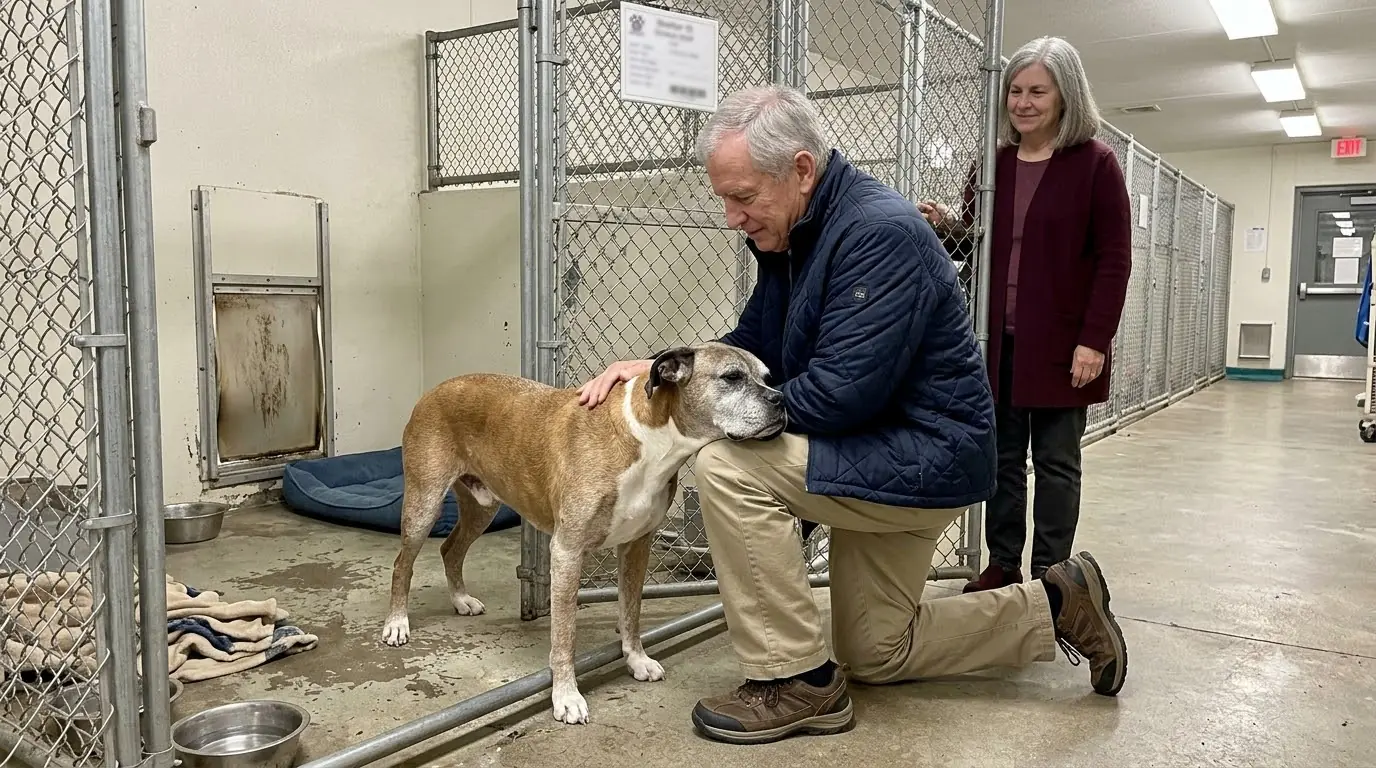
Robert often kneels beside the bed, just as he knelt when the kennel door opened. Daisy leans forward and rests her gray muzzle against his leg.
He never rushes the moment. He does not pull her closer or ask her to perform anything in return.
He simply stays.
The couple has decided to finalize Daisy’s adoption as soon as the medical foster period is formally completed. They know her treatment will continue and that uncertainty remains.
The fungal infection may require many more months of medication. Her chest will need repeat imaging. Her arthritis and old knee injury will require lifelong care.
Additional age-related problems may appear. No honest medical team can promise the family a specific number of years.
Robert and Linda are not adopting Daisy because they believe they can make her young or erase everything she has lost.
They are adopting her because the life she has now still contains comfort, curiosity, trust, and room for new attachment.
Her former owner gave her years of familiarity and love. The shelter gave her safety when that home could no longer continue.
Now Robert and Linda are giving her a quiet place where her age is not treated as a reason to keep walking.
Daisy’s orthopedic bed remains within sight of the front door. She still likes knowing who enters and leaves.
But she no longer sleeps directly against the threshold.
Most nights, she settles on the bed after her final trip outside. Linda covers part of her body with the faded blanket that arrived from her former home.
Robert sits in the nearby chair until Daisy closes her eyes. Sometimes her head remains turned toward the door. Other nights, she faces the couple instead.
Recently, Daisy slept through the sound of someone walking onto the porch. She did not lift her head until Robert returned to the living room.
When she saw him, her tail moved softly against the bed.
She did not need to stand and wait.
He was already coming back to her.