Excuse me, may I please have some more tea? The elderly Japanese man had been sitting alone for four hours. This was the first time anyone heard his voice. A young executive slammed down his fork.
“Did that old Asian just speak? I thought he was furniture. Go back to your country, Grandpa. You’re stinking up the place. Who let him in? This restaurant has standards. We don’t serve beggars.”
Laughter erupted. Phones emerged. Someone livestreamed with the caption “Senile Japanese man lost in Manhattan.” The old man sat frozen, eyes down, hands trembling around an empty cup. Not a single person defended him.
But from across the room, one Black waitress was watching. The one they called invisible. The one nobody respected. She was about to walk over to that table, and when she opened her mouth, she wouldn’t speak English. None of them were prepared for what came next.
But before we get to that moment, you need to understand who Faith Underwood really was. Twenty-eight years old, born in Atlanta, Georgia, raised by a grandmother who worked three jobs and never complained once. Faith had moved to New York six years ago with two hundred dollars in her pocket and a dream that felt bigger than her circumstances. That dream had faded somewhere between the unpaid bills and the double shifts.
For four years, Faith had worked at Sakura and Sage, an upscale fusion restaurant in the heart of Manhattan where a single entrée cost more than her daily wage. She had memorized every item on the menu. She knew which wines paired with which dishes. She could anticipate a customer’s needs before they even opened their mouth. None of it mattered.
To the management, Faith was just another body in a black uniform. Employee of the month, never. Promotion to floor supervisor, not even considered. The best tables with the biggest tips, always given to someone else. She lived in a cramped apartment in the Bronx with two roommates she barely knew. Every month she sent half her paycheck back to Georgia where her mother was fighting a losing battle with diabetes. The medical bills kept climbing. The insurance kept denying claims. And Faith kept smiling at customers who looked right through her.
But here’s what no one at Sakura and Sage knew. Faith Underwood spoke fluent Japanese. Not the tourist phrases you learn from apps. Not the broken sentences picked up from anime subtitles. Fluent, beautiful, the kind of Japanese that made native speakers stop and listen. She had taught herself over seven years. Online courses at midnight after her shifts ended. Language exchange partners on video calls during her lunch breaks. Hundreds of hours watching Japanese films without subtitles, pausing and rewinding until every word made sense.
Why Japanese? Because of her grandmother. Grandma Lorraine had loved Japanese cinema with a passion that Faith never fully understood until she was gone. Kurosawa, Ozu, Miyazaki. Every Sunday afternoon, they would sit together and watch films that transported them far from their small apartment in Atlanta. When Grandma Lorraine passed away three years ago, Faith made a promise. She would learn the language her grandmother had loved. She would keep that connection alive.
She never told anyone at work. Never put it on her résumé. Who would believe a Black waitress from Georgia spoke Japanese?
Sakura and Sage operated on an unspoken hierarchy that everyone understood but no one acknowledged. At the top sat Derek Manning, the floor manager. Thirty-four years old, perpetually stressed and utterly convinced that his position made him important. Derek had a habit of mispronouncing Faith’s name. Sometimes Fay, sometimes Faith, never correct. Despite four years of working together, he never made the same mistake with the white servers.
Below Derek came the front-of-house staff, carefully curated like a magazine spread. Megan Holloway held the prime position, a twenty-five-year-old blonde with less experience than Faith, but significantly more visibility. She worked the front section near the windows where natural light made everything look expensive and tips flowed like champagne. Faith worked the back section near the kitchen, near the storage room, near the bathrooms, where customers went to complain, not to celebrate.
“It’s just how things are,” Derek had explained once, not meeting her eyes. “You understand? The front section needs a certain aesthetic for the brand.”
Faith understood perfectly.
The kitchen staff treated her differently. Carlos, the head chef, always saved her the freshest staff meal. Yuki, the sushi chef, nodded at her with quiet respect. They saw her work ethic. They noticed how she handled difficult customers with grace. But kitchen staff didn’t make promotion decisions. Derek did. And Derek had made his decision about Faith a long time ago.
There was one more figure in the daily landscape of Sakura and Sage, the elderly Japanese man in the corner booth. He arrived every day at precisely two in the afternoon and stayed until closing. He ordered only green tea and one onigiri rice ball. He never complained. He never caused trouble. He simply sat and watched the world pass by. The other servers called him the ghost. Derek called him “that weird old Asian guy” when he thought no one was listening. The customers ignored him completely.
Only Faith noticed that he always chose the booth facing the window, the one with the best view of the sunset. Only Faith noticed that his eyes carried a sadness too heavy for words. Only Faith refilled his tea without being asked.
The old man’s name was Hiroshi Tanaka, though no one at the restaurant knew that. No one had ever asked. Every afternoon he walked the twelve blocks from his apartment on the Upper West Side. Every afternoon he sat in the same corner booth. Every afternoon he hoped that someone, anyone, would see him. Not his expensive watch, not his tailored coat. Him.
Six months ago, his wife Margaret had died. They had been married for forty-three years. She was American, a photographer from Boston who had wandered into his gallery in Tokyo in 1978 and never wandered out. Their life together had been a bridge between two worlds, a constant translation of love across languages and cultures.
When Margaret got sick, they moved to New York. It was her hometown. She wanted to see the seasons change in Central Park one last time. She wanted to hear American jazz playing in small clubs on rainy nights. She wanted to go home. Hiroshi had promised her anything. Three weeks after they arrived, she was gone.
Now Hiroshi sat in Sakura and Sage every day because it was the only Japanese restaurant within walking distance of their apartment. The food wasn’t particularly good. The service was worse. But something about the space reminded him of the small café in Tokyo where he and Margaret had their first date.
He could have gone anywhere. He could have demanded better treatment. He could have revealed who he was and watched the staff scramble to accommodate him. But that wasn’t why he came. He came to remember. He came to grieve. He came to see if anyone in this cold, busy city would notice an old man sitting alone.
Day after day, the answer was no. Servers walked past him like he was furniture. Customers looked through him like he was glass. His tea went cold. His heart went colder.
Until one afternoon, a young Black waitress started refilling his cup without being asked. She never said much, just a small nod, a quiet acknowledgement. It was the first time in months that anyone had truly seen him.
The day everything changed started like any other. Two-fifteen in the afternoon, Mr. Tanaka sat in his usual booth, hands wrapped around a cup of green tea that had long gone cold. The lunch rush had ended, leaving behind scattered customers and the low hum of background music. A group of young professionals occupied the large table near the center of the room. Four men, late twenties, expensive suits, louder than necessary. They had been drinking since noon, celebrating some deal that made them feel invincible.
Faith was clearing a nearby table when she heard them start.
“Hey, check out the old guy in the corner.” The tallest one nudged his friend. “Been here for like three hours, just sitting there. Bet he doesn’t even understand English. Probably waiting for someone to translate the menu.”
“Nah, man. He’s just senile. My grandmother got like that before she died. They just sit and stare at nothing.”
Their laughter bounced off the walls. Faith’s hands tightened around her tray. She glanced at Mr. Tanaka and saw what no one else noticed. His fingers trembling slightly against his teacup. His jaw tensing. His eyes fixed on the window, reflecting something that looked a lot like pain. He understood every word.
“Someone should call his nursing home,” one of the men continued. “Tell them they lost a patient. Or immigration. How do we know he’s even legal?”
More laughter. Someone pulled out a phone to take a picture.
Faith felt something crack inside her chest. She knew that feeling, the humiliation of being mocked in public, the helplessness of standing alone against a crowd. She had swallowed that feeling a thousand times in this restaurant. But watching it happen to someone else was different. Watching it happen to this quiet old man who had never been anything but gentle, that was unbearable.
She made a decision.
Faith set down her tray. Her heart pounded so hard she could hear it in her ears. Four years of keeping her head down. Four years of being invisible. Four years of swallowing every insult and smiling through every slight. She was done.
She walked across the dining room, past the laughing executives, past Megan, who shot her a confused look, past Derek, who was too busy checking his phone to notice. She stopped at Mr. Tanaka’s booth. The old man looked up, startled. In four months of silent acknowledgements, she had never approached him directly.
Faith took a breath and then, in soft, clear Japanese that flowed like water over stones, she spoke.
“Excuse me, honored guest. Those people are terribly rude. Would you like a refill?”
The silence that followed was deafening.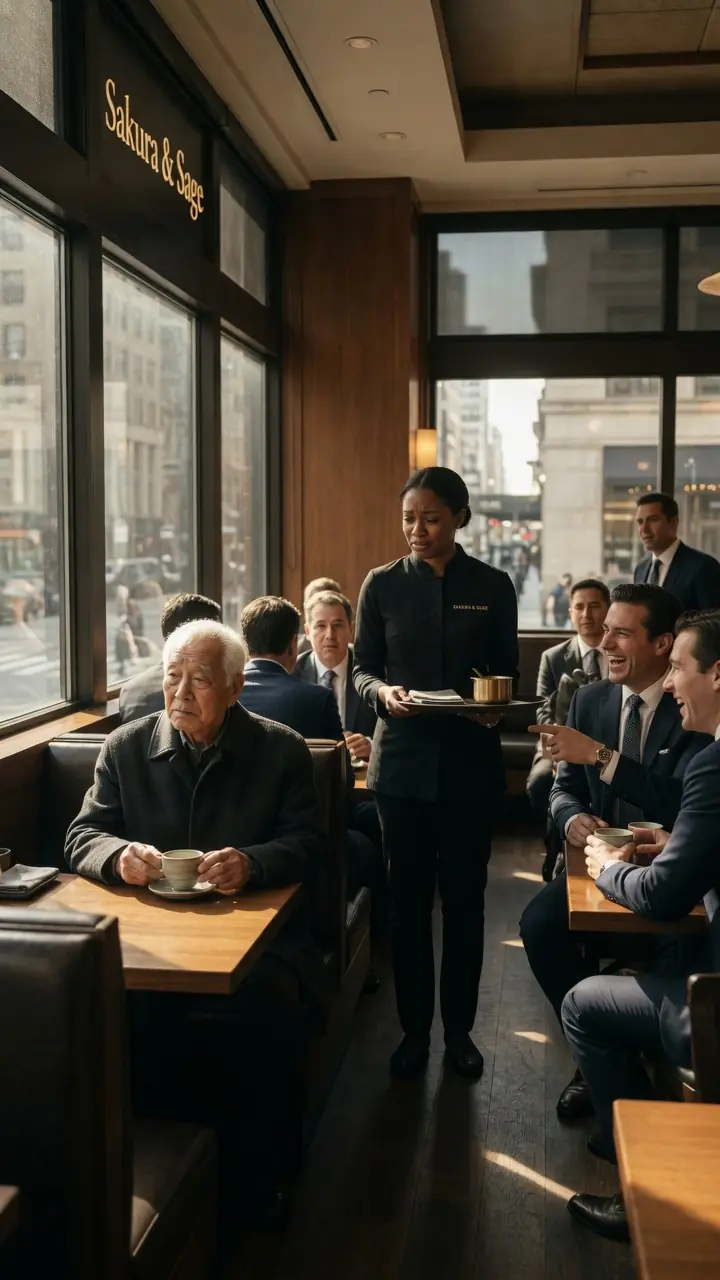
Mr. Tanaka’s eyes went wide. His mouth opened slightly, then closed. For a moment, he seemed unable to process what he had just heard. This young Black woman in a server’s uniform speaking his native language with near-perfect pronunciation.
Then, slowly, something extraordinary happened.
He smiled. Not the polite, distant smile of a customer acknowledging service. A real smile. The kind that reaches the eyes and transforms an entire face. The kind that Faith suspected he hadn’t worn in a very long time.
“Gochisōsama deshita,” he said softly. “Your Japanese is excellent. Gochiso-sama. Thank you.”
“Watashi wa Faith to mōshimasu. My name is Faith.”
“Tanaka Hiroshi desu.” He bowed his head slightly. “Hajimemashite. Nice to meet you.”
The young executives had stopped laughing. They were staring now. Phones forgotten in their hands. But Faith wasn’t looking at them. She was looking at the old man whose eyes had finally found something worth seeing.
Megan Holloway saw everything. She had been arranging menus near the hostess stand when Faith walked across the room. She watched, mouth slightly open, as the invisible back-section waitress bowed to the weird old man and started speaking.
“What was that? Chinese? Korean? Whatever it was, it wasn’t normal.” Her fingers were already moving across her phone screen before Faith finished her first sentence. To Derek: “You won’t believe what Faith just did. Come to the floor now.”
Derek emerged from the back office thirty seconds later, coffee cup in hand, irritation on his face.
“What? I’m busy.”
Megan pointed. Derek followed her gaze to the corner booth where Faith Underwood was having what appeared to be an animated conversation with the elderly Japanese man. The old man was actually laughing. Faith was smiling. They were speaking in a language that definitely wasn’t English.
Derek’s coffee cup stopped halfway to his mouth.
“What the hell is she doing?”
“I don’t know,” Megan said, her voice dripping with false concern. “But it looks really unprofessional, don’t you think? Fraternizing with customers? And since when does she speak whatever that is?”
Derek’s eyes narrowed. This was exactly the excuse he had been waiting for.
Faith was still smiling when Derek appeared beside her.
“A word. Now.” His voice was ice.
Faith’s smile faded. She bowed slightly to Mr. Tanaka.
“Shitsurei shimasu. Excuse me.”
And followed Derek to the narrow hallway behind the kitchen.
The moment they were out of sight, Derek turned on her.
“What the hell was that?”
“I was just—”
“You were just what? Making a scene? Drawing attention to yourself? Since when do you speak Japanese?”
Faith straightened her spine.
“I taught myself. Seven years.”
“Seven years.” Derek laughed, but there was no humor in it. “And you never thought to mention this? Put it on your application?”
“I didn’t think it was relevant.”
“Well, it’s not. And neither is whatever you were doing out there.” He stepped closer, lowering his voice. “We don’t fraternize with guests, Faith. We serve them quickly and quietly. That’s it.”
He was being harassed. Those men were—”
“Those men are paying customers. That old guy orders one tea and one rice ball and sits there for four hours. Who do you think matters more to this restaurant?”
Faith felt the familiar weight of injustice pressing down on her chest.
“He’s a person, Derek. He deserves basic respect.”
Derek’s smile was thin and cold.
“What he deserves isn’t your concern. Stay in your lane. Do your job. And if I see you pulling a stunt like that again…” He let the threat hang in the air. “We clear?”
Faith’s hands clenched at her sides.
“Crystal.”
The next day, something unexpected happened. Mr. Tanaka arrived at his usual time. Two o’clock. Corner booth. Green tea and onigiri. But when Derek approached to take his order, the old man shook his head.
“I would like the young woman,” he said in careful English. “The one who speaks Japanese.”
Derek blinked.
“I’m sorry?”
“Faith-san,” Mr. Tanaka’s pronunciation was precise. “I would like her to serve me today.”
Derek’s jaw tightened. Every instinct told him to refuse. But Mr. Tanaka was still a paying customer, however small his order. And there was something in the old man’s tone, quiet but unmovable, that made arguing seem unwise.
“Of course,” Derek said through gritted teeth. “I’ll send her over.”
Faith approached the corner booth with cautious optimism. Mr. Tanaka gestured for her to sit across from him.
“Please. Just for a moment.”
She glanced toward Derek, who was watching from the hostess stand with barely concealed hostility. Then she sat.
“I wanted to thank you,” Mr. Tanaka said in Japanese. “Yesterday was the first time in six months that someone has spoken to me like a human being.”
Faith’s heart ached.
“Six months?”
He nodded slowly.
“My wife passed away six months ago. Margaret. She was American. We met in Tokyo in 1978.”
“I’m so sorry.”
“She would have liked you.” His eyes grew distant. “She was always saying that kindness crosses all borders. That language is just love looking for a way out.” He paused. “May I ask why you learned Japanese?”
Faith hesitated. Then slowly she told him about Grandma Lorraine, about the Sunday afternoons watching Kurosawa films, about the promise she made at her grandmother’s grave.
“So we both speak to ghosts,” Mr. Tanaka said softly.
“I guess we do.”
For a long moment, neither of them spoke. The noise of the restaurant faded away. It was just two lonely people finding comfort in a shared language of loss.
Derek was still watching. He had no idea what they were saying, but he knew he didn’t like it.
Over the next two weeks, a quiet ritual developed. Every afternoon at two o’clock, Mr. Tanaka would arrive. Every afternoon, Faith would serve him. And in the brief moments between her other duties, they would talk.
He told her about Margaret, how she had wandered into his Tokyo art gallery looking for shelter from the rain and stayed for forty-three years. How she used to burn toast every morning and laugh about it every time. How the apartment they shared felt like a museum now, full of beautiful things and no life.
Faith told him about Georgia, about her mother’s diabetes, about the medical bills that kept her awake at night, about the dream of going back to school that seemed to slip further away with every passing year.
“You have a gift,” Mr. Tanaka said one afternoon. “Your Japanese is exceptional. Why do you hide it?”
Faith stirred his tea slowly.
“Who would believe it? Look at me. Look at where I work. People see what they expect to see. And what do they expect to see? A Black waitress from the South who’s lucky to have a job at a place like this.” She set the teapot down. “Not someone who studied Japanese for seven years. Not someone who dreams of actually using it someday.”
Mr. Tanaka was quiet for a moment. Then he reached across the table and placed his weathered hand over hers.
“My wife used to say that the world is full of hidden treasures. Most people are too busy looking for gold to notice the diamonds at their feet.”
Faith felt tears prick her eyes.
“She sounds like she was very wise.”
“She was.” Mr. Tanaka smiled sadly. “And so are you.”
The following Monday, Derek called Faith into his office.
“Corporate is coming next Friday,” he said without preamble. “Regional VP. Big inspection. Everything needs to be perfect.”
Faith nodded.
“Okay.”
“I’m putting you on back section. Megan will handle the front.” He shuffled papers on his desk, not meeting her eyes. “And I want you to stay away from that old Japanese guy.”
“His name is Mr. Tanaka.”
“I don’t care what his name is.” Derek looked up, his expression hard. “Whatever’s going on between you two needs to stop. It’s weird. It’s unprofessional. And if anything, anything goes wrong during the corporate visit, you’re the first one I’m cutting.”
Faith felt cold.
“You’re threatening my job because I talked to a customer.”
“I’m protecting this restaurant’s image.” Derek leaned back in his chair. “You’ve been here four years, Faith. Don’t blow it now.”
She walked out of his office with her head held high and her hands shaking.
That night, her phone rang. It was her mother, crying.
“The insurance company had denied the claim for her surgery. Again. The hospital wanted four thousand dollars upfront or they would cancel the procedure.”
Faith sat alone in her cramped apartment, staring at a bank account that held less than three hundred dollars. She couldn’t lose this job, but she couldn’t lose herself either.
For the first time in years, Faith didn’t know what to do.
Friday morning arrived with the intensity of a thunderstorm. The restaurant gleamed. Every surface had been polished to mirror brightness. The staff moved in tight, nervous patterns, aware that their jobs might depend on the next few hours.
At exactly eleven o’clock, a black sedan pulled up outside. Mrs. Victoria Harmon, regional vice president of Sakura and Sage Holdings, stepped through the front door like she owned the place, which in many ways she did. Sixty-two years old, silver hair cut in a precise bob, eyes that missed nothing.
Derek practically ran to greet her.
“Mrs. Harmon, welcome. Everything is ready for your inspection.”
“I’m sure it is.” Her voice was cool and clipped. “I’ll be observing the lunch service. Don’t let me interrupt.”
She chose a small table near the back, a position that gave her a clear view of the entire dining room. For two hours, she watched. She made notes in a leather-bound journal. Her face revealed nothing.
Then at two o’clock, the elderly Japanese man walked in.
Mrs. Harmon’s pen stopped moving.
She watched as Mr. Tanaka shuffled to his usual corner booth. She watched as Derek pointedly ignored him. She watched as the other servers walked past without a glance.
Finally, she beckoned Derek over.
“That gentleman in the corner,” she said quietly. “How long has he been coming here?”
Derek shrugged.
“Few months. He just orders tea. Sits there forever. Barely spends anything.”
“His name?”
“I don’t know. Tanaka something. Tanaka Hiroshi.”
Mrs. Harmon’s jaw tightened almost imperceptibly.
“His name,” she said, “is Hiroshi Tanaka. And you have no idea who he is, do you?”
Derek’s confusion was written all over his face.
“Should I know him?”
Mrs. Harmon didn’t answer. She simply turned back to her notebook, leaving Derek standing there like a student who had failed an unannounced exam.
What Derek didn’t know, what no one in that restaurant knew, was that Hiroshi Tanaka was one of the most influential figures in international cultural philanthropy. In 1985, he had founded the Tanaka-Morrison Cultural Foundation alongside his wife Margaret. For four decades, the foundation had built bridges between Japan and America, funding exchange programs, sponsoring artists, supporting educational initiatives that brought young people together across the Pacific.
The foundation was worth forty million dollars. Hiroshi Tanaka had dined with prime ministers. He had been awarded the Order of the Rising Sun by the Emperor of Japan. His photograph hung in museums on three continents.
And for the last six months, he had been sitting alone in a Manhattan restaurant, ordering green tea and onigiri, waiting to see if anyone would treat him like a human being.
It was a test.
After Margaret’s death, Hiroshi had lost faith in people. She had always been the one who believed in humanity’s goodness. She was the optimist, the bridge-builder, the one who saw light in every stranger’s eyes. Without her, the world seemed cold and transactional. People only cared about what you could give them. Status. Money. Power.
So Hiroshi decided to find out for himself. He would go somewhere no one knew him. He would dress simply. He would wait. Would anyone see the man? Not the money.
For six months, the answer had been no.
Until a young Black waitress walked up to his table and spoke to him in Japanese. Not because she knew who he was. Because she knew what it felt like to be invisible.
At two-fifteen, Mrs. Harmon watched something remarkable happen. Faith Underwood, the waitress who had been conspicuously assigned to the back section, approached Mr. Tanaka’s booth with a fresh pot of tea. She bowed slightly, and then she began to speak in Japanese.
Mrs. Harmon leaned forward. The conversation was too quiet to hear from her table, but she could see its effect. Mr. Tanaka’s posture changed. His shoulders relaxed. His face softened into something that looked almost like happiness.
This young Black woman in a worn uniform was doing what no one else in the restaurant had managed to do. She was making Hiroshi Tanaka smile.
Mrs. Harmon made a note in her journal and underlined it twice.
Later, after the lunch rush had ended, she intercepted Faith near the service station.
“Excuse me a moment.”
Faith tensed, expecting criticism.
“Yes, ma’am?”
“You speak Japanese.” Mrs. Harmon’s eyes were sharp but not unkind. “Where did you learn to speak like that?”
“I taught myself, ma’am. Over seven years.”
“Self-taught.” Mrs. Harmon raised an eyebrow. “That’s remarkable. Most people struggle to get past basic phrases.”
Faith didn’t know how to respond. Compliments from management weren’t part of her experience.
“You have a rare talent,” Mrs. Harmon continued. “And it seems you’ve been hiding it.”
“I didn’t think anyone would believe me or care.”
Mrs. Harmon was quiet for a moment. Then she reached into her pocket and produced a business card.
“Sometimes,” she said, “the people who can’t see your value aren’t the people who matter.”
She walked away before Faith could respond.
That evening, Mrs. Harmon called a brief meeting with Derek. Faith wasn’t present, but she heard about it later from Carlos, who had been restocking supplies in the adjacent storage room.
“She asked him about you,” Carlos whispered during the dinner shift. “About why you’re always in the back section. Why you’ve never been promoted.”
“What did Derek say?”
“A bunch of excuses. Something about fitting the brand and customer expectations.” Carlos shook his head. “Mrs. Harmon didn’t look impressed.”
The next morning, Faith received an email that made her read it three times to make sure she wasn’t dreaming.
From: Victoria Harmon, Regional VP
To: Faith Underwood
Subject: VIP Dinner Assignment
Ms. Underwood,
Next Friday, we will be hosting a private VIP dinner in the Sakura Room for the Tanaka-Morrison Cultural Foundation. I am personally requesting that you be assigned to serve this event. Please confirm your availability.
V. Harmon
Faith stared at her phone screen. Tanaka-Morrison. The foundation that Mr. Tanaka had mentioned once, briefly, when talking about his late wife’s passion for cultural exchange.
She didn’t know why Mrs. Harmon was doing this. She didn’t know what it meant. But for the first time in four years, someone with power had looked at her and seen something worth investing in.
She typed her response with trembling fingers.
I confirm. Thank you for this opportunity.
She hit send.
And somewhere across the city, Derek Manning was already planning how to make sure she failed.
The whisper campaign started the next day.
“Did you hear about Faith?” Megan’s voice carried across the break room, loud enough to be overheard, quiet enough to seem accidental. “She’s serving the VIP dinner next Friday.”
“Faith? Seriously?” Another server, Jessica, looked skeptical. “How did she swing that?”
Megan lowered her voice conspiratorially.
“I heard she’s been getting close to that old Japanese man. You know, the creepy one who sits in the corner all day.”
“Close how?”
“Use your imagination.” Megan shrugged with practiced innocence. “All I know is she’s been talking to him in some Asian language and suddenly she’s getting special treatment from the VP. Doesn’t take a genius to connect the dots.”
The rumor spread like wildfire. By Wednesday, half the staff believed Faith was sleeping with Mr. Tanaka. The other half believed she was faking her Japanese skills entirely, that she had memorized a few phrases to impress management and fool a senile old man.
Faith felt the change immediately. Co-workers who had once smiled at her now avoided eye contact. Carlos, usually so friendly, became strangely distant. Even Yuki, the sushi chef who had always treated her with quiet respect, seemed uncertain.
She tried to ignore it. She had survived worse. But isolation has a weight. It presses down on you slowly, crushing hope one ounce at a time.
By Thursday night, Faith felt like she was drowning.
She sat alone in the break room during her fifteen-minute dinner, eating cold rice from a plastic container. No one joined her. No one even looked at her.
This was what it meant to reach for something better. This was the price of being seen.
Thursday afternoon, Derek cornered her in the supply closet.
“Close the door.”
Faith’s skin prickled with warning. She left the door open an inch, just enough for witnesses, just enough for escape.
“The VIP dinner tomorrow.” Derek’s voice was casual, but his eyes were hard. “You understand what’s at stake, right?”
“I understand.”
“Do you? Because Mrs. Harmon put you on this assignment personally. If you screw up, if anything goes wrong, it won’t just be your job on the line. It’ll be mine, too.”
Faith said nothing.
“So let me be very clear.” Derek stepped closer. “One complaint. One mistake. One single thing that makes me or this restaurant look bad, and you’re done. Not transferred. Not demoted. Done. I’ll make sure you never work in this industry again.”
“Is that a threat?”
“It’s a promise.” He smiled, a cold, thin smile that never reached his eyes. “We both know you don’t belong at a VIP event. Mrs. Harmon doesn’t understand how things work here. But I do. And I’ll be watching every move you make.”
He walked out without waiting for a response.
Faith stood alone in the supply closet, surrounded by boxes of napkins and bottles of cleaning solution. Her hands were shaking so badly she had to press them against the shelves to make them stop.
Tomorrow night would determine everything. Her job. Her mother’s surgery. Her future. Everything.
That night, Faith was folding laundry in her tiny apartment when her phone rang.
“Mama?” Her mother’s voice was thick with tears. “Baby, I didn’t want to worry you, but—”
“What happened? Are you okay?”
“The hospital called. They said if we can’t pay the four thousand dollars by next week, they’re going to cancel my surgery.” A sob escaped her mother’s throat. “I don’t know what to do, Faith. I don’t know what to do.”
Faith’s heart shattered into a thousand pieces.
“Mama, listen to me. Don’t cry. Please don’t cry. I’ve been praying every day, baby. I’ve been asking God to find a way, but I’m so tired. I’m so tired of fighting.”
Faith closed her eyes. Four thousand dollars. She had two hundred eighty-three dollars in her checking account. Her credit cards were maxed out. She had no savings, no assets, nothing to sell.
“I’ll figure it out,” she heard herself say. “I promise, Mama. I’ll find a way.”
“How?”
“I don’t know yet. But I will. I’ll call you tomorrow.”
She hung up and sat perfectly still on the edge of her bed. For five minutes, she didn’t move, didn’t breathe, didn’t think.
Then, very quietly, Faith Underwood began to cry.
She cried for her mother. She cried for herself. She cried for every dream that had slipped through her fingers like sand.
Tomorrow she had to perform miracles.
Tonight, she was allowed to break.
Friday morning arrived gray and cold. Faith dragged herself to work on three hours of sleep and a prayer. The VIP dinner was scheduled for seven. She had eight hours to prepare.
But first, she looked for Mr. Tanaka.
Two o’clock came and went. His corner booth remained empty.
Two-thirty. Still nothing.
Three o’clock. The teapot Faith had prepared sat untouched on the service station.
He had never missed a day. Not once in six months.
Faith felt a cold knot forming in her stomach. Had something happened to him? Had he fallen ill? At his age, anything could happen. A stroke. A heart attack. A simple fall down the stairs.
She thought about their conversations, about his loneliness, about the sadness in his eyes when he spoke about Margaret.
What if he had decided he was tired of waiting? What if she never saw him again?
The thought was unbearable.
Four o’clock. Five o’clock. The booth stayed empty.
Faith moved through her duties like a ghost, refilling water glasses and clearing plates without registering any of it. Her mind was split in two, half dreading the VIP dinner, half mourning the old man she had grown to care for.
At six o’clock, she retreated to the bathroom and stared at her reflection in the mirror.
Tonight, she was alone. Just like always.
At six-fifteen, Faith stood in the staff changing room, staring at her uniform. The black fabric was worn thin at the elbows. The buttons were dull. It was the same uniform she had worn for four years, the uniform of someone who blended into the background, who didn’t matter, who could be dismissed and forgotten.
She could walk out right now. Tell Derek she was sick. Go home and hide under her covers and pretend tomorrow was just another day.
But then what? Her mother would still need surgery. The bills would still be due. And she would still be exactly who she had always been. Invisible. Overlooked. Afraid.
Faith closed her eyes and heard her grandmother’s voice, clear as Sunday church bells.
“Dignity isn’t given, baby girl. You carry it in.”
She had carried it through every slight and every sneer. Through every mispronounced name and every stolen opportunity. Through every moment when the world told her she wasn’t enough.
She could carry it one more night.
Faith buttoned her uniform slowly, deliberately, like armor. Then she walked out of the changing room with her head held high.
Whatever happened tonight, she would face it standing up.
The Sakura Room had been transformed. Cherry blossom arrangements adorned every table. Soft lighting cast warm shadows across cream-colored walls. A string quartet played gentle classical music in the corner. Everything whispered elegance, restraint, perfection.
Twelve guests sat around the main table. Donors, executives, foundation board members. Their jewelry glittered. Their laughter was carefully modulated. The combined net worth in this room could buy a small country.
Faith entered through the service door carrying a tray of appetizers. Derek was already there, hovering near the entrance like a hawk. His eyes tracked her every movement.
Mrs. Harmon sat at the head of the table, engaged in conversation with a silver-haired woman wearing pearls. She glanced up as Faith entered and gave an almost imperceptible nod.
Faith began to serve. Her hands were steady. Her movements were precise. Years of experience guided her body while her mind stayed alert, scanning for any problem, any opportunity, any sign of what this night might bring.
The chair at the center of the table, the guest of honor’s seat, remained empty.
“Where is Mr. Tanaka?” one of the guests asked. “I thought this dinner was for the foundation.”
“He’ll be here,” Mrs. Harmon said calmly. “He’s never late. Just private.”
Faith felt her heart skip. Mr. Tanaka was coming. He was alive. He was going to be here. She didn’t know whether to feel relieved or terrified.
At seven-fifteen, the door opened.
Hiroshi Tanaka stepped into the Sakura Room, and for a moment, Faith didn’t recognize him.
Gone was the simple coat and worn sweater. Tonight, he wore a perfectly tailored charcoal suit with a silver silk tie. His posture, usually hunched with grief, was straight and commanding. He moved like a man who had spent decades in rooms exactly like this one.
Because he had.
The transformation was stunning.
But his eyes. His eyes were the same. Still carrying that deep well of sadness. Still searching for something real in a sea of performance.
Those eyes found Faith.
For a single heartbeat, everything else disappeared. The guests, the music, the glittering chandeliers, all of it faded into background noise. It was just the two of them, connected by weeks of shared silence and broken teacups and a language that no one else in this room could speak.
Mr. Tanaka bowed his head slightly. The same small bow he had given her that first day, when the tray had fallen and no one else had cared.
Faith bowed back.
Then the moment passed, and Mr. Tanaka was swallowed by the crowd. Board members rushed to greet him. Donors offered condolences about Margaret. The silver-haired woman with the pearls kissed both his cheeks.
Derek’s face had gone pale. He finally understood who had been sitting in his back section for six months, and he was beginning to realize how badly he had miscalculated.
Dinner proceeded smoothly for the first hour. Faith served courses with practiced grace. Miso soup. Sashimi. Wagyu beef. Each plate delivered with precision timing. She moved like a shadow, present when needed, invisible when not.
Then came the toast.
An elderly gentleman from Tokyo, a longtime friend of the Tanakas, rose to speak. He had been asked to deliver a tribute to Margaret’s memory. But as he began, it became clear that his English was failing him.
“Margaret’s… she was very…” He struggled, his face reddening with embarrassment. “I am sorry. The words in English are difficult. My heart knows what to say, but my tongue cannot find it.”
An awkward silence fell over the room. The board members shifted uncomfortably. Someone coughed. The string quartet stopped playing.
Mr. Tanaka looked pained, watching his old friend struggle.
And Faith made a decision that would change everything.
She stepped forward from her position by the wall.
“Sir,” she said quietly in Japanese, “if you would permit me, I could interpret your words.”
The elderly gentleman’s eyes widened. So did everyone else’s.
Derek made a strangled sound from the doorway, but Mr. Tanaka spoke before anyone else could object.
“Please, Faith-san. Please help my friend speak.”
Faith took a breath.
And then she became a bridge.
The old man spoke in Japanese, pouring out his love for Margaret, his gratitude for her friendship, his sorrow at her passing. His words were poetry, rich with decades of memory and meaning.
And Faith translated them sentence by sentence into English that rang with the same beauty and power.
When she finished, the room was silent.
Then someone began to cry. Then another. And then, slowly, the entire table rose to their feet in a standing ovation.
Not for the speaker.
For the translator.
For the invisible waitress who had just revealed a gift that no one knew she had.
The applause eventually faded.
But the moment wasn’t over.
Mr. Tanaka stood. The room fell silent again, waiting.
“Six months ago,” he said, his English slow but clear, “I lost my wife. My heart. My reason for living. I came to this restaurant every day because I did not know where else to go.”
He paused, gathering himself.
“For six months, I sat alone. Dozens of people walked past me. They saw an old man. A foreigner. Someone who didn’t matter.”
His voice hardened.
“Some of them laughed at me. Mocked me. Told me to go back to my country.”
Uncomfortable shifting around the table. A few people avoided eye contact.
“But one person saw me.” Mr. Tanaka turned to look at Faith. “One person treated me with dignity. One person reminded me why my wife spent her life building bridges between worlds.”
He walked toward Faith, who stood frozen by the wall.
“This young woman,” he said, loud enough for everyone to hear, “has more grace in her smallest gesture than most people have in their entire lives. She spoke to me in my language. She listened to my grief. She saw a human being when everyone else saw nothing.”
Mr. Tanaka bowed deeply. The formal bow of profound respect.
“Thank you, Faith-san. Margaret would have loved you.”
Faith’s eyes filled with tears.
For the first time in her life, she felt truly seen.
The dinner ended at ten o’clock. Guests lingered over coffee and conversation, but the energy in the room had shifted. People kept glancing at Faith, their expressions a mixture of curiosity and reassessment. The invisible waitress had become the most interesting person at the party.
As Faith cleared the last of the dessert plates, Mrs. Harmon approached.
“Walk with me.”
They stepped into the quiet hallway outside the Sakura Room.
Mrs. Harmon studied Faith for a long moment, her sharp eyes revealing nothing.
“How long have you worked here?” she finally asked.
“Four years, ma’am.”
“Four years.” Mrs. Harmon shook her head slowly. “Four years and no one knew what you could do. What you were hiding.”
“I wasn’t hiding. I just—” Faith searched for the right words. “No one asked.”
“No, they didn’t.” Mrs. Harmon’s voice held something that might have been anger. Not at Faith. At a system that had failed to see her. “That changes tonight.”
She reached into her jacket and produced a cream-colored business card.
“The Tanaka-Morrison Foundation is looking for a bilingual program coordinator. The position involves cultural exchange work between Japan and the United States. Travel to Tokyo twice a year. Educational outreach. Community building.”
Faith’s heart stopped.
“The salary is three times what you’re making here. Full benefits. Professional development opportunities.” Mrs. Harmon pressed the card into Faith’s hand. “Mr. Tanaka personally recommended you for the position. I’m just delivering the message.”
“I… I don’t know what to say.”
“Say you’ll think about it.” Mrs. Harmon smiled, a real smile, warm and genuine. “But don’t take too long. People like you don’t come along very often.”
She walked back into the Sakura Room, leaving Faith alone in the hallway.
The business card felt like a winning lottery ticket. Or maybe like a door that had been locked for twenty-eight years finally swinging open.
Faith returned to the Sakura Room to finish her duties. Derek was standing near the entrance, his face the color of old cheese. He had watched everything unfold. The toast. The standing ovation. The private conversation with Mrs. Harmon. He had seen his power evaporate in real time.
As Faith passed him, she paused.
Four years of insults and slights and stolen opportunities hung between them. Four years of “stay in your lane” and “you don’t belong.”
She could say something now. Something cutting. Something that would make him feel a fraction of the humiliation he had inflicted on her.
But Faith looked at Derek, really looked at him, and saw something unexpected.
Fear.
He was afraid. Afraid of Mrs. Harmon. Afraid of losing his job. Afraid of being exposed for what he really was. A small man who had used his small power to make others feel smaller.
Faith said nothing.
She simply walked past him, head high, shoulders straight, carrying her dignity exactly where her grandmother had taught her to keep it.
The silence was louder than any words could have been.
Behind her, she heard Mrs. Harmon’s voice, cold and precise.
“Derek. My office. Monday morning. We need to discuss some personnel concerns.”
Faith allowed herself a small smile.
She had never believed in revenge.
But justice? Justice was something different entirely.
The last guests departed at eleven o’clock. Faith was gathering her things in the staff area when someone knocked on the door frame.
She turned to find Mr. Tanaka standing there, still in his beautiful suit, looking somehow both older and younger than he had before.
“May I speak with you? Just for a moment?”
They walked together to the corner booth. His corner booth. Now empty and quiet in the darkened restaurant. The city lights glittered through the window like scattered diamonds.
Mr. Tanaka reached into his jacket and withdrew a small envelope.
“This is for you.”
Faith opened it with trembling fingers.
Inside was a check.
Her eyes went wide when she saw the amount.
And a handwritten note covered in beautiful Japanese calligraphy.
“The money is for your mother’s surgery,” Mr. Tanaka said. “Mrs. Harmon told me about your situation. Please accept it not as charity, but as an investment in someone who invested in me.”
Faith couldn’t speak.
The check was for fifteen thousand dollars.
“The note,” Mr. Tanaka continued, his voice thick with emotion, “says something my wife used to say. The bridges we build with kindness last longer than any made with stone.”
Tears streamed down Faith’s face. She didn’t try to stop them.
“Mr. Tanaka, I don’t know how to thank you.”
“You already have.” He reached out and patted her hand gently. “You saw me when I was invisible. You spoke to me when I was silent. You gave an old man a reason to keep living.” He smiled. “That is worth more than any money.”
Faith bowed deeply. The respectful bow of a student to a teacher.
“Arigatō gozaimashita,” she whispered. “Thank you for everything.”
“No,” Mr. Tanaka replied. “Thank you.”
Six months later, Faith Underwood stood on a stage in Tokyo. Behind her, cherry blossoms painted the windows pink. Before her, fifty American students sat in rapt attention, notebooks open, eyes bright with curiosity. They had traveled across the Pacific for a cultural exchange program, the same kind of program Margaret Tanaka had dreamed about decades ago.
Faith spoke to them in English and Japanese, switching between languages like breathing, building bridges with every word.
Her mother’s surgery had been successful. The medical bills were paid. Her apartment in Brooklyn, no longer shared with strangers, had actual sunlight and a small balcony where she grew tomatoes in summer.
She called Mr. Tanaka every Sunday. He was doing better now. The grief was still there, would always be there, but it had softened into something bearable. He attended foundation events again. He laughed more. He had even started visiting Sakura and Sage occasionally, sitting in his old corner booth, watching the new staff bustle past.
Derek had been transferred to a location in New Jersey. No one at the Manhattan restaurant missed him.
Megan still worked the front section, but the tips weren’t as good as they used to be. Funny how that worked out.
Faith finished her presentation to enthusiastic applause. As the students filed out, chattering excitedly in a mixture of English and halting Japanese, she felt a warmth spread through her chest.
This was what her grandmother had always talked about. This was what Margaret Tanaka had believed in. Bridges. Connection. The revolutionary act of simply seeing another human being.
Faith didn’t become successful because someone discovered her talent.
She became successful because she refused to hide.
For seven years, she had studied a language in secret, convinced that no one would believe a Black waitress from Georgia could master Japanese. For four years, she had worked in a restaurant that treated her like furniture, swallowing her gifts to survive.
But when the moment came, when a lonely old man needed someone to see him, she didn’t hesitate.
She stepped forward.
She spoke.
She revealed what she had been hiding.
And in doing so, she gave Hiroshi Tanaka permission to stop hiding, too.
That’s the thing about being seen.
It’s contagious.
When you offer it to someone else, truly see them, truly acknowledge their humanity, it comes back to you tenfold.
Faith didn’t wait to be discovered.
She discovered herself.
And that made all the difference.