At first, people assumed he was helping repair the old boundary wall on his family’s property. Then they noticed he was not stacking the stones along the fence at all.
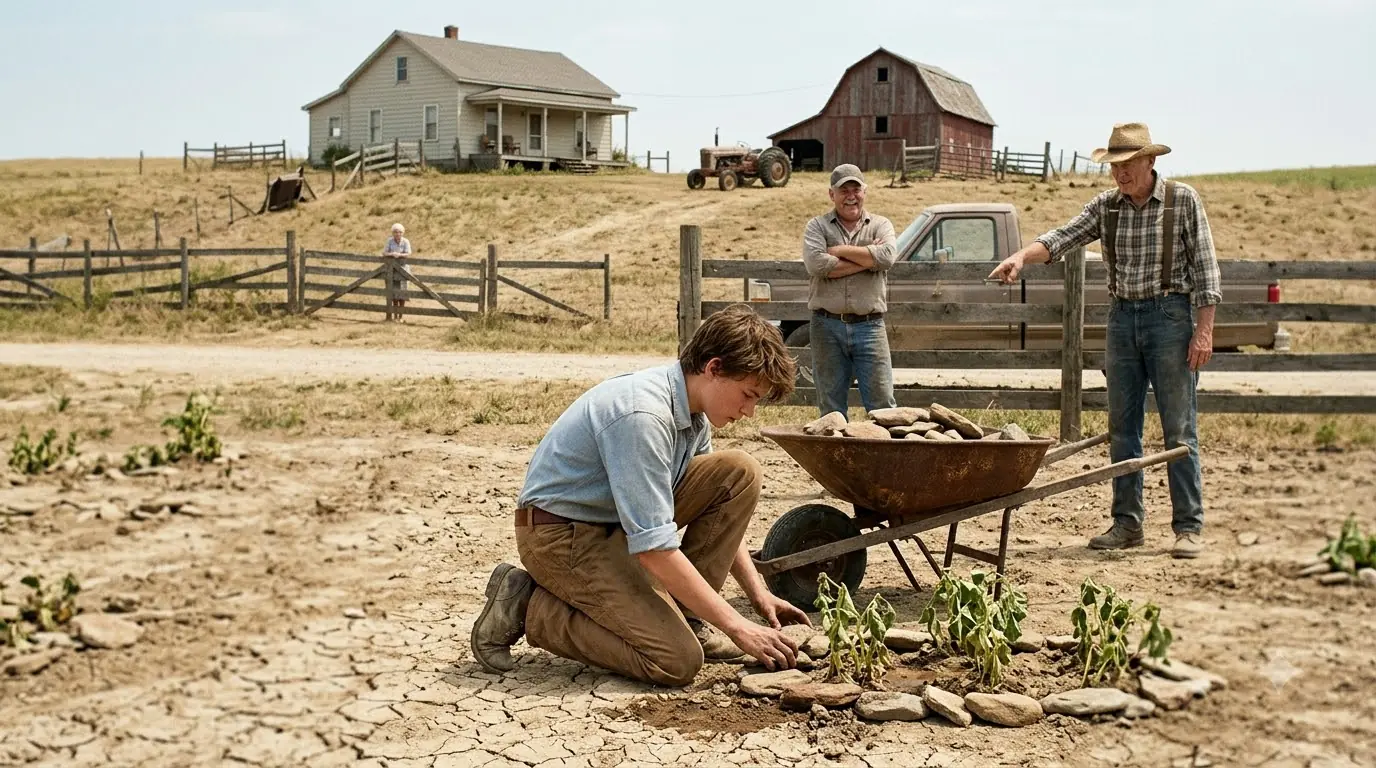
He was laying them directly across the driest section of the field, arranging them in rows around struggling plants as if rocks were something a farmer might intentionally want in good soil.
By the second week, people were slowing their trucks on the dirt road just to stare.
They saw a thin boy in a faded shirt pushing a rusted wheelbarrow beneath an unforgiving afternoon sun. His arms were too small for the load he carried. Sweat darkened the back of his shirt, dust clung to his face, and the wheelbarrow squeaked every few feet because one bearing had worn nearly smooth.
Still, Eli kept going.
One load from the dry creek bed.
One from the fallen stone wall.
One from an old pile the Henderson family had cleared decades earlier and abandoned beneath weeds.
Then back across the Barnett field.
One stone at a time.
Some people laughed from the road.
Others shook their heads.
A few stopped and tried to help him understand what they believed was an obvious mistake.
“Son,” one farmer called from his pickup window, “the idea is to get rocks out of the field.”
Eli looked up briefly.
Then bent down and placed another flat stone beside a bean plant.
The driver laughed and continued down the road.
Another man told him that if he wanted to ruin what little farmland his family had left, there were easier ways to do it.
Someone at the feed store joked that Thomas Barnett’s boy had finally gone strange from too much sun.
Someone else said Eli must be planning to grow stones because nothing else seemed willing to grow on the Barnett farm.
That joke traveled farther than any of them expected.
For a while, even Eli wondered whether they were right.
Millbrook Hollow was not the kind of place where strange ideas stayed private.
The town sat in a shallow valley between low dry hills, forty miles from the nearest city large enough to have more than one grocery store. There was a volunteer fire department, a feed store, a gas station with one working pump, a church built from pale brick, a diner where breakfast ended when the cook felt like switching to lunch, and a cluster of houses gathered around a road that followed the shrinking river.
The river had once defined the place.
Old photographs in the diner showed children swimming there in water deep enough to reach their shoulders.
There had been fishing contests.
Picnics.
Spring floods.
By the time Eli was fourteen, the river sometimes narrowed so badly in August that a person could walk across parts of it without getting water above their ankles.
The land had changed with it.
Farmers who had spent their lives complaining about mud began wishing for it.
Rainfall came unevenly.
A violent storm might dump water in twenty minutes, then nothing for three weeks.
The soil, once dark and loose, hardened beneath repeated drought.
When rain finally came, much of it struck baked ground and ran away before it could soak deeply.
Fields cracked.
Grass browned.
Ponds shrank.
Men at the feed store learned to talk about rain with the seriousness usually reserved for illness.
The Barnett farm suffered more than most.
It was only four acres, small even by local standards.
Eli’s great-grandfather had purchased the first piece when land around Millbrook Hollow was cheap. His grandfather added a narrow strip near the creek and planted vegetables, corn, and beans for local sale.
Thomas Barnett inherited it with no debt but almost no savings.
For years, four acres had been enough to support the family modestly.
Not comfortably.
But enough.
Thomas grew sweet corn, beans, squash, and tomatoes. Ruth kept a kitchen garden and sold preserves when harvests were good. They raised a few chickens and occasionally a pig.
The family did not have much.
They had never expected much.
But they had always had enough.
Then came the drought years.
The first bad season hurt.
The second frightened them.
By the third, the farm was no longer simply struggling.
It was failing.
The corn emerged thin and pale.
Bean vines stopped growing midway up their poles.
Tomatoes split or stayed small.
Some mornings Thomas walked the rows before sunrise carrying a notebook, counting what had survived overnight.
He rarely said what the numbers meant.
Eli understood anyway.
At night, through the wall separating his bedroom from the kitchen, he heard his parents speak after they thought he was asleep.
“Another letter came.”
“How much?”
“More than last month.”
“Can we wait?”
“We’ve already waited.”
“What about selling the old tractor?”
“Then how do I work the field?”
Silence would follow.
Then another question.
“What if we sell the back acre?”
“No.”
“Thomas.”
“No.”
Sometimes Ruth lowered her voice so far Eli could no longer hear individual words.
He did not need to.
Fear had a sound even when language disappeared.
The bank had not threatened foreclosure yet, but it had begun sending reminders about an operating loan Thomas had taken to buy seed, repair the irrigation pump, and cover expenses after the second drought year.
Every envelope made Thomas quieter.
He worked harder because working harder was the only response he understood.
He woke before sunrise.
Checked the well.
Moved irrigation pipe.
Pulled weeds.
Repaired equipment.
Drove into town for part-time mechanical work when neighbors needed help.
Then returned to the field until darkness erased the rows.
Eli tried to help.
He did everything a fourteen-year-old could.
Fed chickens.
Weeded.
Carried irrigation line.
Helped at the roadside stand.
But there were days when helping felt like participating in a losing argument with the weather.
Ruth was different.
She still hummed.
Her garden stood near the porch where the house cast some afternoon shade.
The tomatoes were smaller than they had been when Eli was young, but Ruth treated every surviving fruit as though it were proof of something.
She saved dishwater when it contained no soap harmful to plants.
She spread old leaves around roots.
She shaded seedlings with scraps of cloth when heat became extreme.
She never used the word desperate.
Eli thought perhaps mothers had a rule against it.
Then there was Nana Vera.
Vera Barnett was Thomas’s mother.
She had lived on that land long enough to remember when the river flooded every other spring and farmers complained that the lower road disappeared beneath water.
She was seventy-eight, small, sharp-eyed, and increasingly slow in her movements.
Her knees bothered her.
Her hands had begun to curl from arthritis.
But her mind had lost very little.
Most mornings, Vera carried an overturned wooden crate to the fence line and sat watching the land.
She could remain there for an hour without speaking.
Thomas sometimes teased her.
“You expecting the dirt to do a trick?”
Vera would answer:
“It talks more than you do.”
Thomas usually laughed.
Eli believed her.
Nana Vera noticed things.
She knew where frost would settle first.
Which clouds meant rain and which only looked promising.
Which fence post had termites before anyone else saw damage.
Which chicken was about to stop laying.
She did not describe herself as knowledgeable.
She simply paid attention longer than other people.
One evening in early June, Eli found her in the worst corner of the south field.
That section had produced almost nothing the previous two seasons.
The ground there faced the afternoon sun directly.
Water seemed to disappear from it within hours.
Vera was kneeling carefully, one hand pressed into a wide crack in the soil.
Eli approached.
“You okay?”
“Fine.”
“You dropped something?”
“No.”
She lifted a handful of dirt.
“Feel this.”
Eli crouched.
The earth was hot.
Not warm.
Hot.
The sun was already lowering behind the hills, yet heat still radiated from the ground.
Vera crumbled it between her fingers.
“You feel that?”
“Dry.”
“More than dry.”
She pressed her palm flat against the soil.
“Ground’s screaming.”
Eli smiled faintly.
“What’s it saying?”
“That it can’t hold anything.”
She dug down a few inches.
The soil beneath was only slightly cooler.
“Water hits this and runs.”
“Sun hits it and cooks it.”
“Wind takes what’s left.”
Eli picked up a clod.
It broke apart like fired clay.
“What do we do?”
Vera looked toward the field.
“If I knew that, your father wouldn’t be losing sleep.”
She pushed herself upright slowly.
Then added:
“Land remembers how it used to be, though.”
Eli frowned.
“What does that mean?”
“Means sometimes the answer isn’t putting more into it.”
“Sometimes it’s stopping things from leaving.”
She walked back toward the house.
Eli remained behind.
That sentence followed him for days.
Stopping things from leaving.
He began noticing moisture.
Where it stayed.
Where it disappeared.
Where grass survived.
A collapsed stone wall marked part of the Henderson property boundary.
Most of the wall had fallen decades earlier.
Its rocks lay in a long uneven line shaded by weeds.
One afternoon, Eli sat there resting after carrying feed.
He noticed something odd.
The grass nearest the rocks was greener.
Not dramatically.
But enough.
He pulled one stone aside.
The soil beneath was dark.
Cool.
Slightly damp.
He stared.
The surrounding ground had been dry for days.
Eli pushed his fingers deeper beneath the stone.
Moisture.
A beetle scrambled away.
Tiny roots threaded the soil.
He replaced the rock.
The next day, he checked again.
Still cooler than exposed earth.
Then he went to the dry creek bed.
Flat stones lay where water once moved.
He lifted one.
Dark soil.
Another.
Same.
A third.
Underneath it, an earthworm curled away from the sudden light.
Eli almost laughed.
He had not seen an earthworm in the open field all spring.
He began conducting small tests without calling them tests.
He placed three rocks on exposed soil near the barn.
Left three nearby areas uncovered.
Two days later, he lifted the rocks.
The soil beneath them was noticeably cooler.
After Ruth watered nearby herbs, Eli checked how long dampness remained under stones compared with exposed patches.
Longer.
He did not own a moisture meter.
He had no scientific instruments.
He used fingers.
Color.
Smell.
Weight.
When damp soil clung together in his palm, he remembered it.
When dry soil fell apart, he remembered that too.
At dinner one evening, he finally mentioned what he had seen.
“What if rocks help keep the ground wet?”
Thomas stopped eating.
“What?”
“The dirt under stones.”
“It stays cooler.”
Thomas looked tired.
“Everything stays cooler under shade.”
“Not just shade.”
“I think the rocks slow the water down.”
Thomas rubbed his forehead.
“Eli.”
“I’m serious.”
“I know you are.”
Thomas sighed.
“Rocks don’t grow beans.”
The words were not cruel.
That almost made them worse.
Thomas was too exhausted to even argue.
“We need less rock in that field, not more.”
Eli looked down at his plate.
Across the table, Nana Vera met his eyes.
She gave him the smallest nod.
Nothing more.
Eli waited until morning.
He started with a strip only ten feet wide.
He chose the driest corner because failure there would cost almost nothing.
Several bean plants still struggled in the area.
Their leaves curled by afternoon.
Eli collected flat stones first.
He pushed the wheelbarrow to the dry creek bed and loaded six.
The wheel sank into loose dirt on the return.
He hauled again.
And again.
By noon, his shoulders hurt.
Thomas saw him from across the field.
“What are you doing?”
“Trying something.”
“With my rocks?”
“They were in the creek.”
Thomas stared.
Then shook his head.
“As long as you finish your real chores.”
“I will.”
Eli placed stones around the first bean plant.
Then another.
He tried to imitate the way they had naturally rested near the creek.
By evening, the strip looked ridiculous.
Stones in rows.
Plants between them.
Bare ground still visible.
Ruth came to inspect.
“Is this the experiment?”
“I guess.”
“What do you expect?”
“I don’t know.”
She smiled.
“That sounds scientific.”
He rolled his eyes.
By the third day, Millbrook Hollow knew.
Eli never discovered who started the story.
Perhaps a driver.
Perhaps one of the Henderson boys.
At the feed store, men laughed.
“Barnett’s kid putting rocks back.”
“Maybe he thinks they hold water.”
“Maybe they pray for rain.”
“Thomas know?”
“Thomas has bigger problems.”
Eli heard the jokes because people were not careful enough to stop talking when he entered.
He bought a small bag of chicken feed and left.
On the walk home, humiliation burned hotter than the sun.
For ten minutes, he considered kicking every stone back into the ditch.
Then he reached the field.
He lifted one.
The dirt beneath was cool.
He kept working.
His first design failed.
Badly.
Eli had packed rocks too tightly.
He thought greater coverage meant greater protection.
Instead, the heavy stones formed a low irregular mound.
Then came the first real thunderstorm in nearly a month.
The storm arrived violently.
Wind first.
Then rain so hard the gutters overflowed.
Eli stood at the kitchen window watching water race across the yard.
For half an hour, he felt hopeful.
The field was finally drinking.
The next morning, he ran outside.
His hope collapsed almost immediately.
Water had struck the packed rocks and flowed around them.
One side of the strip became a shallow muddy basin.
The other remained surprisingly dry.
Two bean plants sat in standing water.
Roots exposed where runoff had carved channels.
One plant had been flattened.
Within days, two died.
Thomas said nothing.
That was worse than criticism.
Eli spent an evening staring at the ruined arrangement.
He had misunderstood what the stones were doing.
Covering soil was not enough.
Water still needed somewhere to go.
When Vera found him, he was sitting cross-legged at the edge of the strip holding a dead bean leaf.
“You quitting?”
Eli shrugged.
“Maybe everyone was right.”
“About what?”
“That this is stupid.”
Vera lowered herself beside him.
It took effort.
Eli moved to help.
She waved him away.
“What did the water do?”
“Ran off.”
“Why?”
“Too many stones.”
“Good.”
Eli frowned.
“What’s good about that?”
“You know something tonight you didn’t know two weeks ago.”
“I killed two plants.”
“They weren’t doing very well before you touched them.”
“That isn’t the point.”
Vera looked toward the strip.
“You wanted an answer before you earned one.”
Eli said nothing.
She continued.
“You found a way that doesn’t work.”
“That’s information.”
“It doesn’t feel like information.”
“No.”
“Learning rarely does while it’s embarrassing you.”
Eli looked at her.
“You really think this could work?”
Vera smiled.
“I think you’ve seen something.”
“That’s different.”
She stood slowly.
“Don’t make me responsible for your rocks.”
Then she went inside.
The next morning, Eli pulled half the stones out.
He flattened the rest.
Left gaps.
Created narrow channels so water could travel between them.
He watched the next time Ruth watered.
Better.
Water moved between stones rather than around the whole arrangement.
For several days, the soil beneath retained more moisture.
Eli became excited again.
Then the exposed gaps baked.
The second failure arrived quietly.
There was no storm.
No dramatic event.
Only heat.
By two in the afternoon, sunlight struck the open soil between stones so directly that it hardened.
The stones protected patches.
The gaps became miniature ovens.
Cracks formed beside them.
Eli dug into the soil.
Moist under the rocks.
Powder dry two inches away.
He had created islands instead of a system.
The plants survived.
But not much better than before.
He changed spacing.
Moved rocks.
Experimented with orientation.
Neighbors continued laughing.
A pickup slowed one afternoon.
A farmer named Wade Mercer leaned out the window.
“Eli!”
Eli stopped pushing the wheelbarrow.
“You building a road?”
“No.”
“Foundation?”
“No.”
“Then what?”
“Trying to hold water.”
Wade looked across the field.
“With rocks?”
“Yes.”
Wade laughed.
“Tell your dad I’ve got a pile he can buy.”
Eli resumed walking.
Wade called after him:
“I’ll give him a discount.”
Eli’s face burned.
But he kept going.
The third setback nearly ended everything.
A hailstorm arrived in July.
Not large enough to destroy roofs.
Large enough to damage plants.
Wind pushed hard across the valley.
Several larger stones Eli had propped at angles shifted.
Runoff scattered smaller pieces.
A section he had spent days arranging collapsed.
Leaves tore.
Young plants bent.
When the weather cleared, the field looked beaten.
Eli walked through the damaged strip without touching anything.
He went inside.
The next day he did not return.
Nor the next.
For almost a week, the wheelbarrow stayed beside the barn.
Thomas noticed.
He said nothing.
Part of him was relieved.
Eli had been spending too much time on the project.
Part of him felt guilty for that relief.
Ruth noticed too.
On the sixth evening, she found Eli sitting on the front steps.
She set a glass of water beside him.
He did not look up.
After a minute, she said:
“Your grandmother thinks that dirt looks better.”
Eli shrugged.
“Half of it’s ruined.”
“She said even the ruined part looks darker than it did last year.”
Eli picked at peeling paint on the step.
“Everybody thinks I’m an idiot.”
“Everybody?”
“Most people.”
“I don’t.”
“You’re my mother.”
“That only means I have more evidence.”
He smiled despite himself.
Ruth looked toward the field.
“When I was your age, I tried to grow carrots in a coffee can.”
Eli glanced at her.
“Why?”
“I don’t remember.”
“Did it work?”
“No.”
“What happened?”
“The can rusted through and stained the porch.”
Eli laughed.
Ruth smiled.
“Your father’s mother still brings it up.”
They sat quietly.
Then Ruth said:
“Seems strange to give up because something didn’t work perfectly the first summer.”
“It failed three times.”
“Then you know three more things.”
Eli turned.
“Did Nana tell you to say that?”
“No.”
“But I’ve been married into this family long enough to steal material.”
She stood.
“Drink your water.”
That night, Eli lay awake thinking about the stones.
Not about the mockery.
About shadows.
He remembered how the collapsed wall cast narrow bands of shade depending on the angle of the sun.
He remembered that some stones remained cool beneath their lower edges while others became hot.
He remembered the rain channels.
By dawn, he had another idea.
This time he stopped piling.
Stopped covering.
Started shaping.
He selected flatter stones.
Placed some level.
Angled larger pieces slightly so their midday shadow fell over vulnerable gaps.
Not high enough to block rain.
Not steep enough to create runoff.
He left narrow open channels.
He pressed smaller stones partly into the soil to slow surface flow.
He used the natural slope of the field instead of fighting it.
He began placing stones with the land rather than on top of it.
The work became slower.
A ten-foot section might take an entire afternoon.
He observed before changing anything.
After watering, he waited.
Then checked soil at one hour.
Three.
Six.
Next morning.
He pushed a thin stick into the earth to compare hardness.
He marked sections with twine.
Ruth gave him old jars, and he filled them with soil from different areas to compare texture.
He wrote crude notes in a school notebook.
July 18.
Under flat rock still damp next morning.
Open dirt dry.
July 22.
Big gap too dry.
Move edge stone closer.
July 27.
Angled stone shades beans after noon.
Soil softer.
He was no longer guessing blindly.
The first sign of success was almost insultingly small.
One bean plant.
A single plant at the center of the oldest improved section.
Its leaves were greener.
Eli noticed because he looked every day.
He waited to tell anyone.
A week later, two neighboring plants showed the same difference.
Their leaves remained open longer into the hot afternoon instead of curling.
Eli dug carefully near the roots.
The soil held together.
He found a tiny white root spreading into ground that had once been hard.
Then something moved.
An earthworm.
Eli stared.
He called for Nana Vera.
She came slowly.
By the time she reached the strip, Eli was still kneeling.
“Look.”
Vera crouched as far as her knees allowed.
The worm disappeared into the soil.
She touched the earth.
Cool.
Dark.
Her face changed.
Not surprise exactly.
Recognition.
“Well.”
Eli looked at her.
“Well what?”
“Ground stopped screaming.”
He smiled.
Thomas noticed three days later.
He was carrying a wrench toward the irrigation pump when he passed the stone strip.
Something made him stop.
Perhaps color.
The difference had become visible from several yards away.
The beans inside Eli’s experiment were not magnificent.
They were simply healthier.
In a year like that, healthier looked extraordinary.
Thomas walked into the strip.
He pushed a finger beneath one stone.
Moisture.
He moved to exposed soil beyond the experiment.
Dry.
He dug with his boot.
Hard.
Then back beneath the stones.
Soft.
Thomas looked toward the barn.
Eli was repairing the wheelbarrow axle.
“Eli.”
The boy looked up.
“Come here.”
Eli approached cautiously.
Thomas pointed.
“How long has that been like this?”
“What?”
“Damp.”
“I don’t know.”
“Couple days after watering, sometimes.”
Thomas crouched.
His knees cracked.
He took a handful of earth.
For months, his son had talked about moisture.
Thomas had been too tired to believe it.
Now the soil was in his hand.
“What did you do differently?”
Eli explained.
Spacing.
Angles.
Channels.
Shade.
The failures.
Thomas listened.
Actually listened.
When Eli finished, Thomas looked across the four acres.
“How much could you do?”
“What?”
“How much field?”
Eli shrugged.
“With enough rocks?”
Thomas nodded.
“I don’t know.”
That was the first moment the project stopped belonging only to Eli.
Old Mr. Henderson arrived two evenings later.
He claimed he needed to borrow a post-hole digger attachment.
Thomas reminded him that Henderson owned one.
Henderson said his was dull.
Nobody believed him.
After collecting the tool, he wandered deliberately toward Eli’s stone strip.
He crouched.
Touched the soil.
Lifted a stone.
Looked at roots.
Eli watched nervously.
Henderson had farmed nearly sixty years.
If anyone in Millbrook Hollow knew land, it was him.
Finally Henderson muttered:
“Stone mulch.”
Eli frowned.
“What?”
“Stone mulching.”
“You’ve seen it?”
“Not here.”
Henderson stood.
“Read about it once.”
“Dry-country farming.”
“Vineyards.”
“Places where people can’t afford to lose moisture.”
Thomas approached.
“You telling me the kid reinvented something?”
Henderson shrugged.
“Most good ideas get invented more than once.”
He explained what he remembered.
Properly arranged stone cover could shade parts of the soil surface and reduce direct evaporation.
Stone placement could help slow runoff.
Moisture might condense in tiny amounts beneath cooler surfaces depending on conditions.
The stones also changed how the ground experienced temperature and wind.
It was not magic.
It did not create rain.
It could not rescue land with absolutely no water.
But where moisture existed, even briefly, a protective surface could help keep more of it where plants might use it.
Henderson looked at Eli.
“Main thing is you didn’t bury the plants.”
Eli smiled.
“I did the first time.”
Henderson laughed.
“Good.”
“Means you learned why not.”
Before leaving, Henderson turned to Thomas.
“You ought to let him keep going.”
Thomas nodded.
“I think I will.”
That endorsement traveled through Millbrook Hollow faster than all the jokes before it.
Henderson was respected.
When he said something about soil, people listened.
Within days, several farmers stopped at the Barnett fence.
They no longer laughed openly.
They watched.
One asked Thomas:
“Actually working?”
Thomas replied:
“Looks like it.”
Another said:
“Probably just shade.”
Thomas answered:
“Shade’s useful.”
A third suggested the difference would disappear after the next heat wave.
It did not.
The heat intensified.
The stone strip held.
Not perfectly.
Some plants still struggled.
But they stayed greener longer.
Then the county agricultural extension office heard about it.
The extension officer arrived in a dusty county vehicle wearing a pressed shirt entirely unsuitable for crawling through dry fields.
He introduced himself to Thomas.
Then surprised everyone by addressing most of his questions to Eli.
“How did you decide on this spacing?”
“Trial.”
“What happened closer together?”
“Water ran off.”
“Farther apart?”
“Ground baked.”
“Why angle those?”
“For shade.”
“Did you measure soil temperature?”
“No.”
“Moisture?”
“With my hands.”
The officer smiled.
“Fair enough.”
He collected soil samples from the treated strip.
Then from untreated ground.
He inserted a simple soil thermometer.
The shaded sections were cooler.
He pushed a moisture probe deeper.
The readings differed.
Not enormously.
Enough.
He walked the strip again.
“This isn’t a miracle.”
Eli nodded.
“I know.”
“Good.”
The officer looked toward Thomas.
“It won’t solve the drought.”
“But what he’s doing is reducing stress on the soil.”
“Slowing evaporation.”
“Breaking runoff.”
“Creating micro-shade.”
“And possibly helping biological activity return where the surface was too exposed.”
Thomas asked:
“Worth expanding?”
The officer looked at the labor involved.
“If you have stones and time.”
Eli smiled.
They had more stones than money.
Time was something farmers manufactured by sleeping less.
A local reporter arrived the following week.
By then, someone had called the county newspaper.
The reporter expected a novelty story.
A boy putting rocks into a field.
Easy photograph.
Light feature.
Then he saw the contrast.
On one side:
Cracked earth.
Stunted plants.
On the other:
A narrow but unmistakably healthier strip.
He photographed Eli beside the wheelbarrow.
Eli hated being photographed.
“Do I have to smile?”
“No.”
“Good.”
The article appeared Saturday.
BOY’S STONE EXPERIMENT OFFERS HOPE ON DROUGHT-STRUCK FARM.
Thomas bought three copies.
Pretended he bought one.
Ruth found the extras folded inside the truck.
The article changed the tone in Millbrook Hollow.
Jokes stopped.
Curiosity replaced them.
Then came the most important change of all.
Thomas joined the work.
One evening, Eli returned from feeding chickens and found his father loading stones into the wheelbarrow.
“What are you doing?”
Thomas looked at him.
“Apparently ruining my field.”
Eli smiled.
“You said rocks don’t grow beans.”
“They don’t.”
Thomas lifted another stone.
“You do.”
Father and son began expanding the system together.
They worked after regular chores.
Thomas repaired an old two-wheel garden cart so they could move heavier loads.
Eli selected stone sizes.
They widened the original ten-foot strip.
Then extended it into the next row.
They treated the driest areas first.
Nana Vera supervised from her crate and offered comments nobody requested.
“Too close.”
“Leave the water somewhere to run.”
“That one’s going to slide.”
Eli sometimes asked:
“How do you know?”
Vera answered:
“I have eyes.”
Ruth joined too.
She brought water.
Sorted smaller stones.
Placed them around her tomatoes.
Within weeks, her garden showed improvement.
Not abundance.
Survival.
In that summer, survival was enough to feel like success.
One evening, Thomas received another bank letter.
He opened it at the kitchen table.
Eli watched his father’s face.
“What?”
“Nothing yet.”
“What does that mean?”
Thomas folded the letter.
“They want another payment next month.”
“Can we make it?”
Thomas looked toward the window.
“Depends on harvest.”
That answer gave the stone rows new urgency.
The family was no longer experimenting out of curiosity.
They were trying to buy another year.
The neighbors started helping in unexpected ways.
The first was Mr. Henderson.
He arrived with his pickup bed full of flat stones.
“Cleaning a ditch,” he said.
Nobody asked whether that was true.
Then Wade Mercer, the man who had joked about selling Thomas rocks, stopped by.
He stood awkwardly near the fence.
“I’ve got a pile behind my machine shed.”
Thomas looked at him.
“You charging?”
Wade rubbed the back of his neck.
“No.”
Then looked toward Eli.
“Kid can have them.”
Eli remembered the road joke.
He could have repeated it.
He did not.
“Thanks.”
Wade stayed and helped unload.
The transformation accelerated.
More stones.
Better technique.
Fewer mistakes.
What had begun as ten feet became several rows.
Then a quarter of the field.
Thomas changed how he irrigated those sections.
Instead of flooding quickly, he applied water more slowly so it could settle through gaps and beneath stone edges.
The treated ground held usable moisture longer.
They still needed rain.
Still needed the well.
Still needed luck.
But the plants experienced less severe swings between wet and bone dry.
The soil began changing.
Organic matter from old leaves and plant material no longer disappeared as quickly from the exposed surface.
Small insects returned.
Spiders.
Beetles.
Earthworms in pockets.
Birds visited early in the morning.
Eli noticed everything.
He wrote it down.
One afternoon, he saw dew beneath a few stones before sunrise even though surrounding soil looked dry.
He called Nana Vera.
She inspected it.
“Land remembers.”
Eli smiled.
“You keep saying that.”
“Because you keep needing to hear it.”
The townspeople eventually arrived not to watch, but to learn.
The first was a younger farmer named Caleb Morris.
His field bordered the river and had similar drought damage.
He removed his hat when he approached Eli.
That formality made Eli nervous.
“Can you show me how you’re doing it?”
Eli looked at Thomas.
Thomas said:
“He asked you.”
So Eli walked Caleb through the rows.
“Don’t cover everything.”
“Why?”
“Water needs paths.”
“Flat stones work better here.”
“Why?”
“More shade.”
“These bigger ones I angle a little.”
“How much?”
Eli shrugged.
“Depends where the sun hits.”
Caleb smiled.
“So there’s no formula?”
“Probably.”
“I just don’t know it.”
That answer spread too.
Eli never pretended certainty.
He showed what had failed as carefully as what worked.
He pointed to the first ruined mound.
“Don’t do that.”
He showed the washed channel.
“That was too steep.”
He showed gaps where soil had baked.
“Too wide.”
Farmers respected that more than a speech.
Soon, pickup trucks appeared beside the Barnett farm most evenings.
Men who had laughed now walked behind a fourteen-year-old boy listening.
Some apologized directly.
Others did not know how.
Wade Mercer eventually said:
“You know, I gave you a hard time.”
Eli shrugged.
“Everybody did.”
“You mad?”
“Was.”
“And now?”
Eli looked at the field.
“Too busy.”
Wade nodded.
“That’s probably healthier.”
Not every farm adopted the method.
Stone mulching was labor intensive.
Some properties lacked enough suitable stone.
Others had different soil.
Some larger operations could not imagine applying the method across hundreds of acres.
The extension officer emphasized that it was a tool, not a universal solution.
But several small farms tried it in gardens, orchard rows, and particularly dry patches.
The practice spread selectively.
Exactly where it made sense.
That pleased Eli.
He had never wanted everyone to imitate him.
He wanted the soil to work.
By late August, the Barnett farm looked unlike anything Thomas had expected at the start of summer.
Nearly half the productive ground had some form of stone coverage.
Not a continuous blanket.
Patterns.
Rows.
Bands.
Small channels.
From a distance, the field looked striped with gray.
Up close, green filled the spaces between.
The beans produced pods heavier than the previous year.
The corn on the treated side stood noticeably taller.
Not record-breaking.
Not miraculous.
But alive.
One evening, Thomas walked from untreated ground into a treated row.
He looked back and forth several times.
Then called Eli.
“Stand here.”
Eli joined him.
“What?”
“You see it?”
“Yes.”
The height difference had become impossible to ignore.
Thomas swallowed.
For months he had feared losing the farm.
For years, perhaps.
He did not say that often.
Now he rested both hands on his hips.
“Your grandfather would’ve liked this.”
Eli looked at him.
“You think?”
“He liked anything that made people admit they were wrong.”
Eli laughed.
Thomas did not.
Then he turned.
“I was wrong.”
The words landed harder than Eli expected.
“Dad—”
“No.”
Thomas looked directly at him.
“I didn’t listen.”
“I was tired.”
“That explains it.”
“Doesn’t make it right.”
Eli looked toward the stone rows.
“You let me try.”
“Eventually.”
“That was enough.”
Thomas put a hand on his shoulder.
For a man who struggled with apologies, the gesture finished the sentence.
Harvest began in September.
Everyone in Millbrook Hollow expected the Barnett crop to improve.
Few understood how much until picking began.
The beans were fuller.
The corn ears from treated rows carried better kernels.
Ruth’s tomatoes were still smaller than during wet years but far better than the cracked fruit of the previous summer.
Thomas kept records.
He compared yields.
The treated areas outperformed untreated sections enough to matter.
Enough to make the bank payment.
Enough to buy seed.
Enough to avoid selling land.
The night Thomas calculated the final numbers, he sat at the kitchen table for nearly an hour.
Ruth finally asked:
“Well?”
Thomas looked at her.
“We make it.”
She did not understand at first.
“The payment?”
“The payment.”
“And winter?”
“Tight.”
“But yes.”
Ruth closed her eyes.
Nana Vera, sitting in the corner, said:
“Told you the ground was talking.”
Thomas laughed.
For the first time in months, the laughter did not sound forced.
They did not become rich.
That part mattered.
There was no sudden fortune.
No company arriving with a suitcase of money.
No miraculous rain restoring Millbrook Hollow overnight.
The bank still expected payment.
Equipment still needed repair.
The drought had not disappeared.
But the Barnetts bought time.
One season.
Then another.
They expanded the stone system gradually over the next two years.
Eli improved it every season.
He learned that different stone sizes worked better in different areas.
Some sections needed more open soil.
Some required mulch from leaves and straw beneath stone edges.
Some needed no stone at all.
He learned not to become loyal to the technique itself.
The goal was healthy soil.
The stones were only one tool.
The county extension office helped test soil organic matter.
Thomas experimented with cover crops.
Ruth composted more aggressively.
Together, they rebuilt the farm not with one miracle, but with dozens of small changes that supported one another.
By the third year, the corner that once produced almost nothing gave a respectable harvest.
That was the field people remembered.
Three years earlier, trucks had slowed so neighbors could laugh at a boy carrying rocks into dead ground.
Now those same trucks slowed because drivers wanted to inspect the green rows.
Nana Vera became too frail to walk to the far field by then.
Thomas built a simple bench near the fence where she could sit.
One autumn afternoon, Eli joined her there.
He was seventeen now.
Taller.
Stronger.
The rusted wheelbarrow still existed, though Thomas had replaced its bearing twice.
Vera watched workers move through the rows.
“You know what everybody says?”
Eli smiled.
“That I’m a genius?”
“No.”
“Good.”
“They say you saved the farm.”
Eli became uncomfortable.
“I didn’t.”
“I know.”
He looked at her.
“You’re supposed to agree with me.”
Vera smiled.
“You didn’t save it alone.”
“Your father worked.”
“Your mother worked.”
“Neighbors helped.”
“Rain came when it had to.”
“The well held.”
“The soil responded.”
She looked over the rows.
“But you noticed first.”
Eli said nothing.
Vera continued.
“That matters.”
“What if I’d been wrong?”
“You were.”
“Three times.”
Eli laughed.
She nudged his arm.
“You think being right means never being wrong first?”
The sun lowered.
Long shadows stretched across the field.
Eli looked at the stones.
When he was fourteen, they had seemed like individual objects.
Heavy.
Awkward.
Something to move.
Now he saw a system.
Shade.
Channels.
Moisture.
Roots.
Soil.
He understood why the town had laughed.
Farmers spent generations clearing stones from fields because stones damaged equipment, complicated planting, reduced workable ground.
In most situations, removing them made sense.
Eli had not discovered that everyone else was stupid.
He had discovered that a rule could be useful without being universal.
Sometimes the thing people normally removed could serve another purpose when conditions changed.
That difference became the lesson he carried longest.
Not “ignore everyone.”
Not “old farmers are wrong.”
Not even “rocks save crops.”
The lesson was simpler.
Look at what is actually happening.
Eli eventually left Millbrook Hollow for agricultural college with scholarship help from the county.
Thomas resisted at first.
“Farm needs you.”
Ruth answered before Eli could.
“Farm needed him to learn.”
Thomas lost that argument.
Eli studied soil science and water management.
In his first year, he encountered the formal concepts behind observations he had made as a fourteen-year-old.
Surface evaporation.
Thermal buffering.
Runoff reduction.
Microclimates.
Soil biology.
Mulching systems.
He learned about farmers across dry regions of the world who had used stone and gravel mulches for centuries.
When a professor showed photographs of traditional stone-mulched fields, Eli stared.
Rows of rock.
Green plants.
The idea had existed long before Millbrook Hollow.
After class, he called Nana Vera.
“I found out I didn’t invent anything.”
Her hearing had worsened.
“What?”
“The rocks.”
“People have been doing it forever.”
Vera laughed.
“You thought you were the first person in history to notice dirt?”
Eli smiled.
“No.”
“Good.”
“Means you’re learning.”
He returned every summer.
The farm changed slowly.
Cover crops improved structure.
More organic matter returned.
The family used stone mulching mostly in vulnerable strips rather than everywhere.
Thomas no longer laughed at experiments.
If anything, he became annoying about them.
One day Eli found him testing two mulch depths beside the barn.
“What are you doing?”
Thomas answered:
“Science.”
Eli stared.
Thomas smiled.
“Rocks don’t grow beans.”
They both laughed.
Nana Vera died quietly one winter when Eli was twenty-one.
She was eighty-five.
The ground was frozen too hard to bury her immediately.
The family waited three days for the cemetery crew.
At her funeral, Thomas spoke only briefly.
Ruth cried.
Eli carried a flat stone from the original experiment in his coat pocket.
He did not place it in the grave.
Vera would have called that wasteful.
Instead, he kept it.
Years later, it sat on his desk.
The Barnett farm survived.
That sentence sounded simple.
It was not.
There were still bad seasons.
One flood damaged a crop after years of drought.
An equipment failure consumed half a winter’s savings.
Thomas eventually reduced how much land he personally worked.
Ruth continued gardening until her knees made bending difficult.
But the bank letters changed.
First urgent.
Then ordinary.
Finally absent.
The operating loan was paid.
No land was sold.
Millbrook Hollow changed too.
The river never fully returned to what older residents remembered.
Climate and farming remained difficult.
Some families left.
Some adapted.
Several small farms incorporated stone mulch in limited areas.
Others used straw, cover crops, shade structures, contour channels, or different irrigation methods inspired by the same principle.
Keep water where it falls.
Protect soil.
Watch instead of assuming.
Old Mr. Henderson enjoyed telling newcomers that he had recognized Eli’s idea immediately.
Wade Mercer always interrupted:
“After we laughed at him for a month.”
Henderson would reply:
“I personally did not laugh.”
Everyone knew he had.
The story improved with age.
People began claiming they had always believed in Eli.
Eli never corrected them unless the exaggeration became unbearable.
At a town harvest dinner years later, someone introduced him as “the boy who saved Millbrook Hollow with rocks.”
Eli took the microphone.
“No.”
The room quieted.
He smiled.
“First, I didn’t save Millbrook Hollow.”
“Second, the rocks didn’t save anything by themselves.”
“And third, half of you thought I had heatstroke.”
Laughter filled the room.
Eli continued.
“The stones worked because we had a specific problem.”
“Our soil was exposed.”
“Water was leaving too fast.”
“The ground was overheating.”
“I happened to notice what happened under rocks.”
“That’s all.”
He looked around the hall.
“The important part wasn’t the rocks.”
“It was paying attention.”
The room grew quieter.
“And when the first version failed, paying attention again.”
“When the second failed, paying attention again.”
“When everybody laughed, paying attention anyway.”
He did not mention names.
He did not need to.
Several older farmers stared at their plates.
Eli finished:
“Sometimes experience tells you exactly what to do.”
“Sometimes experience tells you what worked under conditions that no longer exist.”
“Knowing the difference is the hard part.”
Thomas sat near the front beside Ruth.
He was older now.
Gray.
Bent slightly at the shoulders.
When Eli stepped away from the microphone, Thomas clapped first.
Years afterward, students came to the Barnett farm occasionally.
Agricultural classes.
Extension workshops.
Small-farm groups.
Eli never presented the original stone strip as a miracle.
He showed the failed area too.
The mound that shed water.
The spacing that allowed soil to bake.
The section rebuilt after hail.
Those failures mattered.
One teenager visiting with a school group once asked:
“Why didn’t you just copy the right method from a book?”
Eli smiled.
“I didn’t know the right method existed.”
“So you wasted a lot of time.”
“Yes.”
The teenager seemed surprised by the answer.
Eli continued.
“But I wasn’t trying to prove I was smart.”
“I was trying to figure out why some dirt stayed wet.”
“Those are different goals.”
The original ten-foot strip remained visible if someone knew where to look.
Not because the plants were different anymore.
Because the stones were older, darker, and set deeper into the soil.
Grass grew around their edges.
Earthworms lived underneath them.
The ground no longer resembled fired clay.
One late summer evening, decades after the first experiment, Eli stood there with Thomas.
His father needed a cane by then.
They watched the sun lower behind the hills.
Thomas said:
“You remember what I told you?”
“About what?”
“Rocks don’t grow beans.”
Eli smiled.
“You’ve apologized for that about fifty times.”
“I’m not apologizing.”
“Oh.”
“I was technically right.”
Eli laughed.
Thomas pointed with his cane.
“The rocks never grew one bean.”
“No.”
“You did all that work.”
“Mom.”
“Your grandmother.”
“Me, eventually.”
“So I maintain my statement was factually accurate.”
Eli nodded seriously.
“I accept your legal defense.”
Thomas smiled.
Then his expression changed.
“I almost sold.”
Eli looked at him.
“The farm?”
Thomas nodded.
“That summer.”
“I had papers.”
Eli had never known.
“What happened?”
“Nothing.”
“I never signed.”
“Why?”
Thomas looked across the field.
“You started hauling rocks.”
Eli stared at him.
Thomas continued.
“At first I thought you were wasting time.”
“Then I thought maybe I’d wait until harvest.”
“See if anything changed.”
He tapped the cane against the ground.
“That stupid ten-foot strip bought me just enough hope to wait.”
For Eli, that revelation changed the old story again.
He had always believed the final harvest saved the farm.
Maybe it had.
But before harvest, something smaller had mattered.
Possibility.
Enough possibility to stop Thomas from signing papers on a bad day.
Enough possibility to make him wait.
They stood in silence.
Thomas finally said:
“Your grandmother knew.”
“Knew what?”
“That I was thinking about selling.”
Eli smiled faintly.
“Of course she did.”
“She knew everything.”
“Annoying woman.”
“The worst.”
They laughed quietly.
After Thomas died, the farm passed to Eli.
He was middle-aged by then.
He no longer needed the four acres to support his entire livelihood.
His work in soil conservation took him around the state.
He could have sold.
Developers had begun buying rural land.
The offer would have been good.
He kept it.
Not because every inherited farm must remain unchanged forever.
Because for Eli, those four acres were still teaching.
He converted part into demonstration plots.
Different mulches.
Cover crops.
Water-capture methods.
Shade systems.
Soil restoration techniques.
The stone strip remained at the center.
Visitors often noticed it first because it looked the strangest.
They asked the same question Millbrook Hollow had asked decades before.
“Why put rocks in a field?”
Eli would crouch.
Lift one.
Expose dark earth.
Sometimes an earthworm would disappear beneath the surface.
Then he would say:
“Because one summer, this was the only place I could find where the soil was still alive.”
That was the truth beneath every later explanation.
He had been fourteen.
His family was frightened.
The land was failing.
He had no textbook.
No grant.
No laboratory.
No authority.
He had only observation.
A grandmother who told him the ground was screaming.
A mother who reminded him not to surrender after three mistakes.
A father exhausted enough to doubt him but decent enough to let him continue.
And a wheelbarrow.
The town remembered the rocks.
Eli remembered something else.
The silence beneath them.
Cool soil.
Tiny roots.
Small insects.
A thin layer of moisture hidden from a sun that had taken almost everything else.
The answer had not been invisible.
People walked past it every day.
But they had already decided what rocks meant.
Obstacles.
Waste.
Something to remove.
Eli had been young enough not to trust that definition completely.
That was why he looked twice.
He never became proud of proving the town wrong.
Age cured him of that temptation.
Most of the people who laughed had not been cruel.
They had been experienced.
And experience is powerful precisely because it is usually useful.
Farmers cleared stones because stones normally interfered with farming.
The mistake was not knowing that rule.
The mistake would have been refusing to reconsider it when conditions changed.
Eli’s greatest success was not stubbornness.
Stubborn people can fail forever.
It was attention.
He watched what happened.
He changed what failed.
He kept what worked.
He listened when Henderson gave the technique a name.
He listened when the extension officer explained its limits.
He listened when Thomas finally joined him.
He even listened to the field.
Years after Millbrook Hollow stopped laughing, Eli still kept Nana Vera’s old sentence written on a card above his desk.
Land remembers how it used to be.
Beneath it, Eli eventually added another sentence of his own.
Sometimes helping it remember begins by noticing what everybody else has stopped seeing.
Outside his office window, the old Barnett field stretched toward the road.
Green rows moved in a summer wind.
Scattered bands of stone crossed the driest ground exactly where a fourteen-year-old boy had once pushed a squeaking wheelbarrow while neighbors slowed their trucks to laugh.
The wheelbarrow itself still leaned inside the barn.
Rust had almost consumed the original paint.
One handle had been replaced.
The front wheel was newer.
Eli could easily have thrown it away.
He never did.
Because every time he looked at it, he remembered what the field looked like before anyone believed him.
Four acres of tired land.
A father near surrender.
A mother trying not to show fear.
An old woman listening to dirt.
And a boy carrying rocks in the wrong direction.
At least, that was what everyone thought.
They believed he was carrying useless weight back into a field that had nothing left to give.
What he was actually carrying was shade.
Moisture.
Patience.
Failure.
Observation.
And, one load at a time, enough hope to make his family wait for one more harvest.