The first thing Fletcher Owens noticed was not the guard's contempt. It was the way the iron gate remained closed while a familiar street lay waiting on the other side.
Beyond the bars, sunlight fell on the long road leading toward the house where his wife was making coffee, where his favorite reading chair stood beside a window, and where he had left his newspaper folded on the breakfast table.
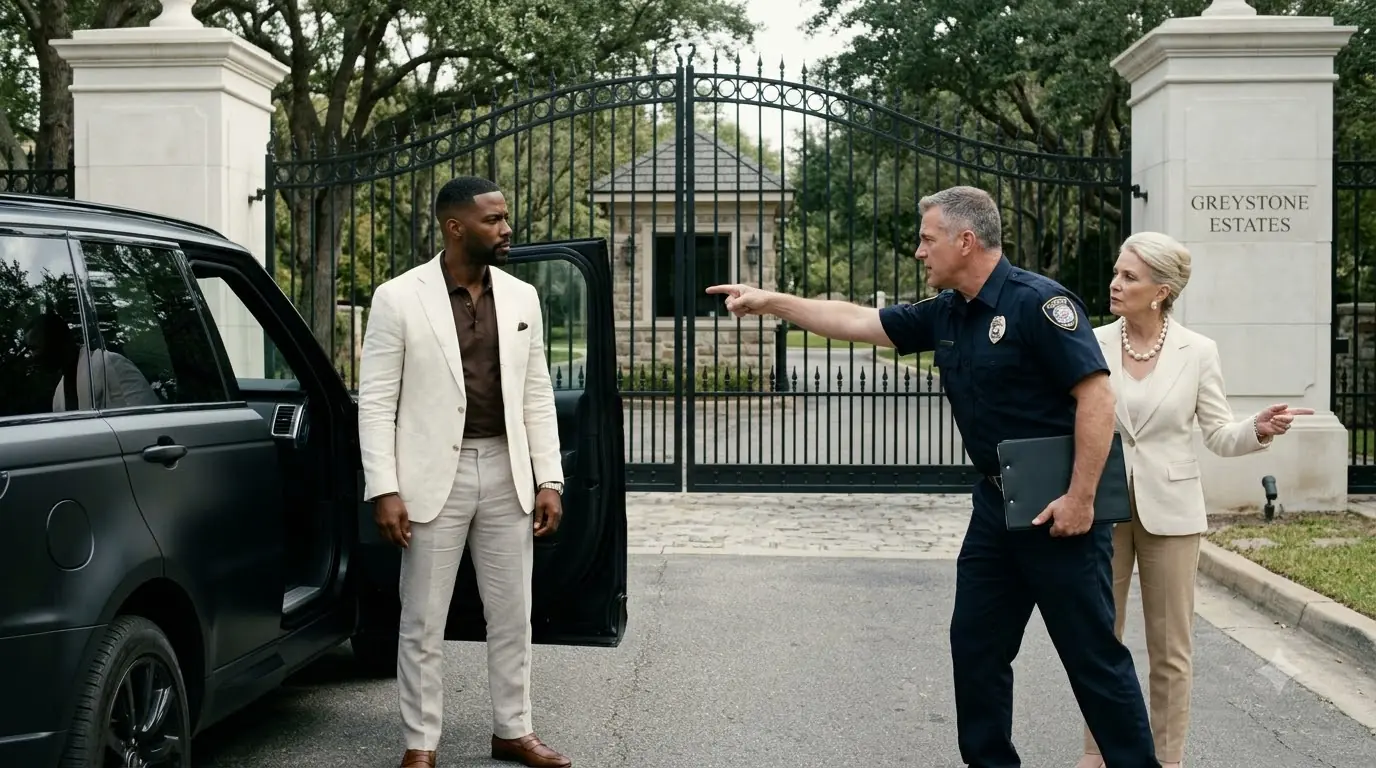
He could see the turn toward his own driveway from the driver's seat of his Range Rover. Yet the man in the security uniform had decided that Fletcher was not going home.
"Excuse me," Fletcher said, keeping his hands on the steering wheel. "I live here. Could you open the gate, please?"
Craig Sutton answered by spitting onto the asphalt beside the front tire. He gave a short, delighted laugh, as though the request had been the funniest thing he had heard all morning. "You live here? I've seen every resident in this community," he said. "None of them look like you. Turn around before I call the real police and have you removed."
Fletcher did not answer the insult. He looked at the metal gate, at the guard's clenched jaw, and at the younger employee positioning a golf cart behind his vehicle. Across the entrance, a woman in an expensive cream blazer stood with her telephone held to her ear, watching without offering the three words that could have ended everything. Fletcher knew she recognized him. What he did not yet know was how much she was prepared to sacrifice to avoid admitting it.
Less than an hour later, a telephone call would change the direction of that morning. The call would not erase the insult, nor would the opening of the gate give Fletcher back the time he had lost. It would, however, start a chain of investigations that reached from the guard booth to a company executive's office, from the homeowners association to a courtroom, and eventually to lawmakers in Raleigh. None of that was visible yet. For the moment, all anyone saw was a Black man alone inside a vehicle, waiting for permission to enter the neighborhood where he owned the largest house.
The morning had begun with a completely different kind of quiet. On a warm Saturday in late September, Fletcher had awakened before his alarm and listened to the faint rush of water from the fountain beyond his bedroom window. The bedroom occupied one corner of the second floor of his twelve-thousand-square-foot home in Greystone Estates, outside Charlotte, North Carolina. Pale limestone columns framed the front entrance, and the circular driveway curved around a low marble basin where water spilled over three shallow tiers. He had paid cash for the property eighteen months earlier, but its size was still less important to him than the feeling of coming through the door at the end of a difficult day.
His wife, Brenda, was downstairs at the kitchen island when he entered. She wore reading glasses and had three folders open beside her coffee, all relating to the nonprofit legal organization she had spent years building. Formerly a civil rights attorney, she had left private practice to help people whose convictions rested on unreliable evidence, inadequate representation, or investigative misconduct. The work was expensive and frequently heartbreaking. It was also the one kind of work she never considered leaving unfinished.