"You think sorry is going to fix this? " "I didn't mean to, I swear. " "That's what every weak kid says. " "People are already filming. You're trending. " "Good. Let them all watch. " "Take your hands off my son. " "Or what? You going to do something, old man? " "Last time I'm asking. " "Take your best shot, Dad. " Blake Mercer did not see a threat. He saw a prop, a quiet man in a worn work shirt who had wandered into the wrong moment.
Blake had built his brand on the idea that the world belonged to the strong and grabbing a 10-year-old's collar in front of a live camera was not cruelty to him. It was content. Seth kept the lens steady. The crowd kept its distance. Nobody stepped forward.
Nobody except one man who moved through the crowd without rushing, without raising his voice, without anything on his face. That kind of stillness is not the same as calm. And the question nobody in that crowd thought to ask is what kind of man stays that still when someone is holding his child off the ground. If you're new here, this channel is where stories like this live. The ones where the person everyone underestimates turns out to be the last person you'd ever want to underestimate.
Hit subscribe so you don't miss what happens next. The plaza sat in that particular state of late morning quiet that only small commercial districts manage a few people moving between storefronts. A coffee cart doing slow business near the fountain. Pigeons working the pavement around the benches with the kind of patience that suggested they'd outlast everyone. It was the sort of place where nothing was supposed to happen.
Where the biggest event on any given Tuesday was a parking dispute or a dog that got loose from its leash. Wyatt Hale had chosen it deliberately. He chose everything deliberately. He was sitting at a table outside the coffee cart with a paper cup and a folded newspaper he wasn't reading. The newspaper was a habit, something to hold, something to look at when he needed to appear occupied.
In practice, his attention moved in a slow, continuous arc across the plaza. The entrance on the north side. The two narrow corridors between buildings to the east. The bench cluster near the fountain where three older men were talking. The gap between the parking structure and the pharmacy where someone could approach without being visible until they were close.
He cataloged all of it without appearing to look at any of it. 37 seconds to the nearest exit. 11 seconds if he didn't mind making a scene. He knew these numbers the way other people knew their home address. Across the plaza, Toby was working on a kickflip.
He'd been at it for 20 minutes, which was about how long Wyatt had been watching him without watching him. The kid had a specific kind of stubbornness about it. Not frustrated, not discouraged, just methodical. He'd set up, try the trick, land wrong, reset, try again. He was 10 years old and he approached failure the way a much older person might, as information rather than verdict.
Wyatt didn't know where he'd gotten that from. It wasn't from him. Or maybe it was just in a form he didn't recognize as his own. Toby's mother had been gone for 4 years. She'd left behind a kid who looked like her and laughed like her and on certain evenings, when the light came through the apartment windows at a particular angle, made Wyatt feel like someone had reached into his chest and moved something that wasn't supposed to move.
He didn't talk about her not to Toby in any detail, not to anyone else at all. There was nothing to say that wouldn't end with him sitting with something he couldn't put back down. So he kept it where he kept everything else that mattered behind his eyes, behind the careful, unremarkable expression he'd worn for so long it had stopped feeling like a mask and started feeling like a face. The apartment they lived in was functional and forgettable, which was the point. The truck he drove was a dark blue Ford with 112,000 miles on it and a crack in the rear bumper he'd never bothered to fix.
He took work as a contractor, plumbing, drywall, the occasional electrical job that didn't require permits. He paid in cash when he could. He didn't have social media accounts. If you searched his name, you found a man who'd served in the Navy, taken an honorable discharge 6 years ago and had since become the kind of ordinary that barely registered. That was the version of Wyatt Hale that existed for the public record.
The other version held a clearance level that most people in government didn't know existed. His commanding officer had been direct about it during the briefing 8 months ago the cover had to be airtight, consistent and boring. Boring was the operative word. The target he was surveilling moved through civilian spaces with practiced ease surrounded by people who had no idea what they were standing next to, which meant Wyatt had to be the same kind of invisible from the other direction. No notable behavior.
No confrontations. No digital footprint. Above all, no demonstration of capability because the moment someone saw a supposed handyman move with the economy that came from years of close quarters training, the questions would start. And questions were the one thing he couldn't afford. He'd been given four rules and he'd followed all of them for 8 months without incident.
The cover held. The work was slow, methodical, and completely invisible, which was exactly what it needed to be. He was thinking about none of this when it happened. Toby set up for the kickflip, planted his back foot flicked his front foot, got the board rotating. For a half second, it looked like he had it.
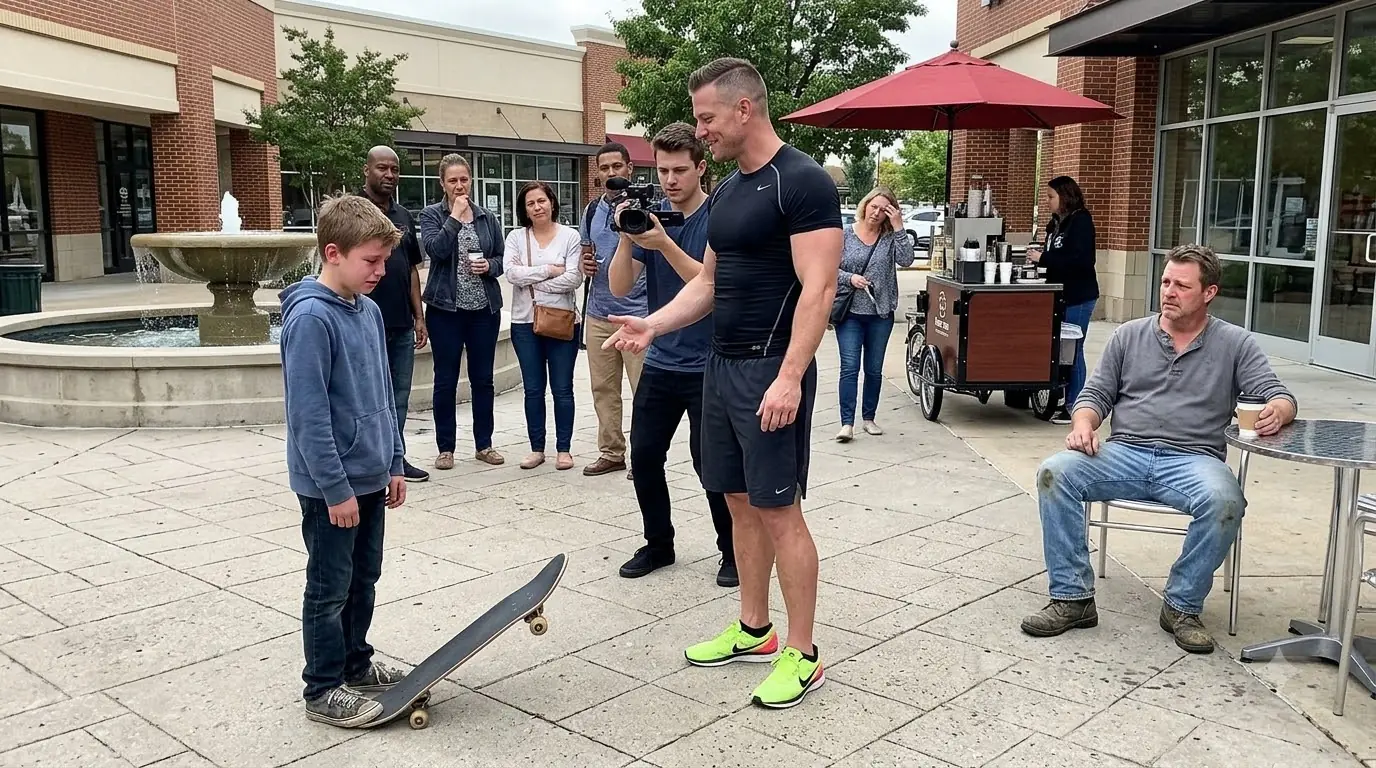
Then his landing foot came down at the wrong angle and the board shot sideways fast and flat and low to the ground, skittering directly into the path of a man who'd been walking toward the gym entrance with a camera crew of one and an expression like he was already performing for an audience that hadn't assembled yet. The board connected with the man's ankle. It wasn't a hard impact. It left a pale scuff across the side of a sneaker that probably cost more than Wyatt's monthly rent and that was the entirety of the damage. Blake Mercer looked down at his shoe the way a person looks at something they've decided to be angry about.
Wyatt had noticed Blake before the skateboard incident had filed him away with the same automatic attention he gave every new element in his environment. Big man, mid-30s, physical in the way that comes from years of deliberate cultivation rather than work. He was wearing gym clothes that were too new and too fitted to be for actual exercise. The camera, a compact professional unit held by a younger man in a gray hoodie, had been rolling since before they crossed the plaza. Wyatt had clocked that, too.
The younger man, Seth, moved with the practiced positioning of someone who'd done this many times, staying slightly behind and to the left, keeping Blake centered in the frame, adjusting without being told to. Toby crossed the plaza in six running steps and started apologizing before he'd fully stopped moving. He was earnest about it the way kids are when they genuinely feel bad, looking up at Blake with wide eyes, telling him it was an accident, saying he was sorry. The apology was real and immediate and entirely without calculation, which was more than Blake Mercer deserved and less than he was willing to accept. What happened next was not about a scuffed shoe.
Blake looked at Seth. Seth adjusted the angle. A few people nearby slowed down. The presence of a camera had a way of doing that, turning foot traffic into an audience. Blake registered this the way a performer registers a filling house and something in his posture changed.
He placed his foot on the skateboard. Not to retrieve it, not to return it, just to make the point that it was now beneath his shoe and would stay there until he decided otherwise. Toby asked for it back politely. Blake told him that sorry was what weak people said when they didn't want to face consequences. He said it in the tone of someone sharing wisdom, which was worse than if he'd said it in anger.
Toby tried to reach for the board anyway. Blake pushed it further away with his foot. From his table near the fountain, Wyatt set down his paper cup. He didn't stand up yet. He watched Blake begin what was clearly a practiced routine, the lecture about strength and accountability, and what it meant to let a skateboard fly loose in a public space.
Blake had the cadence of someone who'd done this before, the rhythm of a man who'd learned that having a camera nearby changed the acoustics of everything he said. The crowd was growing, not dramatically, not all at once, but it was growing. Seth kept the lens moving slowly between Blake's face and Toby's, catching both expressions. Toby held himself very still and took it. He didn't cry.
He didn't argue back. He listened to Blake tell him that his generation had no discipline, that his parents clearly hadn't taught him respect, that the world didn't owe apologies to anyone. He took it with a steadiness that was somehow more unsettling to watch than if he'd broken down entirely. Then Blake grabbed his collar, not violently, not the way you'd grab someone you wanted to hurt. It was the grip of someone who wanted to make a point about access, about the power to hold someone in place.
One hand clenched in the fabric at Toby's shoulder, and Toby's feet came just slightly off the ground. Just enough, just that last escalation past every line that should have existed. Blake kept talking, kept the rhetoric going about wolves and sheep, and which category a kid who couldn't control his skateboard was going to fall into. Toby didn't look at Blake. He looked across the plaza.
He found his father's face in the small crowd that had gathered, and he didn't say anything, Didn't call out. Didn't cry. Didn't make a sound. He just looked. The way a kid looks when they've decided not to ask for something because they already know the answer is coming.
Wyatt stood up. He felt the familiar internal geography of the moment arrange itself around him. The way his breathing changed without him telling it to the way his weight distributed automatically. The way the 12 people between him and Blake became a mapped space with angles and timings already calculated without conscious thought. He noted the camera.
He noted the phones coming out in the crowd. He noted Seth repositioning to capture the approaching figure. He noted all of it and he kept walking. Not quickly. Not in the way that broadcasts intent.
Just steadily the way a man walks across a plaza towards somewhere he needs to be and the crowd opened for him without quite knowing why. He stopped 3 ft from Blake. Blake was still talking. He finished his sentence then registered the new presence and turned his head to look at the man who'd appeared without making any noise about it. He saw what he'd expected to see a man in his early 40s with a worn gray Henley jeans that had been washed too many times, boots with road damage on the toes.
A handyman. Someone's exhausted father. Nothing. Wyatt said, ""Take your hands off my son. "" His voice was level, not quiet in the way that performs calm, but actually quiet the way things are when they no longer require emphasis. Blake heard it.
Seth heard it. The four people closest to the confrontation heard it, and two of them took half a step back without seeming to decide to. Blake released Toby's collar, but the release was contemptuous. He let go and pushed a small sideways motion that sent Toby off balance. Toby caught himself on one knee against the pavement.
Blake turned to face Wyatt fully, and then he smiled. He glanced at Seth to make sure the angle was good. "Looks like Dad wants to play hero. " Blake said loud enough to carry. Wyatt looked at Toby. The kid was on one knee checking his palm where it had caught the ground.
Not crying. Not looking up. Wyatt looked at him for exactly 1 second. Then he looked at Seth and the camera. "Turn it off. " he said.
Seth looked at Blake. Blake made a small motion with two fingers, keep rolling. Wyatt understood what that meant. He understood it the way he understood most things in the field, not with frustration or surprise, but with the cold recognition that a situation had moved past the point where you controlled it and into the territory where you managed it. He couldn't undo the camera.
He couldn't undo the phones. What he could do was narrow the variables, reduce the damage, get Toby out of the space. Those were the priorities now. The only priorities. He had been trained at significant expense to the United States government to assess a threat environment in under 4 seconds.
He used two of those seconds on Blake Mercer and came to the following conclusion. Blake was strong, trained, accustomed to winning in controlled settings, and had never in his life encountered a situation where the person across from him had genuinely no interest in being impressive. That was not a small gap. That was a gulf. He picked up the skateboard from the ground near Blake's foot and checked it.