The shears hit the ground before Clara could scream. Silas Mallister's fist was still tangled in what remained of her hair. Chestnut strands drifting across the barnyard dirt like something sacred being buried. She didn't cry. She wanted to. Every muscle in her throat pulled tight against it. She pressed her lips together and stared at the barn wall and refused to give him the sound he was waiting for.
She was 18 years old and she was done being broken quietly. The morning had started the way most mornings started on the Mallister homestead with silence that wasn't peaceful, the kind that had teeth in it. Clara Whitfield woke before the roosters. She always did. Not because she was eager for the day, but because the sounds of the house told her things the daylight tried to hide. She could hear Silas moving in the kitchen below the heavy drag of his boots across the plank floor.
The particular rhythm of a man who hadn't slept well and intended to make someone else pay for it. She recognized that rhythm the way a dog recognizes a raised hand, not by thought, but by something older and deeper, something that lived below thinking. She dressed quietly. She braided her hair with practiced fingers, not looking in the small cracked mirror above the wash stand. She had learned not to look at herself too closely in this house. It made things harder.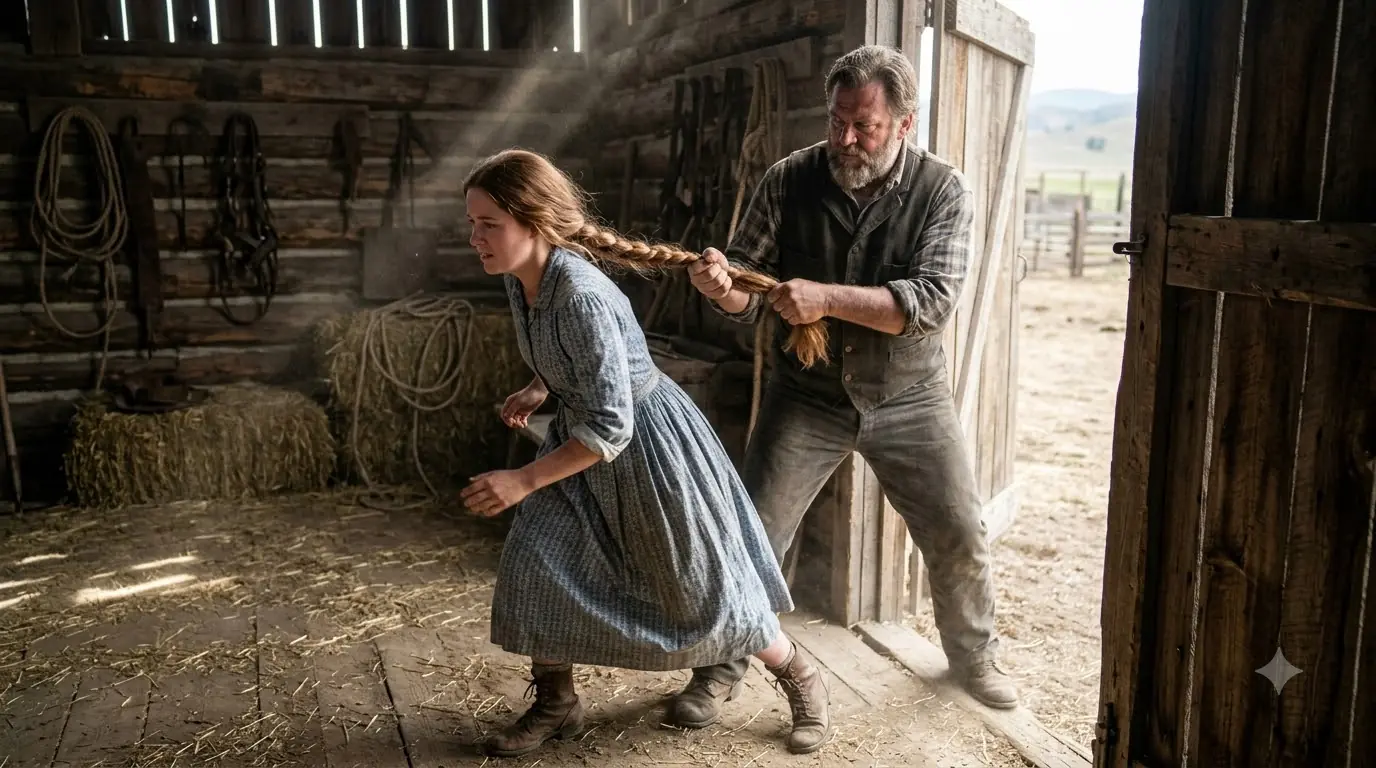
The braid fell past her shoulder blades. Her mother had always said Clara's hair was the color of autumn hillsides, warm brown threaded with copper where the sun touched it. Her mother had loved that hair. Her mother had been dead for three years, and Silas Mallister had moved into the house 6 months after the funeral and never once left. Clara went downstairs. Silas was sitting at the kitchen table with a cup of coffee gone cold, staring at nothing.
He was a big man run to fat in the middle, but still broad through the shoulders with hands that had done hard labor once, and hadn't forgotten how. His face was the color of old leather, and arranged in its usual expression, the one that looked like disappointment, had settled into every line, and wasn't planning to move. He looked up when she came in. "You're late," he said. "She wasn't late. She was in fact 4 minutes early by the clock on the wall behind him.
She had learned not to point this out. "I'll start the eggs," she said. "I don't want eggs." He pushed the cold coffee away. "I want to know why the Hendersons told Reverend Cole that you were talking to their boy outside the mercantile last Tuesday." Clara's hands stilled over the iron skillet. She turned slowly. "I said good morning to him.
He was standing on the boardwalk. You said good morning. Silas repeated it the way men repeat things when they're building towards something and want you to know it. Yes, sir. And you didn't think that looked a particular way. A girl your age standing in the street making herself available for conversation with a boy who's got no business looking your direction.
I wasn't making myself available for anything. I said good morning. It was two words. She knew even as she said it that she shouldn't have. Not the words themselves, the tone, the slight lift of her chin, the way she held his gaze a half second longer than submission required.
She had a bad habit of it. Her mother used to call it her trouble face, and she would laugh and smooth Clara's hair back from her forehead and say, "Baby, that face of yours is going to start wars one day." She hadn't meant it as a warning, but it had turned into one. Silas stood up. He didn't say anything else for a moment. He just stood up and looked at her with those flat gray eyes. And Clara felt the familiar cold spread through her chest.
That specific fear that had no edge to it, just a kind of blankness, like standing at the rim of something deep and not being able to see the bottom. Go out to the barn, he said. I'll be out directly, she went, because what else was there to do? The Hendersons were 3 miles north and wouldn't hear anything. The nearest neighbor after them was the Perty place, nearly 6 miles east.
The Reverend came through twice a month, and had never once looked at Clara with anything that suggested he'd be useful in a crisis. She went to the barn and stood near the post by the hay bales, and she waited, and she hated herself for waiting, and she waited anyway. He came in carrying the sheep shears. Clara saw them and felt something shift in her stomach. Something that wasn't quite surprise and wasn't quite not surprise.
She had known for some time that Silas's punishments had been escalating. The slaps had given way to things that left marks that took longer to fade. The things he took away had gotten more significant. She understood in the wordless way, "You understand a storm building on the horizon that he had been working towards something. You think you're something?" he said. He wasn't shouting. That was almost worse.
The low voice, the deliberate walk toward her. You walk around this place like your mother's ghost is going to come down and protect you. You look at me with those eyes like you've got some kind of say in your own life. Silas, that hair, he said, is vanity. Plain and simple vanity.
And I'm done watching you wear it like a crown. She moved. She was fast. She had always been fast, and she got past him the first time, slipping along the wall toward the barn door. But he was bigger, and the barn wasn't wide, and the door wasn't close enough, and he caught her by the braid with one hand, snapping her head back so hard she saw white for a moment. Her hands went to his wrist by instinct. Her fingernails found skin.
He didn't let go. "You scratch me again," he said quietly. and I'll make sure you regret it for a month. The shears opened with a cold metallic sound. Clara went still, not because she'd given up. She understood the difference between stillness as surrender and stillness as survival.
And she had been practicing the second kind for three years. She went still because the shears were close to her ear, and moving and screaming or fighting now would only make the blade unpredictable. The first cut took most of the braid. She felt the weight of it leave her and felt the sudden lightness the way you might feel a door closing on something you loved all at once with a sound you'd remember. He kept going, not careful about it, not surgical.
He grabbed and cut, grabbed and cut, moving around her head with the indifference of a man trimming a hedge. Hair fell to the barn floor in clumps. She could feel cold air on her scalp in patches, and the places where the shears had dragged instead of cutting cleanly burned in thin lines. She did not cry. She fixed her eyes on the barn wall, a knole third board up from the floor, and she breathed, and she thought about her mother's voice, and she did not give him the sound he wanted.
When he was done, he stepped back. He looked at her the way he always looked when he had finished something, not satisfied exactly, but quieted like the thing driving him had been fed and was resting for the moment. There, he said, "Now you look like what you are." He dropped the shears on the barn floor and walked out. Clara stood still for a long moment after the door shut. Her hands came up slowly and moved over her scalp stubble in some places longer, uneven patches in others. one spot near her left ear that felt wet and stung when she touched it.
She pressed her palm flat against the top of her head and held it there. Then she walked out of the barn. She didn't know why she walked out. There was nowhere specific to go. Silas was on the porch. The road was visible from the porch, but something in her needed the open air and the sky overhead and the feeling of ground under her feet instead of hay and shadows.
She walked out and stood in the barnyard with the morning sun on her bare scalp and her chin level and her hands steady at her sides. That was when she heard the hoof beatats. She didn't look up at first. Riders came through the road past the property sometimes. Stage traffic ranch handsmen on their way to the mining claims up in the Northern Territories. She had no particular reason to look, but something made her look.
He was coming down off the ridge trail the high path that cut along the back of the property where the land rose into rock and pine before leveling out again. A big roan horse moving at a pace that was just short of a full run, kicking up a thin trail of dust in the dry morning air. The rider sat the horse the way men who'd grown up on horseback sat horses not performing it, just part of the animal, effortless and economic in every movement. She didn't know him. He slowed when the trail dropped down toward the flat.
And then he pulled up short at the fence line and looked at the barnyard and looked at her. And something in the way he went still on that horse told her that whatever he'd been riding toward, he hadn't expected to see what he was seeing. For a moment, neither of them moved. Then Silas's voice came from the porch. Keep riding, cowboy. Nothing here concerns you. The rider didn't answer immediately.
He was looking at Clara, not in the way men sometimes looked at her, not sizing her up or cataloging her. He was looking at her the way a person looks when they're trying to understand something. His eyes went from her face to her scalp to her hands, and something shifted in the line of his jaw. "Ma'am," he said finally. His voice was low and level, carrying easy in the morning air.
"You all right?" She opened her mouth to say, "Yes." It was what you said. It was the word that kept things from escalating. The word that made men feel they'd done their part by asking and could continue on their way. She had said it a hundred times. Sometimes when she was bleeding, sometimes when she was shaking so hard she could barely form the syllables.
No, she said I'm not. She didn't plan to say it. It came out of her the way things come out when you've been holding them so long that the container finally gives. Not gradually, but all at once without warning. The rider swung down from the horse.
Silas stepped off the porch. I said, "Keep riding." His voice had the particular flatness that meant he was past irritation and into something colder. "This is my property, and that's my daughter, and whatever you think you're doing, she's not your daughter." The rider said it without heat, without accusation, just as a correction of fact. He had looped his reins around the fence post and was walking toward the barnyard now and Clara noticed he kept his hands visible, not reaching for the revolver at his hip, just open and at his sides, which somehow made him more unsettling rather than less. Stepdaughter, same difference. No, sir. A pause. It really isn't. Silas took three steps toward him and stopped.
He was looking at the rider the way men look when they're calculating weighing size posture how a man carried himself. Silas had done this kind of calculation before and had usually come out of it feeling like the room tilted his direction. He didn't look like he felt that way now. Who in the hell are you? Silas said Ethan Carter.
What you saw is none of your concern. I reckon that's where we differ. Clara watched this exchange from where she was standing near the barn door, and she was aware of something strange happening in her chest. a loosening small and cautious like a knot that had been pulled tight for so long that even a slight easing was almost painful. She pressed her fingers against her sternum and breathed. Silas laughed. It was the ugly sound he made when he was about to do something he decided on.
You think a cowboy riding through is going to ride into my yard and tell me how to manage my own household? He reached back toward the porch and she saw with a lurching dread that he'd left his belt with the leather strap coiled over the railing. Ethan Carter didn't move back. I think he said quietly that you're going to put that down. And I think that girl is going to get her things and I think this is going to happen peacefully if you're a reasonable man.
And if I'm not, Ethan looked at him for a long moment. then it's still going to happen. Clara didn't wait to see what Silas would do next. Something in the steadiness of Ethan Carter's voice, not loud, not threatening in the way she'd learned to dread, but carrying in it a kind of absolute certainty. The sound of a man who had decided something and was past being talked out of it, unlocked her legs. She walked toward the house.
She went up the three porch steps and through the front door and up the stairs to the room that had been hers since she was 8 years old and had contained less and less of her own life with every year that passed. She took the flour sack from under the floorboard, the one with her mother's locket, the $12 she'd saved from the egg money, the folded letter from her mother's sister in Colorado that she'd never answered because Silas had told her she didn't have any family worth knowing. She was back on the porch in four minutes. Behind her, she could hear the two men's voices, low, controlled, not quite shouting. She heard the crack of leather and then a sharp grunt.
That was Silas, not Ethan, and the sound of something hitting the dirt. She kept walking. She came down the porch steps and around the corner of the house. And Silas was on the ground, and Ethan Carter was standing over him with the strap held at arms length like something distasteful. And Silas was breathing hard and looking up with an expression she had never seen on his face before. He looked uncertain. Ethan dropped the strap in the dirt.
He looked up and saw her with the flour sack and something moved in his expression. Not pity. She would have hated pity something closer to recognition. He nodded once. "You ride?" he said. "Yes," she said. "Then let's go." She looked once at Silas on the ground. He was already pushing himself up, already reforming the anger on his face, already reassembling the version of himself that knew how to make her feel small.
She had watched him do this her entire life. She had watched him do it and believed somewhere beneath reason that the reassembly was inevitable, that he would always rise back up and she would always be standing there waiting for him to. She turned away from him. She put her hand on the rone horse's neck and felt the warmth of the animal and the solid reality of it under her palm. And she thought, "This is what the other side of that feels like." Ethan Carter gave her a leg up.
She settled into the saddle with the flour sack across her lap and looked out over the flat brown land, the homestead, the fence posts, the barn where her hair was still lying on the floor in the dirt. and she felt for the first time in three years the particular terrifying lightness of a life that no longer had a ceiling on it. She didn't look back as they rode. Silas was shouting something. She could hear it fading behind her like weather passing. The roan's hooves hit the dry ground in a steady rhythm and Ethan rode alongside her, not speaking, not crowding her, giving her the silence like a gift.
After a long while, when the homestead was out of sight and the ridge trail curved up into the pines, she said, "You didn't have to do that." He kept his eyes on the trail ahead. "No, ma'am," he agreed. "I didn't." "Why did you?" He was quiet for a moment. The pines came up around them, and the air changed cooler, smelling of resin and shade, and somewhere above them a hawk called once and was silent. Because I could, he said simply, "And some things that can be done ought to be." Clara looked at her hands on the saddle horn.
The flour sack was wedged under her knee. The locket inside it was pressing a small hard shape through the fabric. She thought about her mother saying that face of yours is going to start wars, and she thought that maybe her mother had meant it as a promise after all, not a warning. She lifted her face to the pine filtered light coming down through the trees. She kept riding. The Rone horse knew the trail better than Clara did, which was the only reason she didn't lose her nerve on the steep climb through the pines.
Her scalp still burned. Not in any dramatic way, just a steady low heat in the places where the shears had dragged instead of cutting clean and one spot near her left ear that she kept touching with two fingers before she could stop herself. Every time she touched it, she made herself stop. She didn't want Ethan Carter to notice. He noticed anyway. There's a creek about a mile up, he said, not looking at her. Clean water. We can stop. I'm fine.
Didn't say you weren't. She looked at the back of his head, the weathered hat, the way he sat the horse without thinking about it, and felt the particular irritation of being seen clearly by someone she didn't know yet. She pressed her fingers flat against her thigh and left her ear alone. The creek was cold and ran shallow over smooth gray stones, and Ethan dismounted and let the horses drink while Clara sat on a rock with the flour sack across her knees and tried to organize herself. This was something she'd always been able to do.
Take the disorder inside her and sort it into something manageable, something that had edges and could be put on a shelf. She was good at it. She had been doing it since she was 15 and had understood for the first time that no one was coming to make things better and that management was the only tool she had. But the thing about that kind of management was that it required a certain baseline of normal. It required the world to be roughly what it had always been.
And right now she was sitting on a rock in the Wyoming pines with half her hair gone and a flour sack containing everything she owned. and a man she'd met forty minutes ago was crouching by a creek watching his horse drink, and none of the categories she usually sorted things into were applying cleanly. "Where are we going?" she asked. "My place is another two hours north." He glanced up at the sky the way men who'd worked outside their whole lives read the sky without thinking about it. "We'll make it before dark. I can't stay at a strange man's property." No, he agreed.
You probably can't for long. He stood up and brushed his hands on his trousers. But you can stay tonight and tomorrow we figure out what comes next. What comes next is my business to figure out. He looked at her, then straight on without apology.
He had dark eyes, she noticed. Patient eyes, the kind that didn't flicker when things got uncomfortable. Yes, ma'am. He said it is. I'm not arguing with that. She waited for the rest of it.
The part where men explained what they thought she should do. The part where the sentence turned and the implication landed and she understood that the help on offer had a shape to it, a cost built in. He just turned back to the horses. She sat with that for a moment. Then she stood up, adjusted the flour sack, and got back on the horse. They rode north.
The first hour passed mostly in silence, and Clara spent it watching the land change around her and noticing that she was watching it, not braced against the next thing, not cataloging exits, just watching. The pines thinned out, and the country opened up into high sage and yellow grass, and the kind of distance that made you feel both exposed and free sometimes at the same time. She hadn't felt free in so long that she almost didn't recognize the feeling. And when she did recognize it, it scared her a little. Free meant there was nothing between her and whatever came next.
You said you had business with Lou Perty, she said. Did the parties are good people? Met Lou once at the feed store in Casper. He seemed straight. A pause. He owe you something. No. His wife Dot brought food over twice the year my mother was sick.
Silas turned her away both times, but I saw her from the upstairs window. She hadn't meant to say all that. It had come out in a piece which was unusual for her. She pressed her lips together. Ethan didn't respond immediately.
She was learning that this was a pattern that he absorbed things and then said something or didn't. And either way, the silence wasn't uncomfortable. It was just silence. He turned people away often, he said finally. He didn't like the implication that we needed help. While making sure you needed it, she turned to look at him.
He was watching the trail ahead, not looking at her, but the line of his jaw had a particular set to it. Not angry exactly, but resolved. She turned back. Yes, she said. That's about right. The cabin came into view as the afternoon light went long and gold. a solid log structure set back against a rock face. The kind of building that had been put up by someone who understood weather and wasn't in a hurry and had taken the time to do it correctly. A leanto on the east side, a well, a small kitchen garden that was doing reasonably well considering the elevation.
Clara took all of this in automatically. She had always been a noticer of practical details, had learned to read a household the way some people read faces, finding in the state of things, all the information she needed about the people who maintained them. What she read here was a man who lived alone and had made his peace with it. Everything functional, nothing decorative except a single clay pot near the door with a struggling geranium in it, which surprised her enough that she looked at it twice. My mother's Ethan said catching the look.
Brought it up from Laramie two seasons ago. Keeps dying and coming back. Same as her. I suppose she's in Laramie was died in February. He said it's simply the way you say things. You've had time to carry but not time to put down. I'm sorry. Appreciate it.
He unsaddled the horses and put them in the leanto and showed her the pump for the well and said she could have the bedroom. he'd take the front room, and if she wanted to wash up, there was a basin and clean water. He said all of this without meeting her eyes and without hovering, and she understood he was giving her territory. She washed her face and her scalp at the basin, and looked at herself in the small mirror above it. She had not expected what she saw. She had braced herself for devastation, for the image to confirm everything Silas had intended by doing what he'd done, that she was diminished, unmade, reduced to something he'd made a decision about.
She had expected to see helplessness in her own reflection. She didn't. She saw her own face, the same face it had always been. Cheekbones and brown eyes, and a jaw that her mother had always said came from the Whitfield side, which meant stubborn and long-suffering in equal measure. The hair was gone, the scalp uneven and patchy in a way that would take time, but the face underneath was just her face, and it was looking back at her with something she hadn't expected. It looked like the face of someone who had walked out.
She put her hand on the edge of the basin and held it there for a moment, and then she dried her face with the cloth and went out to see if there was anything useful she could do. Ethan was at the wood stove, and from the smell of things, he was better at some aspects of frontier living than cooking. Clara looked at what he had going in the pot and gently moved him aside and took over without explanation, and he let her without comment, which she decided was a mark in his favor. They ate at the small table. The food was plain beans, salt pork, cornbread she'd made from the tin of meal on the shelf.
And it was better than anything she'd eaten at the homestead in a year because no one at this table was angry about something and making everyone else aware of it. How long were you there? Ethan said. The homestead. She broke a piece of cornbread. Since I was 8 when my mother married him. My father died the winter before. And your mother?
Three years ago, this April, she set the cornbread down. She got sick in December. By spring, she was gone. Silas kept the property because her name was on the deed and she'd put his on it when they married. A pause. I didn't know she'd done that until afterward.
No way to have known. I should have known. She said it without heat. A statement of plain accounting. I should have paid more attention to the documents. I was 15.
I thought it wasn't my business. Ethan looked at her over his coffee. That's not a fair thing to hold against a 15-year-old. I'm not 15 anymore. Something shifted in his expression, subtle and thoughtful.
No, he said, you're not. She looked at her plate. Outside the wind had picked up and was moving through the pines with a sound like water, and the fire in the woods stove popped and shifted, and the cabin held the warmth in the way solid things hold warmth steadily without drama. "Why do you live up here alone?" she said. He was quiet long enough that she thought he might not answer.
Then he said, "I was a marshal down in New Mexico territory for 8 years. She waited. There was a situation." He turned the coffee cup in his hands. A family husband, wife, three children claimed jumpers had been working that county for two seasons using a circuit judge on their payroll to push through fraudulent deeds. I'd been building a case. I thought I had more time. He stopped.
I didn't have more time. What happened to the family? They lost everything. Father ended up in the territorial prison on a manufactured charge. The wife and children went to her sister in Albuquerque. I testified at the hearing that invalidated the deeds, and I got the father out, but the land was gone by then. Sold three times. Couldn't undo it.
He set the cup down. I resigned my commission after the hearing. Clara looked at him. You blamed yourself. I was responsible. That's not the same as blame. He looked up at her. There was a pause. the particular pause of a person encountering an idea that rearranged something slightly and needed a moment to settle.
Maybe not, he said. She picked up the cornbread again. You said you had business with Lou Perty. Did he's been having trouble with a man named Hol bought up three ranches east of here last spring. All of them in circumstances that didn't add up when you looked close.
Lou's deed is the last thing between Holtz land and the river access. A pause. I told Lou I'd have a look at his documents. See if there's anything there. Clara's hands stilled. What kind of documents? She said his deed, the survey plat, the tax records from the county recorder.
She put down the cornbread. Who does the survey work in this county? He looked at her differently now. man named Garrett Ty. Why? Because I worked in the county recorder's office in Casper for seven months two years ago before Silas made me stop.
She said it evenly, watching his face. I processed deed filings, tax assessments, survey plat transfers. I know what a fraudulent description looks like in a legal document, Mr. Carter. I know where they put the alterations, and I know how they get the recorder seal onto documents that don't deserve it. The fire popped. Ethan Carter sat down his coffee cup and looked at her.
The way a man looks when the situation he thought he understood has just revealed a dimension he wasn't expecting. Is that right? He said it wasn't quite a question. Lou Perty's wife brought food to my mother when no one else would, Clara said. And Abel Holt has been doing to this valley what was done to that family in New Mexico.
She looked at him steadily. "I'd like to see those documents." He studied her for a long moment. The fire settled outside. The wind moved through the pines. "All right," he said.
She nodded once and picked up her cornbread and ate it and didn't let him see the way her hands had started trembling, not from fear this time, but from something she hadn't felt in so long she'd nearly forgotten the shape of it. Purpose. It felt like standing up straight after years of being told to make herself small. It felt like taking up the exact amount of space she was supposed to take up and having the groundhold beneath her. She did not say any of that. She finished her supper and helped wash the dishes and went to bed in the small back room and lay on her back on the narrow mattress and looked at the ceiling and listened to the wind and thought about survey plats and deed descriptions and the four specific places in a legal document where a man with access to the right tools could make a property line mean whatever he needed it to mean.
She thought about this for a long time. Then she slept hard and deep and dreamless, the way she hadn't slept under Silas Mallister's roof in three years. Morning came cold and clear, and she was up before Ethan, which she had expected. She found oats and made porridge and put coffee on and sat at the table with a stub of pencil in the back of a flour sack and wrote down everything she remembered about the Casper recorder system. The filing sequences, the seal process, the specific clerk who had seemed on two occasions to take a long time in the back room with documents belonging to men from out of county.
Ethan came out and looked at what she'd written without asking what it was and poured himself coffee and sat down across from her. You remember all of that? He said, "I remember most things I write down, and I wrote down everything when I was working there." She looked up. Silas burned the notebooks when he made me quit. But I remember what was in them. Ethan looked at the page.
"The clerk you're describing, Wendell Ferris." Her chin came up. "You know him? I've heard the name." A pause from Lou. He said a man named Ferris processed the deed transfer on one of the ranches Holt acquired. Lou thought it was strange because Ferris worked out of the Casper office and the property was in the Crawford County filing district.
Clara felt something click into place with the particular cold satisfaction of a mechanism functioning correctly. A Casper filing in a Crawford County transaction, she said slowly. That means the property description in the official record and the property description in the county plat wouldn't match. Not exactly. Not if you looked at both. Most people don't look at both.
No, she said they don't. That's the point. She turned the flour sack over and started writing on the other side. Ethan watched her work and didn't interrupt. and she was aware of being watched, but not in the way she was used to being watched, not with the intent to find something wrong. He watched the way people watch something they're trying to understand and want to get right. After a while, he said, "We should ride to lose this morning." Yes.
You sure you're up to it? Yesterday was I'm up to it. She said it without looking up from the page. Yesterday is done. There was a pause. Yes, ma'am," he said quietly.
"I reckon it is." She looked up. Then he was looking at her with something in his expression that she didn't have a name for, yet something that didn't quite belong in the category of stranger, but didn't belong in any other category she had either. It was simply there, like the geranium by the door, a thing that had survived something and was persisting without apology. She looked back down at the page. The pretty place was east, the way the land went soft and rolled before coming back up into ridge country, and they rode it in the early morning light, with the dew still on the sage, and the sky going from gray to pale gold overhead.
Clara had tied a bandana over her head, not because she was hiding, but because the air was cold on her scalp, and practical things were practical. Ethan hadn't said anything about it. She was beginning to understand that he said a great deal by not saying things. Lou Perty met them at the gate. He was a short square man in his 50s with the calloused hands and bent posture of a man who had been working land his entire life. And when he saw Ethan, he relaxed visibly.
And when he saw Clara, he paused and looked at her with an expression she read quickly. Not pity, not prurience, just a careful recognition that something had happened and he wasn't going to make it worse by commenting on it. Ethan, he said, you made it. This is Clara Whitfield, Ethan said. Mallister Homestead, South Ridge. Lou's expression shifted.
His eyes went to Clara with a different quality now. Memory surfacing. Whitfield, he said. Sarah Whitfield's girl. Yes, sir. His jaw worked briefly. Your mother was a fine woman. Dot's been asking about you. He paused. You all right, miss?
I'm better than I was yesterday, she said. He nodded the way men nod when they're accepting a careful answer as the whole truth because they understand that's all that's being offered. Well, come in then. Dot Perty came out of the house and stopped when she saw Clara and then moved forward with a directness that reminded Clara of her mother. Not tentative, not full of questions, just a woman who saw what was needed and moved toward it.
She put her arms around Clara briefly and held on for a moment and then let go and looked at her face and said, "You hungry?" "We already ate." Clara said, "Thank you." "Then sit down and I'll get the coffee and you can eat again." Clara sat down and ate again. The documents were on the kitchen table. Lou's deed folded and worn, and beside it, the survey plat for the eastern parcels and the tax records going back 12 years. Clara pulled them toward her without asking and spread them flat and looked at them the way she had learned to look at documents, not reading top to bottom, but scanning structure first, looking for the places where the formatting shifted, where numbers sat at slightly wrong intervals, where the clerk's notations changed handwriting between lines. Lou watched her from across the table.
Ethan stood near the door. Dot poured coffee for everyone and didn't say a word. 2 minutes in, Clara found it. She didn't say anything immediately. She picked up the survey plat and held it at an angle to the window light and looked at the section lines on the northeast quarter and felt her stomach drop in the specific way it dropped when something she had suspected turned out to be real.
Mr. Perty, she said, who witnessed the original survey of your east fence line? Do you know? Lou frowned. fellow out of Crawford County office. Simonson, I think 10 years back, maybe 11. Was there a resurvey done in the last 2 years? Lose frown deepened.
Holt's man came out last spring and said they were updating the county plat maps survey team. I didn't think much of it. Clara set the plat down. She picked up the tax record and found the page she was looking for and set it next to the plat so both were visible. Look at this, she said.
Ethan moved in from the door. Lou leaned forward. Dot's coffee cup paused halfway to her mouth. The survey plat shows your east boundary at the river bluff. Clara said her finger tracing the line. This line here, that's what it shows.
But the tax record which was filed in the Casper office, not the Crawford County office, has your taxable acreage listed at 43 acres fewer than the plat shows. She looked up at Lou. Someone filed an amended acreage assessment in Casper that doesn't match your survey, which means on paper in the Casper record, 43 acres of your land don't belong to you. The kitchen was very quiet. Lou said, "What?
It's a staging document." Clara said, "They file the amended assessment first. That creates a discrepancy in the official record. Then when they're ready, someone files an adverse claim based on the Casper record argues the survey plat was an error and petitions for a corrected deed. By the time you know it's happening, the documentation trail is already two steps ahead of you. Lou looked at Ethan. You knew about this.
I suspected the method, Ethan said carefully. I didn't know she'd find the specific filing. Clara looked at him. I worked with a deputy attorney general in New Mexico, he said, meeting her eyes. Same method, different county.
We couldn't stop it in time. He paused. We can stop this one. Lou pressed both palms flat on the table. His face had gone through several things in quick succession and settled on something that was part fury and part the particular exhaustion of a man who had been fighting quietly for a long time, and had just been handed proof that he hadn't been imagining it. What do we do? He said.
Clara looked at the documents spread in front of her. We go to the Crawford County Recorder's office, she said. And we file a challenge to the Casper assessment before Holt's people can use it. We bring the original plat and your deed, and we make the discrepancy formal and on the record. Once it's challenged, they can't use the amended assessment as the basis for an adverse claim.
Can they just refile? They can try, but a challenged record with a contemporaneous notation is much harder to weaponize. It also draws attention to the Casper filing, she paused. And it establishes that you knew, that you caught it. That's harder for them to work around than silence.
Dot put her coffee cup down. How does an 18-year-old girl know all of this? I paid attention, Clara said. Dot looked at her for a long moment and then looked at Ethan and then looked back at Clara. Good, she said simply.
Lou picked up his deed and looked at it like he was seeing it for the first time. When do we go to Crawford County? Tomorrow morning, Clara said. First thing, before the weekday clerk changes over. She began folding the documents back into their order.
There's one more thing. The man who filed the amended assessment in Casper, his name is on this record. She set her finger on a notation in the lower margin. Wendell Ferris. Ethan went very still. Lou looked at the name.
I know that name. Most people in this county are going to know that name soon enough. Clara said. She said it quietly. The way she'd learned to say things she meant seriously without drama, without performance, just the plain weight of the words and the fact behind them. She sat back in her chair and looked at the documents and felt the trembling in her hands again, the good trembling, the purposeful kind, and thought about Silas Mallister's voice saying, "You don't have any say in your own life." And thought, "Watch me." Nobody in that kitchen spoke for a long moment.
Then Lou Perty straightened up and looked at his wife and said, "Dot, you'd better pack us food for the trail, and Dot Perty was already moving." They rode for Crawford County before the sun had cleared the ridge. Lou Perty rode his own bay geling, older and steady, the kind of horse that had seen enough not to be bothered by much. Dot had packed cornbread and salt pork wrapped in cloth and a canteen of water, and she'd hugged Clara at the gate and held on a beat longer than the first time, and said quietly into Clara's ear, "Your mother would be proud." Clara had nodded and not trusted herself to answer, and gotten on the horse. "The documents were in the saddle bag behind her. She was aware of them the whole ride, the way you're aware of something fragile, not anxious, but attentive." She'd wrapped them in the oil cloth Lou kept for his survey maps and tucked them flat and checked twice that the buckle held 43 acres of a man's life and livelihood folded into a rectangle the size of a family Bible.
Ethan rode ahead on the trail and Lou rode beside Clara and nobody talked much for the first hour which suited her. She used the time to run through what she knew about the Crawford County Recorder's process, the filing windows, the challenge notation requirements, the specific language that needed to appear in the formal objection to make it stick. She had looked it up twice in the recorder's manual when she'd worked in Casper, not because she'd expected to need it, but because she had always been the kind of person who read the parts of manuals that other people skipped. She had been told more than once that this was an odd quality in a girl. She had never stopped doing it.
You nervous? Lou said. No, she said. Then a little. That's honest. The recorder's clerk in Crawford County. Do you know who it is? Fellow named Aldis Webb. Been there 12, 13 years. Old school.
Lou glanced at her. Means he cares about the process. could work for us or against us depending on how the filing looks. It'll look correct, Clara said. Because it is correct, Lou nodded. She noticed he'd stopped looking at her the way people sometimes looked at her with the particular uncertainty of someone trying to calculate how much weight to put on what a young woman said. He was listening to her the way he'd listened to someone who'd proven they knew what they were talking about.
She appreciated it without making anything of it. Ethan slowed and fell back to ride beside them as the trail widened. "Webb's a straight man," he said. "I had dealings with him two years ago on an unrelated matter. He doesn't bend." "Good," Clara said.
"We don't need him to bend. We need him to do his job correctly. If he does that, we win." "And if Holtz already been to him," she had thought about this. She'd been thinking about it since before dawn, lying on the narrow mattress in Ethan's back room, working through the angles. If Hol has approached Webb directly, Webb would have noted it.
A man who doesn't bend documents his refusals. That notation would be on record. She paused. If someone other than Web processed anything for Hol in that office, that's the thread we pull. Ethan looked at her with that steady expression. She was learning to read the one that meant he was rec-alibrating something. How do you think like this? He said.
She looked at the trail ahead. three years of having to think six steps ahead of a man who controlled everything I had access to. She said, "You get good at it." He didn't say anything, but the line of his jaw said he understood. The town of Crawford came up on them gradually. First the smell of coal smoke and animals. Then the sound of it, the particular accumulated noise of a place where people had business with each other.
Clara straightened in the saddle. She retied the bandana over her scalp and adjusted it and let her hands settle in her lap. Lou pulled up. "You want me to do the talking?" "No," she said. "I'll do the talking." He looked at her. Then he nodded and they wrote in. The county recorder's office was a narrow building between the assay office and the land bank, and it smelled like every government records office, smelled paper and ink, and the particular dry dust of things that had been filed and not touched in years.
A young clerk at the front desk looked up when they came in, took in Lou and Ethan, and then looked at Clara with the brief, confused expression of someone whose categories weren't quite accommodating what they were seeing. help you. He said, "We need to file a formal challenge to an amended acreage assessment." Clara said the property is the Perie Ranch Eastern Parcels Crawford County District. The assessment in question was filed in the Casper office by a Wendell Ferris and it represents a fraudulent reduction of 43 acres from the original survey plat on file here. She set her hands flat on the counter. We'd like to see Mr. Web.
The clerk stared at her. Please, she added. He went into the back. Aldis Webb was a compact man in his 60s with a white mustache and the sharp assessing eyes of someone who had spent a career determining whether documents meant what they claimed to mean. He came out of the back room wiping his hands on a cloth and looked at the three of them. Ethan first, then Lou, then Clara, and stopped on Clara the way people sometimes stopped. And she held his gaze and waited.
Miss, he said, "Mr. Webb, I'm Clara Whitfield. I worked in the Casper Recorder's Office for seven months under Deputy Recorder Hayness. I processed deed filings and tax assessment transfers, and I'm familiar with the filing protocols for both the Casper district and Crawford County. She put the oil cloth wrapped documents on the counter. I found a material discrepancy between Mr. Pertie's Crawford County survey plat and an amended acreage assessment filed in Casper under recorder seal.
I believe it constitutes the first step in a fraudulent adverse claim preparation and I'd like to file a formal challenge before it can be used. Webb looked at the documents. He looked at her. How old are you? He said 18, sir.
The documents are the same age they are regardless of how old I am. Something moved in his expression, not offense closer to the involuntary acknowledgement of a point well-made. He picked up the oil cloth packet. "Come to my desk," he said. They followed him to the back.
Webb spread the documents flat and looked at them in the methodical way of a man who had been doing this long enough that his eyes went directly to the significant details without being led there. He looked at the plat. He looked at the tax record. He looked at the margin notation with Ferris's name. He was quiet for a long time.
Then he opened his filing cabinet and pulled out a folder and set it next to lose documents and opened it. Clara leaned forward. It was a copy of the amended assessment, the Casper filing. It had arrived in the Crawford County office eleven days ago. She could see from the receipt stamp. And in the corner in Webb's neat handwriting was a single notation, "Discrepancy noted.
Pending review." "You already saw it," Clara said. "I saw the acreage didn't match," Webb said. "I flagged it for review. I hadn't yet determined whether it was clerical error or something else." He looked up at her. "You're telling me it's something else?" "Yes, sir.
The acreage reduction corresponds exactly to the Riverbluff parcel that would give Abel Holtz Eastern Holdings direct water access. It's not random. It's specific. That's not a clerical error. Webb looked at Lou. Mr. Pury, has anyone from Holt's operation approached you about the land? Three times, Lou said. Offered to buy it twice, sent a lawyer letter once.
I turned them all down. When was the lawyer letter? 6 weeks ago. Webb looked at the receipt stamp on the Casper filing eleven days ago. His jaw tightened slightly. "The formal challenge," he said to Clara.
"You know the language it requires. I drafted it this morning," she said. She reached into the saddle bag she'd carried in over her shoulder and removed the folded paper she'd written at Lou's table by lantern light before they'd left. "She set it on Webb's desk. He read it. She watched him read it.
She watched his eyes move across the lines and she watched the moment they stopped and went back and reread a section, the section where she'd cited the specific provision of the territorial recording act that prohibited the use of a cross-district amended assessment as the basis for an adverse claim without a concurrent survey verification. He looked up at her. You cited the territorial act. He said section 14 subsection 3. She said the Casper filing doesn't have a survey verification attached.
Without it, it can't legally serve as the basis for a claim. The challenge language makes that explicit on the record. The room was very quiet. Ethan was standing just behind Clara's left shoulder. She could feel the stillness in him, the particular quality of stillness that was attention, not absence.
Webb set the paper down. He looked at it for another moment. Then he looked at Clara with an expression she had not quite seen directed at her before. Not by a man in an official capacity, not in a records office, not anywhere. It was simple professional respect, clear and unperformed.
I'll need to make a copy of this for the official file, he said. And I'll need Mr. Pertie's signature on the challenge document. He paused. And yours, Miss Whitfield, as the preparer? Of course, she said. She kept her voice level. She kept her hands still.
She did not let him see what it cost her to hold all of it in the relief. The fury at how easily Hol had nearly gotten away with it. The particular rage of knowing that the only reason she'd been available to catch it was because Silas Mallister had driven her off her own property with a pair of sheep shears twenty-four hours ago. She signed the document. Lou signed beneath her.
Webb took the papers into the back room, and the sound of his copying press began slow and deliberate, and Lou sat down heavily in the chair by the wall and looked at his boots, and Ethan came to stand beside Clara at the counter. "You did it," he said quietly. "We filed a challenge. We haven't stopped anything yet." She kept her voice low. "Hol will hear about this probably by tonight if he has anyone in this office watching." The question is what he does next. He'll push harder. Yes.
So, we need to be faster. She turned to look at him. The Casper filing Ferris processed it, but Ferris isn't the top of this. Someone told him which parcel to amend. Someone gave him the specific acreage number.
That someone knows the land well enough to calculate exactly what 43 acres would do to lose water rights. She paused. who surveyed Holt's eastern parcels when he acquired them? Ethan's eyes sharpened. I don't know, but I can find out. If it was the same survey team that came to Lou's property last spring, then we have a direct connection between the survey and the fraudulent assessment. That's not just a civil filing discrepancy anymore. She held his gaze. That's criminal.
He was quiet for a moment. That's a different conversation, he said. It's the same conversation, she said, just louder. Webb came back with the copies and the stamped originals, and he went through the filing confirmation with methodical thoroughness. And when he was done, he looked at Clara over the desk. Miss Whitfield, he said, I want to ask you something directly, and I'd appreciate a direct answer.
All right. the man who filed the amended assessment in Casper. Ferris, do you believe he was acting alone? She met his eyes. No, sir, I do not. Do you have evidence beyond the documents you've presented today? Not yet. He nodded slowly.
I'm going to send a formal inquiry to the Casper office today requesting the full filing record on the Ferris submission chain of authorization notarization records. any attached correspondence. He picked up his pen. "If there's more to find, the records will show it." "They usually do," Clara said. They were outside. 10 minutes later, the stamped challenge document safe in the oil cloth. Again, the sun passed noon and the street active around them.
Lou stood beside his horse and looked like a man who had set down a weight he'd been carrying so long he'd forgotten it was possible to put it down. That's the most I've understood about my own property in three years of worrying about it. He said, "Now you understand it." Clara said, "Don't let anyone file anything regarding that property without you seeing the document first." Webb will flag anything that comes through his office, but if Hol goes through a different district, I'll come to you, Lou said. He said it simply and without hesitation as though it were already established fact. She looked at him.
She wasn't sure what she'd expected. Some negotiation about it. Maybe some recalibration based on her age or the bandana over her head or the fact that she'd arrived on his property as someone else's near disaster. But there was no negotiation in his face. Just the plain acceptance of someone who had seen what they'd seen and drawn the obvious conclusion. "All right," she said.
They were mounting up when the trouble started. The man came out of the land bank two doors down, heavy set in a good coat. The kind of good that wasn't frontier good, but eastern import good, worn by someone who wanted you to know they had money that came from somewhere else. He had two men behind him who were not dressed like they worked land. And he stopped on the boardwalk and looked at Lou Perty with an expression that was almost casual, the way dangerous things sometimes present themselves as casual. Pertie, he said. Lou's horse shifted.
Lou held it steady and looked at the man. "Holt," he said. "Abel Holt." Clara looked at him without appearing to look at him, taking inventory the way she'd learned to take inventory of men who held power in rooms. He was around 50 heavy through the jowls with small, pale eyes that moved with a sharpness that the soft body tried to disguise. He was looking at Lou and hadn't looked at her or Ethan yet, which told her he was a man who evaluated threats in order of what he expected them to be. That was going to be a problem for him.
I heard you had some business in the recorder's office today, Hol said pleasantly. Lou said, "Man's entitled to see his own records." "Absolutely," Holt smiled. It was the smile of a man who had used pleasantness as a tool for long enough that he'd stopped distinguishing it from actual feeling. Though I have to wonder what's brought you to Crawford County when your property sits in the Eastern District. His eyes moved now to Ethan first with a brief recalibration then to Clara.
He looked at Clara for a moment too long. Don't believe I know you miss. He said no sir, she said you don't. Friend of the parties. Yes. His eyes went to the bandana and away again, and she watched him note it and file it somewhere, and felt a cold clarity settle over her, the same clarity she'd felt standing in the barn with Silas.
The understanding that a man had just calculated something about her and come out on the wrong side of it. "Well," Holt said, looking back at Lou, "Whatever you've been discussing in there, I hope you're not doing anything that complicates what's been a very simple situation. The situation's been simple for you, Lou said. It hasn't been simple for the Albertsons or the McCriedi family or the Vogler brothers, all of whom lost land to you in the last eighteen months. Holt's pleasantness didn't waver, but something behind his eyes did.
Those were legal transactions, Pertie, properly filed and recorded. Were they? Clara said. He looked at her. She looked back. You have something to say, miss? His voice was still pleasant, but the temperature behind it had dropped.
I said, "Were they?" She said, "As in, I'm curious about the filing history of those transactions, specifically whether a Casper District clerk named Wendell Ferris was involved in processing any of them, and whether the acreage recorded in the Casper assessment matched the acreage in the Crawford County survey plat." She paused. It's a specific question. I expect the answer is specific, too. The boardwalk was quiet. One of Holt's men behind him had shifted slightly, and Ethan had moved, not dramatically, just a step and a half to his left, which put him at an angle that Clara understood without looking directly at it. Hol studied her.
The pleasantness was gone now, replaced by something more honest and considerably less comfortable. "Who are you?" he said. Clara Whitfield. She said it the way Ethan had said his own name the day before without emphasis, just information. I worked in the Casper recorder's office. I know what fraudulent assessment staging looks like, and I know where to find the records that prove it." She held his gaze.
The formal challenge is filed. Mr. Webb has the documentation. He's also sent a formal inquiry to the Casper office today, requesting Ferris's full authorization chain. "Hol was very still. I'd suggest, she said quietly, that whatever you were planning to do with that amended assessment, you reconsider, because the record that exists now documents the discrepancy, documents the challenge, and documents this conversation as having occurred on the day the inquiry was sent.
She let that sit for a moment, which means if anything happens to Lou Perty's property or his family before this is resolved, the timeline tells a very clear story about who benefits. One of Holt's men said something under his breath. Ethan said, "Don't just the one word." Quiet, absolutely flat, the voice of someone for whom that was a complete sentence. The man went still. Hol looked from Clara to Ethan and back.
His jaw was tight, the pleasantness long gone, replaced by the plain face of a man who had just found that the room he'd walked into was not the room he'd expected. He was recalculating. She could see him doing it, running through his options, costing them out, looking for the angle. "You're very confident for someone who doesn't have a deed to anything," he said finally. "I don't need a deed," she said. "I need to be right, and I am." The silence stretched.
Then Holt straightened his coat and looked at Lou one more time. This isn't over, Perty. No, Lou said. But it's different than it was this morning. Holt walked past them without another word. His two men followed. Clara watched them go and kept her breathing even and her hands still at her sides and waited until they'd turned the corner before she allowed herself to exhale.
Lou let out a long breath beside her. "Lord Almighty," he said softly. Ethan came around to her side. He was looking at her with an expression she couldn't quite read. Not the recalibrating look, not the steady professional assessment.
Something different, something more personal and more careful, as though he was approaching it the way you approach something you don't want to scare off. "You all right?" he said. "Yes." She turned to check the saddle bag. The oil cloth packet was still buckled. She rebuckled it anyway because her hands needed something to do.
He'll go back to Ferris tonight or to whoever told Ferris what to file. There's someone above Ferris in this. There has to be. Ferris is a recording clerk. He doesn't know which 43 acres to take unless someone who knows this land told him.
I know who it might be, Ethan said. She looked up. His jaw was set in the way she'd seen it set when he was deciding something. There's a land assessor out of Casper who's done survey work for Holt's acquisitions, man named Decker. He and Ferris came up through the same county office. He paused. I didn't have enough to connect them before, but the survey team that came to Lou's property last spring.
Was it Decker? She said, I need to confirm it, but yes, I think so. She stood with this for a moment. The street moved around them. Horses, boots, the sound of the assay office hammer coming through the wall.
Ordinary sounds of an ordinary afternoon in a town that had no idea what was happening in its recorder's office. If Decker did the survey and fed the acreage numbers to Ferris, she said slowly. Then we have the link between the fraudulent assessment and the land Hol was trying to acquire. That's not a civil matter. She looked at him. You still know people in the territorial marshal's office.
Ethan met her eyes. Some would they listen with the right documentation? He held her gaze with someone who can explain what the documents mean. She understood what he was asking without him asking it. "Then we need Decker's survey records," she said.
"The ones he filed for Holt's previous acquisitions. If the same alteration pattern shows up across multiple properties, it'll show a conspiracy, not just a mistake. Yes. Lou had been listening to all of this from beside his horse. And now he said, "How do we get Decker's records? Those are filed in Casper." Clara thought about the Casper recorder's office. the layout, the filing system, the deputy recorder, who had been her supervisor for seven months, and who had told her on her last day that she was the best eye for document irregularities he'd worked with, and that it was a shame she had to leave.
She thought about the letter she'd never answered tucked in the flour sack at Ethan's cabin, her mother's sister in Colorado, an aunt she'd never met. She thought about the fact that she had nowhere to be and no one telling her where to go. And a set of skills that three years of forced isolation had sharpened rather than dulled because skills you practice in the dark still count when the light comes back. I know someone in the Casper office, she said. Someone who will pull the right files if I ask him the right way.
She looked at Ethan. But I need to be there in person. He won't do it on my word through a letter. He'll need to see the Crawford County Challenge documentation and understand what he's looking for. Ethan was quiet for a moment. Casper is a day's ride, he said.
I know you'd be going as he stopped, chose the next words carefully. You'd be going without a formal position, without papers showing you represent anyone. I'd be going as myself, she said, which is what I've been doing since yesterday morning. and it's worked so far. Something moved in his expression. The careful thing again, the approach.
I'll ride with you, he said, if you'll have the company. She looked at him for a long moment at the steady dark eyes and the weathered hat and the man who had written down off a ridge trail and said some things that can be done ought to be who had stood in a kitchen and told her she wasn't 15 anymore and meant it as respect, not reproach. All right, she said. Lou Pertyie clapped Ethan on the shoulder and shook Clara's hand properly, the way you shake the hand of someone whose work you value, and they parted ways on the Crawford County street in the long afternoon light. Clara and Ethan rode west toward the road that would eventually become north toward Casper and the records that were either going to end Abel Holt's operation or prove insufficient.
She thought they were going to be sufficient. She was not in the habit of being wrong about documents. She was aware also of Ethan riding beside her in the companionable silence that had started to feel like its own kind of language between them. Something that said, "I am here and I am not going anywhere without requiring the words." She was aware of it and she let herself be aware of it and she didn't sort it into a category because she had decided that some things deserve to be left out in the open for a while before you tried to name them. The road stretched ahead of them long and straight and open, and the sun was beginning its long descent toward the mountains.
And Clara Whitfield rode into the fading light with her back straight and her eyes forward. And for the first time in three years, she was riding towards something instead of away from it. They camped that night, where the trail bent north in the shelter of a rock face that blocked the wind off the high country. Ethan built the fire small and efficient, the way a man builds a fire when he spent years making camps that weren't meant to be noticed. And Clara sat across from it and opened her flour sack and took out the letter from her mother's sister.
She had read it twice before years ago, the same two times she'd managed to retrieve it from its hiding place before Silas could find it. She knew what it said. She read it again anyway. Her aunt's name was Margaret BS. She lived in Pueblo, Colorado.
The letter was four years old and offered a place to stay and help finding work and the plain statement that blood was blood and Clara was welcome anytime she needed to come. Clara folded it back and put it in the sack. Family, Ethan said he was feeding small sticks to the fire, not looking at her. My mother's sister in Colorado. She pulled her knees up.
I've never met her. My mother and she were close when they were young and then there was distance and then my mother got sick before she could close it again. You going to write to her? I don't know yet. A pause. I don't know what I'm going to do after Casper.
He was quiet for a moment. That's not nothing. 3 days ago you knew exactly what you'd be doing and none of it was your choice. She looked at the fire. He was right and she recognized it was right. And she also recognized that the open space of not knowing felt less like freedom than she'd expected and more like standing in a doorway with wind on both sides of you and no clear signal about which direction to step.
What did you do? She said after New Mexico rode north. Worked a cattle drive out of Fort Collins. Spent a winter at my brother's place in Montana. He paused. Then I found the land up here and I bought it and I built the cabin and I decided I'd done enough moving.
Was it enough? He considered the question with the seriousness it deserved. Mostly, he said. There are days it isn't, but mostly. She looked at him across the fire. He was looking into it, and the light moved on his face, and she thought about what he'd told her about the family in New Mexico. the thing he'd arrived too late to stop the thing he'd carried up here and sat down imperfectly.
She thought about what it meant to be a person who arrived too late once and then spent years positioning themselves to arrive in time. She thought about him coming down off the ridge trail. You weren't riding to Lerties, she said. He looked up. You said you had business there, but you came down the South Ridge Trail. L's place is east.
The South Ridge Trail doesn't connect to Lou's place without going back through the flat and north again. It's an hour out of the way. She held his gaze. You'd already heard something about Silas. The fire popped. Ethan set down the stick he was holding.
He looked at her with the expression she'd come to associate with him being honest about something he'd rather approach sideways. "Reverend Cole came through my place two weeks ago," he said. on his circuit. He mentioned a girl at the Mallister homestead. Said he'd been worried for a while, but that he couldn't, that it wasn't his place to he stopped. "He's not a brave man.
He said his peace and let me conclude what I concluded." Clara absorbed this. "So you came," she said. "I was going to come sooner," he said. I talked myself out of it twice, told myself it wasn't my land, wasn't my business. Maybe the reverend had misread the situation.
His jaw was set. I waited too long. Same as before. You didn't wait too long, she said. I walked out. Clara, I'm serious. She said it without softness. The way she said things she needed him to hear clearly.
What happened in that barn happened because of what? Silas is not because of when you arrived. And I walked out. I had already decided to walk out before you got there. She paused. You were the reason I could, but the walking out was mine. He looked at her for a long time.
"All right," he said finally. "I need you to mean that," she said. "Not just say it. I mean it," he said. And then quietly, "I'm still glad I came when I did." "So am I," she said.
"But for different reasons than you think." She lay down on her bed roll and looked at the stars through the gap in the rock face overhead and listened to the fire settle and thought about the Casper recorder's office and Wendell Ferris and the specific quality of trouble they were probably riding into tomorrow and eventually she slept. They reached Casper the following afternoon. The town hit them with its particular noise and density. After two days of trail horses and commerce, and the sound of the railyard operating at its constant industrial labor at the edge of town, Clara straightened in the saddle and felt the familiar shape of the place settle around her different now than when she'd lived and worked here because she was coming in from the outside and nothing about her circumstances was the same. Where does your contact work? Ethan said.
The recorder's office is on Second Street. She was scanning the street ahead. His name is Thomas Hayness. He was the deputy recorder when I worked there. He knows me. He trusts my eye for documents. She paused.
He also has a habit of working late on Wednesdays and today is Wednesday. You remember his habits. I paid attention to everything, she said. I didn't know which piece of it would matter later. They tied the horses at the post on Second Street, and Clara took the oil cloth sack, and they went inside.
The Casper Recorder's office was larger than Crawford County's three clerks at the front, a bank of filing cabinets behind them, the sound of a copying press operating somewhere in the back. The clerk nearest the door was Young, New since her time, and he looked at them with the routine weariness of someone whose job involved a lot of people wanting things they weren't entitled to. We're here to see Thomas Hayness, Clara said. Deputy Recorder Hayness is occupied. Tell him Clara Whitfield is here. He'll see me.
The clerk looked at her in the specific way that people looked at her here. The bandana, the flour sack, the plainness of her clothes. He was calculating whether she was worth the interruption. "Please," Ethan said. His voice carried the particular quality that made people reconsider their calculations. The clerk went to the back.
Thomas Hayness came out three minutes later. He was a thin man in his 40s with inkstained fingers and a precise careful way of moving that matched his precise careful mind. He saw Clara and his expression moved through several things. Quickly recognition relief then something more guarded as he took in the bandana and the state of her. Clara, he said, good Lord what?
I'll explain later, she said. I need 15 minutes of your time and access to the Ferris filing records. He looked at Ethan. Ethan Carter, Ethan said. Former territorial marshal. I'm with her. Hayness looked between them and then stepped back from the counter.
Come to my office, he said. His office was small and stacked with files in the particular organized chaos of a man who knew exactly where everything was. Clara set the oil cloth packet on his desk and unwrapped it and laid out loose documents and the Crawford County challenge filing. And then she told him everything quickly and without ornament the way she'd learned to present information facts, first implications, second questions at the end. Hayness listened without interrupting.
When she finished, he sat back in his chair and looked at the ceiling for a moment. Ferris, he said. Yes, I've had concerns about Ferris for a year, he said flatly. I flagged two filings to the head recorder 8 months ago. I was told they were clerical irregularities. Clara felt something cold move through her. Which properties?
He stood up and went to the filing cabinet and came back with a folder. He opened it and set it next to Lou's documents and pointed. She looked, then she looked up. "These are two of the three ranches Holt acquired," she said. "Yes." Hayness sat down again.
His voice was controlled, but there was something beneath it, the specific frustration of a person who had done the right thing and been ignored. I didn't know about Hol specifically. I didn't have enough to draw the connection, but I knew the Ferris filings didn't look right. Who told you they were clerical irregularities? The head recorder. Silas Grant. Ethan went very still beside her.
Clara looked at him. Silas Grant, Ethan said carefully, was the territorial recorder supervisor when I was in New Mexico. He transferred to the Casper office four years ago. He paused. He was the official whose authorization I couldn't get when I was trying to build the case there. The room was quiet.
Clara looked at the folder in Hayness's hand. She looked at the Crawford County documents on the desk. She looked at Ethan's face, which was doing the thing it did when he was arriving somewhere he'd been working toward for a long time. And the arrival was not what he'd imagined. He's here, Clara said. Grant is here in this office.
He's the head recorder. Hayness said has been for three years. And Ferris works under him. Ferris was brought over from the Crawford County office two years ago. Grant recommended him personally. Clara sat down, not from weakness, from the need to think clearly, which she did better when she was still.
She put her hands flat on the desk and looked at the documents and began to reassemble everything she knew in the new shape this information required. Grant had blocked the New Mexico case. Grant had transferred to Casper. Grant had brought Ferris with him. Grant had dismissed Hayness's flags on the Holt-related filings.
Holt had been acquiring land in Wyoming for eighteen months using the same documentation method that had been used in New Mexico four years ago. The same method, the same blocking mechanism, the same paper trail just moved north. It didn't end in New Mexico, she said quietly. It just moved. Ethan said nothing. He was standing with his hand on the back of her chair and she was aware of it. The particular weight of a person holding themselves very still because moving would cost something they weren't ready to spend.
Ethan, she said, "I know." He said, "This is bigger than Lou Perty's 43 acres." I know. Who do we take this to? She said, "If Grant controls the Casper office, any filing we make here can be buried. He'll see it the moment it hits the system. Hayness said there's a territorial land commission review scheduled in Cheyenne in 3 weeks.
It's a formal audit of county recorder operations across the territory. If someone were to submit a documented complaint to the commission directly, not through the local offices, Grant couldn't intercept it. Who sits on the commission? Ethan said. Judge Avery Cole out of Cheyenne and two federal land office representatives. Hayness paused. Cole is clean. I'd stake my position on it.
You may have to, Clara said. Hayness looked at her. Then he nodded once the nod of a man who had been waiting for a moment to matter and had decided this was it. Tell me what you need. I need the fairest filing records for all three Holt acquisitions.
Complete authorization chain notarization records. Any correspondence attached. I need your written statement regarding the flags you submitted 8 months ago and grants response. and I need the survey plat records for those properties comparing the filed acreage against the original survey plat. That's 6 hours of work, Hayness said. Then we'd better start, Clara said. They started. Hayness pulled files. Clara read them. Ethan sat beside her, and she talked through what she was finding quietly and precisely, and he listened, and occasionally asked a question that sharpened her thinking, and the afternoon light through the office window moved from west to long and golden as the hours went. What emerged from the records was not a surprise to her. She had expected to find what she found.
But expecting something, and then seeing it laid out in black ink across a desk, were different things. Every one of the three halt acquisitions showed the same pattern. Ferris processing and amended assessment, the acreage reduction targeting a specific parcel with either water access or road access. The original survey plat showing a different boundary than the assessment. And in two of the three cases, a survey verification document bearing Decker's name dated after the amended assessment was filed. backdated.
She was nearly certain though, proving that would require the original survey field notes. Decker, she said he's in town. Hayness said, not looking up from the file he was copying. Has a office on Front Street. He does a lot of work for the railroad land office. Clara looked up.
The railroad, she said. Hayness met her eyes. The Union Pacific land grant boundary runs along the eastern edge of the properties Holt acquired, he said carefully. If those properties had been assembled with the river access that the fraudulent assessments were designed to remove from their legitimate owners, the combined parcel would have been very attractive to the railroad for a depot and water tower site. The silence in the room had a different quality now.
Holtz a front man, Ethan said. Clara nodded. He's the face of it. The acquisitions, the lawyer letters the approach to Lou. But the person who benefits most from assembling those parcels isn't a Wyoming rancher with eastern money. It's whoever holds the contract to sell the land to the railroad.
Grant Ethan said he'd have the connections. He spent 8 years in the territorial recorder system. He'd know which properties the railroad wanted and he'd have the access to arrange the documentation. It's a conspiracy to defraud the territorial government, Clara said quietly. It's not just land fraud.
It's fraud against the United States government land grant system. She looked at Ethan. The Federal Land Office representatives on that commission. Do they have authority to issue warrants? With the right documentation, Ethan said, and the right presentation. He paused. Clara, I know.
She said you'd have to go to Cheyenne. You'd have to stand in front of that commission and explain what these documents show. A federal proceeding. I know what a federal proceeding is. You're 18. The documents are the right age, she said. You said that to Web in Crawford County.
I'm saying it to you now. He looked at her for a long moment. The office was quiet around them. Hayness, still copying at his desk, the last of the afternoon light going gray at the window. You're right, Ethan said.
I just need to know you understand what you're walking into. I understand that if I don't walk into it, Grant files something in the next 3 weeks that buries the Crawford County challenge and Lou Perty loses his water access, she said. And then the family after him and then the one after that. She picked up the stack of documents she'd been sorting. "I understand it perfectly," he looked at her.
The careful look, the one she'd been watching develop over two days, the one that was starting to feel like something she wanted to understand better rather than something to sort into a category and put away. "All right," he said. Hayness finished the last copy at 7 and straightened the stack and tied it with the red ribbon used for formal submissions. He looked at Clara across the desk with an expression she recognized, the same one Webb had given her in Crawford County. The one she was starting to understand was what respect looked like when it wasn't performing itself.
I'm going to put my name on the complaint, he said. As a co-submitter, my documented flags and Grant's dismissal of them are part of the record. I should stand behind them formally. You understand what that means for your position, Clara said. If this commission does its job, my position will be fine, he said.
If it doesn't, my position isn't worth keeping. He paused. Your mother was a good woman, Clara. I only met her once when she came to pick you up after your first week of work. But she looked at you the way she looked at you the way a person looks when they've made something they're proud of. He stopped. I thought you should know someone told you that. Clara's throat tightened.
She kept her face still and her chin level. "Thank you," she said. They walked out of the recorder's office into the night air of Casper with the document packet under Clara's arm, and she stood on the boardwalk and breathed and let herself feel the weight of the day, the full accumulated weight of it, the New Mexico connection, and Grant's name, and the railroad, and the scope of what they were riding toward. It was a lot. It was also, she thought, exactly the kind of thing that needed doing.
We should find a place to stay tonight. Ethan said, "The Hartley boarding house on Third Street is clean, and the woman who runs it doesn't ask unnecessary questions." All right. They walked. The town moved around them in the night lanterns and windows, a piano somewhere down the street, the smell of cook fires and horses, and the particular density of a place where many lives were happening simultaneously. Clara walked beside Ethan and felt the document packet against her side and thought about Cheyenne. She was not afraid.
She was something else. A feeling she didn't have a word for yet. The feeling of a person who has been compressed into a small space for a long time and is slowly learning the actual size of themselves. It was uncomfortable in the way that growing things are uncomfortable. But underneath the discomfort was something solid and she could feel the shape of it.
Then Ethan said, "Don't look up." She didn't look up. Two men, he said quietly across the street. The taller one was behind Hol in Crawford County yesterday. Her stomach dropped. They followed us. Or Hol sent word ahead and Grant sent a welcome. He kept walking at the same pace.
We're going to turn left at the next corner and go to the boarding house. and we're going to do it without making it look like we know they're there. And when we get to the boarding house, we get the documents secured and we figure out what happens next. She turned left with him at the corner. Her hands were steady. She pressed the document packet to her side and kept her pace even and counted the seconds of the silence behind them.
Are they following? She said. Yes. How far back? far enough to be watching. Close enough to close the gap if they wanted to. A pause. They're not ready to move yet. They're waiting for something. Orders, she said.
Holt's not going to move on us directly without Grant's word. He needs to know what we have first. Which means someone got to Hayness. Ethan said she felt it hit her like cold water. Or someone was already watching the office. Either way, by tomorrow morning, Grant knows what we pulled from those files. He stopped at the boarding house door.
We don't have 3 weeks until the commission. No, she said. We have tonight. He looked at her. If we can get the complaint to Cheyenne by tomorrow, she began. That's 60 miles. I know how far it is. She turned to face him on the step.
The complaint is complete. Hayness signed it. The documentation is in order. If we ride tonight, we can be at the federal land office in Cheyenne before they open tomorrow morning and file it directly with the commission's advance clerk. She held his gaze. Grant can't bury something that's already in the federal record.
Ethan was quiet for exactly 3 seconds. The horses need water and feed, he said. Give me 20 minutes. 15, she said. Something crossed his face. Not quite a smile, but the predecessor of one.
The expression that comes before a smile when a person isn't quite allowing themselves one yet. 15. He agreed. She went inside and paid for a room she wouldn't use and took the key and went up the stairs and stood at the window and looked out at the street below where the two men were standing at a casual distance that wasn't casual at all. And she thought about Grant, knowing by morning what they had. and she thought about Lou Perty's deed in the Crawford County safe and she thought about a family in New Mexico who had lost everything to this same machinery four years ago. She thought about arriving in time. She picked up the document packet and her flour sack and went back downstairs.
Ethan was already at the back door. They went out into the dark together and Clara Whitfield did not look back at the two men on the street because she was done entirely and completely done looking at the things that were trying to hold her in place. Cheyenne was 60 miles north. They had fifteen hours until morning. She rode. The night swallowed them whole the moment they cleared the back alley and hit the open road north.
Ethan rode hard and Clara rode harder, and the document packet was strapped against her body beneath her coat, where no fall and no weather could take it from her. The road to Cheyenne unrolled in the dark ahead of them, 60 miles of Wyoming territory that had never felt so long or so necessary. And she leaned into the roan's neck and let the rhythm of the horse become the rhythm of her breathing and thought about nothing except the miles. They didn't talk for the first hour. There was nothing to say that the riding wasn't already saying.
Around midnight, the horses needed slowing, and Ethan brought them down to a walk and came up beside her and handed her the canteen without a word. She drank and handed it back and looked at the road ahead, pale and straight under a sky full of stars. They'll have figured out we're gone by now, she said. Yes. Can they get to Cheyenne ahead of us? Not by road. We'd see them. He paused. But Grant has a telegraph. She had thought about this.
Who does he telegraph? The Cheyenne Federal Office won't act on a telegraph from a county recorder at midnight. They'd wait for the morning supervisor. Which gives us until the office opens, Ethan said. We'll be there before it opens, she said.
He looked at her across the dark. You're sure about that? I'm sure about the math, she said. 40 miles left. 4 hours if we push. The federal land office opens at 8. We have time.
He looked forward again. And if they have someone in the Cheyenne office, then we find the commission clerk directly. Hayness said, "Judge Cole sits on the commission." Cole is in Cheyenne for the review preparation. He'll have been there all week. A federal judge's private residence is harder to intercept than a government office front desk.
You're proposing we knock on a federal judge's door at 6:00 in the morning. I'm proposing we deliver a formal complaint documenting a multi-county land fraud conspiracy to the one person in Wyoming territory with the authority to act on it. She said the hour is a circumstance, not the proposal. He was quiet for a moment. Then you know what Cole is going to see when he opens that door.
She understood what he meant. an 18-year-old girl with a bandana over her shaved head and trail dust on her coat arriving before dawn with a stack of documents and a story about a conspiracy that reached from New Mexico to the territorial capital. She had thought about this too. He's going to see the documents, she said, and the documents are going to speak clearly regardless of who's carrying them. Clara, Ethan, she said it quietly but firmly. I have been underestimated my entire life by men who looked at the surface of me and stopped there.
Every single time that has been their mistake and my advantage. She paused. Let them keep making it. He didn't answer for a moment. When he did, his voice was different lower, carrying something she'd been hearing more of in the last 2 days, something she was learning the shape of without rushing to name it. "All right," he said.
"Then we ride." They rode. The second hour blurred into the third, and somewhere in the third hour, Clara became aware of a particular exhaustion. Not physical, though her legs achd and her back was tight, but the deep bone tiredness of someone who had been holding themselves at full tension for 3 days without a moment of genuine safety to release it in. She had been running on clarity and purpose and the cold, specific fuel of having something necessary to do. She was still running on it, but she could feel the bottom of it now, the place where it would run out.
And she made a private agreement with herself that she would not let it run out before Cheyenne. After that, she could rest. After that, she could be tired. Not before. They reached the outskirts of Cheyenne as the sky went from black to the particular deep blue that comes before gray. Before dawn had committed to anything, the town was mostly quiet. a few early workers, a bakery with light already in its windows.
The stockyards operating at their constant early morning rhythm on the east side. Ethan pulled up on the main road. "The federal land office is on Capitol Avenue," he said. Cole's residence, if he's staying, where he usually stays when he's in town for commission business, is the Whitmore House on Carey Street. It's a private boarding arrangement three blocks north.
You know Cheyenne well. I've been here before. He paused. With the New Mexico case, Cole was on the preliminary review board. He heard my testimony. He looked at her.
He knows my name. Something shifted in Clara's chest. That's useful, she said. Or it complicates things depending on how he remembers me. How does he remember you? Ethan was quiet for a beat too long. Ethan.
I told him in testimony that someone in the territorial recorder's chain of authority was obstructing the case, he said carefully. I didn't have Grant's name at that point. I had circumstantial evidence and a strong suspicion. Cole noted my testimony and said he couldn't act without a specific named party. He paused. I resigned 2 weeks later.
Clara looked at him steadily. So, you came to him without enough and you're coming back now with everything. That's one way to put it. That's the accurate way to put it, she said. And it means he'll recognize that the case you started in New Mexico is the same case we're finishing now. She picked up the reins. That's not a complication. That's a foundation.
She turned the horse toward Carey Street. Judge Avery Cole answered the door himself, which she hadn't expected, in shirt sleeves and suspenders, with a coffee cup in his hand, which she also hadn't expected. He was a tall, thin man in his 60s with a scholar's face and a plainsman's eyes, the combination of someone who had spent equal time with books and with the country that made books seem inadequate. He looked at Ethan and his expression moved through recognition and something more complex. Then he looked at Clara. He looked at her for a moment, the bandana, the trail dust, the document packet she was already unwrapping in her hands, and she held his gaze and kept her hands moving and let the first document land on top of the packet where he could see the Crawford County Recorder seal.
Mr. Carter, he said. Judge Cole, Ethan said. I apologize for the hour. We've written from Casper. When did you leave? Midnight.
Cole looked at the document in Clara's hands. And you are? Clara Whitfield. I worked in the Casper Recorder's office under Deputy Recorder Thomas Hayness. I identified a fraudulent acreage assessment in the Crawford County filing system 3 days ago. And in the process of documenting it, I found the connection to the New Mexico case that Mr. Carter testified about before your preliminary board four years ago. She held out the document packet.
The complaint is formal complete, signed by Hayness as co-submitter, and documents a conspiracy involving Casper head recorder Silas Grant, recording clerk Wendell Ferris, land assessor Robert Decker, and a land speculator named Abel Holt operating in coordination to defraud land owners of properties intended for railroad acquisition under falsified documentation. She paused. May we come in? Cole looked at the packet. He looked at her. He stepped back from the door. They came in.
He read for forty minutes without speaking. Clara sat across from him at the parlor table and watched him read the way she'd watched Webb read and Hayness copy and Lou's face go through its changes and she kept her breathing even and her hands still in her lap and waited. Ethan sat beside her and was the particular quality of still that she had learned meant he was holding something large and keeping it contained. Cole turned the last page. He set it down.
He looked at Ethan. Grant, he said. One word. Yes, sir. Ethan said. You suspected Grant four years ago. I did. You didn't name him. I didn't have what I needed to name him. I have it now.
Cole looked at the documents again. Then he looked at Clara. Miss Whitfield. The survey discrepancy analysis. the comparison between the Crawford County plat amended assessments. You performed this yourself. Yes, sir. Walk me through it. She walked him through it. All of it.
The filing structure, the specific provision of the territorial recording act, the cross-district assessment mechanism, the acreage targeting that was too precise to be accidental. She talked for 12 minutes and Cole listened with the absolute focused attention of a man who had spent a career separating what mattered from what was noise. And she could see him tracking every point and she could see the moment when the picture completed itself for him. The moment the individual documents became a system. He held up one hand.
The Decker surveys, he said. You believe they were backdated? Yes. The field notes would confirm it. The dates on the verification documents Decker filed don't align with the amended assessments they're meant to authenticate the assessments precede the survey verifications by weeks in two of the three cases which is procedurally backwards. Where are the field notes?
Decker's office in Casper. She paused or destroyed if Grant told him to prepare for a challenge. Cole set his palms flat on the table. He was quiet for a moment. Not the quiet of uncertainty, but the quiet of a man organizing a decision he had already made.
I'm issuing an emergency preservation order today. He said it will freeze all filing activity related to these properties in every district office in the territory pending commission review. Grant cannot process, alter, or transfer any documentation under that order without triggering a federal obstruction charge. He looked at Ethan. I'm also requesting a federal marshal to accompany me to the Casper office this morning.
If Decker's field notes are there, they'll be secured before Grant can reach him. Clara felt the thing she had been holding finally begin to release slowly like a rope going slack after long tension. The commission hearing, she said the formal review will be accelerated, Cole said. I'm moving it to next week. The complaint will be entered into the federal land record today.
He looked at her with an expression that reminded her of Hayness's expression and Webb's expression. The same clear, undisguised thing. "This is thorough work, Miss Whitfield. Very thorough. It needed to be," she said simply. Cole stood and went to his desk and began writing.
The scratch of his pen was the most satisfying sound Clara had heard in days. She sat back in the chair and breathed, and Ethan's hand found hers on the arm of the chair and covered it briefly, not taking hold, just a moment of contact, the warmth of it, and then he moved his hand away. She looked at him. He was looking at Cole's writing, his jaw still holding that set expression. But something in the line of his shoulders had changed.
Something had come down. She understood it. She felt it, too. The thing you carried for years, the failure you'd built a mountain cabin around the thing you'd told yourself you'd set down but kept picking back up in the dark. It had just become something else, not undone, but answered. She thought about the family in New Mexico, the father in the territorial prison who'd gotten out too late to save the land.
She thought about Lou Perty signing his name beside hers on the challenge document. She thought about Dot Perty's arms around her at the gate and Haynes saying her mother had looked at her like something she was proud of. She did not cry, but it was a near thing and she let it be a near thing because some feelings deserve to be felt in their full size even when you kept them private. Cole finished writing and sealed the envelope and sent his housekeeper to the telegraph office with two messages. One to the Federal Marshall station, one to the territorial land commission secretary.
Then he came back to the table and poured coffee for all three of them, which he did with the matter-of-fact practicality of a man who understood that what happened next required everyone to be functional. "You'll need to be available for testimony," he said to Clara. "Both at the commission hearing and potentially at a federal proceeding, if we reach that stage, you understand that means remaining in Cheyenne for the foreseeable future." She had thought about this on the road. She'd thought about the flour sack on her lap with the letter from her aunt in Colorado and the $12 in egg money and the way the open space of not knowing had felt like wind on both sides of a doorway. I need to send a letter, she said.
To my mother's sister in Pueblo before anything else. Cole nodded. My housekeeper can take it when she returns, Ethan said carefully. There's also the matter of the Mallister homestead. He looked at Cole. The property belongs to the Whitfield family by original deed.
The stepfather transferred it to his own name on marriage and the girl was never made aware of the legal implications. She's been living on property that was her mother's for the last three years with no legal recourse. Cole looked at Clara. She looked at Ethan. She had not told him about the deed.
She had mentioned the property and that Silas had taken it, but she had not explained the specific legal mechanism. She looked at him and understood that he had looked it up sometime in the last 3 days in Crawford County. Or Casper, he had looked it up because he was the kind of person who paid attention to details the way she paid attention to documents. The transfer was legal at the time of recording, she said to Cole. My mother signed. I can't challenge the transfer itself. No. Cole agreed.
But a marriage deed transfer executed without independent legal counsel for the signing party in a territory with statutes protecting widow and minor property rights is subject to review if the circumstances of the marriage suggest undue influence. He paused. I'm not making you a promise. I'm telling you it's a question worth asking properly. Clara looked at the table. The homestead was the homestead, the barn, and the knot hole, and her mother's garden gone to weeds, and three years of waking up before dawn to catalog exits.
She thought about it for a long moment. I'll ask the question, she said later, after the commission hearing. Cole nodded. That's the right order. The morning came fully while they were still at Cole's table, and with it came the federal marshal. Cole had summoned a broad, unhurried man named Trask, who shook hands with Ethan with the recognition of men who had worked the same territory and looked at Clara's documents with the focused silence of someone who had learned to let paper tell its own story. Grant, Trask said when he'd read the key sections.
Grant Cole confirmed, I heard his name once in connection with the Albuquerque District irregularities, Trask said. Nothing ever stuck. It'll stick now, Clara said. Trask looked at her. He was not a man given two visible expressions, but something moved at the corner of his eyes. I expected Will, he said.
He left for Casper with two deputies and the preservation order at half 8 in the morning. Clara watched them go from the parlor window and felt the machinery of justice finally finally moving in the right direction. Not because the world had changed, but because someone had built a case correctly and put it in front of the right person and refused to be turned aside. She turned away from the window. Ethan was standing in the hallway had in his hands watching her.
What happens now? He said, "We find a place to sleep for 4 hours," she said. "And then I write to my aunt and then we wait for the hearing." And after the hearing, she looked at him. The question was larger than it sounded, and they both knew it. After the hearing meant after Cheyenne, after Grant, after the thing that had brought them together on a ridge trail 3 days ago, after meant the door opening into whatever came next, the space she'd been standing in the threshold of with the wind on both sides.
She thought about what she knew about herself standing in that threshold. She knew she was good at reading documents that other people missed. She knew that three years of force diminishment had sharpened her rather than dulled her, which was not Silas Mallister's intention, but was the outcome nonetheless. She knew that Lou Perty had shaken her hand like a colleague, and Webb had asked for her signature on a formal filing, and Hayness had co-signed a federal complaint on her word, and that none of those men had done it because they were feeling charitable toward an 18-year-old girl. They'd done it because she'd shown them something worth trusting.
She knew that somewhere between the Crawford County Recorder's office and a federal judge's parlor in Cheyenne, she had stopped being a person who was trying to survive and had become a person who was trying to do something. She knew that Ethan Carter had ridden down off a ridge trail and made a decision and had not once since that moment treated her like something that needed protecting instead of someone worth standing beside. She looked at him standing in the hallway with his hat in his hands and she thought about the geranium by his cabin door that kept dying and coming back and the coffee he'd made badly and let her improve without comment. And the way he said all right when she said something he needed to hear and meant it all the way down. I don't know yet what comes after, she said, but I know I'm not going back to being small. She paused.
And I know I'd like to have someone worth talking to while I figure it out. He was quiet for a moment. I reckon that could be arranged, he said. She felt something ease in her chest. Not dramatically, not in the way stories sometimes describe these moments with rushing feelings and sudden clarity.
Just a quiet settling the way a door settles into its frame when the house shifts and finds its right position. Simple, solid, real. Good, she said. The commission hearing was held eight days later in the Cheyenne Federal Building before Judge Cole and two federal land office representatives from Washington, who had been telegraphed and had come west with a speed that told Clara the name Silas Grant meant something in federal circles that it had not meant in Wyoming circles until now. Trask's deputies had reached Decker's office before Grant's telegraph. The field notes were intact. The dates confirmed what Clara had calculated.
The survey verifications had been backdated in three of the four acquisition cases, some by as much as six weeks. Decker, presented with the federal preservation order and the weight of evidence already in the record, gave a statement within twenty-four hours. He named Grant, he named Ferris. He described a systematic operation running across three territories over seven years with the railroad land acquisition angle providing the financial mechanism and Grant's position in the recorder's chain providing the procedural cover. 7 years. Clara sat in the hearing room and listened to the commission representative read the scope of it into the federal record and thought about how many families had lost, how many acres and how many counties over 7 years of this and felt the fury of it low and steady in her chest.
Not hot, not consuming, just present and clean. The kind of anger that doesn't burn you up, but keeps you warm enough to keep working. When it was her turn to testify, she stood and walked to the front of the room and Ethan watched her from the second row and she did not look at him because she did not need to. She knew he was there. That was enough. She set her hands on the table in front of the commission and looked at the three men sitting across from her and she told them exactly what she had found in exactly the order.
She had found it with the specific document citations and the legal provisions and the cross-district filing analysis that tied everything together. She spoke for thirty-one minutes. She was not interrupted once. When she finished one of the Washington representatives, a gray-haired man who had not changed his expression through the entire proceedings, looked at her over his reading glasses. Miss Whitfield, he said, you worked in the Casper recorder office for seven months. Yes, sir.
And your employment ended because your stepfather required you to leave? Yes, sir. He looked at her for a long moment. The territorial land commission has the authority to recommend candidates for certified land examiner positions to the Federal Land Office. These are formal positions paid by the territory carrying legal authority to review and certify deed filings in disputed cases. He paused. I'm going to be recommending that the commission authorize a position of that type for the Wyoming district.
He set down his pen. I expect the name on that recommendation will be fairly obvious to everyone in this room. The room was very quiet. Clara held his gaze. I'll need to finish my testimony first, she said.
He looked at her. You finished your testimony, Miss Whitfield. Then I accept, she said. Silas Grant was arrested by federal marshals that afternoon, taken from the Casper recorders office in front of the full staff, including Wendell Ferris, who cooperated immediately upon seeing Grant in handcuffs and produced three additional years of documentation in exchange for a reduced charge. Abel Holt's land acquisitions were frozen pending federal review. The families of the three ranches Holt had acquired were notified that their cases would be re-examined under the new federal land examiner's oversight.
Lou Perty's deed was formally certified intact 4 days later. Clara received the certification document by writer and she was sitting at the desk in the small room she'd rented in Cheyenne when it arrived. and she opened it and read it and set it flat on the desk and put her hand over it for a moment, pressing it down, feeling the paper under her palm. She thought about Dot Perty's arms at the gate. She thought about the food that had been turned away from her mother's door. She thought this is what it was for.
Ethan came to find her that evening, knocking on the door of the boarding house with his hat in his hand, the way he'd stood in the hallway at Cole's, and she let him in and showed him the certification document and watched his face move through the things it moved through. And then he looked up at her. "Lou sent a message," he said. "He and Dot want you to come for supper when you're through in Cheyenne." Dot said. He stopped. The corner of his mouth moved. What did D dot say?
She said to tell you the geranium she planted last spring finally took. He paused. I don't know why that's the message. Clara looked at him. I do, she said. She had written to her aunt in Pueblo the morning after the preservation order went out. A long letter.
The first long letter she had written in three years. the kind of letter you write when you have finally been given enough safety to say the true things. Her aunt had written back in four days, which meant she'd answered the same day the letter arrived. And the letter she sent back was three pages and ended with, "Whenever you're ready, the door is open, and it has been opened since the day you were born." Clara had folded that letter and put it with her mother's and held them both for a while. She was not going to Pueblo. Not yet. Maybe later. Maybe when the work here was finished and she had learned the full shape of what she was becoming, but she knew the door was there, and knowing it was there made all the difference.
Ethan was watching her from across the small room with the particular expression she had finally found a name for the one that had been developing since the creek on the first day since the kitchen table and the cornbread, and the way he'd moved to stand beside her without being asked. It was the expression of a man who had found something worth staying near and was in no hurry to ruin it by rushing. "What are you thinking?" he said. "I'm thinking that three days ago I had nothing," she said. "And now I have work that matters and a deed I helped save and a letter from a woman who's been waiting for me to come home to a place I've never been." She looked at him and I'm thinking that the reason I was able to do any of it is because I paid attention to the things people told me didn't matter, the documents, the filing sequences, the parts of the manuals that other people skipped.
Silas thought he was taking something from you, Ethan said quietly. When he made you leave the office, yes, he was wrong. He was wrong about most things, she said. but about that especially. She stood up and picked up the certification document and folded it and put it in the flour sack with her mother's locket and the $12 and the two letters and she closed the sack and set it on the chair and looked at Ethan Carter standing in her doorway with the last of the evening light coming in behind him. She thought about a girl in a barn with shears in her hair and no sound left in her that she was willing to give to the man holding them.
She thought about walking out. She thought about a roan horse and a ridge trail and a man who said some things that can be done ought to be and meant it with his whole life. She had walked out of that barn with nothing but the face her mother gave her and the mind she'd built in the dark. It had been enough. It had been it turned out everything. Supper, Ethan said. Supper, she said.
She picked up her coat and walked out of the room and into the rest of her life. And she did not hesitate at the threshold, and the ground held under her feet. And Clara Whitfield, land examiner of Wyoming territory, walked forward like a woman who had always known exactly how much space she was supposed to take up. She had simply been waiting for the world to catch.
END