“Sir, I need to see some identification.”
Dr. Malcolm Pierce looked up slowly from the medical journal resting across his knee.
The officer standing in front of him was young, broad-shouldered, and positioned just close enough to make the encounter feel deliberate.
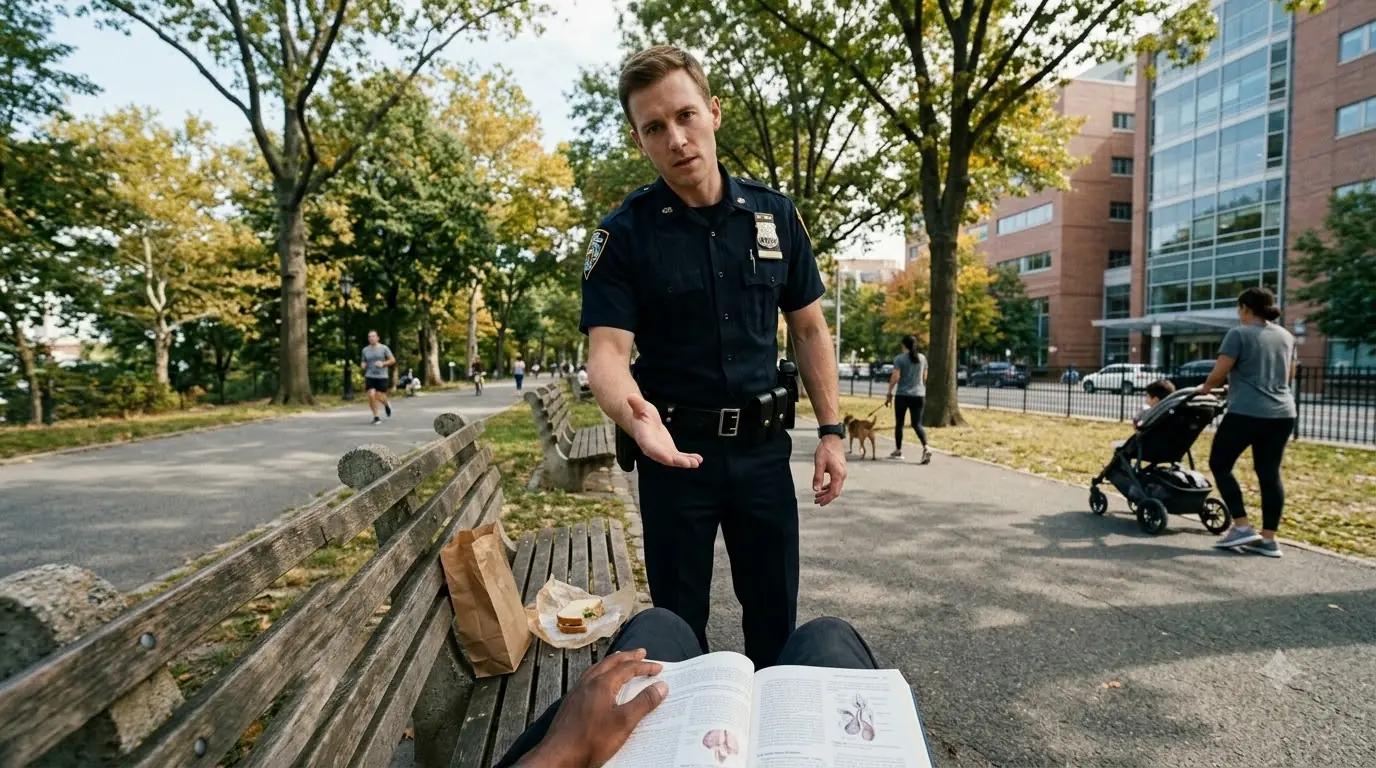
One hand rested near the radio clipped to his vest. The other hung beside his duty belt. A small red light on the body camera centered on his chest told Malcolm that everything was already being recorded.
Malcolm glanced at the turkey sandwich beside him, then at the open journal, then back at the officer.
“I’m sitting on a park bench reading during my lunch break,” he said. “What exactly is suspicious about that?”
The officer’s jaw tightened.
“Do you have identification or not?”
Malcolm studied him for another second.
Across the street, through a break between maple trees just beginning to turn orange, the glass facade of Riverside Medical Center reflected the September afternoon sun.
“I’m a psychiatrist at the hospital over there,” Malcolm said. “I eat lunch in this park almost every weekday.”
“I don’t care if you’re the president.”
The officer’s voice became sharper.
“ID. Now.”
Malcolm closed his journal.
That was when he understood this was not going to be a brief conversation.
And what Officer Nolan Prescott did not know was that the quiet Black man sitting in front of him had spent more than two decades studying police officers for a living.
Not from television.
Not from newspaper articles.
From across a desk.
From psychological testing.
From critical-incident interviews.
From hiring evaluations.
From fitness-for-duty assessments after shootings, complaints, emotional breakdowns, disciplinary incidents, and behavior that supervisors could not explain.
Malcolm Pierce had evaluated more than two thousand law-enforcement personnel during his career.
He knew what ordinary caution looked like.
He knew what genuine officer-safety concerns looked like.
He knew anxiety.
He knew fear.
He knew trauma.
And he knew what happened when a police officer confused authority with obedience.
At fifty-two, Malcolm had reached the point in his career where very little surprised him anymore.
He had spent twenty-three years in forensic psychiatry, much of that time working at the intersection of mental health and public safety. Three police agencies contracted with his practice for specialized evaluations, though he had always insisted on written independence clauses. If a department wanted someone who would simply approve every candidate placed in front of him, they could hire someone else.
Some departments appreciated that.
Some supervisors found him infuriating.
Malcolm had recommended excellent officers for return to duty after traumatic incidents when administrators wanted to remove them simply because they had sought counseling. He had also recommended against reinstatement when an officer demonstrated unresolved rage, severe judgment problems, dishonesty during evaluation, or an inability to regulate behavior under stress.
He had testified both for departments and against them.
He had been accused of being too sympathetic to officers.
He had been accused of being hostile toward them.
Usually by people who had read only the conclusion they disliked.
His answer was always the same.
“I don’t work for the result. I work for the assessment.”
Wednesday lunches in Riverside Park were how Malcolm escaped that world for forty-five minutes.
His office at Riverside Medical Center sat on the sixth floor of the behavioral-sciences wing. By noon, he had usually spent several hours listening to people describe some of the worst moments of their lives.
So, unless rain or winter temperatures made it impossible, he crossed East Madison Avenue, entered the park, and sat on the same dark-green bench near the river.
He had done that for almost eight years.
Hospital employees knew him.
The man selling pretzels near the southern entrance knew him.
An elderly retired teacher named Margaret often walked her terrier past his bench and complained jokingly whenever Malcolm brought the same turkey sandwich three days in a row.
Nothing about September 17 should have been different.
The weather was cool enough for a light breeze but still warm in the sun. Children were feeding ducks beside the pond. Two college students were studying under a sycamore tree. A maintenance worker was emptying a trash bin twenty yards away.
Malcolm wore tan khakis, brown loafers, and a pale-blue button-down shirt with the sleeves rolled neatly to his forearms.
His hospital identification badge was clipped to his belt.
His lunch bag sat beside him.
There was no alcohol.
No disturbance.
No argument.
No concealed object.
No behavior that would cause an ordinary observer to think a crime was taking place.
Officer Nolan Prescott noticed him anyway.
Prescott was twenty-nine and five years into his career with the Metropolitan Police Department.
On paper, he appeared unremarkable.
His evaluations from the academy had been average to above average. His firearms qualifications were solid. He had never discharged his weapon outside training. His annual performance reviews repeatedly described him as “proactive,” “energetic,” and “highly self-directed.”
His supervisors liked his activity numbers.
He made stops.
He initiated contacts.
He produced reports.
He was rarely the officer sitting in the cruiser waiting for dispatch to give him work.
There were two citizen complaints in his file.
One involved a college student who said Prescott had been unnecessarily aggressive while questioning him outside a convenience store.
The second came from a delivery driver who claimed Prescott had detained him for nearly fifteen minutes because his van was parked near a residential alley.
Both complaints were classified as unsubstantiated after short internal reviews.
No one had compared them.
No one had pulled Prescott’s stop history.
No one had examined whether his discretionary contacts showed any pattern.
Five years of data existed.
Nobody had asked the right question of it.
At 12:17 p.m., Prescott entered Riverside Park on foot patrol.
He later wrote that he had been monitoring the area because of “recent suspicious activity.”
That phrase would become important.
There had been theft complaints in the broader district during the previous month.