The asphalt of Route 58 began to tremble before anyone at the abandoned Texaco station could hear the engines.
At first, the vibration was so faint that fourteen-year-old Leo Miller thought another freight truck was moving somewhere beyond the dusty line of eucalyptus trees.
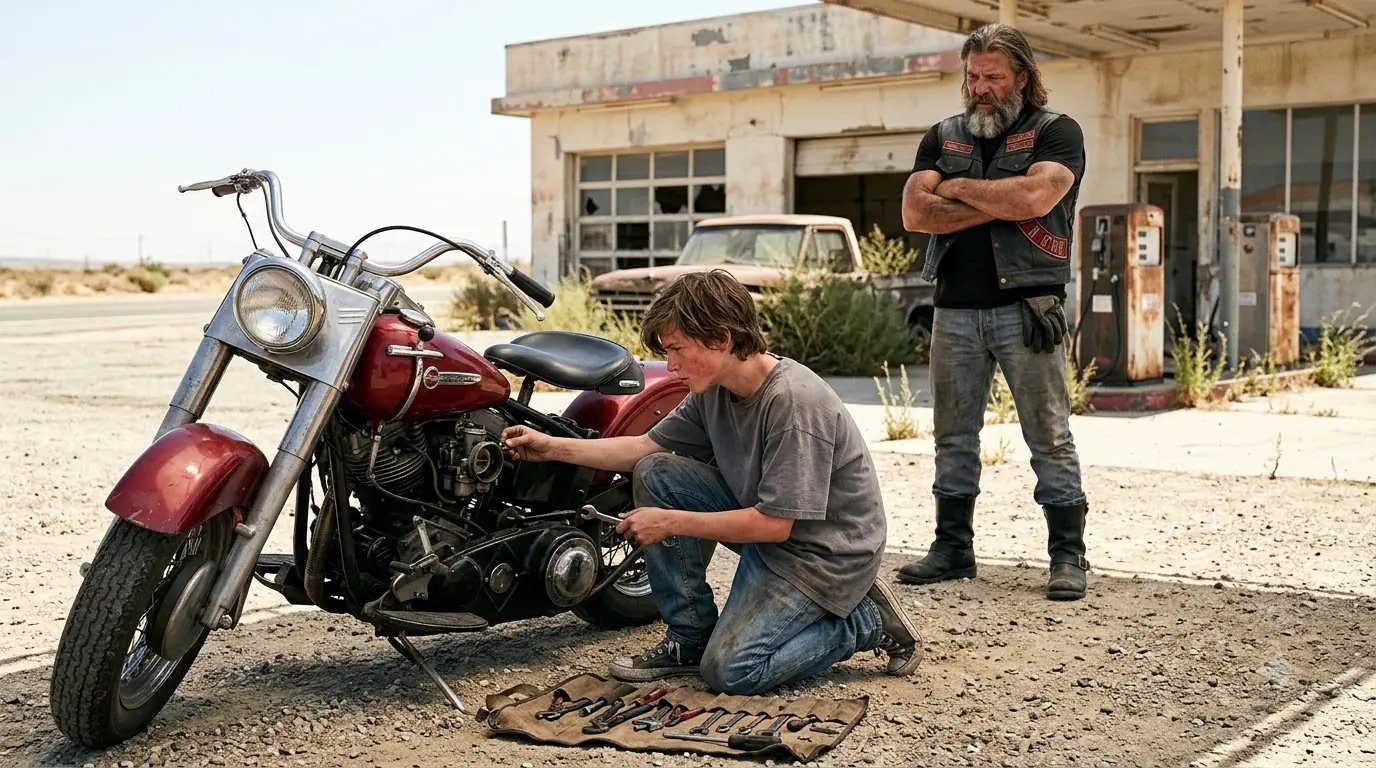
Then the rusted sheet metal above the old service bays started rattling.
A loose socket rolled across the cracked concrete floor.
John Callahan looked toward the highway.
“Here they come.”
Leo stepped out of the shadow of the garage.
The sound reached him a few seconds later.
Not one motorcycle.
Not ten.
Hundreds.
The low thunder rolled across the San Joaquin Valley until the dry California air itself seemed to vibrate.
Then the first headlights appeared around the distant curve.
Chrome flashed beneath the brutal morning sun.
Motorcycles stretched so far down Route 58 that Leo could not see the end of them.
Later, he would learn there were three hundred and twelve riders.
At that moment, numbers meant nothing to him.
What mattered was that for the first time in eight months, somebody had come back for him.
But to understand why three hundred and twelve motorcycles were descending on a forgotten gas station outside Bakersfield, you had to go back to the previous afternoon.
Before the engines.
Before the silver lighter.
Before Silas made the mistake that finally ended the little kingdom of fear he had built around the county’s runaways.
Before Leo Miller realized that being forgotten and being alone were not always the same thing.
The San Joaquin Valley heat had settled over the outskirts of Bakersfield like a lid.
The temperature had climbed past one hundred degrees before noon, and by early afternoon the abandoned Texaco station seemed to shimmer above the ground.
The building had been closed for nearly fifteen years.
Its red-and-white sign remained crooked above the highway, faded almost pink by the sun. The pumps had been removed, leaving concrete islands surrounded by weeds and broken glass.
Behind the boarded office stood two service bays.
One bay door had collapsed halfway inward.
The other still hung from rusted tracks.
That garage had been Leo Miller’s home for twenty-two days.
Home was a generous word.
He slept on a flattened refrigerator box beneath an old workbench.
His pillow was a sweatshirt rolled into a ball.
He had one blanket he had taken from a thrift-store donation bin and a plastic gallon jug he refilled from a service station restroom almost two miles away.
His possessions fit inside a school backpack and a faded canvas tool roll.
The tool roll mattered more than everything else combined.
It had belonged to his father.
Eddie Miller had been a diesel mechanic for almost twenty years.
He could rebuild a Caterpillar engine from memory, diagnose fuel problems by sound, and tell whether an alternator bearing was failing from the vibration it sent through a screwdriver held against the housing.
He was also terrible with money.
Jobs came and went.
Small shops closed.
Customers delayed payments.
Eddie would lend people money he did not have and repair cars for friends who promised to pay next Friday.
Next Friday rarely came.
Still, Leo had worshiped him.
Some boys remembered playing catch with their fathers.
Leo remembered standing on an overturned milk crate beside a diesel engine while Eddie pointed at components with a grease-blackened finger.
“Listen before you touch anything,” Eddie used to say.
“A machine will usually tell you what hurts if you shut up long enough.”
Leo had started handing him tools at six.
By nine, he could change brake pads.
At eleven, he could clean a carburetor.
At thirteen, Eddie trusted him to diagnose basic fuel and ignition problems before touching the vehicle himself.
Then, eight months earlier, Eddie died.
No warning.
No long illness.
One winter morning he complained that his chest felt tight.
Twenty minutes later he collapsed beside a customer’s pickup truck.
The paramedics worked on him in the shop.
Leo watched through an office window.
His father never came home.
Everything after that blurred together.
There was no mother waiting to take custody.
Leo’s mother, Melissa, had left when he was five.
For a while she sent birthday cards from Nevada.
Then Arizona.
Then nothing.
Eddie never spoke badly about her.
He only said some people were better at leaving than staying.
After the funeral, county social services placed Leo temporarily with a foster family.
They were not cruel people.
That almost made what happened more complicated.
The Bakersfield couple already had three foster children and two biological children.
Leo had a bed.
Food.
Clean clothes.
Rules.
What he did not have was his father.
At night he lay awake listening to another boy breathe across the bedroom and imagined Eddie’s tools sitting inside a storage locker the county planned to inventory.
One afternoon, Leo heard a social worker talking about long-term placement.
Another county.
Another school.
Possibly separating him from everything he still recognized.
He panicked.
At two in the morning, he packed his clothes, took Eddie’s canvas tool roll from the garage, and climbed through a bathroom window.
He had been running ever since.
At first, Leo stayed in town.
Bus stations.
Laundry rooms.
A twenty-four-hour diner where a waitress occasionally gave him fries she claimed had been made by mistake.
But adults noticed fourteen-year-old boys sleeping alone.
Police asked questions.
Security guards moved him.
Eventually he drifted outward toward the industrial edges of the city where abandoned buildings offered places to disappear.
That was where he learned about Silas.
Silas Ward did not own the streets.
He simply behaved as though he did until enough frightened people agreed.
He was thirty-eight, thin as electrical wire, with restless eyes and a face marked by years of hard living.
Silas controlled a loose group of men around an abandoned salvage yard near the frontage road.
They collected scrap.
Stole catalytic converters.
Sold drugs.
Bought stolen goods.
Most importantly, they preyed on people unlikely to call police.
Runaways.
Homeless adults.
Undocumented laborers.
Teenagers who slept under bridges.
If you occupied a building Silas considered part of his territory, eventually someone arrived to collect “rent.”