He Followed Her Into the Parking Lot — Then Got Right in Her Face
Reader Theme:
Font Size:
24px
The asphalt smelled of stale rain and old motor oil. He thought she was an easy mark, just a tired woman walking alone to her truck. He had a black belt, a bruised ego, and a desperate need to prove his dominance. He didn't know he was stepping into a meat grinder. The neon sign in the window of Patty's 24-hour hummed with a high erratic frequency.
It was a sound most people tuned out, but for Rachel, it vibrated right against the permanent tinnitus ringing in her left ear. She sat in the corner booth, her back flush against the faux leather vinyl facing the door. It wasn't paranoia, it was architectural conditioning. You don't spend 12 years kicking down doors in places where the map is just a suggestion without permanently altering the way you sit in a room. She pushed a cold greasy wedge of hash browns around her plate with the tines of her fork.
The diner smelled like bleached rags, burnt coffee, and the metallic tang of old cooking grease. It was 2:15 a.m. Rachel was tired, not the kind of tired that a full 8 hours of sleep could fix. It was a bone-deep cellular exhaustion. Her lower back ached with a dull rhythmic throb, a souvenir from a bad fast-rope descent off a Black Hawk 5 years ago. She took a sip of the coffee.
It tasted like hot dirt, but it was warm and the mug felt solid in her calloused hands. Two booths down, the atmosphere was souring. There were three of them, but only one was the problem. He was built like a fire hydrant, thick through the neck and shoulders, wearing a tight black athletic shirt that practically screamed his gym membership status. He smelled overwhelmingly of an aerosol body spray trying to mask the sour yeast of cheap draft beer.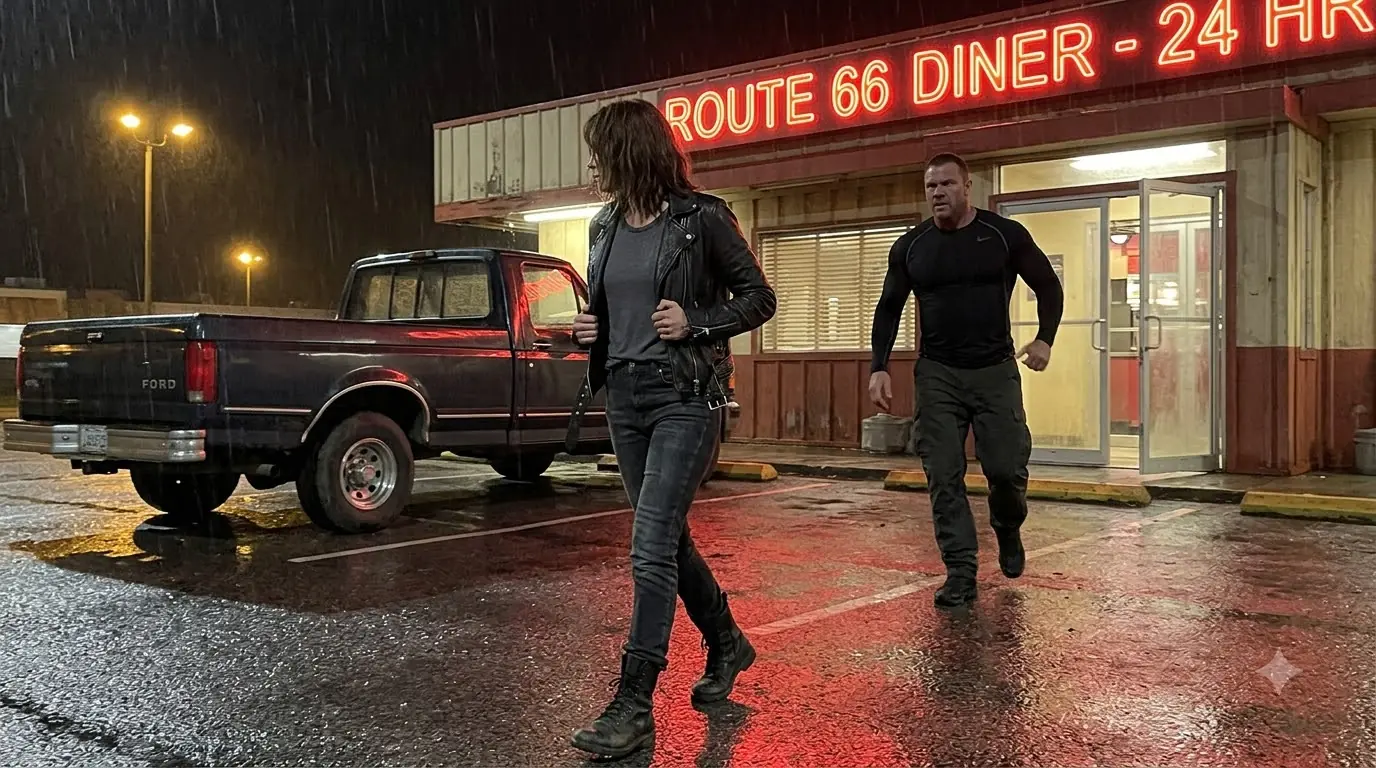
The waitress, an older woman with tired eyes and a name tag that read Nancy was standing at their table clutching her order pad like a shield. "I ordered the steak medium-rare." the thick-necked man said. His voice was too loud for the empty diner. It had that forced baritone of a man performing for an audience. "This is shoe leather.
Are you blind or just stupid?" Nancy shifted her weight looking exhausted. "I'm sorry, sir. The cook is alone back there tonight. I can take it back." "You're right. You can take it back," he sneered, leaning out of the booth and invading her personal space.
He reached out and tapped the clipboard in her hands, a sharp aggressive little gesture. "And maybe tell the guy in the back to do his job before I go back there and show him how." His two friends chuckled low and nervous. Rachel watched the interaction without turning her head using the reflection in the dark windowpane. She hated this. She hated the mundane predictable cruelty of insecure men.
She just wanted to eat her terrible hash browns, pay her tab and drive back to her empty apartment. The man pushed his plate toward Nancy. It slid off the edge of the table and shattered loudly on the linoleum floor. Gravy and ceramic shards exploded across the aisle. Nancy flinched stepping back.
"Oops," the man said, grinning. "Guess you got a mess to clean up." Rachel set her coffee mug down. The clack of the heavy ceramic against the Formica table was sharp. "Pick it up." Rachel said. Her voice wasn't loud.
It wasn't angry. It lacked any theatrical inflection. It was the flat deadened tone of someone who used to call in grid coordinates for danger-close artillery. It cut through the hum of the neon sign and the ambient noise of the kitchen. The thick-necked man stopped smiling.
He turned his eyes narrowing as he scanned the diner before landing on Rachel. He took in her faded flannel shirt, her messy dark hair pulled into a careless tie, the dark circles under her eyes. He saw a woman alone pushing 40. He didn't see the thick ropy muscle in her forearms or the way she was already calculating the distance between his booth and hers. "Excuse me?" he said, his voice rising as he pivoted his heavy shoulders toward her.
"You talking to me, lady?" "I am." Rachel said. She didn't look at him. She kept her eyes on her coffee mug. "Apologize to her, pick up the plate, and pay your bill." A heavy silence fell over the diner. Even the cook in the back seemed to have stopped scraping the grill.
The man let out a short incredulous laugh. He looked at his friend seeking validation, then back to Rachel. "Mind your own business,. You don't know who you're talking to." Rachel finally looked up. Her eyes were a pale, washed-out green.
They held zero emotion. "I know exactly what I'm talking to. It's 2:00 a.m. We're all tired. Pick up the plate." He stood up. He was tall, maybe 6'2", carrying about 220 lbs.
He puffed out his chest, stepping into the aisle. "Or what are you going to make me? I train 5 days a week at Vanguard MMA. I don't take orders from washed-up suburban moms." Rachel stared at him for a long, agonizing second. She felt the familiar cold drip of adrenaline hitting her bloodstream, a physiological response she had spent years trying to suppress.
It didn't feel empowering. It felt like a disease waking up in her veins. Instead of engaging, she reached into the pocket of her jeans, pulled out a $20 bill, and tossed it onto the table. "Keep the change, Nancy." Rachel said quietly. She slid out of the booth, grabbed her jacket, and walked toward the exit.
She didn't hurry. She kept her hands loose at her sides, her chin tucked slightly. She passed within 2 ft of the man. He tensed, ready for a confrontation, but she just walked past him a ghost drifting out the door. Yeah, that's what I thought, he barked after her.
His voice loud trying to reclaim the dominance he felt slipping away. Keep walking. Rachel pushed open the glass door. The night air hit her like a wet towel. It was drizzling a fine mist that clung to her eyelashes and chilled her skin.
The parking lot was poorly lit, the yellow sodium lamps casting long sickly shadows across the cracked asphalt. She heard the diner door chime open behind her before she even made it halfway to her truck. Gravel crunched under heavy work boots. The sound was hurried aggressive. Rachel didn't stop walking.
She breathed in the damp air letting the cold settle into her lungs. Don't do this, she thought, the internal plea aimed more at him than herself. Just go back inside. Eat your steak. Leave it alone.
"Hey, I'm talking to you." The voice was closer now, about 15 ft behind her right shoulder. Rachel stopped. She was parked under a burnt-out street light. To her left was a rusted dumpster, to her right a concrete retaining wall. The geometry of the space was tight.
Poor visibility, wet surface. She turned around slowly. He had followed her out. His friends were clustered by the diner door watching through the mist. The man closed the distance stopping about 6 ft away.
The aggressive body language was dialed up to 11 now. His fists were clenched, his jaw thrust forward. Up close the smell of alcohol and aggression was nauseating. You think you can disrespect me in there and just walk away? He demanded.
The mist caught in his close-cropped hair. "I think," Rachel said, her voice dropping an octave, "you're making a terrible mistake over a broken plate. I have a black belt," he said, stepping into her space, closing the gap to 3 ft. It was an intimidation tactic. He wanted her to flinch.
He wanted her to step back. "I've been on the mat for 6 years. I could snap your arm before you even know what happened." Rachel looked at him, really looked at him. She saw the way he stood bladed, but his weight was entirely on his front foot. His chin was up, exposed.
His hands were low, resting near his waist in a faux relaxed posture that arrogant fighters used when they thought their opponent was harmless. He was relying on mass and intimidation. He had learned violence in a padded room with rules, referees, and tap outs. Rachel had learned violence in mud compounds in Kandar, where the price of losing your balance was a knife in the throat. She had been attached to Naval Special Warfare Development Group.
She didn't just train with SEALs. She taught them how to survive when their primary weapons jammed and the fight ended up in the dirt. "Listen to me," Rachel said. She kept her hands open, palms facing him, held at chest height. A placating gesture to a civilian observer, a perfectly primed guard to a professional.
"This is your last warning. Turn around. Go back inside." He laughed a short, ugly sound. "Last warning from who? You?" He didn't wait for an answer.
His ego demanded a toll. He moved. It was a classic telegraphing street haymaker. He shifted his weight, dropping his right shoulder to load up power, aiming a sweeping arc right at her jaw. To his credit, it was fast.
For a drunk guy in a parking lot, it carried enough kinetic energy to knock an average person out cold. Rachel didn't see a fist. She saw a shift in mass. She didn't step back. Stepping back gave an attacker momentum.
Instead, she stepped in. She moved diagonally, a sharp mechanical pivot off the centerline, slipping inside the arc of his wide punch. The heavy fist whistled past her left ear, rustling her hair. Because he had put all his weight into the swing and hit nothing but damp air, his momentum pulled his body forward, completely compromising his balance. Rachel's right hand shot up, not a closed fist, but an open palm.
The heel of her hand struck the hinge of his jaw with a sickening wet crack. It wasn't a movie punch. It didn't send him flying backward. It snapped his head violently to the side, short-circuiting his vestibular system. His eyes rolled up toward the yellow parking lot lights.
Before his brain could even register the trauma, Rachel's left hand seized the collar of his tight black shirt, anchoring his weight. She drove her right knee upward in a vicious abbreviated arc. She didn't aim for the groin. She aimed for the common peroneal nerve on the outside of his right thigh. The impact sounded like a baseball bat hitting wet clay.
The man let out a high-pitched breathless squeak. His right leg simply ceased to function. The muscle violently spasmed, buckling beneath him. Rachel maintained her grip on his collar, using his own collapsing weight against him. As he dropped, she pivoted her hips and drove her forearm down onto the back of his neck, burying his face into the wet asphalt.
The entire exchange took less than 2.5 seconds. He hit the ground hard. The sound of his teeth clicking together echoed off the concrete retaining wall. He lay there pinned under the agonizing pressure of Rachel's knee resting casually between his shoulder blades. He was gasping a wet rattling sound, trying to suck in the cold air.
The smell of copper blood mixed with the wet pavement. Rachel didn't feel a surge of triumph. There was no righteous vindication. She just felt a profound heavy disgust. Her knuckles throbbed slightly.
The adrenaline was already beginning to curdle in her stomach, making her feel nauseous. "My leg," the man whimpered. The bass completely gone from his voice. It was the voice of a panicked child. "I can't feel my leg." Rachel kept her weight steady.
She leaned down, her mouth inches from his ear. "You're experiencing a severe contusion to the sciatic nerve," she said, her tone conversational, clinical. "It will feel like it's on fire for the next 3 days. Your jaw is likely fractured. Do not try to stand up." He groaned, spitting blood and saliva onto the asphalt.
The bravado had evaporated, replaced by genuine unadulterated terror. He didn't understand what had just happened. The math in his head, his size, his belt, his gym didn't equal his face scraping against oil-stained gravel. Rachel looked up. The two friends were still standing by the diner door, frozen like deer in headlights.
They made no move to intervene. Slowly, Rachel stood up. She wiped a speck of blood off her jacket sleeve. She looked down at the man groveling at her boots. "I told you," she whispered, her voice barely carrying over the sound of the rain.
"Last warning." She turned and walked the remaining 30 yd to her truck. She unlocked the door, climbed inside, and locked it behind her. She sat in the dark cab for a long time, listening to the rain tap against the windshield, waiting for her hands to stop shaking before she put the key in the ignition. The truck's heater smelled like burning dust and old dog hair, coughing lukewarm air against Rachel's damp face. She sat with the engine idling, her hands gripping the steering wheel so tightly her knuckles had turned a bloodless white.
The wiper blade scraped back and forth across the glass, squeaking violently every time they hit a dry patch. She didn't put the truck in gear, not yet. She couldn't. Violence is a high-interest loan, and biology always comes to collect. During the brief 2-second altercation, her sympathetic nervous system had flooded her body with cortisol and epinephrine.
It had dilated her pupils, shunted blood away from her digestive tract, and turned her muscles into high-tension steel cables. Now the threat was gone, and the withdrawal was brutal. Her hands began to shake. First, just a fine tremor in her fingers, then a deep structural shudder that traveled up her forearms and into her chest. Her teeth chattered, clicking together audibly over the rumble of the engine.
She leaned her forehead against the cold, hard plastic of the steering wheel and closed her eyes. She didn't feel like a victor. She felt like a stray dog that had been backed into a corner over a scrap of garbage. "I should have just kept walking," she thought, the familiar cycle of regret taking hold. "I should have let him throw the punch, let it glance off, take the hit, walk away." But she knew that was a lie.
You don't let a man with that much unchecked aggression land a free hit. You don't know if he has a weapon or friends willing to jump in, or if that one punch happens to catch the temple and turn out the lights permanently. Her training wasn't a switch she could toggle off. It was an operating system wired into her brainstem. Threat recognized, threat eliminated, minimum movement, maximum output.
She took a slow, jagged breath, tasting the stale diner coffee lingering in the back of her throat. When the shaking finally subsided to a manageable twitch, she dropped the truck into drive and pulled out of the lot. She didn't look in the rearview mirror. The drive home was a blur of blinking yellow traffic lights and empty rain-slicked intersections. Her apartment was on the second floor of a tired brick building on the edge of the industrial district.
It was the kind of neighborhood where people minded their own business because getting involved usually cost money or blood. She parked, climbed the rusted iron stairs, and unlocked her door. The deadbolt engaged behind her with a heavy, satisfying thunk. The apartment was sparse. A gray sofa, a small television she rarely turned on, and a bookshelf packed with dog-eared paperbacks and heavy dense volumes on human anatomy and kinesiology.
The air smelled of lemon cleaner and old drywall. It was cold, but she didn't touch the thermostat. Rachel walked straight to the kitchen sink and turned on the cold water. She scrubbed her hands with cheap dish soap, watching the suds spiral down the drain. Her right hand was stiff.
The base of her palm, where it had connected with the man's jaw, was flushed a dark, angry pink. By tomorrow, it would be a bruised, mottled purple. She dried her hands on a paper towel and walked into the bathroom. The fluorescent light flickered, casting a sickly green pallor over the mirror. She stared at her reflection.
She looked exactly how she felt, exhausted, hollowed out, carrying a weight that nobody else in the room could see. Her eyes, pale and flat, stared back without offering any comfort. She stripped off her damp clothes, letting them fall to the linoleum floor. Her body was a map of old violence. A thick, raised keloid scar ran across her left ribs.
Small, circular puncture marks dotted her left shoulder. She didn't look at them. They were just topography. She stood under the shower, turning the dial until the water was scalding hot. She let it beat against the back of her trying to melt the lingering ice of the adrenaline crash.
But the hot water only seemed to warm her skin. Her core remained cold, locked in that empty parking lot. Eventually, the water ran lukewarm, then cold. Rachel stepped out, toweled off, and put on a pair of heavy sweatpants. She lay down on her bed, staring at the shadows cast by the street lamp through her cheap blinds.
The silence of the apartment was oppressive. When you live your life at 100 miles an hour, navigating life or death variables, the complete absence of stimuli feels less like peace and more like sensory deprivation. Every time she closed her eyes, she heard the wet sickening crack of the man's jaw. She felt the heavy collapsing weight of him under her knee. She remembered the sound of his voice breaking, transforming from arrogant predator to terrified prey in the span of a single heartbeat.
She hadn't taught him a lesson. He wouldn't wake up tomorrow a better person. He would wake up in agonizing pain, humiliated, and he would likely take that anger out on someone smaller, someone who didn't know how to pivot off the centerline. Violence never really solved the root of the problem. It just transferred the trauma from one vessel to another.
Rachel rolled onto her side, pulling the heavy quilt up to her chin. She lay awake for 3 more hours, listening to the distant wail of a police siren fading into the rain, waiting for the sun to rise and wash the night away. Morning came without grace. It didn't break. It merely seeped through the cracks in the blinds, a gray flat light that made everything look covered in a fine layer of dust.
Rachel woke up with a dry mouth and a dull pulsing ache at the base of her skull. She sat up, the joints in her lower back popping in a staccato rhythm. She looked at her right hand. The heel of her palm was swollen, a deep ugly bruise blooming under the skin like spilled ink. She flexed her fingers.
They were stiff, the tendons protesting the movement. It wasn't broken, but it was going to make her day difficult. 45 minutes later, she pulled her truck into the gravel lot of Finch and Sons Custom Carpentry. It was a small operation housed in a cavernous corrugated steel building that smelled beautifully of pine sap, sawdust, and hot engine oil. This was Rachel's sanctuary.
Here the rules of the world made sense. Measure twice, cut once. Wood didn't have an ego. Wood didn't try to prove its dominance. If you applied the right pressure with the right tool, it yielded perfectly.
If you rushed it, it splintered. There was an honesty to carpentry that human beings completely lacked. She walked through the rolling bay doors. The air compressors were already humming. "Morning, Rach." Arthur Finch, a man who looked like he'd been carved out of an old oak stump, looked up from a massive planer.
He was in his late 60s, missing half of his left index finger, and possessed a quiet, steady demeanor that Rachel deeply respected. He didn't ask questions about her past. He just cared that her cuts were square and she showed up on time. "Morning, Arthur," Rachel said, her voice raspy. She walked over to her workbench.
A partially assembled cherrywood dining table sat in the center of her space. It was a beautiful piece, the grain rich and swirling. She ran her left hand over the unsanded surface. The texture was rough, raw, holding immense potential. She reached for her orbital sander with her right hand.
As her palm pressed against the hard plastic grip, a sharp spike of pain shot up her forearm. She hissed through her teeth, her grip faltering. The sander clattered onto the workbench. Arthur paused the planer. The sudden silence in the shop was heavy.
He wiped his hands on his canvas apron and walked over to her bench. He didn't say anything immediately. He just looked at her, his eyes dropping to her right hand, noting the swelling and the unnatural dark color spreading beneath the skin. "Hit a stud?" Arthur asked mildly. Rachel looked at her bruised hand, then up at Arthur.
She appreciated the out he was offering her. It was the easy lie, the civilian lie. "Something like that," Rachel said. Arthur nodded slowly. He reached into his apron pocket and pulled out a roll of heavy athletic tape.
He tossed it onto her workbench. It landed with a soft thud. "Ida, cherrywood is dense." Arthur said, turning back toward his machine. "Takes a lot of patience to smooth it out. If your hand's compromised, you'll dig the edge of the sander in, ruin the grain.
Tape it tight or switch to hand sanding for the detail work." "I'll tape it," Rachel said. "Take your time." Arthur said over his shoulder. "We aren't building a house on fire." Rachel picked up the tape. She bit the end off and began wrapping it around her wrist and palm, pulling it tight to compress the swollen tissue. The pressure felt good.
It stabilized the joints. She thought about the man from the diner. She wondered if he'd gone to the hospital. She wondered if the doctor had to wire his jaw shut. She tried to push the thought away, but it lingered a dark stain on her morning.
She picked up a block of sandpaper with her left hand, deciding to follow Arthur's advice and start with the manual detail work. She pressed the abrasive paper against the edge of the cherrywood, leaning her body weight into the motion. Scrape, scrape, scrape. The rhythmic sound grounded her. The smell of the cherry dust rising into the air was sweet and earthy.
She wasn't a hero. She knew that now definitively. When she was younger in uniform, the lines had seemed clearer. Bad guys, good guys. Protect the weak, eliminate the threat.
But the civilian world wasn't a combat zone. It was just a messy overlapping web of damaged people bumping into each other in the dark. Now, the man in the parking lot was an arrogant bully. But she was a weapon, an overpowered, highly calibrated instrument of violence that had been unleashed on a localized petty problem. The disparity of force bothered her.
It felt like using a sledgehammer to kill a mosquito on a glass table. The mosquito is dead, but the table is shattered. She pressed harder into the wood watching the rough edges slowly begin to smooth out under her steady methodical strokes. She couldn't change what she was. She couldn't unlearn the angles of vulnerability in the human body or forget how to break a man's balance before he even realized he was falling.
That knowledge was etched into her neurobiology as permanent as the scar tissue on her ribs. But as she ran her fingers over the newly smoothed edge of the table, feeling the transition from rough to flawless, she made a quiet promise to herself. She would keep to the shadows. She would keep her head down, drink her terrible coffee, and sand her wood. She would be the tool, not the weapon, until someone left her no other choice.
END
News in the same category
The Black Belt Shoved the Limping Handyman — Then He Stood Back Up
The Black Belt Shoved the Limping Handyman — Then Kept Mocking Him
He Caught the HOA President Beside His Internet Line
She Blocked His Rolls-Royce and Started Yelling
He Humiliated the New Officer in Front of Everyone
NEXT MOVIE: A Black Belt Publicly Humiliated the New Bus Driver — Then the Entire Depot Went Silent

A Cop Soaked a Black Woman in Her Own Yard — Then She Pulled Out Her Badge
A Black Belt Mocked the Quiet New Bus Driver — He Had No Idea Who He Was Challenging
NEXT : Karen's Spoiled Son Vandalized My Lamborghini — He Picked the Wrong Owner
CHAPTER2: Karen's Spoiled Son Vandalized My Lamborghini — He Picked the Wrong Owner
A Black Belt Mocked the Quiet New Bus Driver — He Had No Idea Who He Was Challenging

A Cocky Black Belt Bullied the New Bus Driver — Then Everything Changed

CHAPTER 2: A Cocky Black Belt Bullied the New Bus Driver — Then Everything Changed
CHAPTER 3: A Cocky Black Belt Bullied the New Bus Driver — Then Everything Changed
Black CEO Steps Into His Daughter’s School Cafeteria — Then One Sentence Makes Him Freeze
A Cocky Black Belt Mocked the Quiet Farmer Before Their Bet — Then His Hidden Past Changed Everything
Black CEO Quietly Enters His Daughter’s School Cafeteria — The First Words He Hears Change Everything
Old Black Mechanic Stops to Help 12 People in the Pouring Rain — Their Return Leaves Him Speechless