Her name was Harriet Voss, 74 years old. Hands that had kneaded bread dough for 50 years, raised three kids, buried a husband, and never once asked the world for anything it hadn't already given her. She had driven into Millhaven, Tennessee that morning to pick up her blood pressure medication from the pharmacy on Broad Street. She stopped at Laney's Diner because she always stopped at Laney's.
She had been stopping there since 1987. She ordered black coffee and a biscuit and opened the crossword puzzle folded neatly in her purse. That was all she wanted. Coffee. Biscuit. 45 across. The man who walked toward her was named Boyd Creel, 47, built like a refrigerator that had been left out in the rain too long, wide and rust-colored and slightly wrong at the edges. He ran Creel Land Holdings out of a glass-fronted office on the square.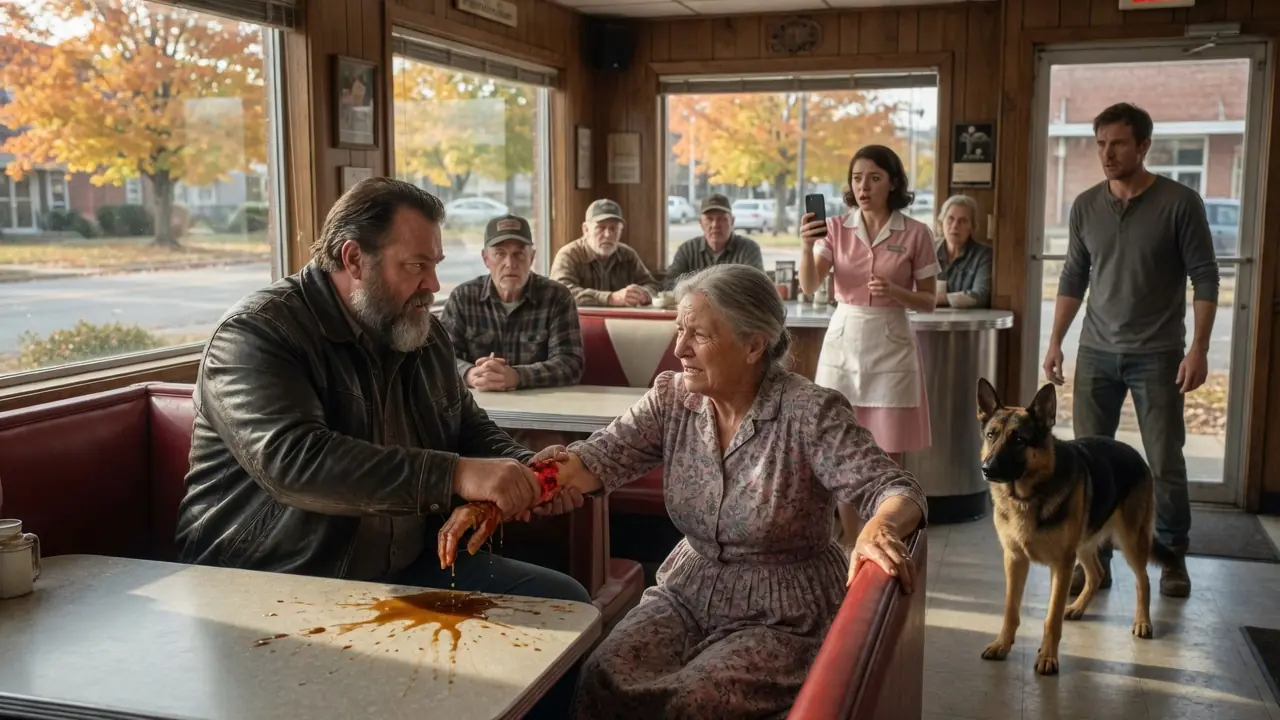
And in Millhaven, that meant he ran more than that. He had the county commissioner in his back pocket. He had the sheriff's department on speed dial. He had been buying up property along the Hatchie River corridor for three years.
And the only parcel he didn't have yet, the only one he needed to complete the deal with the resort developers out of Nashville, was a 14-acre tract on the south bend of the river. That tract belonged to Harriet Voss. Her late husband, Ray, had bought it 40 years ago. They had camped on it every summer.
Her grandson had learned to fish there. She had scattered some of Ray's ashes there quietly one morning before sunrise without telling anyone, it was not for sale. Boyd had sent letters, his lawyers had made calls. His associate, a wiry man named Cutler who wore too much cologne and smiled with only the bottom half of his face, had knocked on her door twice.
Each time Harriet had said the same thing. "Not interested, thank you. Goodbye. " She was polite about it.
She was always polite, but the answer was always the same. Boyd was no longer interested in polite. He stopped beside her table. He didn't sit, just stood there, filling the space, blocking the light from the window. "Mrs. Voss," he said. His voice was loud, casual-loud, the kind of loud that says, "I don't care who hears this. " "Funny seeing you here. " Harriet looked up from her crossword. "Good morning, Boyd. " She said it the same way she might have said it to anyone. Neutral.
Unhurried. Her pen didn't leave the paper. Something tightened in his jaw. "Still thinking about my offer? " he said. "Still not interested," she said. "Thank you. " Around the diner, forks slowed.
He pulled out the chair across from her without being invited and dropped his bulk into it. "That land's been assessed. It's worth maybe $110,000, $120,000 on the market. I'm offering you $200,000, Harriet.
For an old fishing lot. " "I know what you're offering," she said. "So, what's the problem? " She set her pen down.
She looked at him directly. Her eyes were gray and patient, the kind of gray that comes from decades of not being impressed by men who raise their voices. "The problem," she said, "is that it's not about money. " He stared at her for a moment, then he laughed, short, humorless. "Everything's about money," he said. "Not to me. " He leaned forward. His voice dropped, not softer, just lower, more deliberate. "You know what happens to people in this county who make things difficult? " Their property taxes get reassessed. Their permits get delayed. Their driveways get flagged for county easement violations. " He tilted his head. "You got a fence on the west side of your property, don't you? " "About 14 inches into the right-of-way. " "I'd hate for that to become a problem. " The diner had gone almost completely quiet now. Harriet did not look away. "Are you threatening me, Boyd? " "I'm educating you," he said.
She picked her pen back up. "45 across," she said quietly. "Eight letters. " "Abuse of power. " "I wonder what that is. " Boyd's face changed. He stood up fast, the chair scraping back hard against the linoleum. Every head in the diner turned.
The young woman behind the counter, Her name was Petra, 19, first week on the job, had already moved her hand toward her phone without fully deciding to. She pressed record. She didn't even think about it. It was just what you did when you saw something that wasn't right. "You think this is funny? " Boyd's voice had climbed. "You think I won't make your life miserable? " "You're an old woman alone on a county road, Harriet. " "You don't have anyone to call. " Harriet set her coffee cup down. She smoothed the front of her dress. She began to stand.
Boyd's hand came down flat on the table between them. A crack of sound that made three people flinch. The coffee cup jumped. Coffee sloshed over the rim and spread across the table and spilled hot onto Harriet's hand and wrist.
She gasped, pulled her hand back. The skin was already reddening. "Sit down," Boyd said. She didn't sit.
She was going to stand up and walk out with whatever dignity she had left because that was who she was. That was who Ray had loved. And no man was going to take that from her in Laney's Diner on a Tuesday morning. She pushed herself to her feet.
Boyd grabbed her wrist, the burned one, and yanked her back down. The sound that came out of her was small and sharp and involuntary. The sound of pain that couldn't be controlled. Her elbow hit the table edge.
She grabbed for the back of the booth with her other hand to keep from going down. The door opened. The bell above it made its small cheerful sound, entirely wrong for the moment. The man who came in was about six feet tall and moved the way water moves, without wasted effort, without sound, as if friction were something that happened to other people.
He wore a gray Henley and dark canvas pants and worn boots. His hair was short. His face was lean and still. He looked to be somewhere in his late 30s, though it was hard to say with certainty.
There was something about his eyes that suggested he had lived considerably more than 30-something years in the ways that counted. At his left side, on a short leather lead, walked a German Shepherd, black and tan, dense muscle under a thick coat. The dog's ears were up, its gaze moving across the room in one clean sweep, cataloging, assessing, filing. It didn't make a sound.
It didn't lunge. It simply walked in beside the man as if they were two parts of the same machine. The man's name was Ames Rutherford. He was 38 years old.
He was on 10 days' leave from a naval special warfare unit he was not allowed to discuss in public. He had come to Millhaven because his mother lived here. The dog's name was Bravo. Ames took in the scene in the time it takes to exhale.
His mother's burned hand. Her white-knuckled grip on the seat back. Boyd Creel's fist closed around her wrist. The faces of 11 other people in the diner arranged in an expression he recognized from every corner of every compromised place he had ever worked in.
Fear wearing the mask of stillness. He said very quietly to Bravo. "Post. " The shepherd moved without a visible signal.
He flowed forward between the tables silent and unhurried. And placed himself directly in front of Boyd Creel. He did not bark. He did not growl, not yet.
He simply stood there. seventy-eight pounds of absolute professional focus. And looked at Boyd with eyes that understood exactly what was happening. And had no uncertainty about it whatsoever. Boyd let go of Harriet's wrist.
He stepped back. He couldn't help it. Something in the hind part of his brain had received a message that his pride had not yet approved. And his feet acted on it before he could stop them.
Ames walked to his mother. He put one hand gently on her shoulder. "Mom. " His voice was different now.
Not the flat compressed tone he used for Boyd. Something warmer. "You okay? " She straightened.
Her eyes were watering not from grief. But from the pain in her wrist and hand. She would not let it show any more than it already had. "I'm fine. " She said, this is Boyd Creel. "He was just leaving. " Ames looked at Boyd for the first time. Directly, fully.
Without hurry. Boyd was a big man who was used to being the biggest presence in any room. What he saw in Ames's face was not anger. Anger he could have handled.
What he saw was assessment, cold, complete, entirely unhurried assessment. The kind of look a man gives something he is deciding what to do with. Boyd had never been looked at that way before, and he did not like it at all. "I don't know who you are," Boyd said, his voice trying to find its footing again. "Ames Rutherford," Ames said, "her son. " Behind the counter, Petra kept recording. Across the street, a young man named Ricky Beaumont, 22, back home from art school in Atlanta for the summer, trying to document small-town America for a documentary project, had been shooting through the diner's front window when the confrontation started. He had captured everything, including Boyd's hand hitting the table, the coffee spilling, the grip on Harriet's wrist.
His footage was clear, steady, and damning. He stood on the sidewalk now, not moving, watching through the glass as the man in the gray Henley stood quietly between his mother and the man who had hurt her, and he thought, "I don't know what this is yet, but I know I'm not going to stop filming. " Boyd pointed at Ames. "You need to take your mother home and stay out of county business. " Ames said nothing for a moment. He turned to Harriet. "Can you walk? " "Of course I can walk," she said, slightly offended. "Good. " He handed her the dog's lead. Bravo accepted the transfer without breaking his gaze from Boyd. "Hold him for me. " Then he turned back to "Boyd Creel," and he said, still in that same level, almost conversational tone, "You put your hands on her. " "I saw it. " "The camera behind the counter saw it. " "Whatever you came in here thinking today was, it's something different now. " Boyd Creel was not a man who had ever been told what something was. He was the one who decided what things "Get out of my face," he said. "I'll be at the sheriff's office in 20 minutes," Ames said. "I'll be filing an assault charge. " "I'll be providing witness statements and the video. " "If you have any interest in how this proceeds from here," "you should probably contact your attorney. " He turned away from Boyd without waiting for a response. He helped his mother to her feet.
He guided her toward the door, and as they passed the counter, he met Petra's eyes and gave her a single small nod. She was still recording. Outside, in the sharp October air, Harriet let out a long breath. Ames put her into the passenger seat of his truck, a navy blue F-250, dented on the rear quarter panel from a parking lot in Jacksonville three years ago, and examined her wrist and hand.
The skin was pink, beginning to blister slightly where the coffee had hit. He brought Bravo around to the back seat, then sat in the driver's seat without starting the engine. He took out his phone, not a consumer smartphone, something heavier, matte black, with a different kind of lock screen. He made a call. "It's Rutherford," he said when it connected. "I need to report a physical assault on a civilian family member. " "The assailant is a local land developer named Boyd Creel. " "Local law enforcement in Millhaven, Tennessee may be compromised. " "I'm looking into the relationship between Creel and the county sheriff's department before filing. " "I'm requesting NCIS liaison and a case monitoring flag. " He listened. "Affirmative, I have video from two independent sources. " "Will transmit when secure. " He ended the call. Harriet was watching him. She had known since he was 9 years old that her son had a different gear than other people.
She had just never quite seen it engaged from this close before. "What does that mean? " she asked. "Case monitoring flag. " "It means people who are harder to pressure than a county sheriff are now aware of Boyd Creel's name," he said. She was quiet for a moment. "He's been at this for months, Ames. " The letters, the calls, the man he sent to the door. "I know. " "He's connected to the commissioner and Sheriff Tatum. " "They went to high school together. " "I know that, too. " She looked at her hands in her lap. "I wasn't going to sell. " "I know, "Mom. " "I scattered some of Ray's ashes out there. " "By the big sycamore at the bend. " "I remember the sycamore. " She turned to look out the window. The town moved past, the pharmacy, the hardware store, the courthouse square with the bronze soldier she had walked past 10,000 times. "I'm not scared of "Boyd Creel," she said quietly. "I just wanted to drink my coffee in peace. " Ames put the truck in gear. "You will," he said.
While Ricky Beaumont was uploading the diner footage from his laptop back at his parents' house, his phone began ringing. The first call was from a friend in Nashville who had seen it shared on Instagram. The second was from a veterans support account on X that had already reposted it to 300,000 followers. By the time he set his phone down to shower, the video had 400,000 views.
The title he had used was simple. He had not agonized over it. Bully grabs elderly widow's burned wrist in TN diner. Watch who walks in.
By evening, it was being discussed on cable news. By the next morning, the words Millhaven, Tennessee and Boyd Creel were appearing in the same sentences as assault, land grab, and Navy SEAL's mother. In a paneled office on the second floor of a building on the courthouse square, Boyd Creel sat behind his desk and watched the number climb on his laptop screen. He picked up his phone and called the one man he always called when something needed to go away. "Tatum," he said when the sheriff picked up. "We have a problem. " Sheriff Dale Tatum was 53, with a face shaped by decades of small-town convenience, the convenience of being on the right side of the right people. He had been useful to Boyd for a long time.
Permits that moved fast, complaints that moved slow, a way of seeing that was very selective. He told Boyd to relax. He said the internet was always worked up about something, and in 48 hours, everybody would have moved on to the next thing. He said the son was just a soldier on vacation and would have to leave soon enough.
He said he would personally make sure any complaint filed was handled appropriately. What he meant by appropriately, they both understood without saying. Meanwhile, on the other side of town, a woman named Frances Ludlow watched the news in her kitchen. Frances was 61, a retired property attorney who had moved back to Millhaven after 30 years in Memphis to take care of her aging father.
She had her own history with "Boyd Creel," not personal, but professional. She had seen the deeds. She had seen the shell companies. She had seen the pattern of families who had sold quietly after a certain kind of pressure for prices that were just high enough to make the whole thing look voluntary.
She had been collecting documents for eight months. She hadn't known what to do with them. Every attorney she had spoken to quietly suggested that in McNairy County, certain things were complicated. Every reporter she had called had been politely interested and then not followed up.
She watched Harriet Voss on the screen and she recognized something in that woman's face, not fear, but a refusal to be made small. And she thought about the man who had walked in after. She found the video. She watched it twice.
She wrote down the name Ames Rutherford. Then she picked up her phone and called the number for Millhaven's one and only bed and breakfast where she had heard the son was staying while he looked in on his mother. Harriet answered at the house instead. Frances apologized for calling.
She said she knew it was forward. She said she had something that might be useful to Ames, to the situation, but that she needed to give it to someone she believed would get it to the right people. She asked if they could meet. Harriet was quiet for a moment.
Then she said, "Come for coffee tomorrow morning. " "Bring everything you have. " Ames had spent the night running a quiet perimeter around his mother's property, not dramatically, not with any visible equipment that would concern her, just walking the fence lines with Bravo in the dark, checking sight lines, confirming that the gray Dodge pickup that had driven past the house three times that evening had not stopped. He had found two things that bothered him.
A fresh set of boot prints in the soft mud beside the back fence, too deliberate to be a neighbor's, and the motion-activated light above his mother's back porch, which had been working fine the previous evening, was no longer working. Someone had unscrewed the bulb. He didn't tell Harriet. He replaced the bulb with one from a box in the garage.
He sat in the kitchen with Bravo at his feet and drank coffee and waited for morning. When Frances Ludlow arrived, she was a small, precise woman with reading glasses pushed up on her head and a canvas bag over one shoulder that was clearly very heavy. She sat at Harriet's kitchen table, accepted coffee, and began spreading documents across the surface with the methodical efficiency of someone who had once charged by the hour. She had everything.
Eight years of property transfers in a six-mile radius around the Hatchie River corridor, Creel land holdings and four shell companies, two registered in Delaware, one in Wyoming, one that circled back to an LLC with no public members, price histories that told a story, full market value for the first purchase, then declining offers to subsequent holdouts, then a clear acceleration of code violations and permit issues tracked against county records that showed the same inspector signing off on every Creel property, and the same obstruction pattern applied to every refusal. Then there was the money. Three payments totaling just under $40,000 from a holding company linked to Creel to a county account that had Sheriff Tatum's name on the authorized signatories. Not a campaign donation, not a vendor contract, a direct transfer.
Ames looked at the documents for a long time without speaking. Bravo lay at his feet, chin on his forepaws, watching the room. "You've had this for eight months," Ames said. "Yes," Frances said, "and you haven't been able to move it. " "No. " He looked up at her. "Because everyone you'd give it to is either connected to Creel or afraid of him. " "Or both," she said.
She met his eyes steadily. "I don't know who you are beyond what's on the news," "but your mother is the most stubborn woman I have met in 30 years of knowing Harriet Voss. " And the man I watched walk into that diner she paused. "He didn't look like someone who was afraid of Creel. " "I thought maybe he'd know what to do with this. " Ames looked back at the documents. He picked up one of the transfer records. He set it down.
He was quiet for a moment. The way he was quiet when he was not actually quiet, but running something through a system in his head that operated several tiers above what most people used for the same kind of problem. "I need to make copies of all of this," he said. "And then I need to make a call. " The call went to a contact at the FBI's Memphis field office. A woman named Garrison who had worked joint task force operations with NCIS and did not like Boyd Creel's type any more than Ames did for reasons that had nothing to do with Millhaven. He laid it out in about six minutes. The assault, the pattern, the payments, the property transfers, the sheriff's name on the account.
She was quiet for a moment. "You said the local LEO is compromised. " "Sheriff and at least two of his deputies are on Creel's payroll or have received payments from his connected entities," Ames said. "I have documentation. " "It's solid. " Another pause. "How solid? " "Attorney prepared. " "Eight months of records, not circumstantial. " A breath. Give me 2four hours. "Don't file anything locally. " "Already decided," he said. What happened in the next 48 hours did not look like what it was. No sirens, no tactical vests, no press conferences. Two vehicles, county-unmarked gray sedans, arrived in Millhaven on a Wednesday morning and parked in the lot behind the public library.
The agents inside them, four FBI, two NCIS, spent the first four hours doing nothing visible. They were reviewing documents, confirming chains of custody, building a picture that would hold up somewhere considerably less friendly to Boyd Creel than McNairy County. By mid-afternoon, they had what they needed for the first warrant. Boyd Creel was in a meeting with a Nashville developer, the same people who needed that 14-acre river tract to close their resort deal.
When two agents walked into his building on the square and asked his assistant to let him know they were there. He came out expecting to manage the situation. He had managed situations before. He was prepared with a name-dropping opening, a cooperative smile, a quick pivot to his attorney.
The agent who was waiting for him was a woman in her early 50s with the kind of calm that does not need to be performed. She handed him a federal warrant without preamble. He looked at it. The smile left his face in stages. "Boyd Creel," she said, "you are under arrest for extortion, wire fraud, and conspiracy to commit real estate fraud across multiple counties. " "You have the right to remain silent. " He had things he wanted to say, but the words had stopped working correctly. Across town, Sheriff Dale Tatum was still in his office when his own two agents arrived.
He tried the bluster first. Jurisdiction? Harassment? Small-town politics?
It died quickly when they placed the payment records on his desk and pointed to his name on the account. He went quiet after that. The arrest of a county sheriff is a particular kind of event in a small town. People come out of businesses and stand on sidewalks.
They don't cheer, exactly. They just watch with a kind of stunned provisional relief, as if they are seeing something they had started to believe was no longer possible. Petra, who had quit her job at Laney's the day after Boyd's visit, because the manager had asked her to delete the video, and she had declined and been told her services were no longer needed, was on the sidewalk outside the pharmacy when the patrol car came through. She watched it pass.
She took out her phone and filmed it. She didn't have many followers. She posted it anyway. Ricky Beaumont was there, too.
He had his camera. He filmed everything. He didn't know yet what the final shape of his documentary would be, but he knew it had a third act now. Frances Ludlow stood on the courthouse steps and watched with her arms folded and her reading glasses still pushed up on her head.
She had waited eight months for this. She had not let herself fully believe it was coming until she saw the car. Ames was not there. He was at his mother's kitchen table drinking coffee while Bravo lay in a strip of afternoon sun on the linoleum, and Harriet sat across from him working her crossword.
She filled in 45 across. She looked up. "Done? " she asked. "Getting there," he said. The weeks that followed were slow and thorough in the way federal investigations are slow and thorough when the evidence is solid and the agents in charge are not in anyone's pocket. Boyd Creel's four shell companies were unspooled one by one. The Nashville resort developers, who had not themselves broken any laws, but who had certainly benefited from the pressure campaign without asking many questions, withdrew from the project entirely and issued a quiet statement about their commitment to ethical business practices, which everyone read for what it was.
Three other families along the Hatchie River corridor, who had sold under the kind of pressure Frances had documented, were contacted by federal investigators. Two of them were told they had grounds for civil recovery. One of them, an elderly couple who had sold the farm they'd worked for 30 years after a season of code violations and a driveway flooding, that seemed to follow very specifically from a drainage alteration made to adjacent land, broke down on the phone with the investigator and said they had thought nobody would ever care enough to look. The county appointed an interim sheriff.
A municipal oversight board was formed. Frances Ludlow, to no one's particular surprise, was asked to chair it. At a community meeting held in the gymnasium of the middle school, about 200 people came. The interim county manager spoke.
The federal liaison gave a brief update. Francis gave a longer one. And at the end, when the floor was open for comment, a man stood in the back of the room. He was large, broad through the shoulders, going soft at the middle.
He was not wearing his company jacket. He had combed his hair. He held a piece of paper in his hands. His name was Cutler.
He was Boyd's associate. The man who had gone to Harriet's door twice with the offer she would not accept. He had not been charged with anything. He had not known about the payments to Tatum, or at least not the specifics.
He had thought they were doing hard-nosed business. He had told himself that every time he knocked on a door. He didn't read from the paper. He just held it and looked at the room. "I want to say something," he said. His voice was rough. "I'm not here to ask for anything. " "I'm just here to say I knew something was wrong and I kept working, and that's on me. " "I knocked on this woman's door. " He looked at Harriet in the third row. Twice. "And I knew it was wrong and I told myself it wasn't, and I went anyway. " "And I'm sorry for that. " "That's all. " He sat back down. The room was quiet.
Ames, sitting beside his mother in the third row, said nothing. He was watching Cutler the way he watched everything. With patience, without judgment, filing what he saw. Harriet put her hand on Ames's forearm. "Well," she said quietly, "that took something. " He nodded. "Yeah," he said. "It did. " The evening before Ames's leave ended, they sat on the back porch of Harriet's house. The Hatchie River was two miles through the trees, invisible but present in the sound of the nightjars and the smell of the air. Bravo lay at the edge of the porch steps and watched the dark with the specific professional attention of a dog who has never entirely clocked off. Harriet was wrapped in a blanket.
She had a mug of chamomile tea. She was looking at the sky. "You know I still don't fully understand what you do," she said. "What you actually do. " "I know," Ames said. "Ray always understood it, or said he did. " She smiled a little. "I think he mostly just trusted that you were good at it. " "I'm okay at it," Ames said. She turned to look at him. "You're being modest. " He didn't answer.
They sat in quiet for a while. An owl called somewhere out in the black line of trees. "The sycamore's still there," she said. "I went out last week before all this started. " "The ashes are long gone, of course, into the soil, into the river by now, probably. " "But the tree's the same. " He looked at her. "I wanted you to know that," she said. "That it's still there, whatever happens. " Ames looked out at the dark for a long moment. Bravo's ears moved at some sound too far off for a human to place. The dog decided it was nothing.
His ears went still. "I'll come back when I can," Ames said. "I know you will." She reached over and put her hand on his, the way she used to when he was young and had come home from somewhere hard and couldn't say where or why. "Thank you," she said. He didn't say it was nothing because it wasn't. He didn't say you're welcome because it felt too small. He said what was true. "You're the reason I know what's worth protecting," he said. Bravo got up from the steps and turned around and lay down again. This time with his head on Ames's boot, his eyes still open, still watching. And on the river, two miles away, the sycamore stood in the dark where it had always stood, rooted in the same ground that no one would be taking from Harriet Voss.
END