He Hit Her at the Wedding — Then the Biker Walked In
Reader Theme:
Font Size:
24px
A hand clamped over a woman's mouth and shoved her hard against a wall of hanging coats. Her heel caught on a garment bag and she went down onto one knee. A fist gripped the back of her hair and yanked her head up. She didn't scream. She'd learned long ago that screaming only made it worse.
Through the door she could hear music, laughter, 200 people raising glasses to a bride, her sister's wedding. And in a coat room 10 ft away, her own husband was pressing a thumb into the bruise on her jaw and telling her to smile. Her name was Delia Marsh and with her free hand she slid a phone from her sleeve and dialed the only number she trusted. Four words came out in a whisper. Can you come get me?
Now to understand how a woman ends up whispering into a phone in a coat room, you have to understand who she was married to. Delia had been married to Grant Ashford for 6 years and for most of those 6 years she had gotten very good at one thing. Hiding. She hid the bruises under long sleeves in July. She hid the flinch when a door slammed.
She hid the way she counted his drinks at dinner. 1 2 3 4 because four was the number where the man she'd married disappeared and someone else showed up wearing his face. And she got good at other things too. Reading a room the second she walked into it. Knowing from the way Grant set his keys down whether tonight was going to be quiet or long.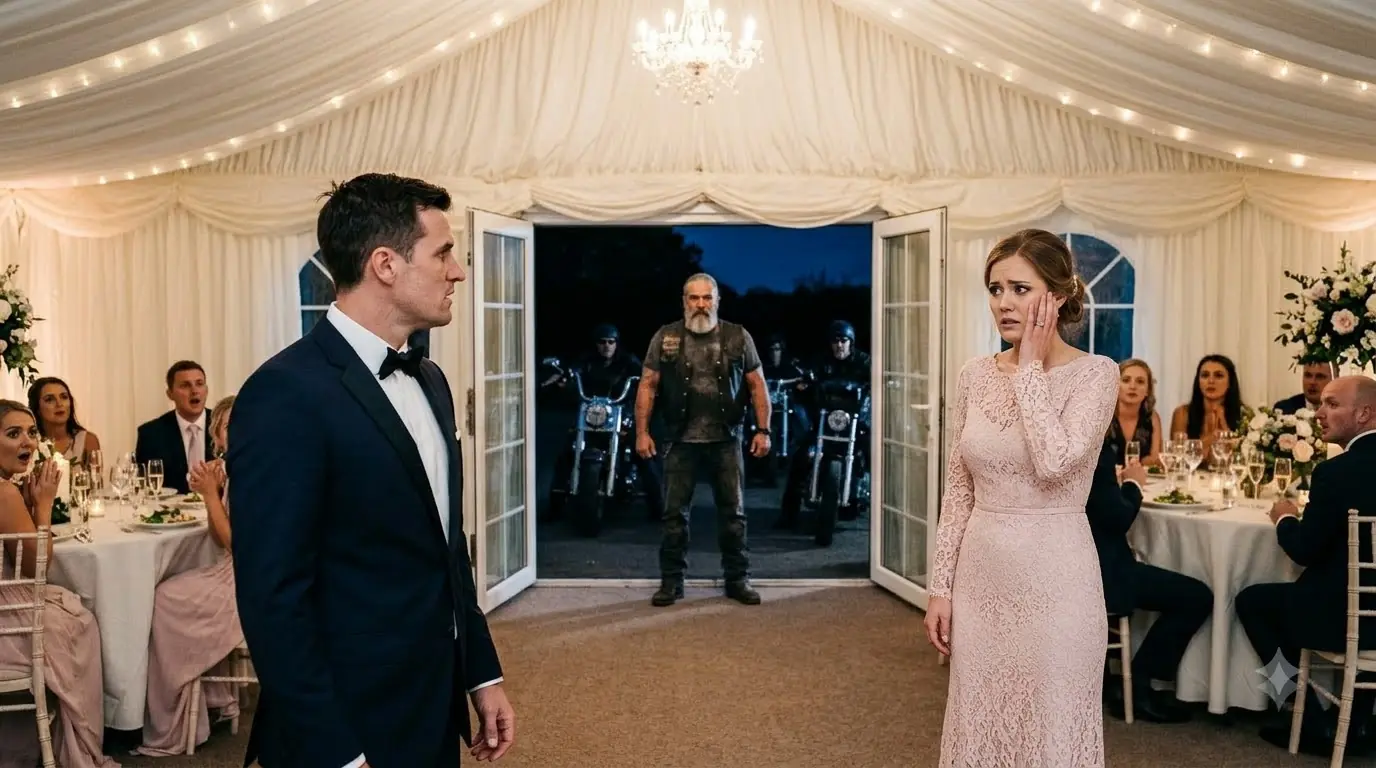
She could tell from across a parking lot what kind of mood he was in by the set of his shoulders. That's a skill nobody wants. It's the kind you only build in a house where the weather changes without warning and you're the one who gets rained on. The Ashfords were not the kind of people you accused of anything. Grant's father owned half the commercial real estate in the county.
His mother sat on three charity boards and knew every judge by their first name. His cousin Wade wore a sheriff's badge. When Delia had once, exactly once, tried to tell a doctor how she really got the cracked rib, the doctor smiled a careful smile and wrote down that she'd fallen on the stairs. Because that was the story the Ashfords wanted. And the Ashfords always got the story they wanted.
You have to sit with that. Because most people, when they picture an abused woman, picture somebody who just needs to walk out the door. They think, "Why doesn't she leave?" But Delia had done the math a hundred times. She had no money that Grant didn't control. Her name was on nothing.
Every friend she had left was really an Ashford friend. And if she ran, where did she run to? A courthouse where the judges played golf with her father-in-law. A sheriff's department where her husband's cousin carried a badge. That's not a marriage.
That's a country, and she was a citizen of it, and there was no border she could reach on foot. So, Delia stopped telling. She got smaller. She got quieter. She learned to live inside a marriage the way you'd live inside a house with a gas leak, moving slow, holding your breath, never lighting a match.
And she might have gone on like that forever if not for a dog. Here's the thing. About eight months before that wedding, on a cold morning when Grant was out of town, Delia found a stray in the alley behind her house. A pit bull. Gray, scarred, ribs showing, and one back leg twisted so badly it dragged.
Somebody had hurt this animal and left it to die. Most people would have walked past. Delia knew exactly what it felt like to be the thing somebody hurt and walked past, so she didn't. She got down on the cold concrete in her good coat and talked to that dog for 20 minutes before it would let her close. And the strange thing was, it wasn't afraid of her.
It was afraid the way she was afraid, watchful, braced, waiting to find out if the next hand coming toward it was going to help or hurt. When it finally laid its blunt gray head in her palm, something happened in Delia's chest that she didn't have a word for. She wrapped that dog in a beach towel, put it in the backseat, and drove it to a vet 40 minutes away where nobody knew her name. The leg couldn't be saved. It had to come off.
And the bill for all of it, the surgery, the antibiotics, the recovery, came to almost $2,000. Delia paid it in cash out of a coffee can she'd been hiding for 2 years. Escape money, she used to call it. Money for the day she'd finally leave. She spent every dollar of it on a three-legged dog she'd known for 6 hours.
And I want you to understand what that was. That wasn't charity. That was a woman handing over her only exit for a creature she owed nothing to. That's the kind of person we're talking about. That dog belonged to somebody.
It took her a week to find out who. The vet had scanned a chip. And the man who came to collect that dog was not what Delia expected. He was big. Military big, thick through the neck and shoulders, gray in his beard, a leather cut on his back with a patch that read Iron Veil, California.
He rode up on a motorcycle that sounded like the end of the world. His name was Cole Burke, though everyone called him Deacon, and he was the president of the local Hells Angels chapter. And when this enormous, terrifying man saw his lost dog limping toward him on three legs, alive, healthy, tail going like a metronome, he got down on his knees on the vet's clean floor and cried. Just cried. Delia stood in the doorway and watched a man the whole county was afraid of fall apart over a rescued animal.
The dog's name was Biscuit. Deacon had raised him from a pup and thought a truck had finished him off on the highway. Somebody had, in fact, hit that dog and driven away. Deacon never found out who. Not yet.
When he stood up, he took Delia's hand in both of his and said, "I owe you a debt I can't pay." And she said what everyone says, "It was nothing. Anybody would have done it." And Deacon looked at her a long moment, at the sleeves in July, at the way she stood angled toward the exit, at how she'd flinch just slightly when he first raised his voice with joy. He'd spent his whole life reading people. He knew what he was looking at. And he said something she never forgot.
"No, not anybody. And here's my number. You ever need somebody, any hour, you call me. I don't care what it's about. I come." She never planned to use it.
A biker's phone number in a domestic abuse survivor's pocket is not a plan. It's a fantasy. But she kept it. She wrote it inside the cover of a paperback where Grant would never look, because Grant didn't read. And on the day her baby sister Nora got married in a garden outside Sacramento, when Grant hit four drinks by 2:00 in the afternoon and dragged her into that coat room and put his thumb in her bruise and told her to smile for the cameras, Delia Marsh finally lit the match.
She dialed the number. And on the other end, a gravel voice picked up on the second ring and said one word. Deacon. Now here's where it turns. Dealia got exactly four words out.
Can you come get me? That was all because Grant's hand came back over her mouth. But Deacon didn't need more. He didn't ask questions. He didn't say calm down.
He didn't say who is this or the thing everybody says, are you sure? He said, keep this line open, put the phone in your pocket, don't hang up, and where are you? She managed to gasp the name of the venue before Grant tore the phone from her hand and looked at the screen and saw a call still running, timer ticking, no name on it, just a number. And Grant smiled because Grant thought a nobody was on the other end of that line. He shoved the phone in his own pocket.
Big mistake, though nobody knew it yet. He grabbed Dealia by the arm and marched her back out into the reception like nothing had happened. His fingers digging into the exact spot on her upper arm where the last set of bruises hadn't even faded. Smile, he whispered into her hair, loud enough for love, soft enough for threat. Your sister's big day.
Don't ruin it. And Dealia smiled. God help her, she smiled because that's what six years teaches you. She stood by the cake table and smiled while her whole body shook. Somebody handed her champagne and she held it and didn't drink.
A cousin she barely knew told her she looked beautiful and she said thank you. Every muscle in her face was doing a job and behind it she was screaming and not one person in that tent could hear it. Nora, the bride, caught her eye across the tent and mouthed, you okay? And Dealia nodded because the alternative was a scene and a scene meant the Ashfords and the Ashfords meant Wade with his badge and around and around it went, a cage with no door. What Delia didn't know was how far away Deacon was when she called.
The answer was 11 miles. And what she definitely didn't know was that Deacon was not alone. It was a Saturday. The chapter was gathered at the clubhouse for a run they'd planned all week. 14 bikes gassed and ready.
When Deacon walked out with his phone still live in his hand and his face gone to stone, his road captain took one look and said, "What do we ride for?" And Deacon said, "A friend." And that was enough. Nobody asked another question. That's a thing about that kind of loyalty. It doesn't ask for a reason. It just asks which way.
He clipped Biscuit's harness into the sidecar the way he always did because the dog went where he went. And the dog had earned a spot at the front of anything the day he learned to walk again. Then Deacon threw a leg over his bike. 14 engines came alive at once, and the sound rolled out over that quiet suburb like a storm you could feel in your teeth. 11 miles.
Deacon made it in 9 minutes. And Delia, standing by the cake, heard it before she saw it. Everyone did. 200 wedding guests in their linen and their pearls, forks halfway to their mouths, all turning at once toward a sound none of them could place. A low thunder growing, getting closer.
Rattling the champagne flutes on the tables. The string quartet lost their place and trailed off into silence. And then, over the white fence at the edge of the garden, the guests saw them come. A line of motorcycles, chrome flashing, rolling up the long private drive of the most exclusive venue in the county. And at the front of them all, a gray-bearded giant with a three-legged pit bull sitting up straight in the sidecar like a king surveying his land.
The bike stopped at the edge of the lawn. The engines cut one by one until the silence that came after was the loudest thing anyone at that wedding had ever heard. Deacon stepped off. He didn't storm the tent. He didn't shout.
He just stood at the edge of the grass, found Delia's face in that crowd of 200 and lifted his chin the smallest amount. A question. You called, I came. You okay? And Delia felt something break loose in her chest that had been welded shut for six years.
She walked. Straight across that lawn in front of everyone, past the cake, past her mother-in-law's open mouth, past Grant's outstretched hand, and she didn't stop until she was standing next to a Hell's Angels president and his crippled dog. Biscuit leaned out of the sidecar and pushed his big blunt head into her hand. And she knelt down and put her arms around that dog's neck, and for the first time in years, exhaled all the way to the bottom. Deacon crouched beside her.
"Somebody got a water for you," he said quietly, and one of his guys was already there with a bottle cracked open held out. Delia took it. She sat down right there on the grass in her good dress and drank the cold water and her hands finally finally stopped shaking. It was over. She'd walked out.
200 people had watched her do it. "He can't touch me now," she thought. "Not in front of all these witnesses. Not with 14 bikers standing here. It was over.
It was not over." Grant's mother reached the microphone first. That was the trigger, though it didn't look like one. Adelaide Ashford, silver hair, silk suit, a voice that had run charity galas for 30 years, picked up the wireless mic the DJ had set down, tapped it twice, and said in a warm, sad, caring voice, "Please, everyone, don't be alarmed. My daughter-in-law is not well, and just like that, the whole thing changed. See, up to that second, Delia had thought she was fighting one man, a husband, a fist, a thing you could run from, but Adelaide Ashford didn't raise a fist.
She raised a story. She stood at that microphone in front of 200 people and told them with tears in her eyes that poor Delia had been struggling for years. Depression, delusions, offer medication again. She spins these stories, Adelaide said dabbing at her eyes, she imagines things, she runs off with strangers, we've been so worried, we didn't want to spoil Nora's day. And she was good at it.
That's the part that turned Delia's stomach. Adelaide had done this before, maybe not this exact thing, but the shape of it, the concerned voice, the loving frown, the way she made cruelty sound like worry. And then Wade, the cousin, stepped forward. The badge on his belt caught the sun, and he said in his flat cop voice, "Ma'am, I'm going to need you to step away from those individuals for your own safety. You feel that?" The whole nature of it just flipped.
It wasn't a husband and a fist anymore. It was a family with a microphone and a badge and a story, turning 200 witnesses from Delia's protection into Delia's jury. Every face that had watched her walk to safety was now watching a sheriff's deputy call her unstable, and you could see them start to buy it. Because who do you believe? A grieving mother in silk or a woman kneeling in the grass hugging a pit bull next to a gang of outlaw bikers?
The witnesses she'd counted on had just become the trap. And that's the cruelest trick in the whole book, the one the powerful use every single time. They don't fight the truth. They just make the truth look crazy. And Wade wasn't done.
He looked right at Deacon and said, "And if this club doesn't clear off private property in the next 2 minutes, I'll have every one of you booked before sundown." He had it all. The badge, the story, the crowd, the law. Grant stood behind his mother with his arms crossed and that smile back on his face, the four-drink smile, because Grant knew how this ended. This was how it always ended. The Ashfords always got the story they wanted.
Delia felt the ground open under her. She looked up at Deacon and the shame just poured off her. And she started to say, "I'm sorry. I shouldn't have called you. You should go.
I'll be fine." Because that's the other thing 6 years does. It teaches you to apologize for your own rescue. She was already halfway to her feet. Already reaching for the version of herself that made everything smaller and quieter. Already ready to hand herself back over just to keep the peace.
Deacon did not clear off. He did not raise his voice. And most of all, he did not raise a fist, which is the one thing every single person on that lawn was braced for. 200 people were holding their breath waiting for violence, because that's what they'd been told a man like him was. Adelaide wanted it.
Grant wanted it. A swing from an outlaw biker would have proved every word they just said. Instead, Deacon reached slowly into the inside pocket of his cut, keeping his hands where the deputy could see them, and pulled out a phone. Not his phone. A cheap prepaid phone.
And he held it up over his head so the whole crowd could see it. Then he said, in a voice that didn't need a microphone, "Deputy, before you arrest anybody, I want you to hear something. And I want all these good people to hear it, too. Because a woman just told me she wasn't well. Let's find out who's telling the truth." He tapped the screen.
And out of that little speaker, turned up all the way, came a sound that rolled across that silent garden and stopped every heart in it. It was Grant's voice. Recorded 11 minutes earlier in the coat room on the open line Delia had left running in her pocket. The line Grant himself had grabbed and shoved into his own jacket, still recording the whole walk back to the reception. Everybody heard it.
They heard the thud of a body hitting a wall of coats. They heard Grant's voice, low and ugly and drunk, say, "You're going to go out there and you're going to smile, or I swear to God I'll finish what I started in the car." They heard him say, "Nobody's going to believe a crazy woman over me. They never have." They heard the sharp gasp of a woman in pain. And then they heard four whispered words that half of them recognized because they'd watched her mouth them across the tent. "Can you come get me?" The garden went so quiet you could hear the fountain running.
And here's what that recording did that a punch never could. It didn't just prove Delia, it proved Adelaide a liar in the same breath. Because the crowd had heard Adelaide 2 minutes earlier call this woman delusional, call her a spinner of stories. And now they were hearing the story and it wasn't in Delia's voice at all. It was in Grant's.
He'd written his own confession and handed it to her without knowing. Adelaide's face fell apart in real time. Wade took a step back because Wade was a lot of things, but he wasn't stupid. And he understood in that instant that there were now 100 phones out in that crowd recording him. And that whatever he did in the next 30 seconds was going to define the rest of his career.
And Grant, Grant lunged for the phone and that was the second mistake because the moment Grant moved, Biscuit came up out of that sidecar. Now understand that dog had been calm the whole time, sitting like a statue. But when Grant lunged, the dog stood up on his three legs, every hair on his back went up. He pulled his lips off his teeth and made a sound nobody who heard it will ever forget. Not a bark, a memory because Biscuit knew that voice.
Biscuit knew that smell. And Deekon, who had spent 8 months wondering who hit his dog and drove away, saw the way his animal reacted to Grant Ashford and he went very, very still. He looked at Grant. He looked at the dog. He looked at the twisted stump where a leg used to be.
And he said, quiet enough that only the front rows caught it, but they caught it. It was you. You're the one who hit my dog off Grand Vista Road 8 months back, gray pit in the road and you didn't even slow down. He wasn't asking. He could see it in the dog.
And Grant, drunk and cornered and stupid, sneered and said the last free words he'd get to say for a long while. It was a dog. Who cares? Deacon didn't hit him. I want to be really clear about that because everybody expected it and it never came.
Instead, Deacon turned to the deputy, held out the prepaid phone, and said, "Deputy Ashford, I believe that recording is evidence of felony domestic violence, terroristic threats, and animal cruelty. There's 200 witnesses and 100 cameras. Now you can arrest your cousin or you can arrest me for standing on grass. But whatever you choose, the whole internet's going to watch you choose it. Your call." And here's the thing about a man like Wade.
When the story flips, so does he. Wade looked around that garden at all those phones, at all those faces that had heard the truth come out of a speaker, at his Aunt Adelaide who had just been caught on video calling an abused woman crazy, and Wade did the math. He unclipped the cuffs off his belt, walked past Delia, put them on Grant Ashford's wrists, and read him his rights in front of 200 wedding guests, and the bride, and the cake, and the whole silk and pearls Ashford dynasty. And there wasn't a single thing Adelaide could do but sit down in the grass in her silk suit and stop pretending to cry. But the folder was the part nobody saw coming.
Because Deacon reached into the other side of his cut and pulled out a worn manila envelope, soft at the corners from being carried a long time, and handed it to the deputy and to two attorneys who happened to be wedding guests and had already come forward. Inside was eight months of something. Dated photographs of Delia's injuries, the ones she'd let a women's advocate photograph in secret. A vet's sworn record of a pit bull with a leg destroyed by a vehicle strike on the exact date and road Grant just admitted to. Statements, records, a whole quiet case built patiently waiting for a day like this one.
See, Delia thought that number in the paperback was a fantasy, but Deeken had never treated it as one. From the day he shook her hand in that vet's office and read the sleeves in July, he'd started getting ready quietly. The way you set aside water and a flashlight for a storm you're sure is coming. The Iron Veil chapter, it turned out, had been sponsoring a domestic violence shelter two towns over for 11 years. Quietly.
No press. They escorted survivors to court. They stood in parking lots so women could get to their cars. They were, a lot of them, men who'd grown up watching their own mothers get hit and had decided the one thing they'd do with their scary reputations was point them at the right people. Delia hadn't just called a biker.
She'd called the one man in that county who'd spent his whole life getting ready for exactly this phone call. And that's what the whole wedding party watched him do. Not throw a punch. Raise a phone, raise a folder, and raise the truth so high that not even the Ashford name could bury it. Grant went into the back of Wade's cruiser with cake still on the tables.
Adelaide's charity boards would ask for her resignation by Monday. And the story the Ashfords always got to tell, the one about the stairs, about the medication, about the crazy woman, died right there on that lawn in front of everyone who'd ever believed it. Now let me tell you how it ended, because the arrest is not the ending. The arrest is just the part where the danger stops. The ending is quieter than that.
Delia didn't leave with the bikes, not that day. Her sister Nora, the bride, walked across that ruined reception in her white dress, mascara everywhere, and she didn't say a word about the wedding being wrecked. She just wrapped her arms around Delia and held on and said, "Over and over, I didn't know. I'm so sorry. I didn't know." And Delia held her sister and said the truest thing she'd said in 6 years, "I didn't let you know.
That's on me." Not you. And the two of them stood there in the wreckage of the most expensive wedding in the county. And for the first time in a long time, Delia felt like somebody's sister instead of somebody's secret. The Ashfords tried, of course. Money always tries.
There were lawyers in the weeks that followed and threats, and a brief, ugly attempt to file for custody of Delia's 4-year-old son, Sam. But you cannot unring a bell that 200 people heard. That recording, Grant's own voice, played in a courtroom just like it played in that garden. Grant Ashford took a plea. Felony domestic violence, criminal threats, and yes, animal cruelty.
Because Deacon made sure that charge stayed on the sheet, and the district attorney, with the whole county watching, was not about to make it disappear. He would not be putting his hands on anyone for a good long while. Delia got the house, though she didn't want it, so she sold it. She got full custody of Sam. And she got something she hadn't had since she was a girl, which was a full night's sleep without listening for a key in the door.
She moved two towns over near the shelter. And this is the part I like. She took a job there. Turns out a woman who spent 6 years learning every trick for hiding bruises and reading a room and knowing exactly when the fourth drink lands. That woman is worth her weight in gold to the next scared woman who walks through the door not knowing if she'll be believed.
Delia believes them. Every time. Before they even finish talking. And Deacon. Deacon didn't ride off into legend and vanish the way they do in the movies.
He showed up. He fixed the shelter's back fence one weekend with three of his guys and a truck full of lumber. He taught Sam how a motorcycle engine works laid out on a blanket in the shelter's little yard. And that boy who'd grown up flinching learned that a big man with tattoos and a gray beard could be the safest thing in a room. Chosen family, people call it now.
Delia just calls them her people. Biscuit, that three-legged dog who started all of it, lived another five good years and he spent most of them riding shotgun in that sidecar and sleeping in the sun outside the shelter door where the kids could find him. The dog Grant Ashford hit and left in the road became the most loved animal in three counties. There's a lesson in that somewhere. I think it's this.
The thing you throw away, the thing you decide doesn't matter, has a way of coming back around and standing between you and everything you thought you'd get away with. People always ask about that moment on the lawn. What made it work? And they want it to be the bikes or the size of the man or the fear, but it wasn't. 14 bikers didn't save Delia Marsh.
A punch would have handed the Ashfords exactly the story they wanted, the violent outlaw, the deputy justified, the crazy woman dragged off by criminals. Deacon knew that. That's why he never swung. What saved her was that when the whole world was ready to call her a liar, one man raised the truth up over his head where nobody could pretend not to see it. And he let 200 people decide for themselves who was really not well.
Think back to how this started. A hand over a woman's mouth. A voice telling her to smile or else. Six years of a woman who wasn't allowed to make a sound. And then think about how it ended.
That same woman standing in a courtroom reading her own statement out loud in a clear steady voice. While the man who told her to be quiet sat there and had no choice but to listen. She didn't whisper it. She said it so the back row could hear. That's the whole story really.
It's the story of a mouth getting uncovered. There's a photo somebody took that afternoon, before the deputy, before the folder, in the one quiet minute when Delia first crossed the lawn. It's just a woman kneeling in the grass with her arms around a battered old dog and a big man crouched beside her holding out a bottle of water. You can't tell looking at it that it's the bravest thing either of them ever did. Delia keeps it on her desk at the shelter.
When a new woman sits down across from her, terrified certain nobody will believe her, sometimes Delia just turns that photo around and lets her look at it. And she says the same thing Deacon once said to her in a vet's office. The words she wrote inside a paperback and carried for eight months like a lit match in her pocket. You ever need somebody, any hour, you call, I come. And that's not a line for a pillow.
That's not a wise saying. That's just what people do, the real ones, when somebody they'll never owe anything picks up the phone and says four small words into the dark. Can you come get me? The whole thing, the bikes, the badge, the truth held up over a stunned garden, all of it lived or died on whether one person hearing those four words decided to drop everything and go. Deacon went.
He always would have gone. And a county that spent years afraid of the wrong man finally found out on the day of a wedding exactly what he'd been saving all that fear for.
END
News in the same category

The Black Belt Mocked the Old Man — Then He Stepped Onto the Mat
The HOA Woman Smashed His Chicken Coop — Then the Old Farmer Came Running
Three Thugs Shoved the Old Mechanic — Then He Stepped Between Them and the Fighter
Six Men Surrounded the Old Biker — Then One Stranger Stepped Out of His Truck
They Slammed the Old Biker to the Floor — Then the Room Heard His Name
Max and Shadow’s Recovery After Waiting Together for Their Owner
Two Cops Stormed Into Her House — Then Someone Hit the Front Porch
The Officer Dragged the Elderly Woman Toward His Patrol Car — Then Someone Started Recording
Koda’s Journey After Waiting for a Family at the Shelter
They Started Towing His Work Truck — Then the Owner Came Running Out
Black CEO Enters His Daughter’s School Cafeteria — What He Hears Makes Him Freeze Instantly
Martial Artist Mocked a Quiet Black Woman in Front of 600 People — Until Her True Skill Left Him Stunned
The Officer Dragged Him Out of the Gala — Then the Entire Room Went Silent
The Black Belt Shoved the Old Man — Then He Stepped Onto the Mat
She Tried a “Master Key” on His Truck — Then the Owner Walked Outside
The Old HOA Lady Called Her Yard a Disaster — Then a State Vehicle Pulled Up
Boxer Dares a Black Janitor to Evade His Punch — Seconds Later, He Learns He Once Ruled the Ring

NEXT VIDEO: A Cocky MMA Fighter Bet an Old Farmer $500 He Couldn't Last 3 Minutes — Biggest Mistake of His Life