The safety on a service pistol makes a sound you never forget.
A small mechanical click.
Barely louder than a fingernail tapping glass.
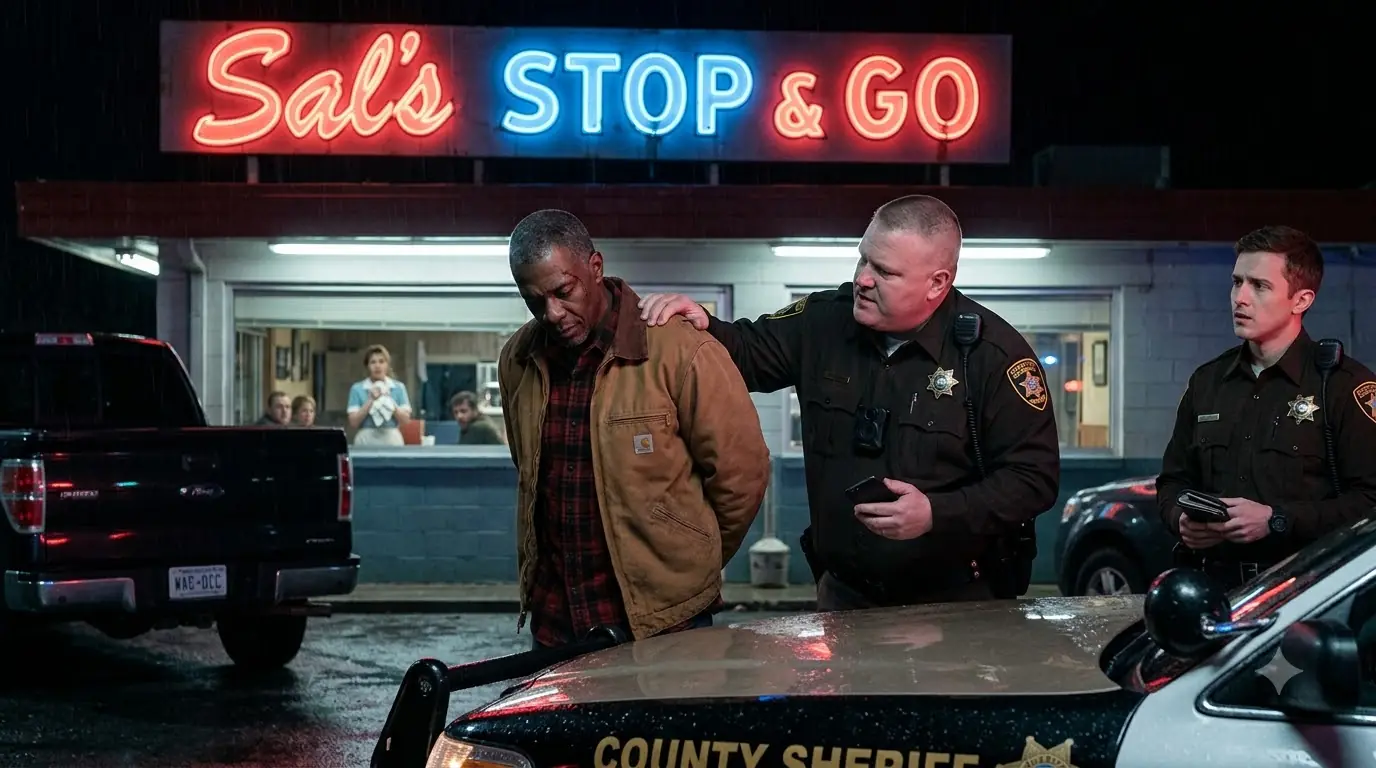
To most people, it would disappear beneath the hum of a diner refrigerator, the hiss of a grill, or tires moving across wet pavement outside.
To Isaiah “Zeke” Washington, it was louder than thunder.
He had heard that sound in training rooms, armored vehicles, aircraft, ruined compounds, and places whose names never appeared in the reports his family was allowed to read. He had heard it in Afghanistan when men were nervous, when men were angry, and when men were about to make decisions they could never take back.
Fear was not what the sound created in him anymore.
Fear required uncertainty.
What Zeke felt was recognition.
Calculation.
And underneath both, a cold anger that had taken decades to learn how to control.
He was fifty-two years old and had stopped at Sal’s Stop & Go for one reason.
Cherry pie.
That was all.
He was not conducting an operation.
He was not meeting an intelligence contact.
He was not following anyone.
He was driving north to visit his daughter in Chicago when the temperature gauge on his black Ford F-150 climbed higher than he liked. Ten miles outside Oak Haven, Alabama, he saw a faint curl of steam beneath the hood and decided that a radiator older than some junior analysts at the Defense Intelligence Agency deserved half an hour to cool down.
Sal’s Stop & Go sat beside State Route 66 beneath a red neon sign that buzzed whenever the wind blew hard.
The building had probably looked tired twenty years earlier.
Now it looked exhausted.
One corner of the roof sagged.
Two letters in the sign flickered.
The white paint around the windows had turned the color of old bone.
But there were four pickup trucks outside, which meant the coffee was probably drinkable, and Zeke had spent enough years traveling through forgotten towns to know that the best pie in America was rarely served somewhere with valet parking.
He parked beneath a dying sycamore tree.
Before getting out, he checked the radiator.
Nothing catastrophic.
A tired hose connection and a cooling system working harder than it should.
He could deal with it after the engine settled.
Inside, warmth hit him immediately.
Coffee.
Bacon grease.
Floor wax.
Fryer oil.
Cinnamon.
Old vinyl.
The smell of a place that had served the same menu long enough that the building itself seemed seasoned by it.
Zeke chose booth four.
He noticed the room automatically.
He always did.
Two exits.
Kitchen door.
Back hallway.
Four civilians.
One elderly man reading a newspaper at the counter.
A middle-aged couple sharing meatloaf in the corner booth.
A trucker staring at his phone.
One waitress.
No immediate threat.
Only after that inventory did he remove his jacket.
Some habits survived retirement because they were no longer habits.
They were architecture.
Zeke Washington had been twenty when the Army first taught him how quickly a normal room could become dangerous.
Thirty-two years later, he still preferred sitting where he could see the door.
He did not look particularly important.
That was intentional.
His close-cropped hair had gone gray around the temples.
A thin scar ran from his left eyebrow toward his hairline, pale against dark skin.
His Carhartt jacket had a repaired tear near one cuff.
Under it he wore flannel.
His work boots were scuffed, though carefully maintained.
Nothing about him suggested the Distinguished Service Cross stored inside a locked case in Washington.
Nothing suggested the classified citations that could not be displayed publicly.
Nothing suggested the years spent moving between conventional military command and work that officially existed only in vague language.
His civilian profile described him as a retired Army officer who occasionally consulted on security matters.
A deeper search required authorization.
A much deeper search produced questions very few people were permitted to ask.
Zeke preferred it that way.
He had spent enough of his life being known by codes, ranks, clearances, and mission names.
These days he liked being a father driving an old truck.
He liked roadside diners.
He liked paperback novels.
He liked choosing his own schedule.
And, whenever possible, he liked pie.
“More coffee, hon?”
The waitress stood beside him holding a glass pot.
Her name tag read BEVERLY.
She was probably in her late fifties, though exhaustion had added a few years around her eyes. Her blond hair was teased high in a style that had survived several presidential administrations, and a pencil rested behind one ear.
Zeke smiled.
“Please, ma’am.”
She topped off his mug.
“Anything to eat?”
“I was told there might be cherry pie.”
Beverly put a hand dramatically over her heart.
“You were told correctly.”
“Fresh?”
“Sal baked it at four.”
Zeke checked the wall clock.
“Then I’m willing to take the risk.”
That got the first genuine smile out of her.
“Warm?”
“Absolutely.”
“Ice cream?”
“I’m driving.”
Beverly laughed.
“That is not how ice cream works.”
“It is after fifty.”
She walked toward the kitchen.
Halfway there, she stopped and glanced back.
“You passing through?”
“Yes, ma’am.”