Chapter 1: The Children Who Chose the Cliff
In broad daylight under a merciless African sun, a woman stood at the edge of a towering cliff. The sky was clear. The land was silent. There was nowhere for truth to hide. Her designer heels scraped against stone as strong hands dragged her forward.
She turned eyes wide, not at strangers, but at faces she had once kissed good night. Children she had carried, children she had built an empire for. "No, please," she whispered, her voice swallowed by the open air. Then came the push. Her body fell through blinding sunlight, not darkness. A gold ring slipped from her finger, flashing once as it spun, then vanished into the void below.
Above the cliff, no one screamed. No one reached out. They believed the daylight would erase what they had done. They were wrong. Adisola Mensah was not born into comfort.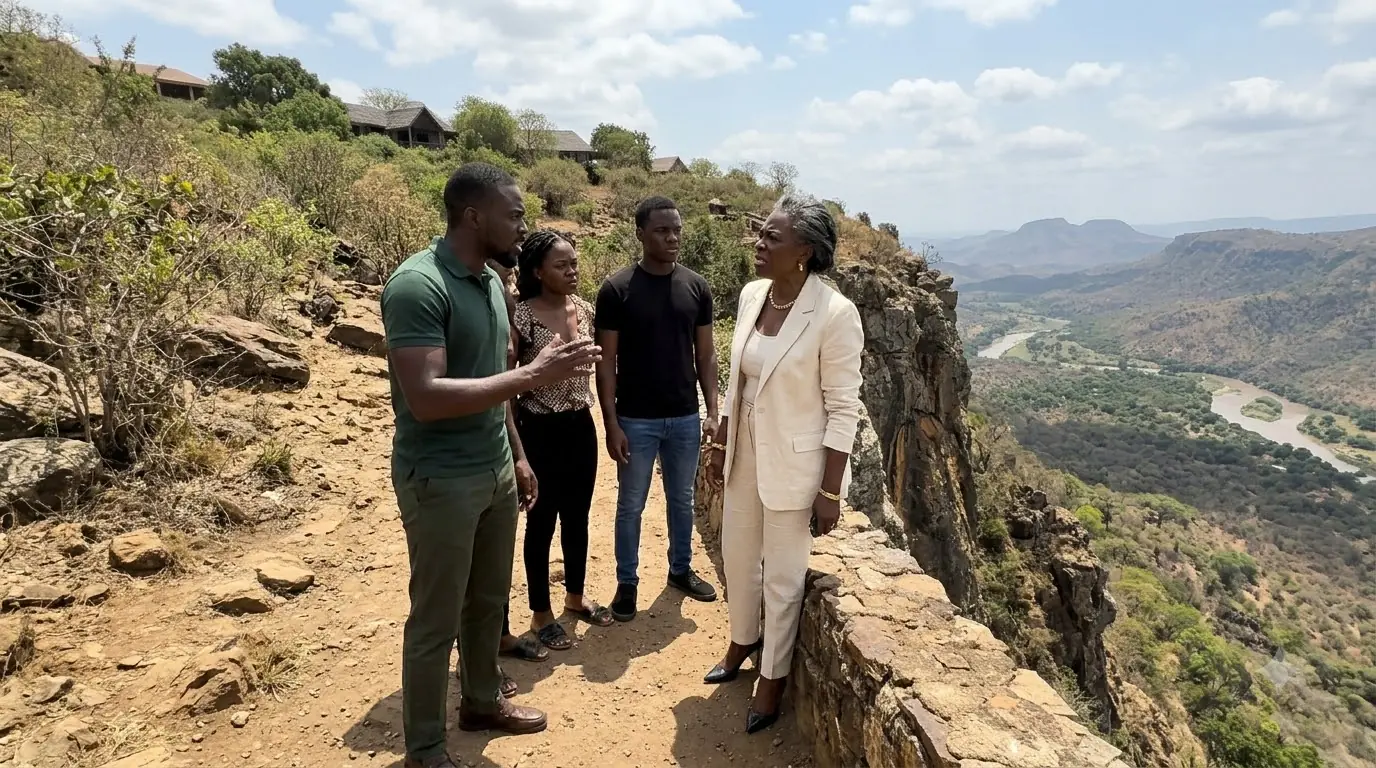
Her story did not begin in boardrooms or behind polished desks. It began decades earlier in a dusty neighborhood on the outskirts of Ibadan where roofs leaked when the sun burned too long and food was measured carefully grain by grain. She was the eldest daughter of a cocoa trader who died young, leaving behind debts instead of savings. By the time Adisola was 22, she was already a widow, holding a newborn baby in one arm and a future full of uncertainty in the other. People often forgot that part of her story.
By the time the world knew her name, Adisola Mensah had become one of West Africa's most powerful women founder and CEO of Mensah Integrated Holdings, a vast empire spanning agricultural exports, logistics, cold storage facilities, and regional transport routes. Governments consulted her. Banks listened when she spoke. Young women quoted her speeches on social media. To the public, she was steel and strategy, a woman who never flinched. But inside the high walls of her mansion on the outskirts of Accra Adisola was simply a mother.
She woke before dawn every day, even after she became a billionaire. Old habits from poverty never truly leave you. She walked the garden herself, greeting the gardeners by name. She insisted on eating breakfast with her children whenever they were home, no matter how busy her schedule was. And when they were younger, she personally supervised their homework, sometimes falling asleep at the dining table with her glasses still on. She had raised three children, Kunlay, Sade, and Tundaiai alone.
Kunlay the firstborn carried himself like a prince who had never been denied. Tall, charming, and dangerously persuasive. He learned early how to speak in ways that made people agree with him, even when they didn't fully trust him. Adisola once believed leadership lived in him. Now she wasn't so sure.
Sade the middle child was sharp and observant. She rarely raised her voice, preferring silence and calculated smiles. She had studied business abroad and returned with polished accents and expensive habits. She understood numbers but not patience. And Tundaiai, the youngest, was once her soft spot. As a boy, he used to cling to her legs when she left for business trips, begging her not to go. Somewhere along the way, tenderness hardened into entitlement.
They lived surrounded by luxury their mother never knew growing up. Private schools overseas, vacations, drivers waiting at every corner. And yet none of them seemed satisfied. That troubled Adisola deeply. One evening, after a long board meeting, she sat alone in her home office, the city lights flickering beyond the tall glass windows. She removed her heels slowly massaging her feet, exhaustion seeping into her bones. On her desk lay reports profits were up, expansion plans approved, but her eyes drifted instead to a framed photograph.
It showed her children years ago standing barefoot in the rain, laughing as muddy water splashed around them. Back when they still laughed easily. "Where did I lose you? " she whispered to the room. Her concern wasn't sudden.
For months, no years, she had watched her children change. They argued over allowances long after they should have been financially independent. They questioned her decisions in public, subtly undermining her authority. They talked about the company as if it already belonged to them. One night at dinner, Kunlay had leaned back in his chair and said casually, "Mother, don't you think it's time you rested?
You've done enough. Let the next generation take over. The words sounded respectful. The tone was not. Adisola looked at him calmly.
Rest is earned, she replied. And leadership is not inherited like land. It is proven. Sade smirked, faintly swirling her wine. But we are your legacy, Mama. Adisola met her daughter's eyes. "No," she said quietly.
"Your character is your legacy. " The table fell silent. What her children didn't know, what no one knew was that Adisola had been planning something for a long time. She had watched other wealthy families tear themselves apart after death. Brothers suing brothers, daughters selling off companies their parents had built with blood and sweat.
She refused to let that be her story. So she did what every strategic mind does when facing uncertainty. She prepared. In secret meetings with her lawyer and a trusted elder from her village, Adisola rewrote her will not out of fear of death, but out of fear of corruption. She designed it carefully, line by line, ensuring her wealth would not become a weapon in the hands of greed.
Her children would inherit responsibility, not riches. The bulk of her fortune would be placed into a foundation focused on rural education, widows empowerment, and agricultural training for young farmers. Her children would oversee parts of the business only if they proved integrity, transparency, and service. She knew they would be angry, but she did not expect hatred. The shift in her household was subtle at first.
Conversations grew colder. Smiles became forced. When she entered a room, voices dropped. When she traveled, phone calls went unanswered. The love she once felt so surely around her now felt conditional, fragile, as if tied to something else entirely. Still, Adisola hoped. Hope is a stubborn thing in mothers.
She believed that once her children understood her reasons, they would come around that they would see she was protecting not just the company but their souls. She was wrong. Very wrong. Because while Adisola saw her children as heirs of values, they saw her as an obstacle standing between them and everything they believed they deserved. And behind closed-doors, whispered conversations began to take place. Conversations filled with bitterness, impatience, and a single dangerous question. What if she was no longer in the way?
Unaware of the storm forming inside her own bloodline, Adisola accepted an invitation that would change everything, a family retreat, Kunlay called it. A chance to reconnect, to heal. A mother's heart wanted to believe him. And so she agreed. If gratitude could rust, it had long begun to corrode inside the hearts of Adisola Mensah's children. From the outside, they looked like a perfect legacy, educated, wealthy, polished. But inside the mansion, far from cameras and business partners, something darker had taken root. Something fed by impatience and entitlement.
Kunlay believed the world owed him leadership simply because he was first born. He walked through life with the confidence of a man who had never been told no. And when he was, he learned to hear it as a temporary inconvenience. In meetings, he interrupted senior executives twice his age. He spoke of expansion plans without understanding the fragile networks his mother had spent decades building. One afternoon during a closed-door strategy session, Kunlay leaned back in his chair and said with respect, "Mother, this old school caution is slowing us down.
We should be aggressive, faster, bigger. " Adisola didn't raise her voice. She rarely did. Speed without wisdom destroys more than it builds, she replied. Kunlay smiled, but it was thin, controlled, the kind of smile that hid resentment.
Sade, on the other hand, was quieter. She observed everything. She had learned early that silence could be more powerful than noise. She noticed how executives still deferred to her mother, how the board waited for Adisola's nod before making decisions. "And she hated it, not because her mother was wrong, but because she was still there.
" "She doesn't trust us," Sade whispered to Kunlay one evening as they sat by the pool, city lights reflecting off the water. That's what this is really about. Kunlay scoffed. She doesn't need to trust us. She just needs to step aside. Tundaiai, the youngest, listened more than he spoke. But when he did speak, bitterness spilled out in unexpected ways.
He had grown up the most protected, the most indulged, and yet felt the most overlooked. He believed his mother saw him as a child even now. I'm tired of being treated like I don't matter," he muttered once after Adisola questioned one of his reckless investments. "Everything I do," she corrects. "Everything.
" What none of them wanted to admit was this. They had never known hunger. They had never slept uncertain of tomorrow. They had never buried a spouse and still risen before dawn to fight for children who depended entirely on them. They did not know sacrifice.
Their mother's wealth had insulated them from struggle and over time that insulation turned into distance from her values, from her pain, from her humanity. The turning point came during a family dinner that was meant to be peaceful. Adisola had returned from a long trip to the north where she'd visited rural farmers affected by drought. Her clothes still carried the scent of dust and sun. She spoke softly that night, sharing stories of women walking miles for water, of children studying under lantern light.
"We have so much," she said gently, "and with that comes responsibility. " Kunlay placed his fork down. Responsibility to whom he asked. To strangers who didn't build this company. Adisola looked at him surprised.
To the people whose labor feeds our success. Sad sighed dramatically. Mother, that sounds noble, but this is business. Sentiment doesn't keep companies alive. Adisola's voice remained calm, but something hardened behind her eyes.
Sentiment built this company, she said. "Love for my children, love for dignity, love for a future bigger than myself. " Tundaiai pushed his chair back. "So, what about our future? " he snapped.
"When do we matter? " The room went silent. Adisola stood slowly. "You matter," she said. but not more than your character. That night, doors slammed, conversations continued in whispers, and something shifted from frustration to something far more dangerous. Over the following weeks, the siblings met without their mother.
Sometimes in Kunlay's penthouse apartment, sometimes in Sade's sleek office after hours. They spoke openly there without restraint, without guilt. She's holding everything hostage, Kunlay said one night, pacing. The board listens to her. The lawyers listen to her, even the banks. And that will never change while she's alive, Sade replied quietly.
The words hung in the air longer than anyone expected. Tundaiai looked up. What are you saying? Sade didn't answer immediately. She picked up her glass, swirled the contents slowly.
I'm saying time is not on our side. Kunlay stopped pacing. He stared at her, careful. But he didn't shut her down. Instead, he sat. That was the moment something irreversible formed between them. Not a plan, not yet, but permission. Permission to think the unthinkable. They began justifying their thoughts the way people always do before crossing a line.
She's old. She's stubborn. She doesn't understand modern business. We deserve this. And beneath all of it lay the ugliest truth of all. They believed they were entitled to her life's work.
Simply by blood. Adisola sensed the distance growing wider. She felt it in the way her calls went unanswered, in the way conversation stopped when she entered a room, in the tension that wrapped around her like cold air. Still, she held on to hope. A mother always does. When Kunlay suggested a family retreat, just us, mama.
No phones, no boardrooms. Let's reconnect. Something in her heart softened. She wanted to believe her children were reaching back toward her. This could be good.
She told her longtime assistant. "We've lost our way. " The assistant hesitated. "Are you sure, ma'am? " Adisola smiled faintly.
"They're my children. " She did not know that by the time the invitation was extended, the idea of reconciliation had already been replaced by calculation. That what she saw as healing her children saw as opportunity. As the date approached, their conversations grew more focused, more deliberate. They chose a location far from city noise, a cliffside retreat overlooking vast empty land. Isolated, quiet, perfect. Adisola packed lightly.
No security detail, no press, just a mother, hoping to bring her family back together. As she prepared to leave, she paused at the doorway of her bedroom, looking around at the life she had built. Brick by brick, loss by loss, she touched the framed photo of her children when they were small. I did this for you, she whispered. And somewhere else, miles away, her children spoke of inheritance as if it were already theirs. They had forgotten who built the road they now wanted to run on. and soon they would commit an act that would change all of their lives forever. The will was not announced with drama.
There were no flashing cameras, no grand speeches meant for the public. Adisola Mensah chose a quiet afternoon, one of those deceptively calm days, when the city moved slowly and nothing seemed urgent. She summoned her children to the family conference room, a long oval table carved from dark wood, its surface polished smooth by decades of decisions. Her lawyer was already there. So was an elderly man from her hometown, Chief Adakunle, someone who had known Adisola before wealth had changed her address but not her spine.
Their presence alone should have warned her children that this was not an ordinary conversation. Kunlay arrived first, confident as always, phone in hand, smile rehearsed. Sade followed, composed, her expression carefully neutral. Tundaiai came last, shoulders tense, irritation barely concealed. What's all this about?
Kunlay asked lightly, taking his seat at the head of the table, her seat. Adisola did not comment on that. She folded her hands and waited until everyone settled. "I won't waste your time," she began. Her voice was steady, neither warm nor cold.
"I'm not ill. I'm not dying. But I've lived long enough to understand that clarity is a gift best given early. The lawyer slid a folder onto the table. This Adisola continued is my updated will. The air shifted.
Sade straightened slightly. Tundaiai leaned forward. Kunlay's smile widened just a fraction. None of them said thank you. None of them asked why.
They assumed naturally that what followed would confirm what they already believed. Adisola nodded to the lawyer. He cleared his throat. In the event of Madame Mensah's death, he read the majority of her personal wealth, including liquid assets and controlling shares will be transferred into the Mensah community trust. Silence fell like a dropped plate.
Kunlay blinked. I'm sorry what trust Adisola met his eyes. A foundation, she said, for rural education, agricultural training, and support for widows, causes that matter, said lips tightened. And the company the company remains operational, the lawyer replied. But leadership succession will be conditional. Tuna frowned. Conditional?
How Adisola answered herself. You will not inherit power simply because you share my blood. Each of you will earn responsibility through service, transparency, and proven integrity. Kunlay laughed. It came out sharp and humorless.
You're joking. I am not. Adisola said placed her hands flat on the table. Mother, this is extreme. You built this for us.
I built this so you would never be desperate. Adisola replied. Not so you would become careless. Tundai stood abruptly. So strangers get your money and we get tests. Conditioned strangers.
Adisola echoed softly. Those strangers are the people whose lives mirror the one I came from. Kunlay pushed his chair back and stood too. This is punishment, he said. You don't trust us. That's what this really is.
Adisola's gaze did not waver. Trust is not declared, she said. It is demonstrated. The meeting ended without resolution. No one shouted.
No one begged. They simply left one by one, faces tight with fury. They refused to express openly. That night, the siblings gathered without their mother. They did not speak of reconciliation. They did not ask how to meet her standards. Instead, they spoke of betrayal.
"She's humiliating us," Kunlay said, pacing the length of the room, making us look like children who need to be disciplined. "She's giving away what belongs to us," Tundaiai added bitterly. To people who don't even know her. Sad said nothing at first. She sat by the window watching the city.
Lights pulsed like distant signals. When she finally spoke, her voice was low and deliberate. She's rewriting our future without without us, she said. And she knows it. Kunlay stopped pacing. So what do we do? That was the question. None of them had dared ask out loud before.
Days passed, then weeks. The tension did not ease. It hardened. At family events, smiles were forced. Conversations were shallow.
Every interaction felt like a negotiation neither side trusted. Adisola noticed everything. She saw the way Kunlay avoided her eyes. The way Sade answered politely but without warmth. The way Tundaiai's temper flared at the smallest correction.
Still, she did not retreat. She believed boundaries were an act of love. Even when misunderstood in private, her lawyer expressed concern. "They are angry," he warned gently. I know, Adisola said.
Anger can teach if they let it, but anger left unchecked often seeks shortcuts. Behind her back, the siblings began testing their influence, calling board members, sounding out allies, measuring how much power they truly held without her. The answers frustrated them. Adisola's reputation was too strong, her authority too deeply rooted. She's untouchable, Kunlay muttered after one such call ended poorly.
Sade's eyes flickered. Not untouchable, she said. Just in the way. The idea of a family retreat was born that night. Kunlay presented it a week later. His tone softened his expression carefully, remorseful.
Mama. He said, "We've been wrong. We've been fighting instead of listening. Let's get away. Just us.
No lawyers, no board, no pressure. " Adisola studied him. For a moment, she saw the boy. He used to be the one who held her hand crossing busy roads. The one who cried when she left for long trips.
"We need time together," Kunlay added. Before things break completely. Her heart ached with hope. Sad nodded in agreement. We've forgotten how to be a family.
Even Tundaiai managed a quiet please. Adisola agreed. She did not know that while she packed light and left her security behind her, children prepared something far heavier than luggage. that the will meant to teach them humility had instead convinced them that patience was no longer an option. To them, the document was not guidance. It was a threat, and threats they believed were meant to be eliminated. As the sun set on the day she signed that will, Adisola stood alone on her balcony, watching the city she had helped build.
She felt uneasy but not afraid. She had no idea that the words she had written to protect her legacy would become the very reason her children decided she could not be allowed to live. Betrayal rarely announces itself loudly. It grows quietly nourished by resentment and watered with justification. By the time it shows its face, it already believes it is right.
After the will was signed, something inside the Mensah household shifted permanently. The mansion still stood immaculate and guarded, but the warmth that once lived there had thinned into something brittle. Adisola felt it in the silences longer, now heavier. She felt it in the way her children avoided shared spaces, as if the walls themselves had chosen sides. Kunlay stopped coming home for dinner. When he did, he arrived late, distracted his phone always in his hand.
Sad became suddenly busy with consulting projects, staying out late, and returning with tired eyes that never met her mother's. Tundaiai oscillated between anger and withdrawal. A restless storm that never quite broke. Adisola tried to reach them anyway. She invited them for breakfast.
She asked about their work. She suggested family counseling even laughed it off gently when they refused. "We'll talk when you're ready," she said, masking her worry behind patience she had learned the hard way. "But patience in the wrong company looks like weakness. " behind her back.
The siblings were meeting regularly now. The locations varied Kunlay's penthouse overlooking the Ocean Sade's office after the staff had left even a private room in a members-only lounge where questions were never asked. They spoke freely there, their words shedding pretense. She's playing chess while we're expected to wait for permission, Kunlay said one night, pouring himself a drink. By the time she decides we're worthy, the best years will be gone.
Tundaiai paced the room. She doesn't see us as adults. She never has. Sad listened, eyes narrowed. She sees us as risks, she said. And she's removing risk.
Kunlay scoffed. By handing our inheritance to villagers, by placing it somewhere we can't touch. Sade corrected calmly. Unless she's gone. The room went quiet.
Tundaiai stopped pacing. You keep saying that, he said. What does that mean? Sade didn't answer immediately. She reached for her bag and pulled out a document, an overview of the trust structure, public filings anyone could access.
She laid it on the table. As long as she's alive, Sade said, "Everything stays locked. The board won't move against her. The banks won't either. She is the anchor. " Kunlay stared at the paper jaw tightening.
"So, we're trapped. " "Not trapped," Sad said softly. "Delayed that night. Lines were crossed in thought. if not yet in action. Each of them went home carrying a version of the same idea, turning it over in their minds, testing its weight.
They began to rationalize. She's old, Kunlay told himself. She's lived her life. She's stubborn, Tundaiai muttered. She refuses to listen.
She's endangering the future, Sade concluded. And leaders make hard choices. Every justification made the next one easier. The plan did not arrive fully formed. It grew piece by piece. Suggestions, hypotheticals, quiet questions asked without waiting for answers.
Kunlay suggested isolation. Sade suggested distance from security. Tundaiai suggested locations, places far from witnesses, far from help. They told themselves it was only talk. But talk has momentum. When Kunlay proposed a family retreat, the idea slid into place too smoothly to ignore. He framed it as healing as reconciliation.
He practiced his tone before calling their mother, lowering his voice, softening his words. "We've all been hurting," he said. "We need time away from everything. " Adisola heard the regret, she wanted to hear. She did not hear the calculation underneath.
Sad supported the idea with precision. She researched locations remote but accessible, scenic enough to feel like peace. She chose a cliffside lodge overlooking a vast stretch of land where the horizon swallowed sound and mobile reception weakened just enough to be unreliable. It's beautiful, she told her mother, showing her photos. You'll love it.
Tundaia handled the logistics, transportation, accommodation. He insisted it be just the family, no aids, no guards. Please, Mama, he said, let's be normal for once. Adisola hesitated. Her assistant noticed.
Ma'am, she said gently. Perhaps security. No. Adisola interrupted. She smiled, though it didn't quite reach her eyes. If my children want peace, I won't bring suspicion.
She chose trust. The days leading up to the trip were filled with strange quiet preparations. Kunlay cleared his schedule completely. Sade canceled meetings without explanation. Tundaiai stopped calling his friends.
Each of them withdrew into themselves rehearsing conversations that would never happen. Outcomes they refused to name aloud. On the morning of departure, Adisola dressed simply. She left her jewelry behind, choosing only a thin gold ring she had worn since her husband's death. As she walked through the mansion, she paused just once to look around, not because she sensed danger, but because something felt final. Her children watched her from a distance.
Kunlay studied her posture straight despite her age. Sad noted the calm in her face. Tundaiai avoided her eyes entirely. During the drive, conversation stayed polite, neutral, safe. The land grew quieter as the city fell away, buildings replaced by open sky and rock.
Adisola looked out the window, taking it all in. It's beautiful, she said sincerely. Kunlay smiled. You deserve this, Mama. The lodge sat near the edge of the cliff, perched as if daring gravity to make a decision.
The air was warm. The sky was painfully clear. No storms, no darkness to hide behind. They settled in. Luggage unpacked, lunch served, and then little by little, the masks began to slip.
Small comments turned sharp. Old grievances surfaced. Accusations long buried were dragged into the open. Adisola tried to calm them, tried to redirect, but the tension had its own gravity now pulling everything toward the edge. You never trusted us.
Tundaiai snapped during one heated exchange. I trusted you with your lives, Adisola replied. What more could a mother give? Kunlay's jaw clenched. Sade's eyes went cold. That afternoon, Kunlay suggested a walk.
"Just you and us," he said. "Let's clear the air. " The path led toward the cliff. Adisola followed, still believing in words, still believing in blood. Behind her, her children exchanged glances, silent, final.
The seeds had been planted long ago. Now they were ready to bear fruit. And as Adisola stepped closer to the edge, unaware of how thin the line beneath her had become, betrayal, stood waiting, patient, justified, and convinced it was doing what needed to be done. The path narrowed as it approached the edge, the ground changing from packed earth to jagged stone. The sun stood high and unblinking, casting hard shadows that refused to soften anything it touched. There was no wind strong enough to cool the tension, only a dry heat that pressed against skin and patients alike.
Adisola walked slightly ahead of them, her steps careful but unafraid. She had walked harder roads than this roads lined with grief debt and sleepless nights. A cliff did not frighten her. What unsettled her was the silence behind her. No questions, no laughter, just the measured sound of footsteps that stopped when she stopped.
Here, Kunlay said at last, gesturing toward the edge. Look. The land opened beneath them, a vast stretch of rock and scrub falling away into distance. It was beautiful in a severe way, honest, unforgiving. Adisola took it in slowly, hands clasped before her.
It reminds me of the farms in the north, she said, wide, exposed. You see everything coming? No one answered. Sade stood to her left, arms folded, eyes fixed on the horizon. Tundaiai lingered a step behind, jaw-tight fingers, flexing as if testing their strength.
Kunlay positioned himself closest to Adisola, close enough that she could feel the warmth of him. Mother Sad said, her voice controlled, "We need to talk. " Adisola turned to face them. "I'm listening. " Kunlay inhaled deeply as though preparing for a speech.
"This can't continue," he said. The way things are. You holding everything, treating us like children. I'm protecting what I built. Adisola replied evenly.
For you, for us, Tundaiai snapped. You don't even trust us to run our own lives. Adisola's eyes softened. Trust grows, she said. It doesn't arrive fully formed.
Sad stepped forward. You don't understand, she said quietly. The world has changed. You're holding us back. The words stung more than Adisola expected. Not because they were loud, but because they were rehearsed.
I never stopped you from becoming more. Adisola said, "I only asked that you become better. " Kunlay laughed. Then a short sharp sound that echoed against the rock. Always the lesson, he said. Always the test.
Adisola frowned. What is this really about? For a brief moment, something flickered in Kunlay's eyes. Doubt or perhaps memory. The image of a woman who had sold her wedding jewelry to pay his school fees, who had worked until her hands cracked so he could stand here strong and unafraid. But the moment passed.
"It's about the future," Kunlay said, voice firm now. "And you're standing in the way of it. " Adisola took a step back, more out of instinct than fear. The ground beneath her heels shifted slightly. Pebbles rolled toward the edge and disappeared without sound.
"Careful," she said. "This is dangerous ground. " Sade's gaze flicked briefly to the cliff, then back to her mother. "It doesn't have to be. " Tundaia swallowed hard.
His voice shook when he spoke. "You could change the will. " Adisola looked at him. "Truly looked at him. " "Is that what this is?
" she asks softly. A negotiation. Say you'll fix it. Kunlay pressed. Say you'll put things back the way they should be.
Adisola straightened. Something resolute settled into her posture. I won't, she said, because what you're asking me to fix is not the document. It's your hearts. Silence fell again, thick suffocating.
Kunlay's expression hardened. Then you leave us no choice. The words landed heavier than a shout. Adisola felt it then the shift. The moment when conversation ended and intention took its place. Her breath caught not in panic but in disbelief.
No, she whispered. You wouldn't. Sade looked away. Tundaiai closed his eyes. Kunlay stepped closer.
Adisola raised a hand not to shield herself but as a plea. I am your mother. I know Kunlay said. That's what makes this hard. The shove came fast. Decisive practiced.
Hands struck her shoulders driving her backward before she could regain balance. Her heels scraped against stone searching for purchase that wasn't there. Time stretched. Adisola saw the sky widen above her impossibly blue. She saw Assad's face pale and set.
She saw Tundaiai's hands reach out too late or not at all. And then she was falling. The world flipped silently, sunlight blinding as rock rushed upward. Her breath tore from her chest. The air burned her lungs. She thought not of money, not of betrayal, but of the little boy Kunlay once was crying in the dark because he was afraid to sleep alone.
A sharp pain exploded through her side as she struck a ledge, then another. Her body tumbled, rolled, slammed. Something snapped. Something else went numb. Her gold ring slipped from her finger, catching the light as it spun away.
A brief flash before vanishing into space. Above the edge remained unchanged. The land did not mourn. When the motion finally stopped, Adisola lay still among broken stone and dust. The sky framed her like a distant memory. Her chest rose once, twice, then shallowly.
At the cliff's edge, Kunlay stared down, heartpounding ears ringing. "Is she? " he began. Sade cut him off. "We can't know," she said.
"We shouldn't stay. " Tundaiai was shaking. "What have we done? " he whispered. Kunlay forced himself to breathe.
"It's an accident," he said quickly. She slipped. "That's what we say. " Sad nodded, already thinking ahead. No one saw anything.
There's no reception here. We call for help from the lodge. They walked away from the edge together, their footsteps hurried now uneven. Below, unseen by them, Adisola's fingers twitched weakly against the stone. Blood pulled beneath her dark against the pale rock.
Pain pulsed through her in waves so intense she could not scream. She drifted in and out, the world blurring at the edges. Voices echoed faintly memories or perhaps something else. Her husband's laugh, her children's cries, the hum of markets at dawn. She did not know how long she lay there.
What she did not know, what her children did not know, was that the cliff did not finish her story. that beneath the edge they believed was final, the land twisted and sloped, offering not mercy, but possibility. And somewhere not far away, a different set of footsteps would soon approach, ones that did not carry entitlement or fear, but curiosity and compassion. Above the siblings rehearsed their lie. Below a mother fought to live.
Her children believed the cliff had erased their crime, but Adisola's story was not over. While they prepared to inherit her world, a stranger's compassion was about to give her a second life.
Her Children Kicked Her Off a Cliff for the Inheritance — Then Her Ring Started Transmitting
Theme:
Font Size:
24px