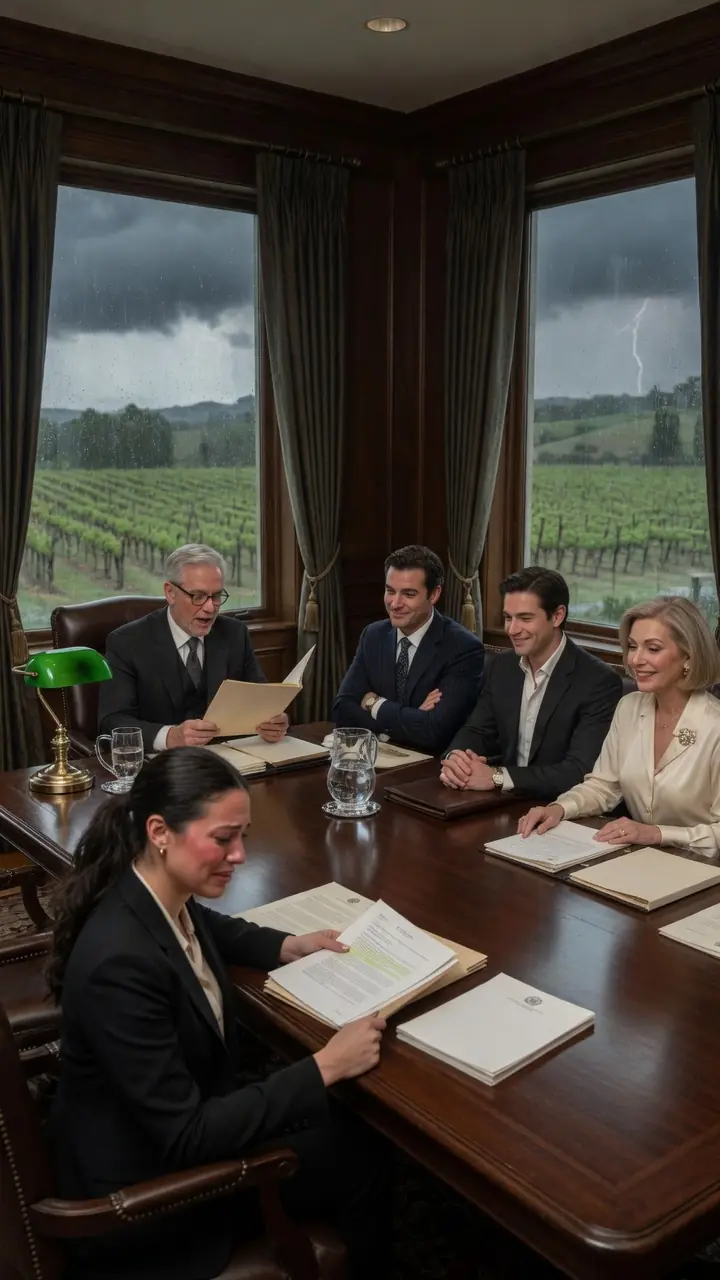
The day her father’s will was read, Maya’s world collapsed.
Her white stepbrothers inherited the mansion, the vineyards, the cars, and the fortune. She inherited only the old farmhouse and the rotting barn beside it.
Laughter broke across the room when the lawyer read her name.
One brother muttered that maybe she would find a horse to go with her hay. Her stepmother, polished and smug, smiled and called it symbolic, saying Richard had always thought Maya was “earthy.”
Maya sat still through the humiliation, her hands clenched so tightly her knuckles hurt. The papers in front of her felt unreal.
The same father who had once taught her to plant seeds, count stars from the barn roof, and fix broken fences had left her scraps while giving them the kingdom.
But she said nothing.
She stood, swallowed the burning in her throat, and quietly said she would take what was hers.
By the time she drove out to the property, rain was sliding across the windshield and thunder rolled over the valley.
The farmhouse rose through the mist like a memory that had been left behind too long. Its roof sagged, shutters hung loose, and ivy climbed the walls as if trying to keep the house from falling apart.
The barn stood where it always had, weathered and silent.
When Maya opened the door, the smell hit her first: wet hay, rust, old oil, and wood soaked with years of work.
The silence inside was thick with memory.
This was the place where her father had laughed, repaired machinery, and let her help him when she was too small to do anything useful.
Now it was empty except for cobwebs, dust, and the ache she had carried since the funeral.
She found a cracked broom and started cleaning.
At first it was only something to do with her hands, a way to keep from thinking about the scene in the lawyer’s office.
But as she swept, the barn began to feel less like an insult and more like a message she had not yet learned how to read.
She found old feed sacks, rusted buckets, broken lanterns, and tools left exactly where her father must have last used them.
Hours passed.
Dust rose in golden shafts of light as the storm eased outside.
At one point she paused in front of a warped beam carved with two sets of initials: RT and a smaller MT, scratched into the wood when she had been a child.
Beneath the carving, the wood looked splintered, as though something had once been loosened there.
Before she could think more about it, she heard tires on gravel.
Peeking through the gap in the barn boards, she saw a white SUV pull up.
Her stepmother stepped out with one of the brothers.
They did not come inside.
They just stood there looking over the land.
Maya heard her brother say she could have the dump, and her stepmother answered that Richard had only left Maya something because he was sentimental.
Maya crouched behind the hay bales, listening, her shame hardening into resolve.
When they finally drove away, she returned to work, no longer cleaning from grief but from instinct.
Something about the barn felt wrong in the way a locked room feels wrong when you know someone meant for it to stay hidden.
Near the back corner she noticed one floorboard sat slightly higher than the others.
When she pressed her boot against it, it shifted.
A hollow sound answered beneath.
Kneeling, she brushed dirt aside and lifted the loose board.
Inside was a small compartment.
There was a brass key wrapped in oilcloth and a folded note yellowed with age.
Her father’s handwriting was unmistakable.
It read:
“Where the earth meets its mirror, truth waits for its keeper.”
The words made no sense, but they were deliberate.
Maya turned the brass key in her hand, her heart beginning to pound.
This was no accident.
Her father had hidden something, and he had meant for her to find it.
That night she could not sleep.
The note kept turning over in her mind.
After hours of staring at the ceiling, she pulled on her father’s old jacket, grabbed a flashlight, and crossed the field back to the barn under a silver wash of moonlight.
Inside, the space felt even more secretive than before.
This time she looked harder.
Near the back wall, beneath a stack of crates, she found a hairline crack in the concrete.
When she pushed, a section of floor lifted like a trapdoor.
A breath of stale air rose from below, thick with soil and iron.
Narrow wooden steps disappeared into darkness.
She descended slowly, the flashlight trembling in her hand.
At the bottom was a small underground chamber lined with old shelves and boxes.
Her beam landed on labels written in her father’s hand.
Harvest logs.
Company records.
Then one box with only a single word:
Maya.
Her throat tightened.
She opened it.
Inside were neatly tied folders, old photographs, legal records, and a small recording device.
The first document she unfolded listed the ownership of Thompson Holdings.
The principal shareholder named on the page was Maya Thompson.
She sat down hard on a crate, staring at the words.
Her father had not disinherited her.
He had done the opposite.
He had hidden the truth.
With shaking hands, she pressed play on the recorder.
Static crackled, then her father’s voice filled the tiny room.
He told her that if she was hearing the message, it meant he had run out of time to explain things in person.
He said the company was hers.
He had built it under her name years ago.
He warned her that her stepmother had been trying to move assets and manipulate the estate for months and that this had been the only way to keep control where it belonged.
He told her to trust the barn because it had always protected what mattered.
Maya covered her mouth and cried, not with the bitterness of the will reading, but with the shock of being seen after all.
Her father had known exactly what was coming.
He had allowed the public humiliation because it shielded the real inheritance.
While her stepfamily laughed at the barn, he had left her the company that owned everything else.
By dawn, she had gathered the documents into a leather folder and locked the trapdoor behind her.
When she emerged into the barn, sunlight was spilling through the open doorway.
Dust turned gold in the air.
For the first time since the funeral, she did not feel abandoned.
She felt entrusted.
The next morning, she dressed carefully, packed the papers, and went downtown to the estate conference room.
Her stepmother and brothers sat with their attorneys, smug and certain that Maya had come to beg for scraps or challenge the will out of emotion.
The lead lawyer began formally, assuming she meant to contest what had been read.
Maya calmly laid the documents on the table one by one.
Incorporation certificates.
Ownership records.
Signed filings.
Notarized transfers.
Every page confirmed the same fact.
Thompson Holdings, the company that controlled the estates, the land, the vineyards, the cars, and the money, belonged to Maya as majority shareholder.
At first, no one believed it.
Her stepmother called the documents forged.
One brother dismissed them.
But then the registrar’s office confirmed the filings.
The lawyer went pale.
Legally, Maya held the controlling interest.
Everything her stepfamily thought they had inherited existed only because the company owned it.
And the company was hers.
The room went silent.
Maya did not gloat.
She simply told them the will they had mocked was never the whole picture.
They had inherited appearances, not control.
When one of the brothers sneered that she was not even fit to run something like this, Maya looked him in the eye and asked softly:
“Not even what?”
He had no answer.
Her stepmother hissed that this was Richard’s final punishment.
Maya answered that her father had not been punishing anyone.
He had been protecting what he built from greed.
The lead attorney, now thoroughly subdued, admitted the documents were valid and that the company would have to recognize Maya’s authority immediately.
Before leaving, Maya told them she was not there to take their homes for sport.
She was there to end the game.
The family would no longer be ruled by manipulation and entitlement.
As she walked out into the sunlight, she heard the same attorney who had read the will say quietly that her father would be proud.
News spread quickly.
The papers ran headlines about the hidden heir and the barn that concealed the truth.
Her stepmother threatened appeals, but the evidence was airtight.
One by one, the allies who had surrounded her withdrew.
The law was clear.
Maya had full ownership.
She returned to the barn that evening, stood beneath the carved initials, and placed her palm against the old beam.
The wood felt warm beneath her hand.
Everything had changed, yet the barn remained exactly what it had always been:
The one place where her father had spoken to her honestly.
She understood now.
He had not left her a building.
He had left her proof.
In the weeks that followed, Maya began restoring the property in earnest.
She cleaned the farmhouse and repaired the barn, not out of obligation but because it no longer symbolized rejection.
It symbolized trust.
The structure that had been laughed at in the drawing room became the center of her inheritance, the place from which truth surfaced.
New paint went up.
Sunlight returned through cleaned windows.
The scent of mold and neglect slowly gave way to fresh wood, clean hay, and spring air.
Every board she replaced felt like mending something deeper than property.
One afternoon, as rain softened the fields around the house, her two stepbrothers arrived unexpectedly.
They came without their mother and without the polished confidence they used to wear like armor.
One of them held a small box.
Inside was their father’s pocket watch.
He admitted their mother had claimed it was lost, but they had found it hidden away.
Maya took the watch in silence.
Its faint ticking sounded louder than either of them speaking.
No one apologized directly, but the air between them had changed.
The older brother finally said their father must have known exactly what he was doing.
Maya answered that he had trusted time to show the truth.
It was enough.
They stood together for a moment in the grass, not as enemies exactly, but as people who had finally seen the same reality.
That evening, Maya sat on the barn steps where her father used to drink coffee at sunrise.
The valley glowed gold in the fading light.
Wet earth, hay, and fresh-cut wood scented the air.
She held the pocket watch in her hand and listened to its steady ticking.
Her father had not left her a barn in place of love.
He had hidden love inside the barn because he knew it was the one place no one else would bother to value.
Looking out over the land, Maya finally understood what had happened.
He had not forgotten her.
He had not chosen them over her.
He had built an entire plan around the belief that she, and only she, would be patient enough, grounded enough, and strong enough to uncover the truth without greed blinding her first.
While everyone else ran toward the visible wealth, Maya had walked into dust, silence, and labor.
She had claimed the one thing they all despised.
And because of that, she found everything.
The barn doors creaked softly behind her in the wind.
She could almost hear her father laughing, warm and proud.
She whispered into the evening that he had outsmarted them all.
But more than that, he had trusted her completely.
And that was the real inheritance.
Not the company.
Not the land.
Not the fortune.
The certainty that love, when it is real, can survive greed, humiliation, and even death itself, waiting quietly under the floorboards until the right hands are ready to lift it into the light.