At 6:18 on a Tuesday morning, two sheriff's cruisers came over the rise above Dawson Creek Ranch with their blue lights flashing, and Laura Bennett stepped out of a black Lexus looking like she had already won.
She had brought a leather folder, a rolled survey map, two association security guards, and enough confidence to make a stranger believe she owned everything within sight.
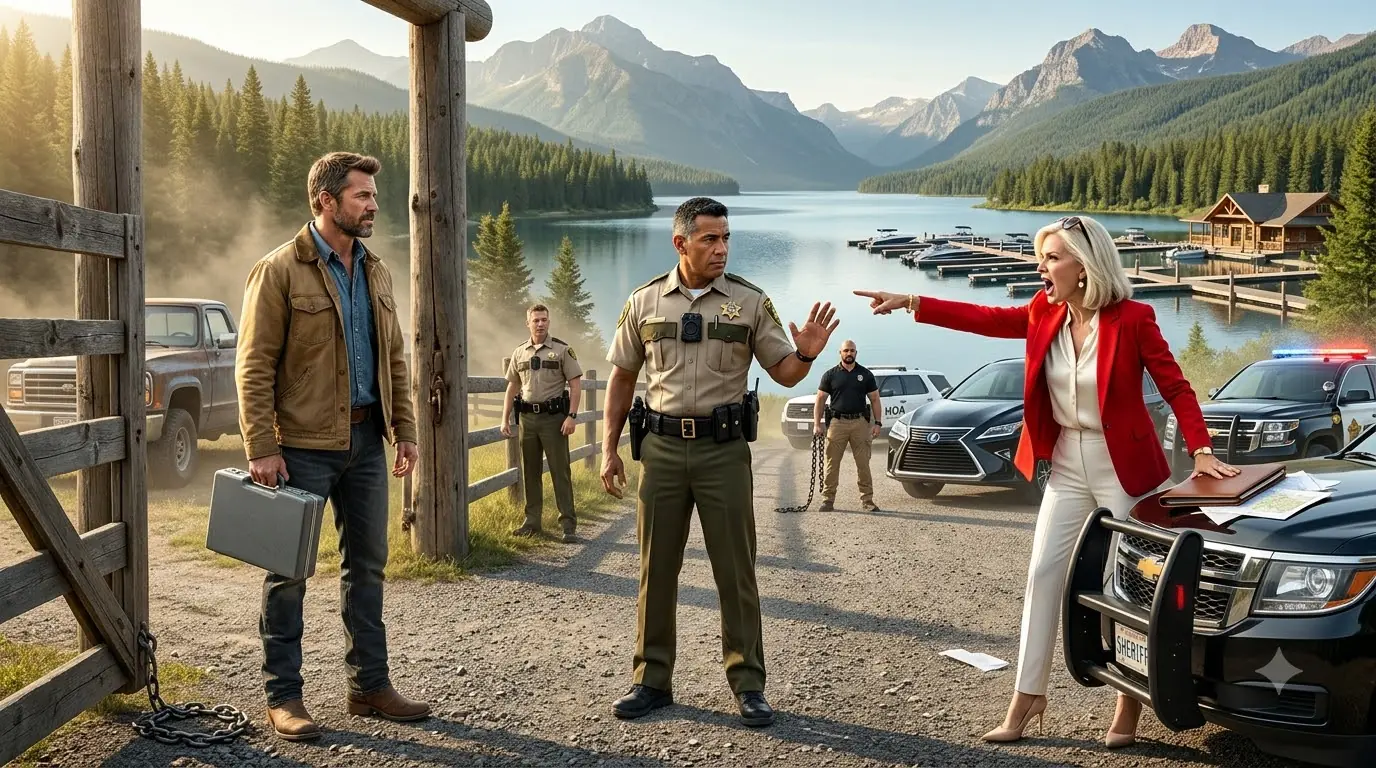
She wanted the sheriff to remove me from my own gate for trespassing. Eleven days earlier, I had signed the papers that made me the controlling owner of the marina she was claiming belonged to her homeowners association.
What she did not know was that the marina was not the whole secret. Beneath part of its parking area, its western docks, and the service yard behind its cedar clubhouse lay a strip of shoreline that my family had never sold. The $4.8 million acquisition she had promised her neighbors rested on a ground lease nearing expiration, an access agreement that had expired almost two decades before, and a proposed expansion that depended on treating my land as if it were hers. Laura had called the sheriff expecting an argument over a chain. She was about to discover what happened when somebody finally read all the pages in her own file.
My name is Cole Dawson. I was forty-eight that summer, a licensed excavation contractor in western Montana, and the third generation of my family to work Dawson Creek Ranch. We ran cattle on the lower meadows, leased summer grazing farther north, and maintained the kind of roads that only looked simple if you had never spent a winter trying to keep them passable. I had spent most of my adult life around survey monuments, drainage easements, grading plans, county permits, and deeds with descriptions so old that half the landmarks had disappeared. None of that made me a lawyer, but it taught me the value of a line drawn accurately and a promise put into writing.
The ranch covered 1,620 acres between the foothills and the western shoulder of Silver Pine Lake. Some of it was rocky enough to discourage even ambitious developers. Some was meadow so beautiful in June that people driving the county road would slow down without realizing they had touched the brakes. The southern fence followed an old wagon route that my grandfather had repaired after the war, and the lake gate sat beside a cottonwood whose lower branches had been bent by generations of wind. I knew the sound of that gate's latch better than I knew the chime on my phone.
My father, Thomas Dawson, never confused ownership with the right to make life difficult for other people. If a neighbor needed to move a sick animal, he opened the gate. If a family wanted to get a small boat to the lake after the spring thaw, he generally let them through, provided they closed the gate behind themselves and stayed off the hayfields. He kept a pocket notebook with dates and names, not because he distrusted everyone, but because memory gets less dependable when people discover that money is involved. After he died, I found forty-three of those notebooks in a cedar chest, each one tied with cotton string.