The orange sign was the first thing I saw.
It stood in the middle of my front lawn, fluorescent against the green St. Augustine grass, held upright by two thin metal stakes.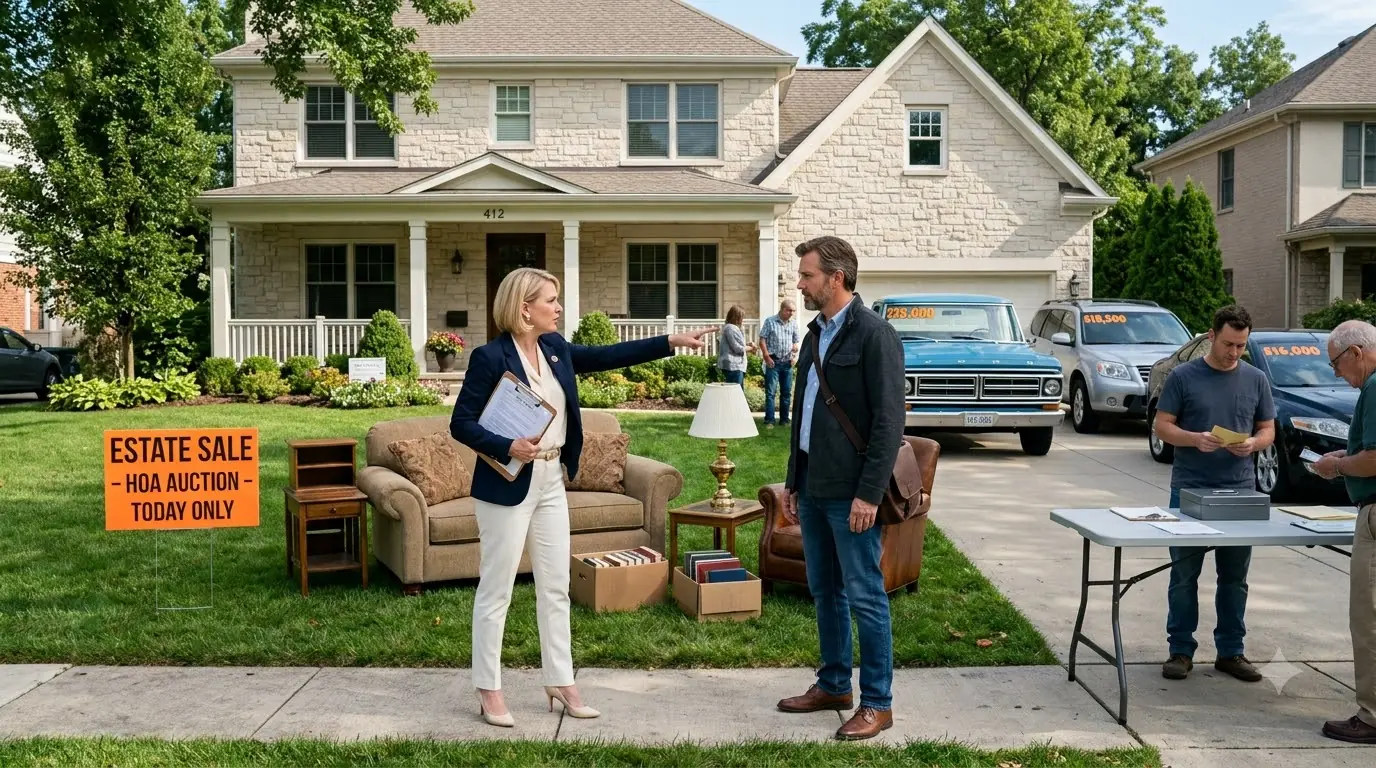
ESTATE AUCTION TODAY.
Underneath, in smaller black letters:
ALL SALES FINAL. CASH, CERTIFIED FUNDS, OR ELECTRONIC TRANSFER ACCEPTED.
For several seconds, I sat behind the wheel of my rental car and tried to make the scene fit inside some reasonable explanation.
It would not.
My 1972 Ford F-100 sat in the driveway with a neon price sticker across the windshield.
$9,500.
My silver sedan had another.
My late wife Rebecca’s small blue SUV, which I had never been able to bring myself to sell, had one too.
The garage door stood open.
My sofa was on the driveway.
My grandfather’s leather armchair sat beside it.
Two lamps.
A side table.
Boxes of books from my study.
A set of copper cookware Rebecca had spent almost a year collecting piece by piece because she refused to pay full retail for anything.
And sitting on the grass near the curb was the reading lamp she had chosen six months before she died.
That was the object that made the scene stop looking absurd and start looking personal.
The lamp was nothing special.
Brushed brass.
Cream shade.
A narrow pull chain.
Rebecca had found it in a furniture store in Dallas and stood underneath it for ten minutes trying to decide whether the light was soft enough for the chair beside our bedroom window.
She had read there during chemotherapy.
Sometimes two pages.
Sometimes twenty.
Sometimes she opened a book and never turned a page at all.
After she died, I moved the lamp into my study.
I could have replaced it for maybe two hundred dollars.
That was not the point.
A man I had never seen before was holding the shade in one hand and examining the base with the other.
I stayed in the rental car.
My name is Martin Hale.
I was forty-eight years old that afternoon, although my knees had started making a persuasive argument for fifty-five.
I had spent twenty-one years practicing commercial contract law in Texas, mostly representing companies that discovered too late that the sentence nobody wanted to read on page forty-seven was the sentence that mattered.
I negotiated leases.
Reviewed acquisition agreements.
Handled construction contracts.
Conducted mediations.
And, more often than I liked admitting, spent my professional life sitting in rooms with intelligent adults who had convinced themselves that confidence could substitute for documentation.
It could not.
Three days earlier, I had been in Phoenix mediating a dispute between a logistics company and the owner of a refrigerated warehouse.
We had blocked fourteen days for it.
The parties settled on day eleven.
At six the next morning, I took the first available flight back to Texas.
I did not tell anyone I was coming home early.
Not my office.
Not the HOA.
Not my neighbor.
Not even my sister, because I had planned to spend the first evening home eating takeout and sleeping for twelve hours.
That unannounced return was the only reason I was looking at my own estate sale while I was still very much alive.
A woman stood behind a folding table near the garage.
Navy blazer.
White blouse.
Pearl earrings.
Dark slacks.
Clipboard in one hand.
Pen in the other.
A metal coffee can sat beside her with DEPOSITS written across it in thick black marker.
A printed QR code had been taped to the side.
Five prospective buyers stood nearby.
Two couples.
One older man with a checkbook.
A contractor in a sun-faded work shirt stood slightly apart holding a thick cash envelope.
I knew the woman.
Karen Whitcomb.
President of the Cypress Hollow Homeowners Association.
Three years running.
Karen was fifty-two, with auburn hair cut into a precise shoulder-length bob and the controlled smile of someone who considered friendliness a management technique.
She was good at remembering names.
Good at sending condolence cards.
Good at standing at the entrance during community events and greeting people as though she personally had granted them permission to live there.
She had lived in Cypress Hollow for six years.
President for three.
And during those three years, the HOA had somehow become less like an association of ninety-six homeowners and more like a small government nobody remembered electing.
I rolled to the curb and stopped.
Karen looked toward the rental car.
She did not recognize me.
That was the first gift she gave me that afternoon.
She walked over.
Quickly.
Confidently.
“Sir, this property is under HOA forfeiture.”
I looked at my house.
“Is it?”
“Yes.”
“We’re conducting a legal estate liquidation.”
“Estate?”
“That’s correct.”
“Whose?”
Her smile thinned.
“The owner is in default.”
“I see.”