“Mr. Callahan, excuse me. There’s a crane on my driveway.”
Brenda Carver did not turn around immediately.
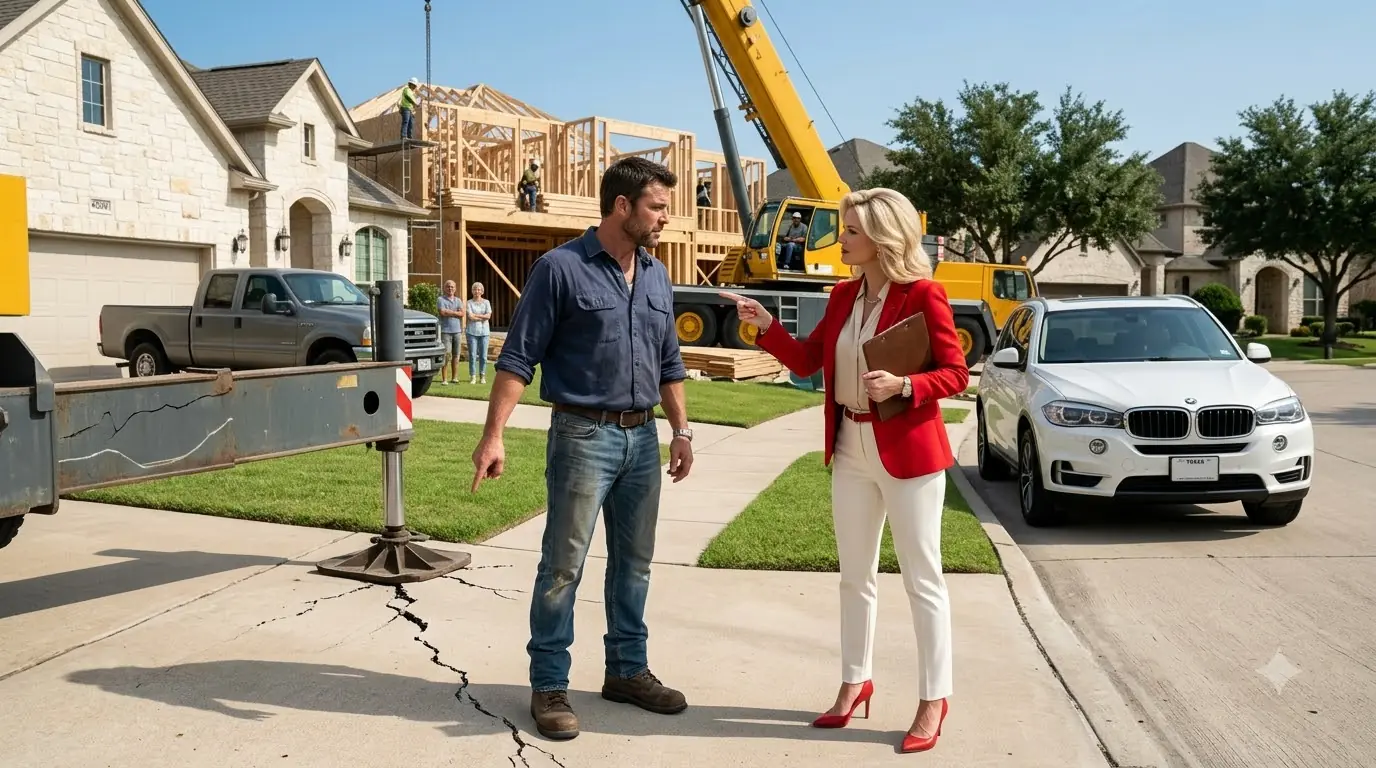
She was standing on the dirt of Lot 93 in cream trousers, a pale silk blouse, and red-soled heels that had no business anywhere within a hundred feet of an active construction site. A pearl-white Porsche Cayenne sat near the curb behind her, polished enough to reflect the framing crew working on the house beside mine. She was studying a set of architectural renderings held by her husband, Mitchell, as if the rest of the street existed only as background scenery.
When she finally turned, she looked at me the way she had looked at every homeowner who had ever interrupted her.
Not annoyed.
Worse.
Amused.
“And?” she asked.
“It’s cracking my concrete.”
She lowered her sunglasses slightly.
Behind me, the diesel engine of a sixty-ton mobile crane idled heavily enough that I could feel vibration through the soles of my boots.
“Could you have it moved, please?”
Brenda’s gaze traveled from my work boots to the dust on my jeans, then to my Ford F-250 parked half in the grass because the crane was occupying the driveway I actually owned.
“Your driveway is the closest flat surface,” she said. “Deal with it.”
“It’s my property.”
“Your property?”
She laughed softly.
It was not the kind of laugh that came from humor. It was the kind people use when they want everyone nearby to understand that another person has said something too ridiculous to deserve a serious response.
Then she stepped closer.
“Look at you, Nate. Work boots. Dirty truck. You work for the county somewhere, right? Permits or records or whatever it is?”
“Something like that.”
“You’re a government nobody who got lucky enough to qualify for a mortgage in Ridgecrest Meadows.”
Mitchell’s eyes came up from the plans for half a second.
Brenda continued.
“People like you don’t tell people like me how major projects get built.”
I looked past her toward the crane.
One outrigger had already driven a visible fracture through the western section of my slab.
“I’m just asking you to get your equipment off my property.”
“Three families before you asked me for exceptions to community projects.”
She smiled.
“They’re gone.”
Then she turned away.
No argument.
No discussion.
As far as Brenda Carver was concerned, the conversation had ended because she had decided it had ended.
I stood there for a moment watching her walk back toward Mitchell, the heels sinking slightly into compacted construction soil with every step.
She had no idea who she had just dismissed.
More importantly, she had no idea that I had spent sixteen years looking at buildings, permits, engineering details, structural failures, fraudulent construction documents, unlicensed work, overloaded foundations, unsafe cranes, and contractors who assumed rules were only for people too weak to ignore them.
Brenda thought she had picked a fight with a neighbor.
What she had actually done was place a sixty-ton crane on the private driveway of the chief building official responsible for enforcing construction standards across Williamson County.
And the crane was only the first thing she had gotten wrong.
My name is Nate Callahan.
I was forty-one years old when all of this happened.
For the previous five years, I had served as chief building official for Williamson County, Texas. Before that, I spent eleven years as an inspector, plans reviewer, and structural engineer, first in private practice and later in public enforcement.
I still held my professional engineering license.
Not because my position required me to stamp routine county inspections, but because I had worked too hard to earn it and because engineering had never stopped being the language my brain used to understand the physical world.
Some people walk into a house and notice the kitchen.
I notice the beam spanning the kitchen.
I notice whether the load above it has a clean path to the foundation.
I notice whether a second-floor wall lands over framing designed to carry it.
I notice whether an exterior column has enough bearing.
I notice whether a roof connection is clipped, strapped, bolted, or merely nailed and prayed over.
My wife, Jenna, says I am incapable of entering a restaurant without mentally inspecting the ceiling.
She is correct.
Once, while we were waiting for appetizers, I stared at a crack above the bar for so long that she finally asked, “Is the building going to collapse?”
“No.”
“Then stop looking at it.”
“The crack shouldn’t be there.”
“Nate.”
“It changes direction at the beam line.”
“Nate.”
I stopped looking.
For almost thirty seconds.
That is the kind of person I am.
It is also the reason I bought our house.
Ridgecrest Meadows sat north of Round Rock, a planned community of roughly two hundred and twenty homes built in phases over several years. Most of the houses were variations of the same four designs: warm stucco, limestone accents, shallow roofs, small front porches, and landscaping selected from a menu of plants apparently chosen because they could survive both Texas summers and homeowner neglect.
Jenna chose the neighborhood because of the schools.
Our son, Owen, chose it because our house was on a cul-de-sac.
I chose it because of the garage.
Twenty-four feet by twenty-eight.
Insulated walls.
A separate electrical subpanel.
A concrete floor that had been poured reasonably flat.
I had inspected worse commercial workshops.
Within a month of moving in, I turned half of the space into a woodworking shop.
Table saw.
Miter saw.
Drill press.
Dust collection.
Wall-mounted clamps organized by size.
A heavy maple workbench I laminated and flattened myself.
I never expected Owen to care about any of it.
Then, when he was five, he wandered into the garage carrying a plastic dinosaur and asked what a clamp did.