The knock echoed through thirty-four million dollars of empty marble like a warning shot made of manners.
Tap. Tap. Tap.
Not a neighbor’s knock. Not a contractor knocking with an elbow because both hands were carrying something. Not even the impatient pounding of a delivery driver trying to make a schedule.
It was metal against glass.
Three precise strikes against the tall front door of a cliffside estate overlooking the Pacific Ocean, each one spaced almost exactly the same distance apart.
I was standing twenty feet away in the foyer with drywall dust on my jeans, a pencil tucked behind my right ear, and a streak of white primer across the sleeve of a work shirt I had owned for at least seven years.
The house smelled like fresh paint, cedar shims, damp plaster, cut stone, and the salt coming in through an open terrace door at the rear.
At that hour, just after seven in the morning, the marine layer still covered most of the horizon. The Pacific beyond the back lawn was gray-blue and flat, almost metallic, rolling beneath the cliff with the calm indifference of something that had been there long before any mansion, gate, deed, or homeowners association.
The knock came again.
Tap.
Tap.
Tap.
I pulled the pencil from behind my ear and laid it beside a moisture meter on the temporary plywood workbench.
Then I opened the door.
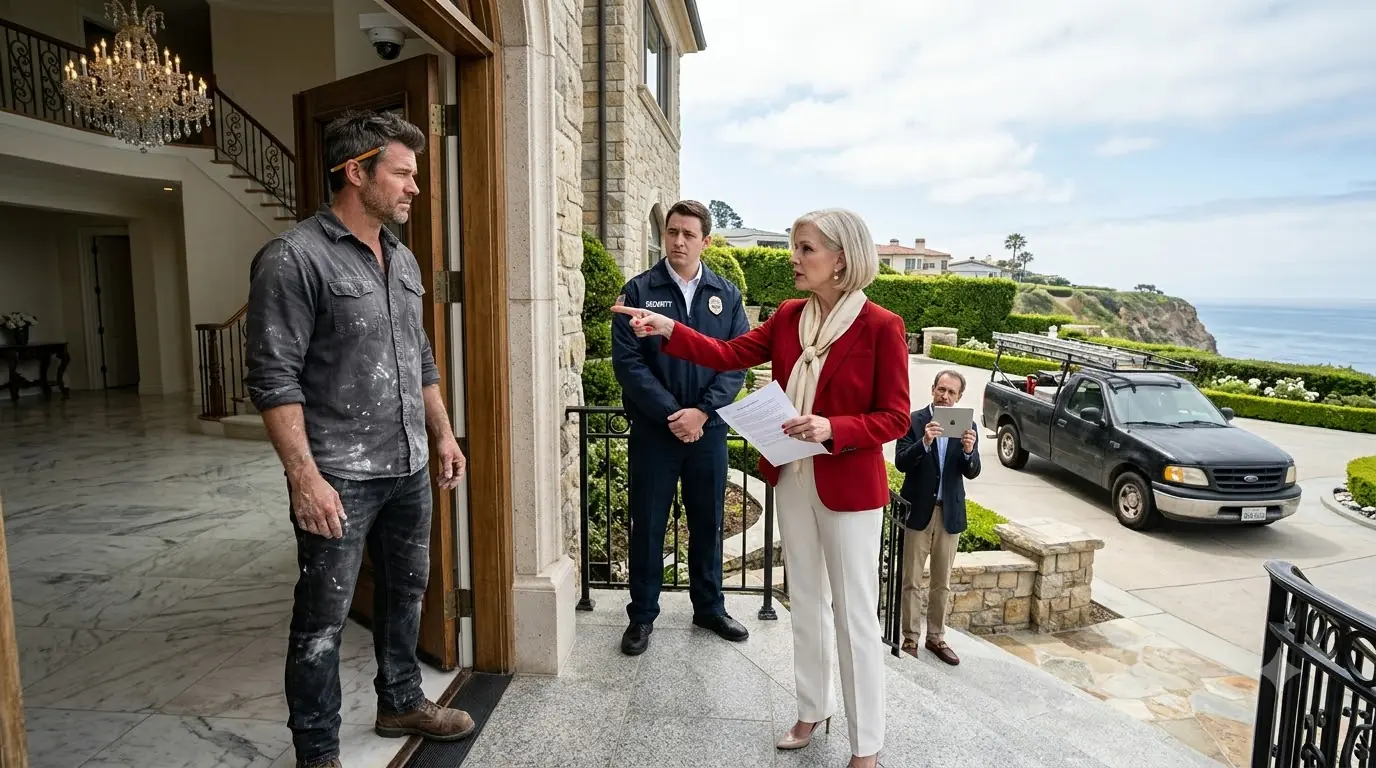
Three people stood on the landing.
The first was a security guard in a navy jacket with a stitched Seacliff Point emblem over the chest. He looked to be in his late thirties and had the careful posture of someone who had already been told exactly what the problem was before arriving.
Behind him stood a thin man in loafers and a pale blue quarter-zip sweater, holding a tablet.
And directly in front of them stood Margaret Ellison.
I knew who she was.
Everybody who owned property in Seacliff Point eventually learned who Margaret was.
She was sixty, perhaps sixty-one, though she carried herself with the polished precision of someone who believed age was a detail best kept between a dermatologist and an accountant.
Her silver-blonde hair disappeared beneath a cream scarf tied neatly behind her neck. Her white slacks were spotless despite the wet morning. She wore low leather shoes that probably cost more than the circular saw sitting in my library.
Her nails were painted red.
Between two fingers she held a small metal stylus.
That was what she had been tapping against my glass.
She looked me up and down.
Work boots.
Dusty jeans.
Old shirt.
Primer.
Then she looked past me into the foyer.
Twenty-one thousand square feet of unfinished luxury.
Drop cloths.
Temporary lighting.
A stack of limestone samples.
Plastic protecting the curved staircase.
A portable dehumidifier humming somewhere upstairs.
Her eyes came back to me.
“Who authorized you to be inside this residence?”
Her voice was calm.
That was the thing about Margaret.
She rarely needed to raise it.
She had spent enough years in committee rooms, charity boards, architectural reviews, and private clubs to understand that certainty often sounded more powerful when delivered quietly.
For a moment, I said nothing.
I looked beyond her toward the driveway.
My truck sat beside the fountain.
A ten-year-old black Ford F-250 with ladder racks, scratched paint, a dent near the rear wheel well, and two five-gallon buckets in the bed.
It looked ridiculous against the pale stone façade of the house.
Farther downhill, past clipped hedges and a row of eucalyptus trees, I could see part of the main community road curving toward Seacliff Point’s guarded entrance.
That truck had fooled her.
The boots had helped.
The dust finished the job.
My name is Bennett Hayes.
I was forty-one years old that morning.
I had spent the first decade of my adult life as a framing carpenter, the second learning how to buy and rehabilitate neglected real estate, and the years after that building a portfolio quietly enough that most people who met me still assumed the truck represented my financial ceiling.
I preferred it that way.
And I was the legal owner of the house Margaret Ellison was trying to remove me from.
Not the caretaker.
Not the project manager.
Not the contractor.
The owner.
The house had been empty for almost three years before I bought it through Hayes Coastal Trust.
The listing described it as a “legacy oceanfront residence of exceptional architectural pedigree.”
My general contractor described it differently.
“A twenty-one-thousand-square-foot leak with limestone attached.”
Both descriptions were accurate.
There were six bedrooms, eight full bathrooms, two half baths, a paneled library, formal dining room, screening room, old wine cellar, guesthouse, three terraces, an infinity pool, and enough imported marble to make every dropped wrench feel like a felony.
There were also leaking balcony membranes, outdated electrical control systems, rotted framing behind one terrace door, a roof section improperly flashed during a remodel twelve years earlier, and moisture behind the library wall that three prior inspection reports had somehow described as cosmetic.
I had been inside since 5:40 that morning checking that moisture problem personally.
Because when a project manager tells me something is “perfect now,” I have a bad habit of taking off the baseboard.
Margaret lifted her chin.
“We received a report of unauthorized labor entering the property outside approved hours.”
The man with the tablet began typing.
She continued.
“Seacliff Point is a controlled private community. All workers must be properly registered through the gate, and labor may not enter residences without the owner or designated representative present.”
I glanced at the security guard.
He shifted his weight.
Not dramatically.
Just enough to tell me he was less comfortable than Margaret.
I asked:
“Are you ordering me to leave?”
Margaret looked almost surprised that I needed clarification.
“Until the real owner can be contacted, yes.”
The real owner.
The words sat between us.
I kept my face neutral.
Behind me, my phone rested on the plywood workbench.
Recording.
I had pressed the button when I saw Margaret’s SUV pull into the driveway.
The entry camera above the chandelier was recording too.
So was a temporary construction camera installed in the front corner of the foyer after tools disappeared during the second week of renovation.
Every voice in that doorway was being preserved from three angles.