"What's next? A homeless girl? A Black street dog fixing my jet?"
Fifty engineers and mechanics laughed. Faith Brooks, twenty-two years old, homeless and Black, stood three feet away holding a wrench. Preston Caldwell looked her over with open contempt and added, "Cockroaches don't belong in cockpits. Go crawl somewhere else."
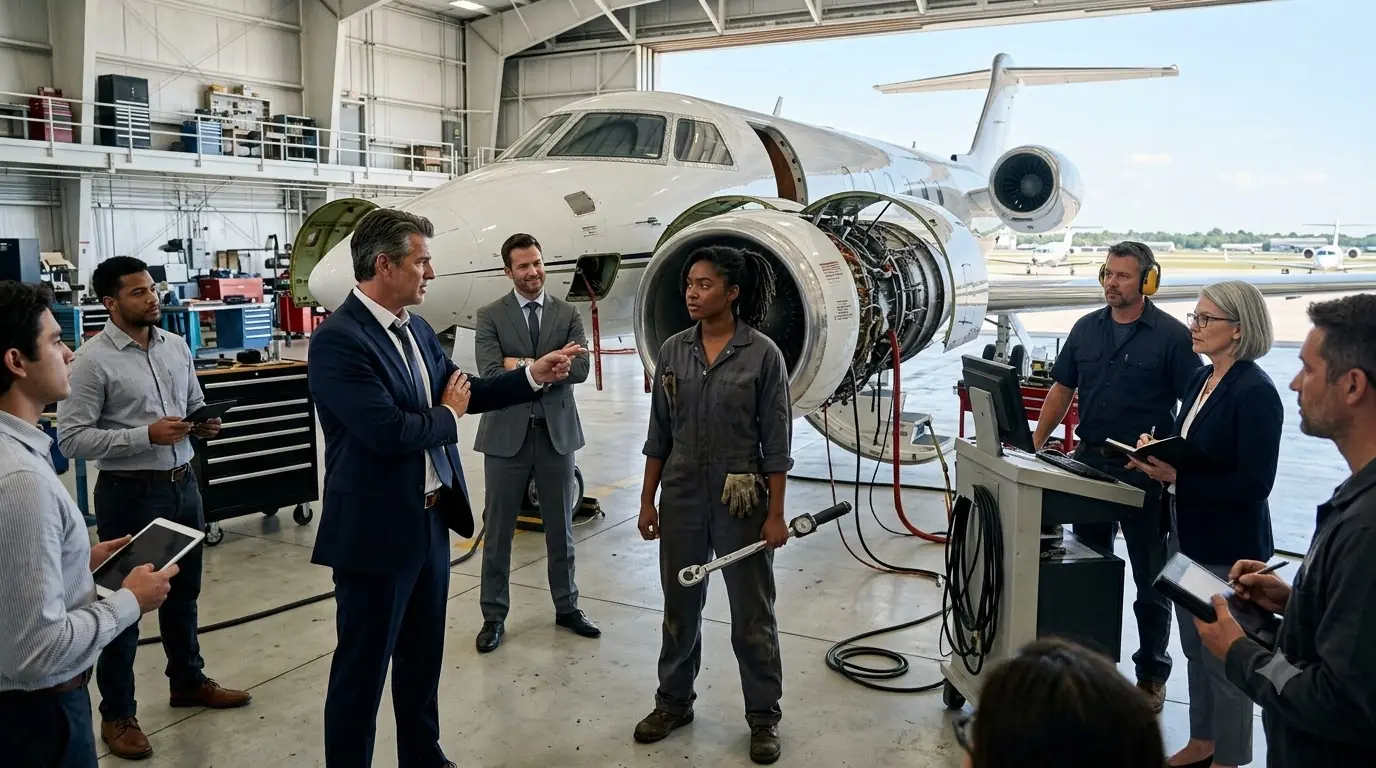
Nobody said a word, but Preston had a problem. His $100 million jet had been grounded for forty-eight days, fifty top mechanics had failed to fix it, and the only person who seemed to understand what was wrong was the young woman he had just humiliated. His jaw tightened because he had no good options left.
"Fine," he said at last. "Let her try. Film everything. If she breaks something, I want it on camera."
He thought he was setting a trap. What those cameras would actually record was the most humiliating moment of Preston Caldwell's career, and the beginning of the unraveling of everything he thought he controlled.
Caldwell Aerospace Industries sat on two hundred acres south of Houston, Texas. The campus had a private airstrip, six hangars, and enough buildings to feel like a small town. Preston liked to tell people that he had built the company from nothing, although the truth was that his father's oil money had paid for the first hangar and Preston had spent the following years expanding from that foundation.
The crown jewel of the operation was the CA-90, a next-generation executive jet with twin engines, a top speed just under the speed of sound, and a price tag of $100 million. Preston called it the future of private aviation. The Pentagon called it interesting enough to consider a $500 million defense contract.
That contract could transform Caldwell Aerospace from a successful private manufacturer into a company with national defense standing. All Preston had to do was demonstrate the CA-90 for a Pentagon delegation in sixteen days. There was only one problem: the CA-90 could not fly.
Forty-eight days earlier, during what should have been a routine test flight, both engines had flamed out at fourteen thousand feet. There had been no warning and no gradual loss of power, only sudden silence where the thunder of two turbines had been. The pilots barely managed to glide the aircraft back to the runway, and one of them resigned the next morning.
Since then, the jet had sat in Hangar Three like a beautiful and useless sculpture. Preston's internal team had attacked the problem first. Twelve senior mechanics who had helped build the aircraft from the blueprints pulled apart the engines, rebuilt systems, inspected components, and ran every diagnostic available.
The engines would start normally. They would run for roughly ninety seconds with clean readings across the board, and then both would shut down at almost the same time. The same fault code appeared again and again without revealing a clear root cause.
Preston brought in outside specialists. Engine-manufacturer representatives flew in from Connecticut, independent aerospace experts arrived from California, and a former Air Force turbine specialist came from Colorado. By the time the crisis reached its second month, fifty mechanics and engineers had worked on the aircraft and nearly $8 million had been spent on diagnostics, replacement parts, software updates, and competing theories.
Nothing worked. Ninety seconds, shutdown, fault code. Every time.
A whiteboard in Hangar Three became a monument to failure. Fuel contamination, software glitch, sensor malfunction, wiring fault, turbine-blade microfracture, pressure instability, and dozens of smaller theories covered the board. One by one, every idea was tested and crossed out in red marker.
The hangar smelled of jet fuel, hot metal, stale coffee, and frustration. Mechanics argued over tablets, engineers stopped making eye contact with one another, and department heads began protecting their reputations instead of solving the problem. Caldwell Aerospace stock had fallen twelve percent since the grounding, and Preston was losing millions through delays and contract penalties.
That was when Faith Brooks entered the story. She did not come through the front gate carrying a resume. She first appeared beyond the chain-link fence with a pair of borrowed binoculars.
Faith lived in a converted cargo van parked in a gravel lot three blocks from the Caldwell campus. The van had once delivered restaurant supplies. Now it served as her bedroom, kitchen, storage space, and workshop, all compressed into roughly sixty square feet.
Every morning she woke before sunrise and walked forty minutes to the Houston Public Library. She sat at the same table whenever it was available and read FAA technical publications, aviation-maintenance manuals, turbine-engine theory, fuel-system schematics, and whatever other engineering material she could access for free. She had been doing it for years, long before the CA-90 crisis made newspaper headlines.
Faith read the way some people breathed. After the library closed, she walked back toward the van, often stopping at junkyards along the way. She bought broken parts for almost nothing: small engines, generators, outboard motors, carburetors, pumps, and damaged electrical assemblies.
She carried them back to the van and repaired them under portable lights. When the machines worked again, she sold them to local mechanics for enough money to cover food, fuel, and the next batch of discarded parts. It was not stability, but it kept her learning and kept her alive.