The first thing I heard at the cabin was water. Not traffic, not somebody's television through a shared wall, not a delivery truck backing toward a loading dock before dawn.
Water moved against the narrow strip of stones beneath the porch, a soft, repetitive sound that had no schedule and demanded nothing from me.
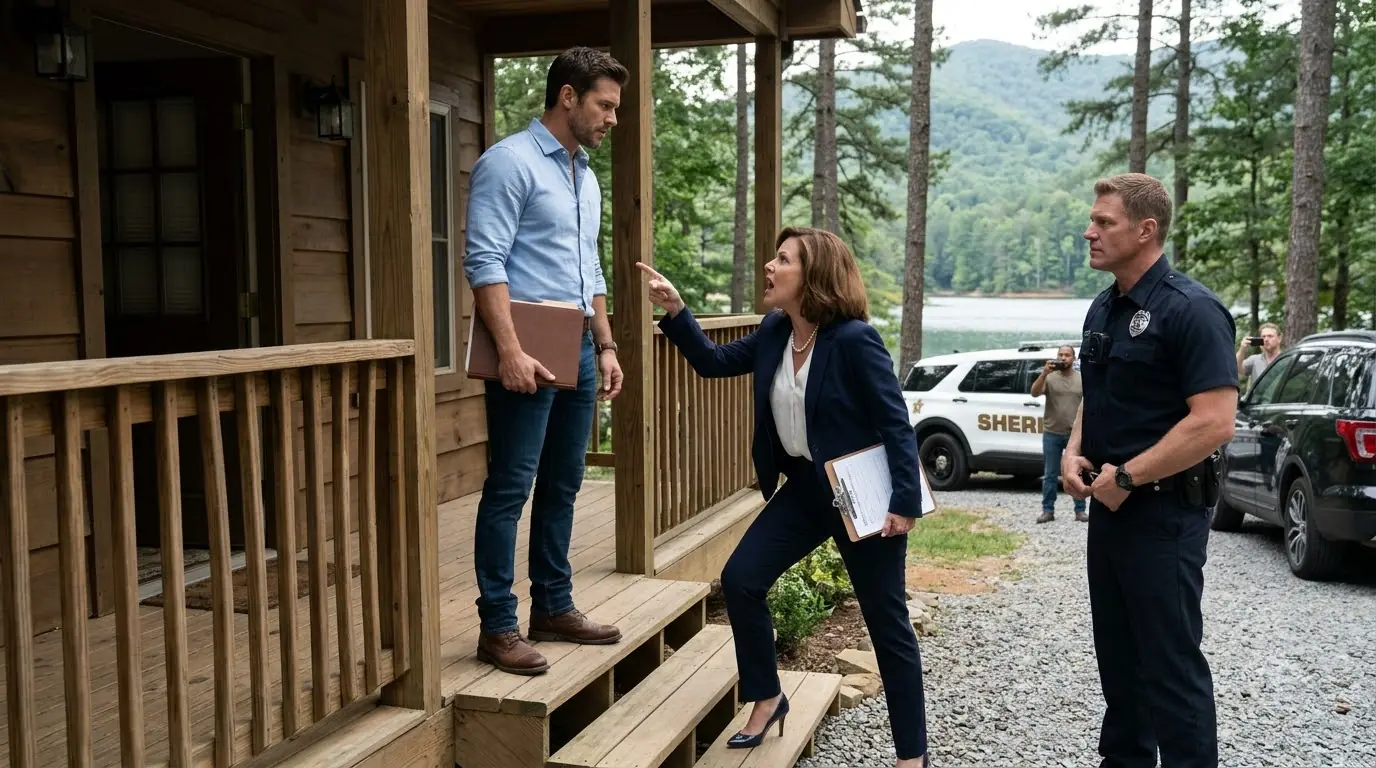
I stood there with my car keys in my hand, watching the last of the afternoon light settle over the North Carolina mountains, and told myself that I had finally found a place where nobody would tell me what to do.
Three days later, a homeowners association I did not belong to demanded eight hundred and fifty dollars and threatened to take me to court. Within two months, its president would persuade strangers to call me a criminal, send lawyers after me, and make a small mountain town feel less welcoming than the office I had left behind. She would claim that the only road to my property belonged to her neighborhood. There was one problem with that claim, and it would eventually change forty-seven families' understanding of the place they called home.
The road was mine.
My name is Alexander Meyers. I was thirty-eight when I bought the cabin, and for fifteen years before that I had worked as a structural engineer in Charlotte. I designed and reviewed things people expected to remain standing: warehouse additions, parking structures, public buildings, repairs to bridges that had carried more traffic than anyone had originally imagined. It was good work, meaningful work, and I had once loved the problem-solving of it more than almost anything else.
But meaningful work can become consuming without anybody noticing when the line gets crossed. A phone call during dinner becomes normal, then another on Saturday, then a client who expects you to answer while you are on vacation because last time you did. I had spent years telling junior engineers that a structure needed spare capacity, that no responsible designer should assume every member could carry its maximum load forever. Somehow I had failed to recognize the same principle in myself.
The final year in Charlotte had been especially ugly. We finished one difficult project only to discover that the next client expected us to recover eight months of delays in five weeks. I spent more time explaining timelines to people who had never opened a drawing than I spent making drawings myself. One Thursday night I woke up on my office sofa with a red mark across my cheek from a rolled blueprint and realized I could no longer remember the last uninterrupted afternoon I had taken for myself.
So I sold my townhouse, accepted a quieter consulting arrangement, and went looking for water and trees. My requirements were simple enough to make the real estate agent laugh: a roof that did not leak, a view that did not include another person's kitchen, and absolutely no homeowners association. I repeated the third requirement three times. She assured me that the two-bedroom lakefront cabin on seven-point-two acres was outside the boundaries of nearby Pine Ridge Estates.