“Get out of this neighborhood.”
The words cut across Hawthorne Lane just seconds before Susan Whitmore raised the garden hose and squeezed the brass nozzle.
A hard stream of cold water struck Marcus Reed across the chest.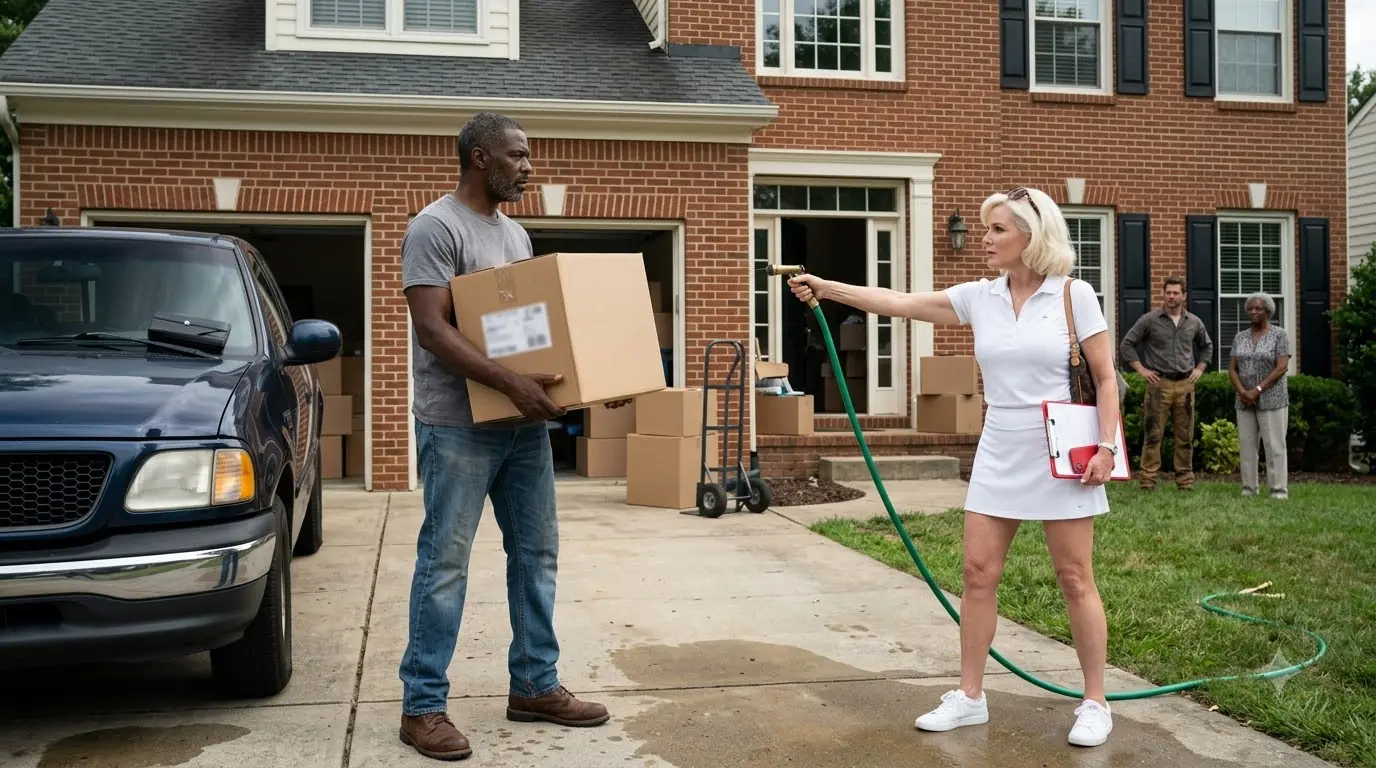
The force was not enough to knock him down, but it startled him badly enough that he shifted one foot backward on the polished concrete. Water spread instantly across his faded gray T-shirt, turning the fabric almost black against his shoulders and ribs.
Marcus looked down once.
Then back at Susan.
He did not shout.
He did not curse.
He did not step toward her.
That seemed to infuriate her more than anger would have.
“You heard me,” Susan snapped. “Leave.”
Marcus stood in the driveway of 814 Hawthorne Lane, the home he had legally purchased less than a month earlier and unlocked with his own key twenty minutes ago.
Behind him sat an aging dark blue Ford F-150 with fading paint along the hood, rust beginning around one wheel well, and a long scratch across the passenger door.
Several cardboard moving boxes remained stacked in the bed.
One was marked in black marker:
FAMILY. DO NOT BEND.
Marcus pointed toward the brick house behind him.
“I live here.”
Susan laughed.
It was not nervous laughter.
It was dismissive.
The kind of laugh meant to tell everyone listening that the idea itself was ridiculous.
“No, you don’t.”
Marcus looked at her for a long moment.
Then he said quietly, “Yes, ma’am. I do.”
Susan sprayed him again.
This time the stream struck his left shoulder, splashed against his neck, and caught the cardboard box in his arms.
Marcus turned his body instinctively, shielding it.
“Stop.”
That was the first time his voice carried.
Across the street, Daniel Harper stepped out of his open garage.
“Susan.”
She ignored him.
The hose hit the box again.
Water darkened the cardboard almost instantly.
Marcus’s expression changed.
Not because of his shirt.
Not because of the humiliation.
Because he knew exactly what was inside that box.
Photographs.
Albums.
Letters.
Thirty years of his life with his wife.
And one picture of his father that could never be replaced.
Marcus backed toward the porch.
“Susan, enough,” Daniel said more firmly.
Susan swung the nozzle briefly in Daniel’s direction.
“Stay out of this.”
Marcus moved quickly now, not toward Susan but toward the house.
The wet cardboard sagged beneath his hands.
He disappeared through the front door.
Susan stood in the driveway breathing hard.
Around Hawthorne Lane, doors had opened.
Curtains shifted.
Neighbors watched.
Nobody came closer.
A minute later, Marcus returned.
His shirt was still soaked.
His boots left dark prints on the front steps.
Something had changed in his face.
Susan expected rage.
Instead, she found restraint.
That frightened her more.
Marcus stopped at the edge of his porch.
“Mrs. Whitmore.”
She raised her chin.
“Do not touch me or my property again.”
Susan stared at him.
Then, almost mechanically, she reached for her phone.
Daniel saw it.
“Susan, don’t.”
She tapped the screen.
Marcus understood what she was doing before the phone reached her ear.
He had spent twenty-eight years in law enforcement.
He knew the pattern.
When some people failed to provoke the reaction they wanted, they invented one.
Susan turned away as the call connected.
Her voice changed immediately.
Seconds earlier she had been shouting.
Now she sounded frightened.
Small.
Careful.
“Yes,” she said into the phone. “I need police here.”
Marcus closed his eyes briefly.
Susan continued.
“There’s a man refusing to leave a property on Hawthorne Lane.”
Daniel stared at her.
“He lives there.”
Susan turned her back.
Marcus said nothing.
“Yes,” she told the dispatcher. “A Black man.”
There was a pause.