Gail Prescott called state wildlife officers on me for fishing in my own lake.
She stood at the top of the gravel boat ramp in a pressed white blouse, cream slacks, and sunglasses that made her look more like she was waiting for a valet than trying to have a neighbor arrested.
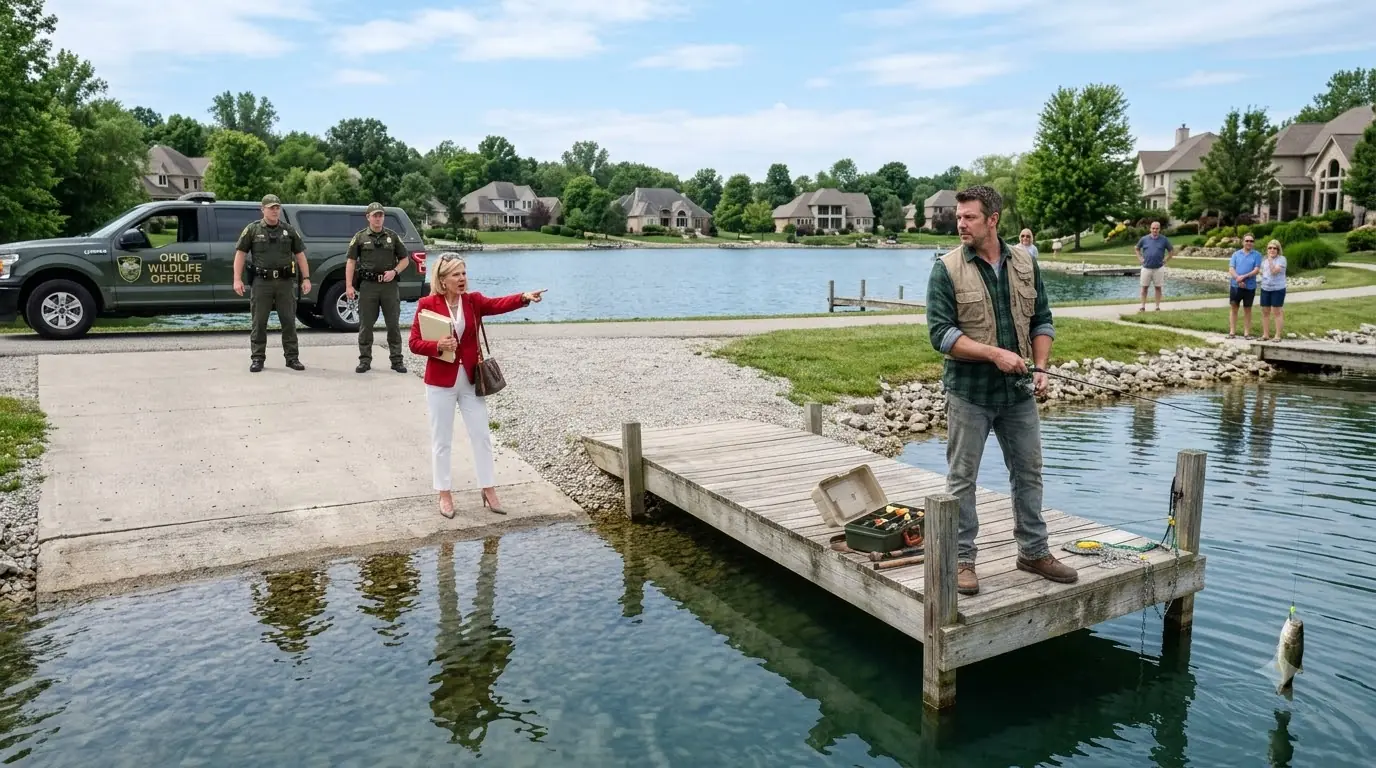
Her arms were crossed tightly over her chest, chin lifted, while a green-and-white state wildlife truck rolled to a stop behind her silver SUV.
I was standing on my grandfather’s dock with a fishing rod in one hand and three bass hanging from a stringer beside me.
Same dock.
Same water.
Same Saturday routine I had followed for most of my life.
The only difference was that Gail Prescott had decided that morning belonged to her.
Two uniformed wildlife officers stepped from the truck.
She did not wait for either of them to ask what was happening.
“That’s him,” she called.
Her voice traveled cleanly across the water.
“He’s been poaching from our lake for months. He has been warned repeatedly. He knows the rules and refuses to follow them.”
One of the officers looked toward me.
I stayed where I was.
Gail pointed at my stringer.
Then my tackle box.
Then at me.
“He’s not a member of the homeowners association. He has no right to use this water. We’ve issued violations, fines, and a formal trespass notice. He ignores everything.”
She lowered her voice slightly when the lead officer reached the bottom of the ramp, as though volume had been the only thing separating outrage from professionalism.
“I have documentation,” she said. “This is theft of an HOA resource and repeated criminal trespass. I want him removed today, and I want charges filed.”
The lead officer looked at the fish.
Then at the dock.
Then at Gail.
Then he started walking toward me.
What happened next was the moment Gail had spent weeks trying to manufacture.
Uniforms.
Authority.
Witnesses.
Me standing on the defensive.
Except there was one fact she had never bothered to learn.
The state wildlife division already knew exactly who I was.
But to understand why that mattered, you have to go back more than fifty years, long before Gail Prescott had an HOA logo, a clipboard, a petition, or any reason to believe she had authority over the water behind my house.
My grandfather, Raymond Anderson, bought the land in 1972.
Twelve acres in rural Wisconsin.
Back then, it was mostly timber, open grass, and a gravel drive leading to a small farmhouse that had already been standing for thirty years.
The lake was the reason he bought it.
Three acres of spring-fed water sat almost perfectly in the middle of the parcel, deep enough at the center for bass and cool enough that even during the worst August heat, the water remained clear.
Granddad used to say the lake had its own temperament.
Wind from the west made the bass disappear.
Cold spring mornings brought bluegill into the shallows.
If the frogs went silent after sunset, rain was coming before morning.
He knew all of it.
When I was six, he taught me to cast.
At eight, he taught me to tie a clinch knot.
At eleven, he made me clean my own fish for the first time and laughed when I nearly threw up.
When I was fourteen and my parents separated, he did something more important.
He took me fishing.
We sat at the end of the dock for almost two hours without speaking.
No advice.
No promises that adults would sort everything out.
No speech about families.
He handed me a rod, opened a thermos, and let the water occupy the space where words would have made things worse.
That was Granddad.
He did not believe every problem required language.
Sometimes you just sat beside someone long enough that they understood they were not alone.
The dock was his work.
Pine decking.
Cedar posts.
A handrail along one side that stopped abruptly about two-thirds of the way down because, according to him, he was “getting to it.”
He never did.
For decades, nobody cared.
The unfinished rail became part of the place.
When Granddad died, he left me the twelve acres.
The house.
The woods.
The dock.
The lake.
Everything.
His deed was old.
Typed on thick bond paper with a legal description full of section references, bearings, distances, and language most people would never voluntarily read.
Near the end was the sentence that would eventually matter more than anything Gail Prescott ever printed on HOA letterhead:
Including the spring-fed lake and all riparian rights thereto.
The lake was not merely next to Granddad’s parcel.
It was part of the parcel.
Named.
Conveyed.
Surveyed.
Recorded.
When I inherited the land, I moved back permanently.
I repaired the farmhouse roof.
Replaced old wiring.
Rebuilt part of the dock where winter ice had lifted two posts.
I cleared fallen timber after storms and kept enough of the surrounding woods untouched that deer still crossed behind the house in the mornings.
And I fished.
Almost every Saturday.
For years, my life around that lake was uneventful.