At six o’clock on a Friday morning, Brenda Kowalski parked her white Lexus sideways across my driveway and told me she was prepared to seize my property by force.
The sun had barely cleared the maple trees along Meadowlark Road.
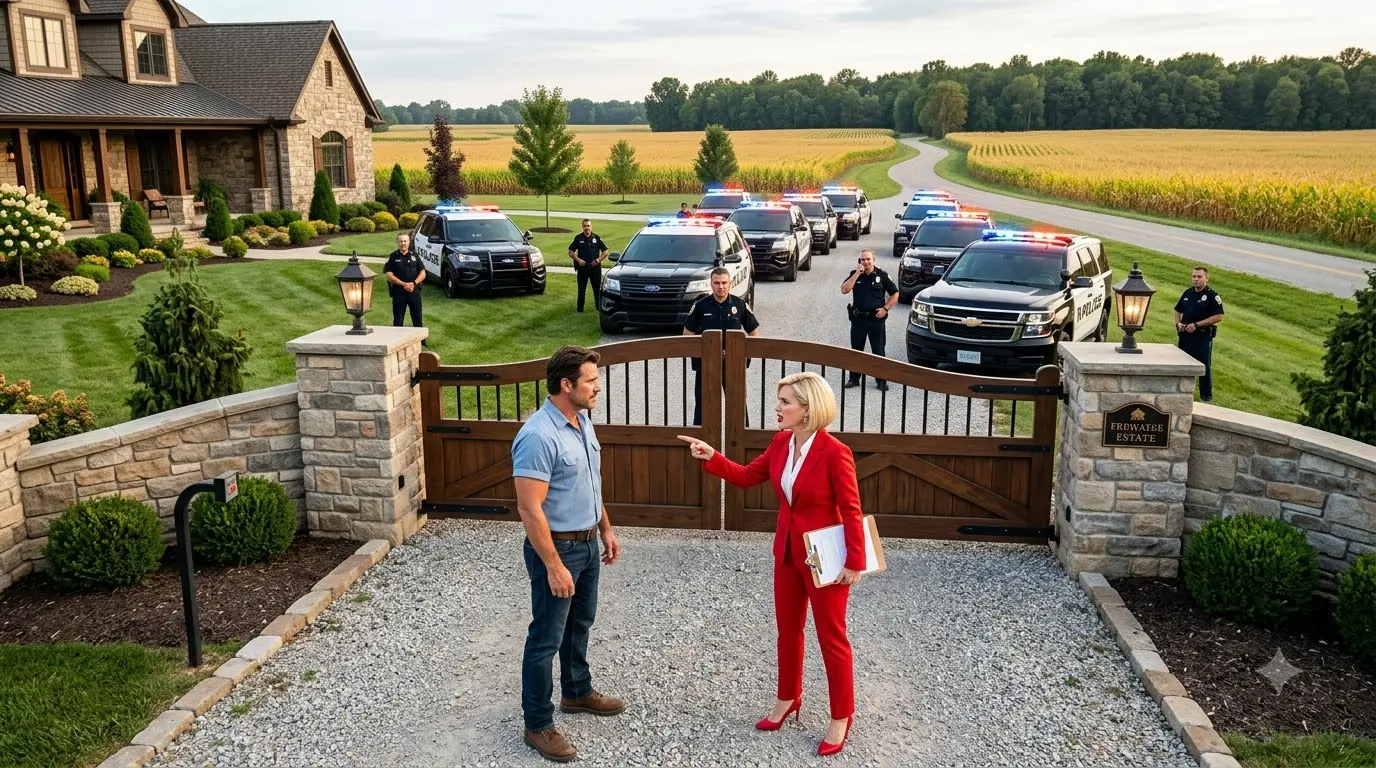
Dew still covered the grass. I had one tool case in the back of my work truck and another in my hand because I was supposed to be downtown by seven to finish a restaurant service-panel replacement before the kitchen crew arrived.
Instead, I was standing twenty feet from a woman who had spent the previous eighteen months manufacturing violations against me.
Her blonde bob, normally stiff enough to survive a hurricane, had strands falling loose around one ear. She was wearing a navy blazer over yesterday’s-looking blouse, and the circles beneath her eyes suggested she had not slept much.
That made two of us.
The difference was that I had spent most of the night reading the document that had finally explained everything.
Brenda did not know that yet.
“This ends today,” she shouted.
Her voice carried down the quiet road.
A light came on in Tom Hendricks’s upstairs window across the way.
I put the tool case on the ground.
“Move your car, Brenda.”
“No.”
“I have work.”
“You have been given eighteen months to comply voluntarily.”
“With what?”
“With Willowbrook authority.”
“My property is not in Willowbrook.”
She pointed at me as though I were a child who had failed to understand a simple instruction.
“That technical argument has been addressed.”
“No, it hasn’t.”
“You don’t get to decide that.”
“Neither do you.”
Her face changed.
That was something I had learned to recognize.
Brenda Kowalski had several versions of anger.
There was board-meeting irritation, controlled and bloodless.
There was performative outrage, usually accompanied by a clipboard.
Then there was this.
Desperation.
“You have interfered with community safety investigations,” she said. “You have harassed licensed professionals. You have intimidated board members, disrupted legitimate utility inspections, and spread defamatory information about Willowbrook’s finances.”
Every sentence was designed to sound official.
None answered the basic question.
What authority did her HOA have over my two-point-three acres?
I reached into my pocket.
Brenda’s eyes followed my hand.
I pulled out my phone.
“I’m recording now.”
“Good.”
She stepped closer.
“Record this. If you continue refusing lawful community compliance, Willowbrook will take whatever steps are necessary to secure the property.”
“Secure it how?”
“Through enforcement.”
“What does that mean?”
“You know exactly what it means.”
“No, Brenda. Say it.”
Her nostrils flared.
Behind her, another window opened.
Mrs. Henderson from two houses down appeared in a robe.
Brenda didn’t notice.
“We will seize your property by force if we have to.”
There it was.
Clear.
Recorded.
I almost smiled.
Not because the threat was funny.
Because after eighteen months of fake citations, bogus inspections, fraudulent surveys, anonymous complaints and whispered attacks against my business, Brenda had finally said the quiet part in front of a camera.
And she still had no idea what was sitting inside the folder on my kitchen table.
I’m Dalton Martinez.
I was forty-five when I bought the farmhouse on Meadowlark Road.
I had been an electrician and small commercial contractor for almost twenty years, which meant I made a living finding problems other people could not see.
A breaker tripped.
A light flickered.
A motor overheated.
People looked at the visible symptom.
I looked upstream.
Electricity had rules.
It did not care about confidence, titles or expensive clothes.
If the wiring diagram said one thing and somebody’s story said another, I trusted the diagram.
That habit probably saved my property.
My marriage ended two years before I moved to Meadowlark Road.
No dramatic betrayal.
No screaming courtroom battle.
My former wife, Andrea, and I reached the point where both of us were tired of being disappointed by each other. She moved to Raleigh. Our son, Mateo, was already in college by then, so the divorce was sad but relatively clean.
The apartment I rented afterward was not.
I lived beneath a couple with a toddler who apparently trained for Olympic sprinting between eleven at night and three in the morning.
The HVAC compressor outside my bedroom window sounded like a garbage truck trying to digest a shopping cart.
Management sent emails if my work van remained in guest parking more than twenty minutes.
After eighteen months, I started looking for a house.
I wanted three things.
Space.
A detached garage.
No homeowners association.
The farmhouse appeared on a Thursday afternoon.
Built in 1948.
White siding weathered gray at the corners.
Deep front porch.
Two-point-three acres.
Detached two-car garage with a workshop addition that needed rewiring so badly I considered the defects a personal invitation.
There were mature oaks, an old pear tree, honeysuckle growing along the back fence and enough yard for the vegetable garden I had never been able to keep in an apartment.