I had spent twelve years building my detailing business before I finally bought the yellow Lamborghini.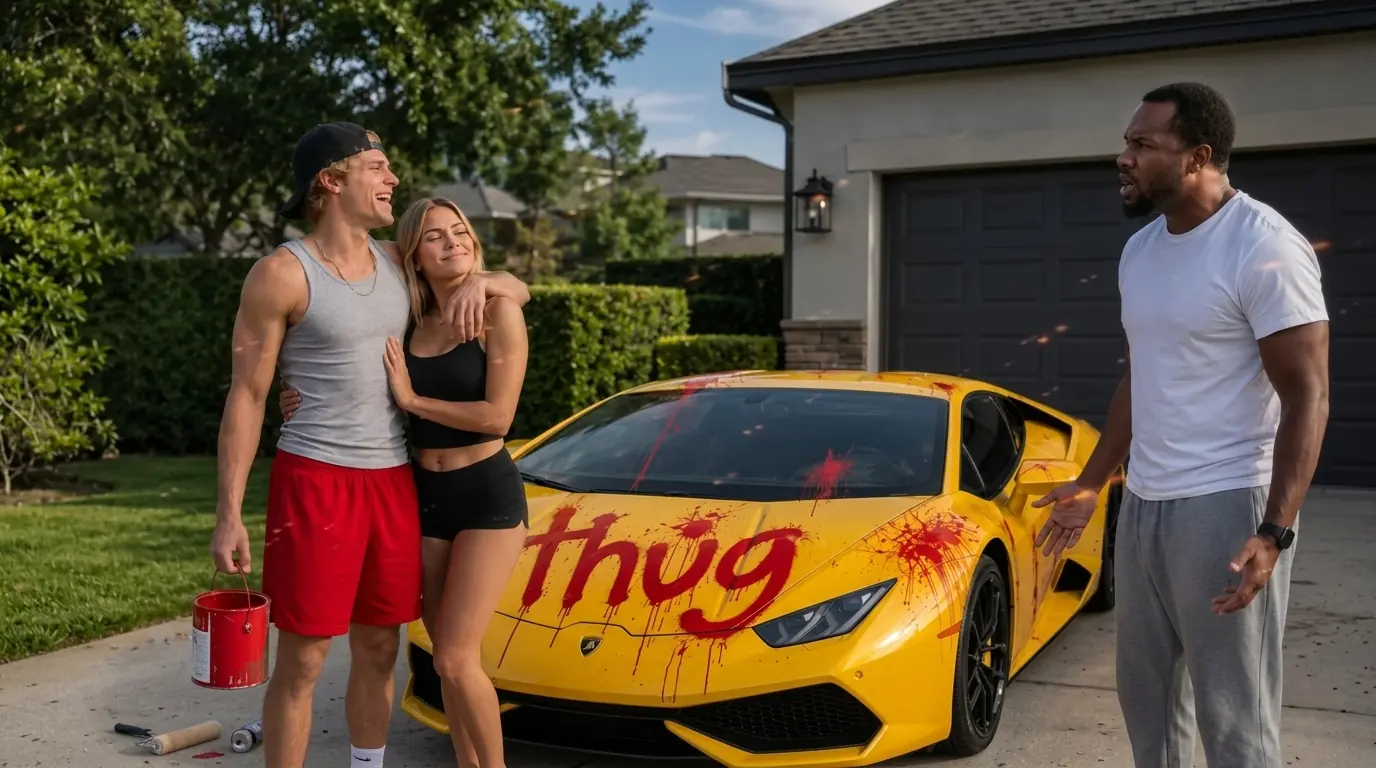
Twelve years.
People saw the car and imagined overnight success. They saw the bright yellow paint, the low body, the carbon fiber, the sound of the engine starting in the morning, and they assumed money had simply appeared in my life.
They did not see the beginning.
They did not see me working out of a rented garage with a leaking roof and one fluorescent light that flickered whenever it rained.
They did not see the winter mornings when I arrived before sunrise and filled buckets with water so cold my fingers went numb before the first customer arrived.
They did not see me sleeping four hours a night because I worked another job while trying to keep the business alive.
They did not see the rejected loan applications.
They did not see customers look at my tiny shop, look at me, and hesitate before handing over the keys to an expensive car.
They did not see the weekends I missed, the vacations I never took, or the birthdays I attended late because somebody needed their vehicle finished Monday morning.
Slowly, one customer became ten.
Ten became fifty.
Then people started recommending me.
A local collector brought me a Porsche.
Another customer trusted me with a Ferrari.
A dealership began sending difficult paint-correction jobs my way.
Eventually, my little rented garage became a real shop with employees, proper lighting, lifts, detailing bays, security cameras, and my company's name across the front.
I remembered standing outside that building on the first morning after we installed the sign.
That meant more to me than almost anything I owned.
The Lamborghini came later.
I did not buy it because I needed strangers to think I was successful.
I bought it because I had spent years restoring other people's dream cars while quietly wondering whether I would ever own one myself.
So when the opportunity finally came, I bought the yellow Lamborghini.
It was not just a car.
It was proof.
Proof that every late night had meant something.
Proof that every rejected loan application had not stopped me.
Proof that every customer who doubted me before eventually trusting me had helped build something real.
I knew exactly what that machine represented because I understood every inch of its finish.
The paint had been customized.
The protective coating had been applied carefully.
Certain carbon-fiber pieces had been upgraded.
The entire car had been corrected until the yellow looked almost liquid beneath direct sunlight.
I did not park it outside every day.
I did not rev the engine for attention.
Most mornings it sat quietly in my garage.
But on that particular morning, I had planned to drive it to my shop.
I stepped outside carrying coffee and my laptop bag.
For several seconds, my brain refused to understand what I was looking at.
Something red was dripping down the hood.
I stopped walking.
My coffee remained halfway toward my mouth.
A thick line of red paint crossed the yellow finish.
Then another.
Then another.
The paint had been poured across the hood, splattered onto the windshield, dragged across the driver's-side fender, and kicked onto the door.
Across the center of the hood, someone had painted one hateful word in huge uneven letters.
I stared at it.
For a moment, everything around me became strangely quiet.
Then I heard laughter.
Beside the car stood my neighbor's nineteen-year-old son.
He was laughing with his girlfriend.
He still had the open paint can in his hand.
Red paint covered two of his fingers and dotted the front of his shoes.
His girlfriend had her phone raised toward him.
She was recording.
He leaned against the damaged fender like he was posing beside something he had accomplished.
When he noticed me, he smiled wider.
"Morning."
His girlfriend laughed.
I looked at the paint can.
Then at him.
Then at my car.
He lifted the can slightly like he was making a toast.
"What?" he said. "You don't like the new color?"
His girlfriend nearly doubled over laughing.
I did not answer.
He started mocking my business.
He said everybody knew people like me exaggerated how successful they were.
He said the Lamborghini was probably rented.
He said maybe I had borrowed it for social media.
He said I had bought it because I wanted the neighborhood to believe I was somebody important.
I put my coffee on the driveway.
Then I took out my phone.
The moment he saw the camera, he laughed harder.
"Yeah, record me."
So I did.
His hand.
His shoes.
The red streaks.
The damaged mirror.
The splatter pattern across the driveway.
The hood.
The fender.
His girlfriend filming.
Everything.
That was when his mother came storming across the lawn.
She did not look shocked.
That was the first thing I noticed.
She did not look at the ruined Lamborghini and ask what happened.
She did not ask her son why he was holding a paint can.
She did not ask why his hands were covered in red paint.
She walked directly toward me.
"You probably did this yourself."
I stared at her.
"For attention," she added.
Her son laughed.
His girlfriend kept recording.
I felt my chest tighten.
The easiest thing in the world would have been to yell.
Part of me wanted to.
But twelve years of running a business had taught me something important.
The moment somebody wants you angry, anger becomes dangerous.
So I stayed still.
I continued taking pictures.
The Lamborghini was worth more than their house.
The custom paint alone had taken months.
The finish had been built in layers, tested beneath shop lights, cured, corrected, polished, and protected with the kind of precision most people never understand because they only see the shine when the work is finished.
I knew red paint dripping into vents and panel gaps was not a simple cleaning job.
I knew exactly how expensive this was becoming.
The son apparently did not.
He stepped closer.
"Call the cops," he said.
I looked at him.
He smiled.
"Nobody's going to believe you over us."
His mother folded her arms.
Then she said something loud enough for several houses to hear.
"People like you shouldn't own cars like that in this neighborhood anyway."
Everything changed.
Until that sentence, somebody could have tried to describe what happened as a stupid teenager committing vandalism.
Cruel.
Expensive.
Criminal.
But stupid.
Her sentence revealed something deeper.
This was not only about a car.
It was not only jealousy.
It was not only a spoiled nineteen-year-old trying to impress his girlfriend.
It was about who they believed belonged there.
I looked toward the surrounding houses.
Curtains moved.
People were watching.
A garage door across the street was partially open.
Someone stood behind it.
Another neighbor watched through an upstairs window.
Nobody came outside.
Nobody said anything.
That silence told me something too.
This family was used to people staying quiet.
I called the police.
Then I called my company attorney.
The son kept joking while I made the first call.
He stopped joking during the second.
I deliberately mentioned the market value of the Lamborghini.
I mentioned the custom finish.
I mentioned security footage.
Then I mentioned that the repair amount could potentially turn what he considered a prank into a serious property offense.
His smile flickered.
His mother noticed.
She stepped closer to me.
Her voice became quieter.
"Delete whatever you recorded."
I backed away.
"No."
"I'm telling you to delete it."
"Everything is already uploading."
She looked at my phone.
"Uploading where?"
"Cloud storage."
For the first time that morning, I saw fear in her face.
It lasted maybe one second.
Then anger covered it.
She understood something her son had not understood yet.
They could no longer simply talk louder than me and make reality disappear.
The police arrived minutes later.
Two officers separated everyone.
One officer spoke with me while the other questioned the son.
His story changed almost immediately.
He claimed he had found the paint can near my driveway.
He said he had picked it up because he was curious.
His girlfriend agreed.
She said they had walked outside only after noticing the damaged car.
I looked at the phone still in her hand.
One officer noticed it too.
"Were you recording?"
She lowered it.
"No."
The officer looked at her.
"I saw you holding the phone when we arrived."
She hesitated.
"I was just texting."
The son interrupted.
"She didn't record anything."
That was his second mistake.
The officer asked whether he could see the phone.
She refused.
Then he looked toward the surrounding houses.
"Anybody around here have cameras?"
That question changed the neighborhood.
At first, nobody moved.
Then an older man across the street slowly opened his front door.
"I do."
Another neighbor stepped out.
"My doorbell camera might've caught something."
Then another garage opened.
Within ten minutes, people who had been watching silently were suddenly checking phones and security systems.
There was doorbell footage.
Garage-camera footage.
A camera mounted above somebody's side gate.
Then a delivery driver who had passed through the neighborhood that morning returned after one neighbor called his company.
His dash camera had recorded part of the street.
Every angle showed the same thing.
My neighbor's son walking toward the Lamborghini carrying paint.
The footage was worse than I expected.
He had not lost his temper for thirty seconds.
He had spent almost ten minutes damaging the car.
He poured paint slowly across the hood.
He used a brush to form the word.
He stepped backward to admire it.
His girlfriend moved around the car recording different angles.
Then he kicked the side mirror.
Once.
Twice.
The second kick cracked the housing.
Afterward, he posed beside the hood.
But the worst part appeared in footage from across the street.
His mother was standing on her porch.
Watching.
She had been there almost the entire time.
At one point, her son looked toward her.
She clapped.
When the officer replayed that section, nobody spoke.
The mother finally shouted that the footage was misleading.
Nobody answered her.
There was nothing to answer.
The camera had done what the neighbors had been too frightened to do.
It had spoken plainly.
Her son's face changed when one officer told him to place his hands behind his back.
He looked toward his mother.
"Mom?"
She immediately stepped forward.
"You cannot arrest him."
The officer told her to stay back.
"This is ridiculous. He's nineteen."
"Ma'am, stay back."
"It was paint."
The officer looked at the Lamborghini.
Then at her.
"That's going to be for the court to decide."
Her son finally stopped laughing when they told him the repair value could make the charge much more serious than he expected.
His girlfriend started crying.
His mother did not.
She pointed at me.
"This isn't over."
My attorney was still on speakerphone.
He heard her.
She continued.
"I'll make sure every customer you have knows what kind of person you are."
I looked toward the officer.
"Did you hear that?"
He nodded.
My attorney told me not to respond.
So I didn't.
That silence seemed to make her angrier than anything I could have said.
She screamed while her son was placed inside the cruiser.
But something had changed around us.
The neighbors were no longer hiding behind curtains.
They were standing outside.
Some were recording her.
Others were talking quietly to officers.
For the first time, she was the one being watched.
The Lamborghini was transported to a specialist facility that afternoon.
The first estimate arrived several days later.
Approximately $184,000.
Even I stared at the number for several seconds.
The red paint had seeped into vents.
Sensors had been damaged.
Carbon-fiber trim was stained.
The protective coating was destroyed.
The mirror housing was cracked.
The driver's door had been dented.
Several panels needed removal.
Electronic systems required recalibration.
Parts had to be ordered.
Sections of the custom finish had to be rebuilt from the base layer upward.
My insurer covered the repairs.
Then the claims representative said something very calmly.
"We intend to recover every dollar."
That changed the financial reality for my neighbor's family.
Their son had laughed while holding a paint can that morning.
Now his family was potentially facing a claim larger than their mortgage.
That evening, his mother called me.
I recognized the number.
I answered only after starting a recording and confirming with my attorney how to handle further communication.
She did not apologize.
She did not ask how much damage had been done.
She did not ask whether we could sit down and resolve things.
Her first sentence was a demand.
"You need to withdraw the charges."
I said nothing.
"And tell your insurance company you're not pursuing us."
"I don't control what the insurance company does."
"Yes, you do."
"No."
She exhaled loudly.
Then her voice changed.
Suddenly she sounded friendly.
Almost reasonable.
She offered me five thousand dollars.
"If you tell the police this was a misunderstanding, I'll give you five thousand cash."
I actually thought I had misunderstood her.
"You want me to lie to the police?"
"I'm saying everybody got emotional."
"Your son poured paint on my car."
"He's a kid."
"He's nineteen."
"Exactly. He's young. Young people make mistakes."
I remembered her standing on the porch.
I remembered the footage of her clapping.
"No."
Her friendliness disappeared.
Then came the crying.
She said I was destroying her son's future.
She said he had college plans.
She said one stupid mistake should not follow him forever.
She said I was being heartless.
I reminded her that she had watched him destroy something I had spent years earning.
Silence.
Then her voice dropped.
"You don't know who you're dealing with."
My attorney heard every word.
The next morning, we filed for a protective order.
The call was added to the intimidation report.
The case was no longer only about vandalism.
It now included threats, pressure, and an attempt to silence the victim.
And once investigators started looking more closely at that family, old stories began resurfacing.
The first involved a private school.
Their son had previously been expelled after vandalizing a teacher's car.
His mother had pressured the school and the teacher until the matter disappeared quietly.
Then investigators found complaints involving rental properties.
Delivery drivers.
Contractors.
A former classmate.
A landscaper.
People had complained about the son damaging property, making threats, or harassing them.
Again and again, his mother appeared afterward.
Sometimes she offered money.
Sometimes she threatened lawsuits.
Sometimes she threatened jobs.
Sometimes she simply exhausted people until they decided fighting back was not worth it.
My Lamborghini became the first incident they could not bury.
Then former victims began contacting police.
Two came forward first.
Then four more.
One had photographs.
Another had text messages.
Someone had repair invoices.
Another person had audio recordings.
Each story sounded different on the surface.
Underneath, they were almost identical.
He caused harm.
She protected him.
The victim was pressured.
The incident disappeared.
For years, that system had worked.
This time, there was too much evidence.
The criminal hearing was where their old power finally began collapsing.
His mother entered the courthouse wearing designer clothes and carrying herself like she was attending a meeting she expected to control.
Her son looked completely different.
No backwards hat.
No girlfriend beside him laughing.
No smirk.
He wore a suit that seemed slightly too large.
His shoulders remained tight.
His eyes stayed mostly on the floor.
Every few minutes, he looked toward his mother.
I recognized the look.
He still expected her to fix everything.
Then the prosecutor played the girlfriend's video.
The courtroom watched him walk toward my Lamborghini.
They watched him open the paint.
They watched him laugh.
They watched him pour red paint across the yellow hood.
They heard him mock my business.
They heard him say I probably rented the car.
They watched him pose.
Then came the audio nobody on their side wanted played.
His mother's voice.
"Make the letters bigger."
Her lawyer stood immediately.
He objected.
The recording continued after the judge ruled.
Her voice was unmistakable.
For the first time, I looked toward the judge.
His expression hardened.
Every second of video removed another excuse.
This had not been an accident.
It had not been impulsive.
It had not been a misunderstanding.
It had been deliberate.
Then the girlfriend testified.
Her parents had hired an attorney shortly after the arrest.
Apparently, once they understood the seriousness of the case, they wanted their daughter separated from it as quickly as possible.
She admitted the vandalism had been planned.
The son had seen a photograph of my Lamborghini online.
He became angry.
Not because I had done anything to him.
Because I owned it.
He told friends I was showing off.
He said he wanted to embarrass me.
He wanted to make a video.
He wanted people online to laugh.
Then she revealed the detail that destroyed the remaining defense.
His mother had suggested the word painted across the hood.
The courtroom became completely quiet.
The son turned toward his mother.
His expression was not anger at first.
It was disbelief.
For the first time in his life, maybe he understood that the person who had always protected him had helped create the situation that could now send him into custody.
The shield had cracked.
And it had cracked publicly.
The judge denied leniency.
He described the attack as planned.
He referenced the intimidation.
He referenced the prejudice behind the act.
He referenced the extraordinary financial damage.
The son received time in custody, followed by years of probation.
He was ordered into counseling.
He received hundreds of hours of community service.
And the restitution order would follow him long after his release.
His driver's license was suspended.
He was prohibited from contacting me.
He was prohibited from entering my street.
When the judge finished reading the conditions, the young man who had once told me nobody would believe me sat completely still.
His mother faced separate charges.
Conspiracy.
Intimidation.
Participation in attempts to conceal prior offenses.
Her confident expression finally disappeared when deputies approached her chair.
But criminal court was only one part of the consequences.
The civil case became even more devastating.
My insurance company sued for the repair costs.
Then came loss of use.
Diminished value.
Legal expenses.
Additional business losses connected to canceled appearances and events.
Their attorney tried to negotiate quietly.
Months earlier, that probably would have worked.
Now too many victims were involved.
Too many records existed.
Too many people were watching.
The court froze certain assets after concerns were raised that money might be moved.
Their luxury SUV disappeared from the driveway.
The mother's jewelry collection was listed among assets.
A lien was placed against the house.
For years, that family had measured people by what they owned.
Cars.
Homes.
Clothes.
Jobs.
Neighborhood status.
Now the same family that mocked my success had to sell pieces of its own lifestyle to pay for the consequences of what they had done.
But money was not the part that changed the neighborhood most.
The mother had been president of the neighborhood association.
For years, she had used that position like a private throne.
She decided which complaints mattered.
She pressured residents she disliked.
She challenged renovations.
She threatened fines.
She treated minor disputes like opportunities to remind everyone who had influence.
Most residents tolerated it because fighting her seemed exhausting.
Then the Lamborghini case exposed her.
The board scheduled an emergency meeting.
I expected maybe twenty people.
The room was packed.
Some residents stood along the walls.
Others waited outside.
She sat in the front row.
For once, she was silent.
An elderly widower stood first.
He described being threatened repeatedly because of a porch light she disliked.
Then a young couple spoke.
They said they had received selective complaints after refusing to sell their home to one of her friends.
A single mother described how the son harassed delivery drivers coming to her house until several drivers stopped wanting to accept deliveries there.
A contractor brought printed emails.
Another resident brought photographs.
Someone else carried an entire folder.
One by one, people who had stayed quiet for years finally spoke.
The board members looked uncomfortable.
They should have.
For years, they had mistaken fear for order.
They had mistaken silence for peace.
They had called intimidation "strong leadership."
That night, the illusion ended.
The board voted unanimously.
She was removed as president.
Then removed from every committee.
Her access to community accounts was revoked.
Her name disappeared from every position that had once given her authority.
She sat there while people she had dismissed for years finally described what she had done to them.
Nobody shouted at her.
Nobody needed to.
The record was enough.
Her son's social life collapsed almost as quickly.
The friends who had encouraged his behavior disappeared when restitution became real.
Nobody wanted to be connected to the video anymore.
The college that had accepted him withdrew its offer.
His employer fired him after learning he had lied about the arrest.
His girlfriend ended the relationship.
Then she testified against him during the civil proceedings.
He had damaged my Lamborghini because he wanted attention.
The attention stripped away nearly everything he valued.
And even after release, part of every paycheck he earned could be taken toward the judgment.
Potentially for decades.
Months passed before I saw my Lamborghini again.
The restoration was extensive.
Panels were replaced.
Carbon fiber was repaired.
Sensors were rebuilt and recalibrated.
The damaged finish was stripped and reconstructed.
The protective coating was reapplied.
Every detail was corrected.
Then one afternoon, a transport truck stopped outside my house.
The Lamborghini rolled slowly down the ramp.
Neighbors came outside.
The yellow paint looked perfect.
Deep.
Clean.
Bright beneath the afternoon sunlight.
No red paint.
No cracked mirror.
No hateful word.
Nothing visible remained from that morning.
I thought I would feel victorious.
Instead, I felt something heavier.
Because I remembered exactly where every mark had been.
I remembered the red paint running toward the windshield.
I remembered the laughter.
I remembered his mother's voice.
Most of all, I remembered looking toward the neighboring houses and seeing curtains move while nobody came outside.
I invited several neighbors closer.
I thanked the people who had eventually provided footage.
Some looked embarrassed.
One man admitted he had seen everything from the beginning.
He had footage too.
He simply had not wanted to get involved.
"You were involved the moment you saw it," I told him.
He looked at me for several seconds.
Then he nodded.
He did not argue.
That conversation stayed with me.
Because the biggest lesson was no longer about my Lamborghini.
It was about silence.
That family had controlled people because everyone assumed somebody else would eventually stand up.
Nobody wanted the inconvenience.
Nobody wanted the argument.
Nobody wanted to become the next target.
So everybody stayed quiet.
And every quiet person made that family slightly more powerful.
Truth ended what silence had protected.
I could have stopped there.
The car was repaired.
The criminal case had consequences.
The civil case was moving forward.
The neighborhood association had removed her.
But something bothered me.
I owned a business.
I had lawyers.
I had insurance.
I had cameras.
I understood documentation.
What happened to somebody who had none of those things?
A delivery driver?
An elderly neighbor?
A landscaper?
A young mechanic?
Someone working alone who could not afford to spend thousands of dollars proving what happened?
So instead of revenge, I decided to build something useful.
My company began installing basic security cameras for elderly neighbors and families who could not afford them.
Then we created a small legal fund for delivery drivers, contractors, mechanics, and service workers facing harassment from people who assumed a uniform or work van made somebody easy to intimidate.
At first, I thought maybe a few people would contact us.
Three delivery drivers called during the first month.
Then a landscaper.
Then a young mechanic who had been accused of stealing tools from a garage he had never entered.
We helped people preserve evidence.
We connected them with attorneys.
We helped install cameras.
Sometimes proof mattered more than sympathy.
That became the part of the entire story I was proudest of.
The vandalism caused months of stress.
It disrupted my business.
It damaged something I had worked years to afford.
But their attempt to humiliate me accidentally strengthened the same community they had spent years intimidating.
That outcome hurt them more than anything I could have done in anger.
Eventually, the mother lost the house.
At sentencing, she asked the judge for mercy.
She claimed one mistake had destroyed her family.
The judge corrected her.
It had not been one mistake.
It had been years of intimidation.
Years of cover-ups.
Years of cruelty.
Then a deliberate crime committed because they believed consequences were for other people.
Her son sat behind her staring at the floor.
Neither of them ever gave me what I considered a sincere apology.
They apologized when the consequences reached them.
That is different.
Months after the legal case ended, I parked the Lamborghini outside my shop during a community event.
People walked around it.
Some admired the paint.
Some asked about the repairs.
Some wanted to know whether I was still angry.
I had to think before answering.
Of course I had been angry.
Anyone would be.
But anger was not what carried me through the case.
Discipline did.
Documentation did.
Evidence did.
Community did.
That family wanted me to lose control.
They wanted me to scream.
They wanted me to threaten them.
They wanted one ugly moment they could record and use to rewrite everything that happened before it.
I refused to give them that moment.
Their cruelty created the evidence.
Their arrogance created the witnesses.
Their threats created additional charges.
Their history created the pattern.
I simply refused to erase what they had done.
People sometimes ask whether I forgave them.
I tell them forgiveness and silence are not the same thing.
You can choose not to live with hatred while still allowing consequences to exist.
They faced consequences because those consequences were earned.
The son wanted ten minutes of laughter.
His mother wanted another cover-up.
They both believed the same thing every bully eventually starts believing.
That the person they hurt will be too frightened, too shocked, too isolated, too embarrassed, or simply too exhausted to fight back properly.
They were wrong.
The car was repaired.
Their house was sold.
The judgment remained.
But the story still was not finished.
As my business received more attention, people began sending me messages from across the country.
Some had nothing to do with expensive cars.
A plumber told me about a customer who falsely accused him of theft after refusing to pay an invoice.
A delivery driver described being threatened by a homeowner who knew his employer would probably believe a customer before an employee.
A young contractor said somebody damaged his truck after he refused to perform thousands of dollars of extra work for free.
An elderly man told me his neighborhood association had intimidated him for years because they knew he lived alone.
Different places.
Different people.
Same pattern.
Power survives when people believe resisting it costs more than surrendering.
That realization changed how I ran my company.
We added cameras covering every customer handoff.
Employees were trained to photograph vehicle condition before beginning work.
Threatening calls were documented.
Important conversations were confirmed in writing.
Nobody on my staff was expected to endure abuse simply because a customer had money.
I told them something I had learned the hard way.
Professionalism does not mean allowing somebody to mistreat you.
Sometimes professionalism means staying calm enough to preserve the evidence.
About a year after the vandalism, I attended another neighborhood meeting.
It felt like a completely different place.
People disagreed openly.
Nobody whispered before criticizing the board.
Residents asked questions.
Minutes were recorded properly.
Complaints were reviewed instead of selectively enforced.
An older neighbor approached me afterward.
"You know what's strange?" he said.
"What?"
"We thought she was keeping this neighborhood peaceful."
He looked around the parking lot.
"Turns out everybody was just scared to speak."
That was exactly it.
Silence can look like peace from far away.
It is not always peace.
Sometimes it is fear that has learned good manners.
The Lamborghini became almost secondary to me after that.
I still loved the car.
I still loved hearing the engine come alive.
I still appreciated the craftsmanship every time sunlight moved across the hood.
But I no longer saw it only as the reward I bought after twelve years of work.
It had become a reminder.
Not of what they did.
Of what happened afterward.
One Saturday, I drove it to the shop early.
Nobody else had arrived yet.
I parked outside and stood there with a cup of coffee.
The morning was quiet.
Sunlight reflected across the yellow hood.
I could see the building behind me in the paint.
The sign.
The garage doors.
The business I had built.
For a second, I remembered the same hood covered in red.
Then the memory passed.
There was no paint anymore.
No insult.
No teenager laughing beside it.
No woman shouting from the lawn.
Only my reflection.
Only the shop.
Only the sky.
That was when I understood something.
Their karma had never come from me destroying them.
I did not vandalize their property.
I did not threaten their family.
I did not ruin their jobs.
I did not make their friends disappear.
I did not take their house.
They did that themselves.
Their cruelty created the investigation.
Their arrogance created the witnesses.
Their lies created deeper scrutiny.
Their threats created more charges.
Their history brought former victims forward.
Their refusal to accept responsibility made every consequence heavier.
All I had done was document what happened and refuse to disappear.
The son wanted a viral joke.
Instead, he exposed his family's history.
His mother wanted another frightened victim.
Instead, she created the case that finally gave her previous victims enough confidence to speak.
The neighborhood they thought they controlled learned that their power had always depended on everybody else remaining silent.
Once people stopped being silent, there was almost nothing underneath it.
Years later, people still occasionally recognize the Lamborghini.
Someone will ask whether it is "that car."
Sometimes I say yes.
Sometimes I simply smile.
Because I no longer need the story every time I drive it.
I bought the Lamborghini because I had earned it.
That remained true before the vandalism.
It remained true while red paint covered the hood.
It remained true in court.
And it remained true after everything was repaired.
The people who tried to convince me that I did not belong had eventually lost the very status they used to measure belonging.
I did not need to celebrate that.
Consequences were enough.
I still drive the Lamborghini sometimes.
Not every day.
Not to impress anybody.
Not to prove anything.
I drive it because I enjoy it.
I drive it because twelve years of work put those keys in my hand.
And sometimes, when the road opens ahead of me and the afternoon sun reflects across that clean yellow hood, I remember the morning when somebody tried to turn it into a symbol of humiliation.
They failed.
The paint came off.
The damage was repaired.
The insult disappeared.
But the evidence remained.
The witnesses remembered.
The victims finally spoke.
The neighborhood changed.
And the family that believed nobody would ever challenge them discovered something they should have learned years earlier.
Money can intimidate people.
Status can intimidate people.
Threats can intimidate people.
A powerful family name can keep people quiet for a surprisingly long time.
But once the truth is documented, once witnesses stop hiding, and once enough people decide they are no longer afraid to speak, that truth becomes heavier than money, status, influence, or any threat whispered over the phone.
The son laughed beside my Lamborghini once.
He never laughed in court.
His mother told me I did not know who I was dealing with.
She was right.
I didn't.
Not then.
But eventually everyone did.
The investigators knew.
The judge knew.
The insurance company knew.
The neighborhood knew.
The former victims knew.
And finally, the two people who had spent years believing consequences were something that happened to other families knew too.
The Lamborghini still sits in my garage.
The yellow paint still shines.
Sometimes I run my hand across the hood before getting inside.
There is no trace of the red paint anymore.
No hateful word.
No scar visible beneath the finish.
Just a clean reflection of whatever happens to be above it.
Most days, that is only the sky.
And that is the only victory I ever needed.