The first thing I saw that morning was red paint running down my garage like blood. My front window was cracked. My security light had been smashed. Somebody had poured trash across my driveway. And then, in the middle of it all, in huge letters, were the words, “Mind your own Wi-Fi.”
I stood there in my blue robe, coffee shaking in my hands, trying to understand how a password dispute had turned into someone attacking my home. My house was supposed to be the place where I could breathe after work. Instead, it looked like somebody wanted to send me a message, and they did. They just didn’t realize how expensive that message would become. For context, I work from home.
My internet is not just for movies, games, or scrolling through my phone. It is how I make money. I handle customers’ accounts remotely, take video meetings, upload reports, and sometimes work late into the night when everybody else is asleep. So, when my Wi-Fi started slowing down every afternoon, I noticed. At first, I blamed my provider.
Then I blamed my laptop. Then I blamed the weather. But after the third dropped work call in one week, I opened my router app. There were way too many devices connected: phones, a laptop, a gaming console, a tablet. And I only live with one other person.
I changed my password immediately. For one day, everything ran perfectly. Then the next afternoon, my connection slowed again. I checked the app. The same unknown devices were back.
That was when I realized this wasn’t an accident. Somebody nearby had access to an old guest connection that I had forgotten about. The previous homeowner had set it up through a range extender near the garage, and it was still active. I had not used it for months, but clearly someone else had. And they were using it hard.
Downloads, video streaming, online games, everything. I could see the activity spike every day right after school. The next morning, I went outside and found the answer sitting near the edge of my driveway. It was my neighbor’s son. He was 17, always dressed like he had somewhere important to be, even when he was just standing around with his phone.
White polo shirt, beige pants, fancy shoes, expensive watch. He had a laptop open on the hood of his mother’s car. I walked over calmly and asked, “Are you using my internet?” He barely looked up. Then he said, “It reaches the street. That means it’s public.”
I honestly thought he was joking. He wasn’t. I told him that was not how Wi-Fi worked. I explained that I was paying for it. I used it for work, and he needed to disconnect.
I was polite. I was not yelling. I did not insult him. I gave him every chance to act normal. He laughed.
Then he said, “You have fast internet, and you’re not even using all of it.” That sentence bothered me more than it should have because it showed exactly how he thought. He believed that if someone had more than him, he was entitled to take it. I disabled the old guest network that night. Problem solved, right?
Wrong. The next day, he came to my driveway furious. He said his games had disconnected during some tournament. He said he’d been lagging because of me. He said I embarrassed him in front of his friends.
I told him that was not my problem. That is when his mother came outside. She crossed her arms, looked at me like I committed a crime, and said, “Why are you being so selfish with the child?” I looked at her son, 17 years old, taller than me, holding an expensive phone. Then I said, “He’s not a child when he’s stealing services from me.”
She didn’t like that answer. She started yelling about how neighbors should help neighbors. She said I had plenty of money because I work from home. She said I should be grateful that her son even liked my internet. Her son stood behind her smiling.
That smile told me everything. He had learned his behavior somewhere. He learned that when he pushed, someone else would step in and protect him from consequences. I didn’t argue. I didn’t insult either of them.
I simply told them that my Wi-Fi was no longer available. Then I went inside, but I knew the kid was not done. For the next week, he kept hanging around my driveway. Sometimes he sat in his car. Sometimes he stood near the garage pretending to text.
Sometimes I caught him walking slowly past my house with his phone raised, clearly checking for a signal. It was childish, but it also became personal. I changed every password. I disconnected every old device. I added strong security to my network.
I even called my provider to make sure nothing strange was still active. Then I had an idea. Not a dangerous idea, not a violent idea, just a harmless little lesson for someone who clearly believed that boundaries were a joke. I created a decoy guest network. Its name was simple: Free Neighbor Wi-Fi.
I knew exactly who would connect to it. The network didn’t provide real internet access. It only opened a fake login page that displayed a message. It said, “Unauthorized device detected.” Then after a few seconds, “Device overheating, disconnect now.”
That was it. No hacking, no damage, no touching his phone, just a fake warning screen for someone who should not have been there in the first place. But I wanted the visual to hit harder, so I added one more harmless detail. Near the edge of my driveway, I placed a small battery-powered theatrical fog device underneath a metal side table. It never touched him.
It never touched his phone. It produced cool vapor, not heat, not fire, and nothing dangerous. From the right angle, though, it made it look like the smoke was curling around whatever was sitting on top of the table. I had an old empty propane tank from a grill. It had no fuel, no valve, and no connection to anything.
I carried it behind my back as a ridiculous visual joke. Looking back, it was dramatic, but the point was not to hurt him. The point was to scare him into finally respecting a boundary. The next afternoon, he showed up exactly like I knew he would. White polo, beige pants, phone in hand.
He stood near my driveway and connected to the fake network. For a second, nothing happened. Then he stared at the screen. His face changed. He looked confused, then worried, then panicked.
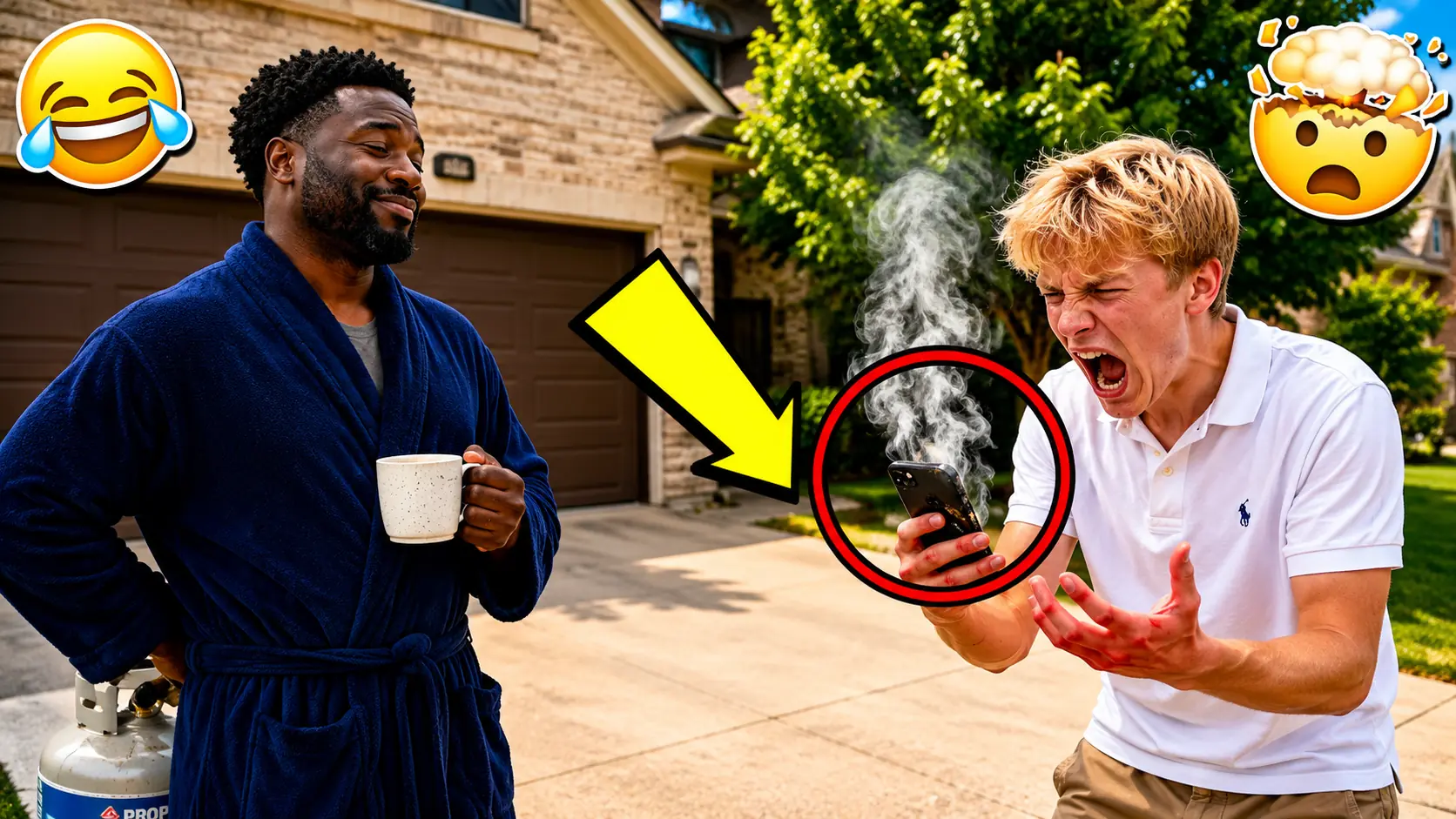
The vapor began drifting up from beneath the table, curling around the area near his phone. He yelled, “What is this?” I stepped outside in my blue robe, holding my coffee. The empty propane tank was partly hidden behind my leg. He looked at it, then he looked at the smoke, then he looked at me, and completely lost his mind.
He started yelling that I had ruined his phone. He was waving it around, screaming at the screen, telling me it was burning, but his phone was perfectly fine. It was not hot. It wasn’t damaged. It was not even close to a flame.
The fake Wi-Fi page was still visible on the screen. I let him panic for maybe 10 seconds, then I said, “Relax, your phone is fine.” He looked at me like I had betrayed him. I pointed toward the little fog device under the table. Then I told him the truth.
“Your phone is not smoking. You should just not be using networks that don’t belong to you.” He was embarrassed, not just annoyed, embarrassed. Two of his friends were sitting in the car nearby watching the entire thing. One of them laughed.
The other one pulled out his phone and started recording. That made the kid even angrier. He called me crazy. He called me old. He called me names that told me he had no real argument left.
I told him calmly, “You came onto my property signal again after I warned you. The lesson is over. Go home.” Then I picked up the fog device and showed him it was harmless. His phone still worked perfectly. His battery was fine.
Nothing had happened to hurt him, but his pride was hurt. That should have been the end of it. It should have been a funny story he told his friends one day, a reminder that he got caught taking something that did not belong to him. Instead, he went home furious. His mother came over later that night and knocked on my door.
She didn’t ask whether her son had been using my Wi-Fi. She didn’t ask whether he had been disrespectful. She didn’t care that no one got hurt. She only cared that he got embarrassed. She told me that I humiliated her son.
I told her, “No, your son humiliated himself when he kept taking what’s not his.” She threatened to call the police. I told her she was free to do that. I showed her the fake login page, the harmless fog device, and the empty propane tank. I explained that nothing had touched her son or his phone.
She didn’t call the police because deep down she knew what really happened. Her son had been caught. That was all. But instead of teaching him to own his mistake, she went inside and told him he had been wronged. That was the moment I realized this was bigger than Wi-Fi.
It was about what happened when someone is raised to believe consequences are abuse. For a few days, everything was quiet. Too quiet. Then early one morning, I woke up to the sound of glass breaking. By the time I ran downstairs, whoever had done it was gone.
My front window was cracked. My garage had been spray-painted. My mailbox was knocked over. My security light was smashed. And in the middle of my driveway were the words, “Mind your own Wi-Fi.”
I didn’t need a detective to understand the message, but I also knew better than to accuse someone without proof. I called the police. Then I called my insurance company. And then I called out of work. Officers took photos, wrote everything down, and asked me if I had problems with anyone nearby.
I told them the truth. I explained the Wi-Fi situation. I explained the harmless scare. I explained the mother’s threats. I even told them I understood why it looked suspicious.
I didn’t hide anything because when you’re telling the truth, you do not need to build a perfect story. You just explain what happened. The officer listened quietly. Then he asked if I had cameras. I said yes, but the cameras were not the whole case.
They were only one piece. The footage showed two people approaching my house late at night. Their faces were partly covered. It wasn’t a perfect movie-style recording. You couldn’t magically see every detail.
But it showed their height, their clothes, the vehicle they arrived in, and the direction they came from. More importantly, one neighbor had heard them arguing before the vandalism started. Another neighbor had seen the vehicle parked near the spoiled son’s house earlier that evening. And one of the people involved started talking when police questioned him. That’s what broke the case open.
Not one camera slip. A pattern. The people who vandalized my home were not strangers. They were two older guys the spoiled son knew through school and sports. He had offered them money to “teach me a lesson.”
That was how they described it. He didn’t personally throw the paint. He didn’t personally crack the window. But he had planned it. He had paid for it.
And after it happened, he had bragged about it in messages to his friends. That’s what shocked me the most. This was not a heat-of-the-moment mistake. He had time to calm down. He had time to think.
And he still chose revenge. When the police brought him in with his mother, she tried to blame me again. She said my prank pushed him over the edge. The detective looked at her and said something I will never forget. He said, “A person being embarrassed does not give them permission to damage someone’s home.”
That was the first time I saw her go quiet. Her son sat there staring at the floor. Not angry. Not smug. Just scared.
Because suddenly this was not about Wi-Fi. This was about charges, restitution, probation, school discipline, and the people he had pulled into his mess. The court process took months. I’ll be honest, it was exhausting. People think justice happens quickly because that is what they see on television.
In real life, there were reports, meetings, repair estimates, statements, school notices, insurance questions, and hearing dates. I had to miss work. I had to replace damaged property. I had to explain to family members why my house looked like it had been attacked. And every time I saw the paint stain that would not fully come out of my driveway, I got angry all over again.
But I stayed patient because anger can make you reckless. Evidence makes you powerful. The judge treated the situation seriously. The spoiled son was 17, so the case stayed in juvenile court. But the judge made it clear that being young did not erase what he had done.
He had recruited others. He had paid them. He had targeted a neighbor’s home. He had caused thousands of dollars in damages. And he had shown no remorse at first.
The court ordered restitution for the repairs along with a strict probation plan. His family ended up facing more than $18,000 in costs, fees, repairs, and required programs. This was the part his mother never expected. But the money was not the biggest consequence. The judge ordered him into a juvenile detention program for 45 days.
Then he had 18 months of supervised probation, no unsupervised hangouts, no hangouts with the people who helped vandalize my house, mandatory counseling, mandatory community service, and regular check-ins. He also had to complete a restorative justice program where he had to hear directly from people affected by property crime. Not just me. Older homeowners, small owners, families who had lost things they worked years to build. That program changed him more than yelling ever could.
His mother changed, too. Not overnight, but she had to. Her son lost access to his car. His gaming setup was sold to help cover restitution. His allowance disappeared.
His weekend freedom disappeared. She had to work extra shifts to help him pay for repairs. She had to explain to relatives why her son was not around. She had to face the fact that defending him every single time had not protected him. It had prepared him for a fall.
Sometimes love is not giving someone whatever they want. Sometimes love is teaching them that actions carry weight before the world teaches them harder. About three months later, I saw him outside. He was wearing a plain work uniform. No fancy watch, no expensive shoes, no smug smile.
He looked tired. He asked if he could speak to me. I almost said no. Part of me wanted him to sit down with the silence the way I had sat with the damage to my home. But then I remembered something important.
Justice is not always about crushing someone. Sometimes it is about making them understand what they almost became. So, I nodded, and he started crying before he even finished his first sentence. He apologized. Not the fake kind where someone says, “I’m sorry you felt that way.”
A real apology. He said he had been angry because I had embarrassed him in front of his friends. He said he thought vandalizing my house would make him feel powerful again. Instead, it made him feel sick. He’d watched his mother cry over bills.
He’d watched his friends turn on each other. He had spent time in juvenile detention realizing nobody was impressed by his attitude anymore. That’s when he said something that surprised me. “I kept using your Wi-Fi because I thought you would never do anything.” That sentence stayed with me because that’s the heart of the entire story.
He didn’t take my Wi-Fi because he needed it. He took it because he believed there would be no consequences. He believed the world would keep bending around him. But nobody can live like that forever. Eventually, you meet a boundary that does not move.
Eventually, your choices become your responsibility. I told him I accepted his apology, but I would not pretend that damage never happened. Forgiveness does not mean removing consequences. It means refusing to carry hatred after the consequences have done their job. Over the next several months, he helped repair parts of the neighborhood through his community service program.
He cleaned public spaces. He helped repaint damaged fences. He worked at a local food bank. I heard from one of the coordinators that he was quiet at first. Then slowly, he started showing up early.
He started asking questions. He started helping without being told. Maybe it was real growth. Maybe it was just the fear of getting in trouble again. Either way, it was more accountability than he had ever shown before.
And sometimes growth starts with fear before it becomes character. As for his mother, she stopped coming by my door angry. One afternoon, she came by alone. She looked embarrassed. She said she had spent years confusing protection with parenting.
She thought defending her son made her loyal, but really she had taught him that everybody else was the problem. I told her I was not happy about what happened. I didn’t enjoy watching a teenager face detention, bills, and shame. But I was glad he had finally faced reality before he became an adult with even bigger consequences waiting for him. She nodded, and for once, she didn’t argue.
Today, my internet is secure. My house is repaired. The paint has gone. The window was replaced, and the old guest network is permanently shut down. The whole thing started with Wi-Fi, but it ended with a much bigger lesson.
Respecting boundaries is not optional. Being embarrassed does not justify revenge, and sometimes protecting someone from every consequence does not save them. It can quietly teach them to become someone dangerous. Because eventually, everybody learns. The only question is how expensive the lesson has to be.