# Luna's Recovery After Being Found Living in an Abandoned Shopping Cart
Reader Theme:
Font Size:
24px
PART 2 — CURRENT CONDITION UPDATE
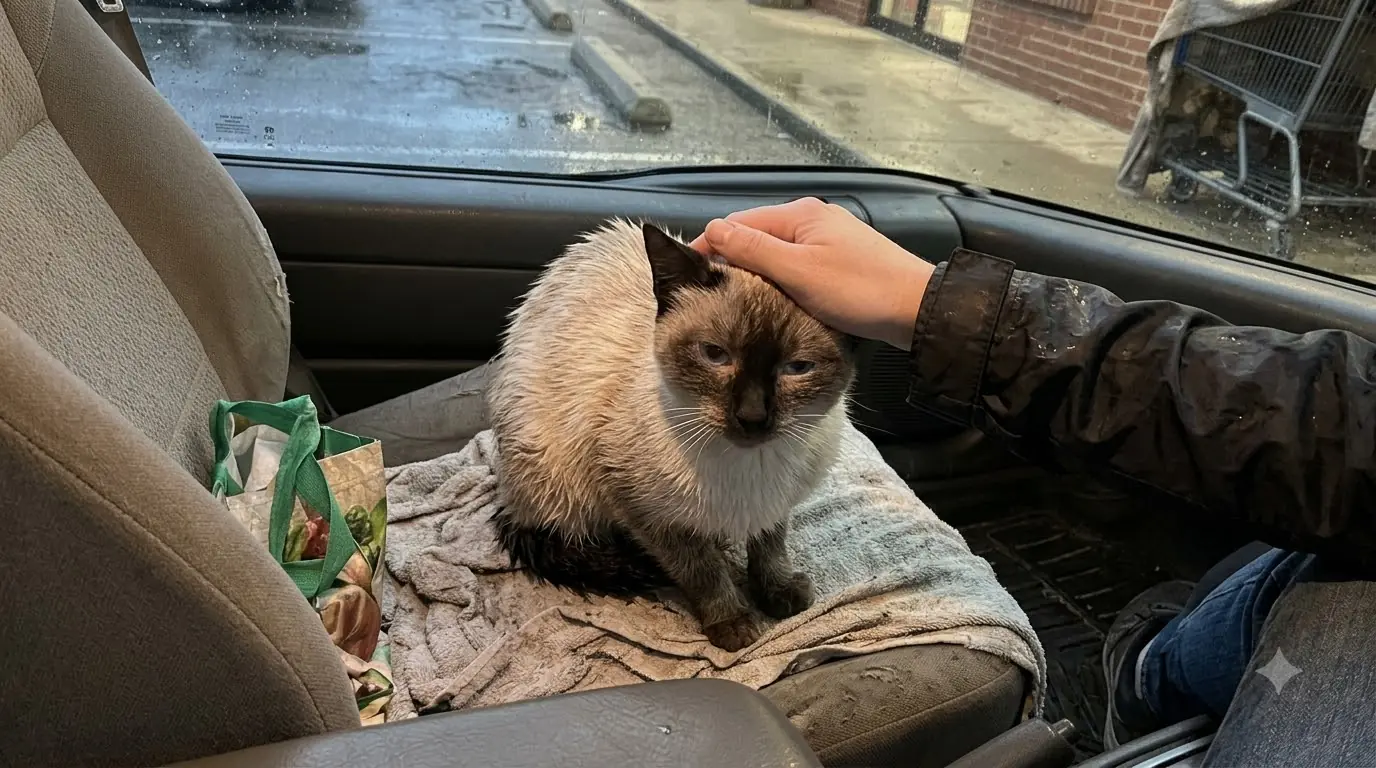
Luna's first night indoors was warmer and quieter than the days that came before it.
After several nights of sleeping beneath an old blanket inside an abandoned shopping cart, the 2-year-old Siamese mix finally had dry bedding, fresh water, regular meals, and a veterinary team watching her closely.
She also had something she seemed to value just as much.
People.
From the moment Luna climbed voluntarily into the woman's car, she showed us that human contact was familiar to her.
She did not behave like a cat who had spent her entire life avoiding people.
She rubbed against legs.
She sought hands.
She followed voices.
And even while tired and uncomfortable, she leaned into gentle touch.
But affection could not tell us what the rain and cold had done to her physically.
That was what the veterinary team needed to determine first.
The First Concern Was Her Body Temperature
When Luna arrived, she was cold from being soaked.
Her fur, especially along her belly, chest, and legs, was still damp despite the short car ride.
Wet fur loses much of its insulating ability, and a small cat exposed to rain for hours can have difficulty maintaining a normal body temperature.
Fortunately, Luna was not profoundly hypothermic.
She was responsive.
She could walk.
She lifted her head when people spoke.
Still, she was colder than the veterinary team wanted.
Rather than using extreme heat, staff warmed her gradually.
She was dried with towels and placed in a temperature-controlled area with soft, dry bedding.
The goal was to return her body to a normal temperature without creating additional stress.
Over the next several hours, Luna's temperature improved steadily.
As she became warmer, her posture changed.
At first, she sat tightly curled with her paws tucked beneath her body.
Later, she stretched one front leg forward.
Then another.
Eventually, she lay on her side.
That simple change told us she no longer felt the same need to conserve every bit of body heat.
Her Breathing Needed to Be Watched
One concern from the first examination was whether several cold, wet nights had coincided with the beginning of a respiratory problem.
Cats exposed to damp weather do not automatically develop pneumonia simply because they were cold.
But stress, crowding, poor nutrition, and an unknown vaccination history can leave a cat more vulnerable to respiratory illness.
Luna occasionally gave a soft sniffle during her first day.
That was enough for the veterinary team to pay attention.
They listened to her lungs carefully.
Her breathing effort remained normal.
She was not breathing with her mouth open.
She was not coughing repeatedly.
There was no significant nasal discharge.
Her temperature, once warmed, did not rise into a concerning fever range.
Those were encouraging signs.
For the moment, the team decided that close monitoring was more appropriate than assuming she had a serious respiratory infection.
Over the following days, the sniffles became less frequent rather than worse.
Her lungs continued to sound clear on examination.
Her appetite remained strong.
And she did not develop the lethargy or labored breathing that would have made us much more concerned.
That unresolved question from her first night became much less alarming.
Her Paws Were Sore From Staying Wet
Luna's feet told another part of the story.
The pads themselves were intact, but the skin between several toes was irritated.
Extended exposure to moisture can soften skin and make it more susceptible to inflammation.
Luna had also been walking across pavement, concrete, and the metal surface of the shopping cart area while trying to find food and shelter.
The irritation was not severe enough to prevent her from walking.
Still, she occasionally lifted one paw after standing for a while.
The veterinary team cleaned her feet gently and checked for cuts, embedded debris, swelling, or signs of infection.
No serious wound was found.
The main treatment was surprisingly simple.
Dryness.
Clean bedding.
Keeping the paws clean.
And giving the irritated skin time to recover.
Within several days, Luna stopped lifting her paw as often.
She walked normally across the kennel floor.
Then she began stepping onto a low platform without hesitation.
That was exactly the progress we hoped to see.
Dehydration Was Mild but Real
Despite the rain, Luna was mildly dehydrated when she arrived.
That might sound contradictory.
But being surrounded by water is not the same as having reliable access to clean drinking water.
We do not know how often Luna had been drinking during those days behind the convenience store.
The woman who had been feeding her had provided water when she could, but the bowl was not always there.
Luna received supportive hydration based on the veterinary team's assessment.
Fresh water was kept close to her resting area.
Wet food was also offered to help increase moisture intake naturally.
Luna accepted both quickly.
She drank independently during her first evening.
By the next day, her gums were less tacky.
Her energy was better.
And her litter box showed normal urine production.
The dehydration resolved without complication.
Luna Was Thinner Than She Looked
Siamese-type cats naturally tend to have a leaner appearance than some breeds.
That can make body-condition assessment especially important.
Luna was not dangerously emaciated, but she was clearly underweight.
Her ribs were easier to feel than expected, and she had lost some muscle over her back.
The veterinary team could not know whether inconsistent food was the only reason.
So her examination included appropriate baseline screening based on her age and condition.
There was no immediate sign of a major systemic illness causing rapid weight loss.
That made inconsistent nutrition the most likely explanation, although her progress still needed to be monitored.
Luna was started on measured meals.
She did not require aggressive nutritional rehabilitation.
What she needed was regularity.
Breakfast.
Lunch.
Dinner.
The same routine every day.
And Luna quickly learned it.
Her Appetite Was Strong From the Beginning
Some rescued cats refuse food when stressed.
Luna did not.
Once she was warm and dry, she ate with enthusiasm.
Her first meal was wet food.
She finished most of it.
A few hours later, she accepted another small portion.
The veterinary team intentionally avoided giving her an enormous meal all at once.
Even mildly underweight cats can develop stomach upset if they suddenly consume too much after inconsistent feeding.
Smaller meals gave us a better way to judge appetite and tolerance.
Luna handled them well.
No repeated vomiting.
No persistent diarrhea.
No refusal to eat.
By the third day, she was beginning to slow down during meals.
That was a good sign.
She no longer acted as though she needed to finish every bite immediately.
Now she sometimes eats part of her meal, stops to groom, and returns later.
The Litter Box Was Never a Problem
Luna understood the litter box immediately.
That was another clue that she may have lived indoors before.
She stepped into it within hours of arrival.
She urinated normally.
She covered her waste.
She used it consistently after that.
There was no repeated straining.
No frequent unsuccessful attempts.
No visible blood.
Her bowel movements also became regular as her feeding schedule stabilized.
For the medical team, this was useful information.
Normal litter-box behavior supported the broader picture of a cat recovering from environmental exposure rather than dealing with a major urinary or gastrointestinal problem.
She Began Grooming as Soon as She Felt Better
Luna's coat had been wet, dusty, and slightly greasy when she arrived.
Staff dried and cleaned what was necessary but did not subject her to a full bath.
There was no need.
Once Luna felt comfortable, she took over.
On the second day, a staff member found her washing one front paw.
Then she rubbed it across her face.
Later, she groomed her chest and shoulders.
Over the next few days, her cream-colored coat became noticeably cleaner.
The darker points on her ears, face, paws, and tail stood out again.
That grooming behavior mattered.
Cats often reduce normal grooming when they are frightened, sick, chilled, or exhausted.
The fact that Luna resumed it so quickly was another sign that her physical comfort was improving.
Luna Wanted Contact More Than Hiding
What surprised us most was how social she remained.
Many cats become withdrawn after a sudden rescue.
Luna did not completely avoid people.
If anything, she seemed worried when nobody was nearby.
During her first day, she repeatedly moved toward the front of her enclosure whenever someone entered the room.
If a caregiver paused beside the kennel, Luna approached.
She rubbed her cheek against the door.
If the person offered a hand at her level, she pushed her head beneath it.
She seemed to understand exactly what gentle petting meant.
But there was another side to that behavior.
When people left, Luna watched.
Sometimes she gave a soft meow.
Sometimes she remained at the door for several minutes before returning to her bed.
We could not say what she was thinking.
But her behavior strongly suggested that people had been important in her life before the shopping cart.
We Had to Consider That Luna Might Be Lost
A cat this comfortable around humans may have had a home.
That possibility had to be taken seriously.
Luna was scanned for a microchip.
No chip was detected.
That was disappointing, but not conclusive.
Not every owned cat is microchipped.
Her description, approximate age, sex, markings, and rescue location were documented.
The surrounding area was checked against available lost-pet information, and her case was handled according to the appropriate local procedures.
We also asked the nearby employees whether anyone had recognized her.
Nobody had.
The employees only knew that she had appeared in the parking lot and kept returning to the shopping cart.
The Shopping Cart Raised Questions
The cart had been abandoned behind the convenience store before Luna arrived.
Someone had placed an old blanket across part of it.
We cannot say who.
We also cannot say whether that person intended it specifically for Luna.
Perhaps someone saw her sleeping there and tried to give her shelter.
Perhaps the blanket was already there and Luna simply discovered it.
What matters is what she did with it.
Luna returned to that same place every evening.
During the day, she approached people.
At night, she climbed back beneath the blanket.
That pattern told us the cart had become her temporary base.
It was not a good home.
But it was predictable.
Predictability matters to cats.
The Woman Who Fed Her Became Familiar
The woman who eventually brought Luna in had been feeding her for several days.
She did not immediately try to catch her.
Instead, she let Luna become familiar with her presence.
Food arrived.
Water arrived.
The woman spoke softly.
Then she left.
Luna began approaching whenever she saw her.
That relationship became important during the storm.
When the rain became heavy, the woman returned and found the blanket soaked.
Luna was sitting beneath it.
She was shivering.
The woman knew leaving her there another night was no longer reasonable.
So she opened the car door.
Luna made the decision easier than expected.
She Climbed Into the Car Herself
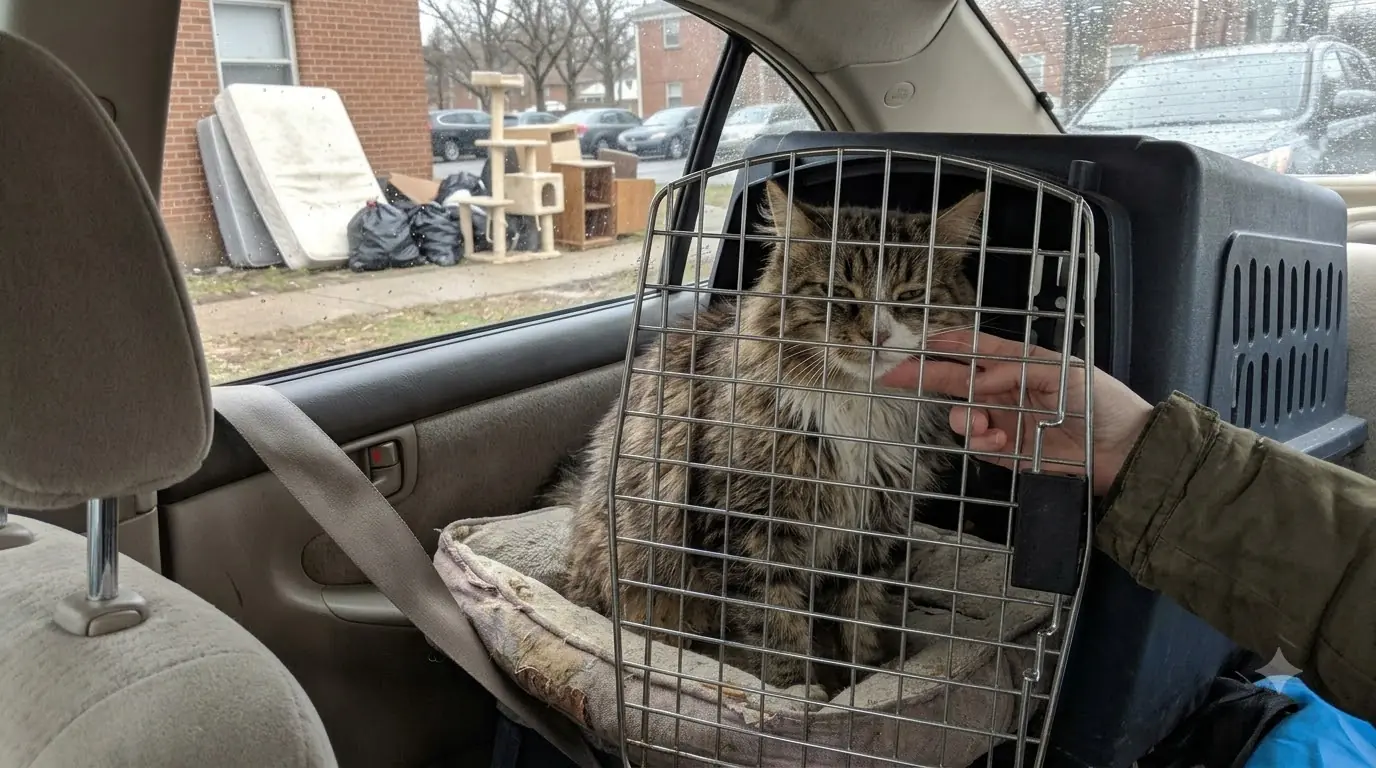
The car door opened.
Luna approached.
She paused for only a few seconds.
Then she climbed onto the passenger-side floor.
That action told us more about her comfort with people than almost anything else.
Cars can be frightening to cats.
The movement.
The smell.
The engine.
The confined space.
But Luna did not panic.
She stayed low on the floor during the drive.
Whenever the woman reached down, Luna pushed her head beneath the hand.
She did not attempt to climb around the car.
She did not throw herself at the windows.
She remained quiet.
That calm behavior continued at the clinic.
Her First Nights Indoors Were Different
At the clinic, Luna had a clean bed positioned toward the back of her kennel.
She used it.
That alone made her different from cats who spend their first nights pressed against the door or hiding beneath bedding.
Luna seemed relieved to have a dry place.
But she still wanted to know where people were.
If footsteps approached, her ears turned.
If someone stopped nearby, she raised her head.
She sometimes came forward for attention.
Afterward, she returned to the bed.
That ability to settle independently was encouraging.
She Started Sleeping Deeply
By the third night, Luna was sleeping much more comfortably.
One technician found her stretched on her side.
Her hind legs were extended.
Her front paws were relaxed.
She did not wake when the room door opened.
The technician moved quietly and let her sleep.
Later, Luna woke, groomed herself, ate part of her meal, and returned to bed.
For a cat who had spent evenings inside a wet shopping cart, that kind of ordinary sleep represented a major improvement.
The Paw Irritation Continued Healing
The skin between Luna's toes looked much better after several dry days.
There was less redness.
She no longer reacted when her feet were examined gently.
She walked without favoring any limb.
The veterinary team did not see signs of worsening infection.
No bandage was needed.
That was fortunate because some cats become stressed by foot bandages, and they can create additional problems if not truly necessary.
Instead, Luna's treatment remained conservative.
Keep the paws dry.
Keep the kennel clean.
Monitor.
Allow healing.
It worked.
Her Breathing Remained Normal
The respiratory concern also continued moving in the right direction.
Luna did not develop a significant cough.
She did not develop thick nasal discharge.
Her resting respiratory rate stayed normal.
Her lungs continued to sound clear.
The occasional early sniffle disappeared.
By the end of the first week, the veterinary team no longer considered respiratory illness one of her primary concerns.
We still monitor any cat for changes.
But the problem everyone had worried might develop after the cold, wet exposure did not progress.
That was one of the best pieces of news from Luna's first week.
She Is Gaining Weight Slowly
Luna's weight is moving upward.
Not dramatically.
That is intentional.
We want healthy, steady restoration.
Her ribs are becoming slightly less prominent.
Her muscle condition will take longer to rebuild.
That is normal.
The feeding plan continues to be adjusted based on her weight trend and activity level.
Luna's appetite remains dependable.
She enjoys wet food.
She also eats dry food appropriately.
And she now shows less urgency when meals arrive.
The bowl is no longer something she needs to guard or empty instantly.
Food has become predictable.
Her Energy Level Has Changed
When Luna first arrived, she was affectionate but tired.
Now she is playful.
Not constantly.
But enough to remind us that she is only 2 years old.
Her first toy was a small fabric mouse.
Luna sniffed it.
Ignored it.
Then, about an hour later, staff saw her batting it across the floor.
She chased it twice.
After that, she stopped and groomed herself as though nothing unusual had happened.
Another day, she became interested in a wand toy.
Her movements were cautious at first.
Then she pounced.
The entire session lasted only a few minutes.
That was plenty.
Short play sessions are giving Luna physical activity without overwhelming her.
She Likes Being Near People, Not Necessarily Held
One important part of understanding Luna has been learning the difference between affection and restraint.
Luna loves rubbing her face against hands.
She likes cheek scratches.
She often walks toward familiar caregivers.
But she does not always want to be picked up.
If lifted unexpectedly, her body can become tense.
So staff avoid unnecessary carrying.
Instead, Luna is allowed to initiate most interactions.
If she wants contact, she approaches.
If she wants space, she walks away.
That has helped her trust grow without pressure.
She Has Started Greeting Familiar Caregivers
Luna now recognizes several people.
When one particular technician arrives in the morning, Luna often walks to the kennel door with her tail upright.
She gives one short meow.
Then she rubs her cheek against the edge of the doorway.
If the technician offers a hand, Luna pushes her forehead beneath it.
After a few seconds, she often walks back toward her breakfast.
The interaction is brief.
But it is confident.
She is no longer simply reacting to every person as though each might be her only chance for attention.
She is beginning to recognize routine relationships.
We Still Don't Know Her History
Luna's past remains uncertain.
We do not know where she lived before the convenience-store parking lot.
We do not know why she appeared there.
We do not know whether someone was searching for her.
We do not know whether she had been intentionally left behind.
Those possibilities should not be stated as facts.
What we know is enough.
She was friendly.
She was underweight.
She had been sleeping in a shopping cart.
She was exposed to several days of rain.
She approached people.
And when someone finally opened a car door, Luna chose to climb inside.
A Foster Home Could Be an Important Next Step
Once Luna completes the appropriate medical and administrative steps, a foster home may help us learn more about her.
A shelter kennel tells us only part of a cat's personality.
In a home, we can learn whether Luna follows people between rooms.
Whether she sleeps on furniture.
Whether she enjoys windows.
Whether she is comfortable with normal household sounds.
Whether she wants to sleep near someone.
Whether she prefers a quiet household or more activity.
Those observations would help with future placement.
Her Future Home Will Need to Be Secure
Because Luna spent time wandering outdoors, indoor safety will be important.
Any future caregiver should make sure exterior doors and windows are secure.
If Luna is transported, she should travel in a properly closed carrier.
She should not be allowed to roam freely outdoors while she is still adjusting.
A new environment is especially risky during the first days after placement.
Even affectionate cats can bolt when frightened.
Luna deserves a transition that is calm and controlled.
Her Medical Needs Are Becoming Routine
At this point, Luna's care is much less urgent than it was on the night of the storm.
Her hydration has normalized.
Her body temperature is normal.
Her paws are healing.
Her appetite is good.
Her litter-box habits are normal.
Her breathing is comfortable.
Her weight is gradually improving.
Her coat is clean.
The next steps are ordinary.
Continue monitoring weight.
Continue routine veterinary care.
Complete preventive care appropriate to her individual situation.
Watch for any returning respiratory signs.
Maintain good nutrition.
Keep her indoors and dry.
Sometimes ordinary is exactly what a rescued animal needs.
One Evening, Luna Chose the Bed Before the Door
During her first days, Luna often came forward whenever someone entered.
Recently, a volunteer sat beside her kennel after finishing evening care.
Luna approached.
She rubbed against the bars.
The volunteer offered several gentle cheek scratches.
Then the volunteer remained seated.
Luna stayed at the front for a minute.
After that, she turned around.
She walked to the back.
She climbed into her bed.
And she curled up.
The volunteer stayed there for another ten minutes.
Luna did not come back to check.
She simply slept.
That was another small sign that Luna is learning something important.
People can be nearby without needing to be followed every second.
And when someone eventually leaves, food, warmth, and safety remain.
The Woman Who Rescued Her Still Visits
The woman who had been feeding Luna has visited again.
Luna recognized her voice.
Her head lifted before the woman reached the enclosure.
Then Luna walked toward the front.
She rubbed her face against the woman's fingers and gave a soft meow.
The woman stayed for a while.
Luna alternated between receiving attention and sitting quietly beside her.
That balance felt significant.
Their relationship had started in a parking lot.
Food on the pavement.
A soaked blanket.
A car door opened in the rain.
Now Luna could interact without needing anything urgently.
She was already fed.
Already warm.
Already safe.
The visit was simply companionship.
Luna Is Beginning to Look Like a Different Cat
Her appearance has changed in quiet ways.
Her coat lies smoother.
The cream areas are cleaner.
The darker points on her face and ears are more defined.
Her eyes look brighter.
Her body posture is more relaxed.
She no longer sits tightly compressed against herself.
She stretches.
She rolls partly onto one side.
Sometimes she reaches one paw through the kennel door when a familiar person passes.
The physical changes are subtle.
The emotional ones are, too.
Together, they tell us she is improving.
Recovery Is Not Finished
Luna is doing well.
That does not mean everything is complete.
She still needs to regain some weight.
Her paw skin needs to finish healing.
We still want to observe her for any delayed medical changes.
She still needs the appropriate preventive care and placement process before moving on.
And emotionally, she may behave differently in a home than she does here.
A new environment could temporarily make her more cautious.
That would not mean she had lost progress.
Adjustment is rarely a straight line.
The Biggest Concern From Her First Night Has Eased
The question we had at intake was whether exposure to wet, cold conditions had caused more serious respiratory illness or significant paw injury.
So far, it has not.
Luna's lungs remain clear.
Her breathing is normal.
The early sniffles resolved.
The irritated skin between her toes is healing.
She walks comfortably.
She plays.
She eats.
She sleeps deeply.
Those are the answers we were hoping for.
Tonight, Luna Is Dry
Outside, another rainstorm moved through the area recently.
Luna heard the rain against the building.
She lifted her head.
Then she went back to sleep.
There was no soaked blanket above her.
No cold metal cart beneath her.
No parking lot to cross.
No need to walk toward strangers hoping someone would stop.
She has clean bedding.
Fresh water.
Measured meals.
A warm room.
A litter box she uses reliably.
Veterinary staff checking her condition.
And caregivers who already know that if they offer a hand, Luna will probably push her head beneath it.
We still do not know exactly where Luna came from before she appeared behind that convenience store.
We may never know why she chose the abandoned shopping cart as the place she returned to each evening.
But she no longer needs it.
The cart gave her temporary shelter.
Now she has something better.
Luna is warm, medically stable, gaining weight, and surrounded by people who do not expect her to survive one more night alone in the rain.