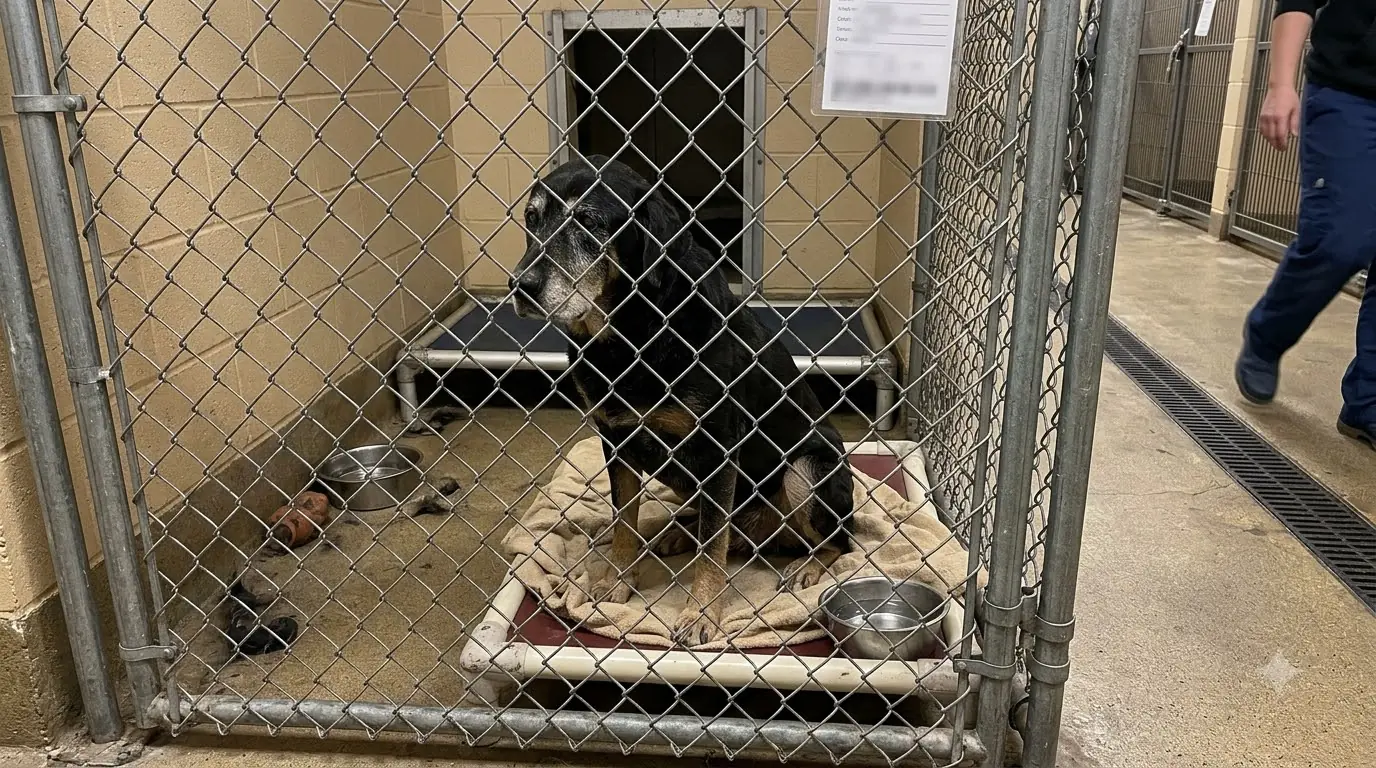
Maple’s New Life After 14 Months Waiting at the Shelter
Reader Theme:
Font Size:
24px
CURRENT CONDITION UPDATE
Maple is home, and the first update from her new family arrived only two days after she left our shelter.
His daughter told us that her father spent most of Monday sitting quietly in his usual chair with Maple pressed against his leg. They were not playing. Nobody was trying to teach her anything. There was no dramatic moment. He simply kept one hand resting on Maple’s back while she stayed beside him.
Then his daughter told us something he had said: “She breathes slow. It helps me breathe slow too.”
That sentence has stayed with everyone who cared for Maple during her fourteen months with us.
Medically, Maple is doing well for a nine-year-old senior dog with complete vision loss. Her pre-adoption examination confirmed that she remains blind, and there is no expectation that her sight will return. Her eyes are comfortable at this time, with no signs that would suggest an immediate painful emergency, but her new family has been advised to continue regular ophthalmic monitoring.
Blindness changes how Maple moves through the world, but it does not prevent her from having a good quality of life.
She relies heavily on scent, hearing, memory, and touch. At the shelter, we watched her build mental maps of familiar spaces. Once she learned where her bed, water bowl, kennel gate, and outdoor path were located, she moved through those areas with surprising confidence.
Her new home is being introduced the same way.
Furniture is being kept in consistent locations. Her food and water bowls stay in the same place. Her family avoids leaving unexpected objects in walking paths, and they speak before touching her so she knows someone is approaching.
During her first evening, Maple explored very slowly.
She kept her nose low and moved along the edges of the rooms, stopping frequently to listen. Her new owner remained close but did not constantly guide her. Instead, he allowed Maple to investigate while his daughter quietly described where each person was standing.
Within several hours, Maple had already identified the path between the living room, her bed, and the water bowl.
By the second day, she could make that short trip without hesitation.
Her mobility is also being monitored because her veterinary examination revealed mild age-related stiffness in her hips. X-rays showed early arthritic changes but no fracture or serious orthopedic injury. She does not currently require aggressive treatment, but she has started joint support and may receive anti-inflammatory medication when needed under veterinary supervision.
Her new family placed non-slip rugs along the areas she uses most often.
That is particularly helpful for a blind senior dog because slipping can reduce confidence as much as it causes physical discomfort.
Maple has already learned the texture of those rugs.
Her daughter told us that Maple sometimes pauses when her paws reach the edge of one, then changes direction as though she understands exactly where she is.
Her appetite has remained excellent.
Shelter life never completely took away Maple’s interest in food, and apparently that has not changed.
She learned the location of the kitchen remarkably quickly.
Breakfast and dinner are offered on a regular schedule, and her family uses a short verbal cue before placing the bowl down. Maple waits until she hears the bowl touch the floor before stepping forward.
She is drinking normally and has shown no significant digestive problems during the transition.
Sleep has been another encouraging part of her adjustment.
During Maple’s first night, her family expected her to pace or remain unsettled in the unfamiliar house.
Instead, she chose a bed beside her new owner’s chair.
She circled carefully, lowered herself onto the blanket, and remained there.
At some point during the night, she moved closer until part of her body was touching his foot.
He left his foot there.
By morning, Maple was still beside him.
That preference for physical contact was not something we saw consistently at the shelter.
Maple accepted affection from familiar staff, but she was selective about how closely she positioned herself around people. Because she could not see someone reaching toward her, sudden touch sometimes made her cautious.
With her new owner, something was different almost immediately.
During their first meeting, Maple approached him without being pulled or guided.
She sniffed his hand.
She listened.
Then she leaned against him.
His daughter described the same behavior at home.
Maple often finds his leg before settling.
Sometimes she rests against his chair.
Sometimes she places her shoulder against his shin while standing.
Once she finds him, she seems content to remain there.
The relationship works in the other direction too.
Her owner is blind, so he does not communicate with Maple through eye contact or visual gestures.
Instead, he talks to her.
He lets her smell his hand before touching her.
He keeps one hand along her shoulder or back when they sit together.
His daughter believes this has created an unusual kind of understanding between them.
Neither depends primarily on sight.
Both pay close attention to sound, touch, and physical presence.
We would never claim that Maple understands her owner’s blindness in the human sense. What we can say is that their methods of navigating space happen to fit each other remarkably well.
Their first walks have been short and carefully controlled.
Maple uses a harness rather than relying only on a collar, and her family follows the same route so she can begin memorizing familiar sounds, smells, surfaces, and turns.
Her owner walks with assistance from his daughter during these early outings while everyone learns a safe rhythm together.
Maple is already showing progress.
On the first walk, she stopped often and moved cautiously.
On the next one, she recognized the transition from the porch to the sidewalk and walked several steps with much more confidence.
Her tail was relaxed.
Her nose remained busy.
When she heard her owner’s voice beside her, she turned toward him immediately.
Her emotional behavior has changed in other small ways too.
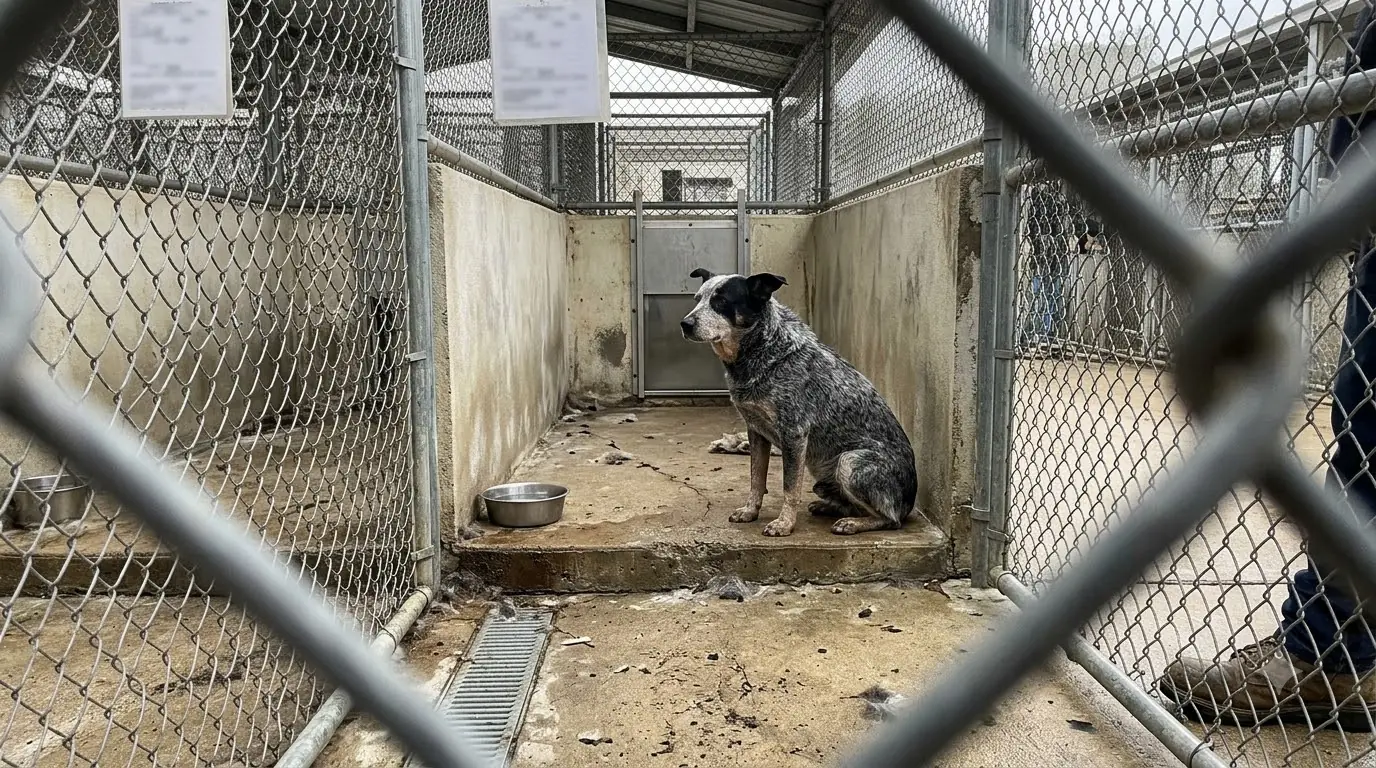
At the shelter, Maple often slept deeply during quiet hours but became alert whenever unfamiliar footsteps approached her kennel. Fourteen months of changing volunteers, visitors, and neighboring dogs taught her to listen closely.
At home, she is beginning to distinguish ordinary household sounds.
She recognizes her owner’s chair moving.
She reacts to his voice before his daughter’s footsteps.
She has learned the sound of the refrigerator opening.
And she appears to know exactly which cabinet contains her treats.
One evening, his daughter walked into the living room and found both of them exactly where they had been several hours earlier.
Her father was sitting in his chair.
Maple was beside him.
His hand rested across her back.
Neither appeared to need anything else.
Those quiet hours may be the most meaningful part of Maple’s recovery.
Shelter dogs are often surrounded by activity. Even well-run facilities cannot reproduce the stability of a quiet home. There are barking dogs, doors, cleaning routines, staff changes, visitors, and unfamiliar sounds throughout the day.
Maple lived with those noises for fourteen months.
Now her world has become smaller and more predictable.
She has one familiar voice to locate.
One chair she can find.
One bed that remains where she left it.
One household learning how she moves.
Her next medical steps are routine but important. Maple will continue senior wellness checks, monitoring of her eyes for discomfort, and evaluation of her arthritis as she becomes more active. Her family will also watch for changes in appetite, sleep, mobility, orientation, or behavior that could indicate pain or another age-related condition.
For now, there is no significant medical concern preventing her from enjoying her new home.
Maple is eating.
She is sleeping comfortably.
She is navigating increasingly well.
She is accepting affection.
And she is choosing closeness.
After fourteen months, that last part means more to us than we can easily explain.
She spent so long being the older blind dog people admired but did not take home.
Then one Sunday, a man walked into our adoption event and specifically asked for the dog nobody wanted.
We brought him Maple.
She had no way to see him.
He had no way to see her.
And apparently neither of them needed that.
Maple used her nose and ears to understand the stranger sitting in front of her. He used his hands and her breathing to understand the dog leaning against him.
Thirty seconds later, she had already made a decision.
Two days later, she was still pressed against his leg.
Fourteen months of waiting ended in a small room on a Sunday afternoon, not because someone overlooked Maple’s blindness, but because the right person understood that sight was never the most important thing about her.
Maple is safe now.
She has a quiet home, appropriate medical care, a family learning every detail of how she navigates, and one person whose hand seems to belong naturally on her back.
He found the dog nobody wanted.
And somehow, Maple found exactly who she had been waiting for.
News in the same category
She Blamed Me for Her Cheating… Until I Revealed Why I Really Came to That Hotel
She Told Her Husband, “I Feel Single Even When You’re Sitting Right Next to Me”… Then He Found Out Why She Had Already Started Leaving
He Returned Early From His Business Trip and Found His Wife Kissing Another Man… He Walked Away Without Saying a Word
She Came Home Early and Found Her Husband in Their Bed… But She Didn’t Scream

Noah’s Recovery After a Quiet Winter at the Rescue Center
The Two Gym Bullies Took Over His Daughter’s Birthday — Then One of Them Put Hands on Him
The Fighter Crashed the Block Party — Then Threw Gloves at the Quiet Dad
The Black Belt Wouldn’t Let Her Tap — Then a Stranger Stepped Onto the Mat
The Cop Refused to Release Her — Then the Captain Recognized Her Father
The HOA Woman Was Relaxing in His Pool — Then She Saw Something Swimming Toward Her
The HOA Woman Was Sunbathing in His Pool — Then Something Moved Behind Her
The HOA Woman Planted “Evidence” in His Car — Then Had Him Pinned Down
Bailey and Cooper’s Journey While Waiting Together for a Home
The Gym Champion Charged the Old White Belt — Then the Whole Room Froze
The Cop Smashed Her Phone — Then Slammed Her Against the Car
White Officers Forced An Older Woman Onto Her Car Hood — Then One Man Across The Street Stopped Cold
She Accused the Old Man of Stealing the Ferrari — Then Police Surrounded Him