“Get off my stage.” “I just want to—” “Did I stutter? Move.” Megan Holloway’s lip curled. She looked Grace Carter up and down like something stuck to her shoe. “Look at you sweating through that cheap leotard like an ugly cow.”
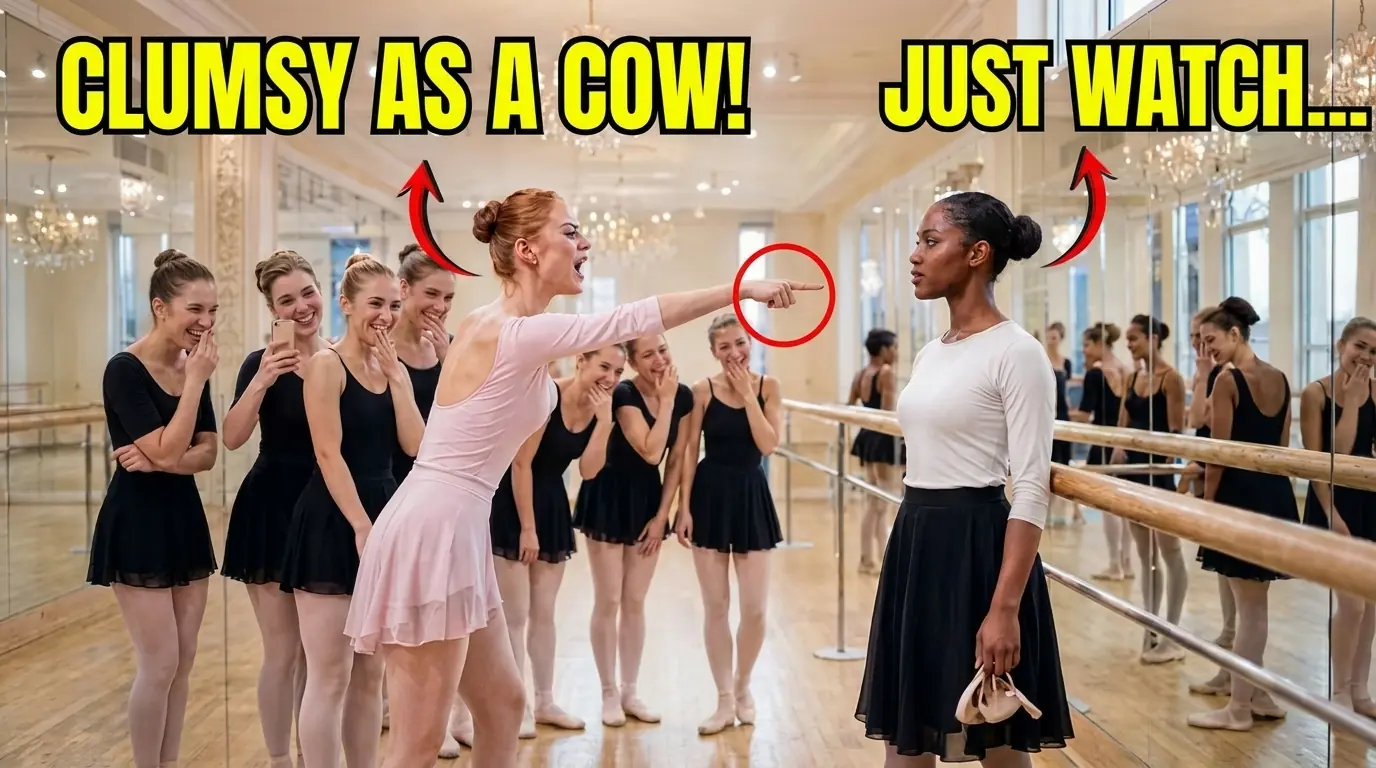
Grace gripped the barre and said nothing. “You know what?” Megan stepped closer. “You’re clumsy as a cow. A big stumbling cow.” Laughter cracked across the studio. The phone rang, red light blinking. “Get back to the cow shed you came from,” Megan hissed. “Before you embarrass yourself worse.”
Grace’s fingers tightened around her grandmother’s worn ballet shoes, ribbons frayed to threads. That night, the video of the performance went viral. Two million views. The whole world laughed at the clumsy cow. But when they reached the end, what that Black girl did left everyone gaping in astonishment.
Grace Carter had been dancing before she could spell her own name. The south side of Detroit wasn’t known for ballet studios. It was known for boarded-up windows, corner stores with bulletproof glass, and the kind of silence that settled over streets after dark. Not the peaceful kind. The holding-your-breath kind.
But inside a narrow garage on Maple Avenue, music played every single evening without fail. Eleanor Carter had converted that garage herself. Forty-four years ago, she’d been the most promising ballet dancer in the Midwest, a Black woman in a world that wasn’t built for her, spinning through auditions where judges marked her down before she took a single step.
The old photographs told the story better than words. Eleanor at twenty-four, suspended mid-leap, her body a perfect arc against a dark curtain. Eleanor at twenty-six holding a bouquet after her first principal role. Eleanor at twenty-eight crumpled on a stage floor, both hands clutching her right knee. The career she’d built note by note, collapsing in a single terrible crack.
She never performed again. But she never stopped teaching. The garage had plywood laid over concrete, sanded smooth and sealed with three coats of polyurethane. The barre was copper plumbing pipe bolted into the wall studs. The mirror was a patchwork, three salvaged pieces glued to a sheet of particle board, a crack running through the center that split every reflection in two.
And in front of that cracked mirror, five-year-old Grace had learned her first plié. By seven, she could hold an arabesque for forty seconds. By ten, she was drilling fouettés while Eleanor counted from a folding chair, one hand resting on the cane she now needed to walk. By fourteen, Grace had watched every ballet performance on YouTube twice and every street-dance battle three times.
She didn’t see two different worlds. She saw one language spoken in two dialects. Eleanor taught her the vocabulary of classical ballet. The precision. The discipline. The centuries of technique refined until every movement carried meaning. The streets taught her the rest.
Late at night, after Eleanor had gone to bed, Grace would pull up videos on a cracked phone screen and teach herself popping, locking, floor work, power moves. She’d drill them in the garage with the lights off, feeling the rhythm through her feet, letting her body answer questions her mind hadn’t asked yet. She never told her grandmother about the street dance. Not because Eleanor would disapprove, but because Grace wanted to surprise her someday.
She was building something new, fusing two worlds that had never been asked to share a stage. She just didn’t have a name for it yet.
The poster appeared on a Tuesday. Grace spotted it taped to the window of a coffee shop on Jefferson Avenue, four blocks from home. Regional Dance Championship hosted by Prestige Dance Academy. Grand prize: full scholarship to Juilliard. Open to all dancers aged eighteen to twenty-five. Any style. Any background.
The photograph on the poster showed the academy’s grand theater. Chandeliers. Velvet seats. A stage so wide it looked like it could hold the ocean. Grace stood on the sidewalk and stared at it for a long time. A city bus rolled past behind her, kicking up grit that stung her ankles. She didn’t move.
That evening, she told Eleanor. The old woman was sitting in her chair by the garage window, rubbing liniment into her knee the way she did every night. Slow circles. The smell of camphor filling the room. She listened without interrupting. When Grace finished, Eleanor looked at her. Really looked at her the way only someone who has watched you grow from nothing can look. And said five words. “Go show them what this garage made.”
Grace registered the next morning. Prestige Dance Academy sat on the north side of the city like a different country. Glass walls. Polished marble floors. A reception hall with fresh flowers and framed photographs of former students who’d gone on to Juilliard, the Royal Ballet, American Ballet Theatre. Everything gleamed. Everything whispered money and legacy and you don’t belong here.
Grace walked through the front doors in her cleanest jeans and a T-shirt she’d ironed twice. Her bag held her grandmother’s old ballet shoes, a water bottle, and a granola bar she’d packed at five in the morning because she couldn’t afford the café downstairs. The woman at the reception desk looked up. Her eyes traveled from Grace’s sneakers to her hair to the bag hanging from her shoulder. A pause just long enough to feel like a judgment.
“Can I help you?” “I’m here to register for the competition.” Another pause, longer this time. “The dance competition?” “Yes, ma’am.” The woman’s expression shifted into something Grace had seen a hundred times. The careful, practiced politeness that covered surprise or doubt or both. The kind of smile that said, I’m not going to say what I’m thinking, but we both know what I’m thinking.
“Down the hall. Room 114.” Grace nodded and walked. The hallway stretched ahead, lined with studio doors, each one leaking music and the sound of shoes striking wood. Through one glass panel, she saw a dozen dancers in matching black leotards. Every movement synchronized. Every body long and lean and pale. None of them looked up. None of them needed to.