# Murphy's Recovery After Being Found Beneath a Burned Porch
Reader Theme:
Font Size:
24px
PART 2 — CURRENT CONDITION UPDATE
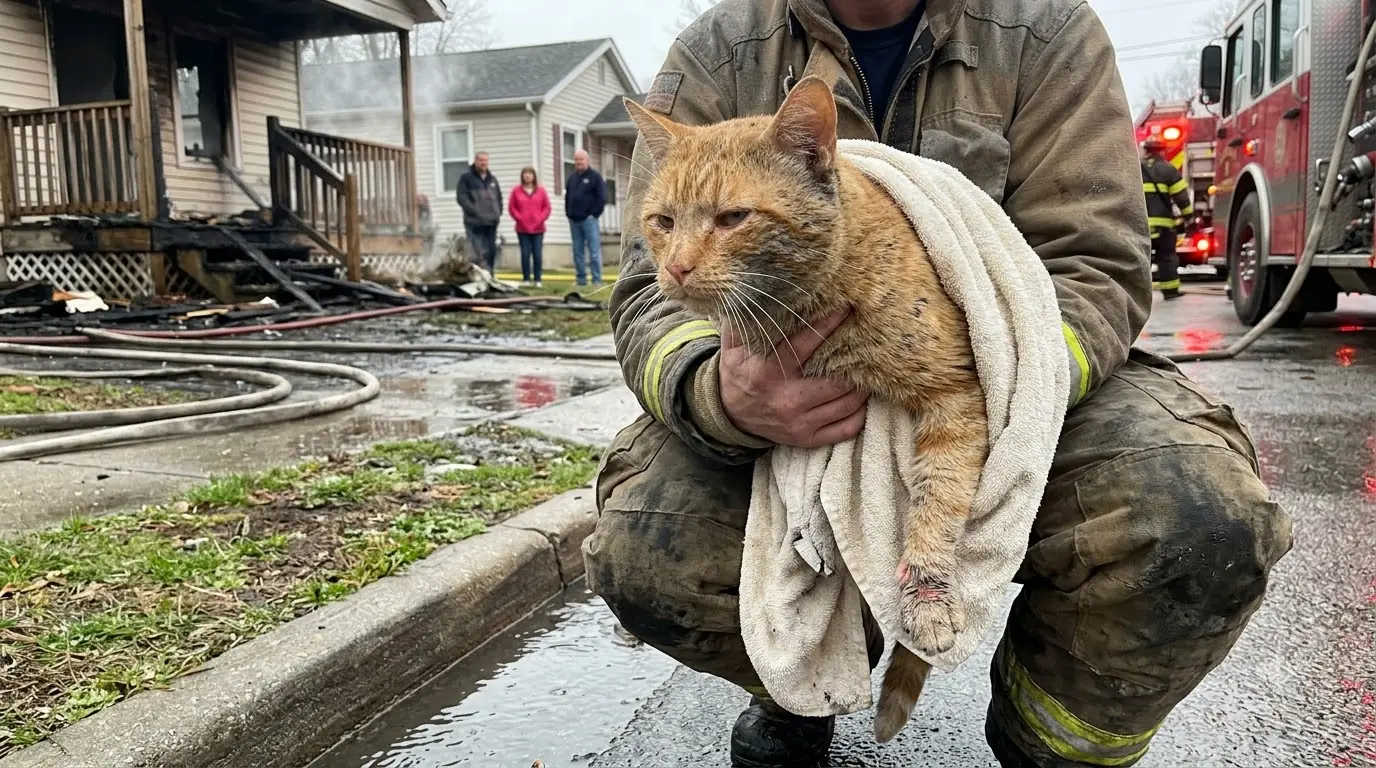
Murphy's first night in veterinary care was much quieter than the afternoon that brought him there.
By the time he arrived, the fire had been extinguished, the emergency vehicles were beginning to leave the neighborhood, and the orange cat who had spent hours surrounded by smoke, noise, strangers, and debris finally had somewhere protected to rest.
But the veterinary team could not assume that being out of the fire meant the danger had passed.
After smoke exposure, some complications can become more obvious only after an animal has been removed from the scene.
Murphy needed careful monitoring.
The First Concern Was His Breathing
His singed whiskers and ash-covered coat immediately told us that Murphy had been close enough to the fire or smoke to require a thorough respiratory evaluation.
Smoke can irritate the upper airway and lungs.
Depending on the duration and intensity of exposure, an animal may develop coughing, noisy breathing, rapid breathing, oxygen problems, airway swelling, or lung inflammation.
Murphy was alert enough to respond to the veterinary team, but he was exhausted.
The first priority was to determine whether that exhaustion was simply from stress and dehydration or whether he was struggling to breathe.
His respiratory rate was monitored closely.
The veterinarian listened carefully to his lungs and watched the way his chest moved.
They checked the color of his gums and looked for excessive effort with each breath.
Murphy was not showing severe respiratory distress when he arrived.
That was encouraging.
He was breathing without obvious open-mouth panting, and there was no dramatic collapse or inability to remain upright.
Still, because respiratory changes can develop after smoke exposure, he remained under observation rather than being sent immediately to a standard shelter kennel.
His Oxygen Levels Stayed Reassuring
During the first hours, Murphy's oxygenation remained in a range the veterinary team considered reassuring.
He was kept in a calm environment and handled as little as necessary.
Stress can raise a cat's breathing rate, so keeping him quiet helped staff interpret what they were seeing more accurately.
The veterinary team continued watching for any delayed signs of respiratory irritation.
They wanted to know whether Murphy would begin coughing.
Whether his breathing would become faster while resting.
Whether he would develop nasal discharge.
Whether his appetite would suddenly disappear.
Whether he would become weak or unusually difficult to wake.
None of those signs became severe.
Murphy did occasionally breathe a little faster when someone entered the room or when he was examined, but once left alone, his breathing settled.
That pattern made stress a more likely contributor than a developing respiratory emergency.
Even so, nobody stopped watching him.
The Ash Made Him Look Worse Than Some of His Injuries Were
Murphy's coat looked dramatic when he was found.
Gray ash had settled across his back, shoulders, sides, and face, turning parts of his orange fur almost brown.
His whiskers had curled at the ends from heat exposure.
Those details immediately drew attention.
But visually striking does not always mean medically catastrophic.
Once the ash was carefully removed and Murphy's coat was examined more closely, staff found no widespread deep burns across his body.
That was one of the biggest pieces of good news from his first day.
There were, however, several areas that needed care.
His paw pads were irritated.
A few spots on his lower legs had mild superficial heat-related redness.
His whiskers were damaged, but the skin around his muzzle was intact.
The veterinary team checked his ears as well, because the thin tissue at the edges can be vulnerable to heat.
Fortunately, they did not find extensive full-thickness burns.
His Paw Pads Needed Time
Murphy's paws were more uncomfortable than the rest of his body.
That made sense.
He had likely moved across hot, rough, or ash-covered surfaces before reaching the space beneath the porch.
We cannot know exactly what path he took.
But when he arrived, several pads were tender and mildly inflamed.
He could walk.
He was not dragging a limb.
There was no evidence of a major fracture.
But he moved carefully.
For the first couple of days, Murphy preferred soft bedding.
When he stepped onto harder surfaces, his movements were slower.
The veterinary team cleaned his paws gently and checked for embedded debris.
No large foreign objects were found.
Treatment focused on protecting the pads, keeping them clean, controlling discomfort, and preventing excessive licking.
Murphy tolerated those checks better if they were brief.
If someone held a paw too long, he tried to pull it back.
That was fair.
So staff learned to examine one area at a time.
His Whiskers Will Grow Back
The singed whiskers worried many people who saw Murphy's first photographs.
But whiskers themselves are specialized hairs.
When the hair shaft is damaged without deeper injury to the skin and follicle, new whiskers can grow over time.
The veterinary team confirmed that the main concern around Murphy's face was superficial exposure rather than severe facial burns.
No one trimmed the damaged whiskers simply for appearance.
They were left alone unless an individual hair became loose or problematic.
Over time, the curled ends will be replaced naturally.
That process will not happen overnight.
It may take weeks or longer before his face looks completely normal again.
For now, the important thing is that Murphy is eating, drinking, breathing comfortably, and showing no sign that the damaged whiskers are preventing normal behavior.
Dehydration Was Another Immediate Problem
Murphy was also dehydrated.
That could have come from several factors.
We don't know how long he had been outside before the fire.
We don't know whether he had access to water earlier that day.
And acute stress can quickly change how an animal behaves around food and water.
He received supportive hydration based on the veterinarian's assessment.
Fresh water was also made continuously available once he was stable enough to drink on his own.
At first, Murphy ignored the bowl.
He was simply too tired.
Several hours later, he lifted his head, sniffed the water, and drank for a short period.
That was encouraging.
By the following day, his drinking had become more consistent.
His gums were less tacky.
His overall alertness improved.
His litter box also gave staff useful information.
He urinated normally and did not appear to strain.
That helped reassure us that his hydration was moving in the right direction.
His Appetite Returned Gradually
Murphy did not immediately eat a full meal.
Again, that was not surprising.
Cats under intense stress may refuse food for a period even when no severe gastrointestinal illness is present.
The first offering was a small portion of wet food.
Murphy sniffed it.
Then he looked away.
Staff did not force him.
A few hours later, another small portion was offered.
This time, he licked the surface.
Later that evening, he ate several bites.
By the next morning, he had consumed enough that the veterinary team felt more comfortable about his appetite.
From there, feeding became more regular.
He preferred wet food during the first days.
That also helped support hydration.
As Murphy became more comfortable, he began eating with more interest.
Now he usually finishes most of his measured meals.
He Wasn't Severely Underweight
One difference between Murphy and many cats arriving after long periods outdoors was his body condition.
Murphy was not dramatically emaciated.
He was slightly leaner than ideal, but he still had reasonable muscle for an adult cat.
That raised another question.
Had Murphy been living near people?
His behavior suggested that possibility.
He was cautious in unfamiliar surroundings, but he was not feral in the behavioral sense.
He understood human proximity.
He allowed handling when approached carefully.
He pressed against the firefighter's boot.
He watched people closely.
He seemed particularly attentive whenever someone entered the room.
None of that proves he had an owner.
But it strongly suggested he had experience with people.
So while his medical recovery continued, another part of the rescue process began.
We Looked for a Microchip
Murphy was scanned carefully.
No microchip was detected.
That did not automatically mean he had never belonged to anyone.
Many owned cats are not chipped.
Some chips migrate and require a thorough scan.
And some cats simply never receive one.
His rescue location, coat pattern, approximate age, sex, and other identifying details were documented.
Local lost-pet reports could then be compared against that information.
If someone came forward, they would need to provide details that matched Murphy and could be reasonably verified.
Until then, he remained in rescue care.
Nobody at the Fire Scene Recognized Him
The neighborhood itself offered few immediate answers.
Neighbors had gathered while firefighters worked.
Several people looked at Murphy.
Nobody confidently identified him.
The house itself had reportedly been empty when the fire started, which made the situation more confusing.
We could not assume Murphy lived there.
He may have entered the property for shelter.
He may have been wandering nearby.
He may have come from another house on the block.
The burned porch could simply have been the closest place he found to hide when the noise began.
We may never know.
What we do know is that after firefighters reached him, Murphy repeatedly looked toward approaching people.
That behavior continued during his first days in care.
Murphy Watched Every Door
In the veterinary holding area, Murphy rested often.
But whenever the door opened, his head came up.
If a technician entered, he watched.
If someone spoke, his ears turned toward the voice.
If footsteps stopped outside, he became alert.
He did not throw himself against the kennel door.
He did not cry constantly.
Instead, he watched.
There was something measured about it.
As though each new person deserved a careful look.
Again, we cannot say Murphy was searching for a specific individual.
That would be an assumption.
But he was clearly interested in people.
The Firefighter Came Back
The firefighter who had arranged Murphy's veterinary care returned to check on him.
Murphy was still cautious.
At first, he remained toward the back of the enclosure.
The firefighter sat outside and spoke quietly.
Murphy's ears turned.
After a few minutes, he stood.
He walked forward.
Then he stopped just inside the door.
The firefighter did not reach through.
Murphy sniffed the air.
A little later, he came close enough to rub one cheek along the edge of the enclosure.
That was the beginning of another small routine.
The firefighter could not stay for hours.
But when shifts allowed, he checked in.
Murphy began recognizing the voice.
He Started Grooming Again
One of the clearest signs that Murphy was becoming more comfortable came when he began cleaning himself.
During the first day, grooming was minimal.
Ash remained around parts of his coat even after the necessary cleaning because staff did not want to overwhelm him with a full bath.
Cats often dislike bathing, and unnecessary stress would have offered little benefit.
Instead, the worst debris was removed gently.
Murphy handled the rest.
Once he felt better, he began licking his chest.
Then his shoulders.
Then his front legs.
Over several days, his orange coat became brighter.
The gray dust disappeared.
The difference was striking.
More importantly, grooming told us Murphy had enough energy and comfort to return to normal feline behavior.
His Paws Improved Slowly
The paw pads remained the main source of physical discomfort for several days.
Murphy's walk was cautious, but it improved.
He stopped shifting his weight away from the more sensitive areas.
He began standing normally while eating.
Then he started stretching.
Soon he was stepping onto his low resting platform.
We did not encourage jumping onto high surfaces at first.
There was no reason to challenge tender paws while they were healing.
Instead, his enclosure was arranged so everything he needed was easy to reach.
Food.
Water.
Litter box.
Bed.
A low platform.
That simple setup helped him move without unnecessary strain.
His Litter Box Habits Stayed Normal
Murphy used the litter box consistently.
That was especially useful while the veterinary team monitored hydration and mobility.
He stepped inside without hesitation.
He postured normally.
He covered his waste.
He did not appear to strain.
There was no blood seen.
Those details may seem mundane.
In rescue medicine, they are valuable.
Normal litter-box behavior helped support the broader picture of a cat recovering rather than deteriorating.
He Began Sleeping More Deeply
The first time Murphy closed his eyes inside the towel, he looked exhausted.
During his first night, sleep was still light.
He woke when people entered.
He lifted his head when equipment moved.
He reacted to unfamiliar sounds.
Over the following days, that changed.
Staff began finding him asleep on his side.
Sometimes one paw was stretched forward.
His body no longer remained tightly curled every time he rested.
A cat that sleeps deeply is not automatically medically recovered.
But in Murphy's case, deeper sleep appeared alongside other encouraging signs.
Normal breathing.
Improved hydration.
Better appetite.
Less paw discomfort.
More grooming.
More relaxed posture.
Together, those changes mattered.
The Respiratory Concern Became Less Worrisome
The biggest unanswered medical question from Murphy's first night was whether smoke exposure would lead to delayed breathing problems.
So far, it has not.
His respiratory rate remained stable at rest.
His lungs continued to sound reassuring during follow-up examinations.
He did not develop persistent coughing.
There was no repeated open-mouth breathing.
He did not become weak from lack of oxygen.
That allowed the veterinary team to reduce the intensity of respiratory monitoring.
We are still cautious.
Any new breathing change in a cat with known smoke exposure would deserve attention.
But Murphy has passed the period that initially worried us most without developing severe respiratory complications.
That is excellent news.
The Minor Burns Are Healing
The superficial areas on Murphy's paws and lower legs are improving.
They are less red.
He is less reactive when the areas are examined.
No major infection has developed.
The veterinary team continues to check his skin because damaged tissue can occasionally change as healing progresses.
But at this point, Murphy's injuries are behaving like limited superficial burns rather than deep destructive wounds.
That distinction matters enormously for recovery time and comfort.
He does not require major surgical treatment.
He does not need extensive bandaging.
Instead, his care remains focused on cleanliness, pain control as prescribed, rest, and monitoring.
His Energy Returned Before His Confidence Did
Physically, Murphy began acting like a healthier cat fairly quickly.
Emotionally, he remained cautious.
He became interested in toys before he became fully comfortable with unfamiliar hands.
A volunteer placed a soft ball in his enclosure.
Murphy ignored it for an entire day.
The next morning, it had moved.
Later, staff saw him tap it once.
A few days after that, he chased it several feet.
His play sessions remain brief.
Murphy is not constantly energetic.
But he is curious.
That is a good sign.
He Has Very Clear Boundaries
Murphy's affection is real.
So are his limits.
He likes cheek scratches.
He sometimes rubs against a familiar person's hand.
He may sit close to someone.
But if a hand moves over his head too quickly, he ducks.
If someone attempts prolonged handling, his body stiffens.
We listen.
There is no benefit in forcing affection.
Murphy has already experienced enough chaos.
Our goal is to give him predictability.
He Still Watches New People
Whenever someone unfamiliar enters, Murphy studies them.
He rarely hides completely now.
Instead, he sits toward the middle or front of his enclosure.
His eyes follow movement.
His ears rotate toward voices.
Sometimes he steps forward.
Sometimes he doesn't.
If the person sits quietly, Murphy may investigate.
That pattern reinforces our belief that he had prior human contact.
But again, it does not solve the mystery of his past.
The Firefighter Became One of His Familiar People
Murphy's reaction to the firefighter grew warmer over time.
On a later visit, Murphy walked directly to the front.
The firefighter sat down.
Murphy sniffed the offered hand.
Then he rubbed his cheek against it.
After a few minutes, he settled on the bed nearby.
He did not crawl into the firefighter's lap.
He did not need to.
For Murphy, choosing to rest beside someone was enough.
We Still Have No Confirmed Family
At the time of this update, no verified owner has been identified.
That may change.
Rescue organizations follow appropriate local procedures for found animals, and Murphy's information remains documented in case someone is legitimately looking for him.
If a person comes forward, identification would need to be confirmed through appropriate details.
Until then, we avoid making assumptions.
Murphy may have belonged to someone.
He may have been living independently for some time.
He may have been fed by residents.
There are many possibilities.
Our priority is to make sure the uncertainty does not interrupt his care.
His Weight Is Stable
Murphy's body condition has remained stable and is beginning to improve slightly.
He does not need aggressive weight restoration.
Instead, he receives balanced measured meals appropriate for his size and activity level.
His appetite is dependable.
He drinks independently.
His bowel movements are normal.
There has been no ongoing vomiting or diarrhea.
That allows the medical team to focus on healing rather than nutritional crisis.
His Coat Is Orange Again
A few days after the rescue, a staff member joked that Murphy was finally orange again.
The ash had made him look almost gray.
Now his coat is clean enough that his natural color is obvious.
There are still uneven spots where fur was singed.
Those areas will take time to grow out.
His whiskers remain shorter and curled at the ends.
But his appearance is changing daily.
The biggest difference is that Murphy is doing much of the maintenance himself.
He grooms after meals.
He cleans his front paws.
He smooths the fur along his sides.
That normal routine tells us he feels far better than he did under the porch.
His Next Veterinary Step Is Simple
Murphy does not currently need dramatic medical intervention.
His next steps are continued rechecks.
The veterinary team will make sure his paw pads complete healing.
His skin will be checked.
His breathing will remain part of routine monitoring.
His weight and appetite will continue to be documented.
He will receive standard preventive care appropriate to his individual situation before any future placement.
If his breathing suddenly changed, or if any burn area worsened, that plan would change.
For now, his recovery remains uncomplicated.
A Foster Home May Help Us Learn More About Him
Once Murphy's medical team is satisfied with his physical progress, a foster home may be a useful next step.
Shelters and veterinary facilities are busy.
A quiet home environment can reveal behaviors that are difficult to see in a kennel.
Does Murphy sleep on a couch?
Does he follow people between rooms?
Does he enjoy sitting near windows?
Does he play more at night?
Does he prefer one person or several?
Those details could help us understand the type of permanent home that would suit him best.
He May Need a Quiet Transition
Even though Murphy is social, he has been through a major environmental disruption.
A future foster or adopter should not expect him to walk into a new house and behave completely relaxed on the first day.
He may hide.
He may spend time watching.
He may choose a small room.
That would be normal.
A safe room with food, water, a litter box, a bed, hiding places, and familiar-smelling items would allow him to adjust gradually.
The same principle that helped him here would apply there.
Let Murphy choose.
Recovery Is Becoming Ordinary
One of the best things about Murphy's progress is how ordinary his days have become.
There are no sirens.
No smoke.
No crowds standing outside.
No burned porch.
Breakfast arrives.
The litter box is cleaned.
Someone checks his paws.
He sleeps.
He grooms.
He watches people.
He plays for a few minutes.
Then he sleeps again.
Ordinary is exactly what Murphy needs.
One Afternoon, He Stopped Watching the Door
Murphy had developed a habit of watching the doorway whenever someone visited.
Recently, the firefighter came in again.
Murphy approached.
He received a few gentle scratches.
Then the firefighter sat nearby.
For several minutes, Murphy watched the door as usual.
Then he turned away.
He curled on his bed.
He began washing one paw.
A few minutes later, his eyes closed.
He slept while the firefighter remained nearby.
That was a small change.
But it told us something important.
Murphy no longer seemed to believe he had to monitor every person who came and went.
We May Never Know Where He Came From
The fire did not answer Murphy's history.
It only brought him into view.
No one recognized him at the scene.
No microchip was found.
The empty house provided no obvious explanation.
It is possible that his past will remain unknown.
That does not prevent us from giving him a future.
Tonight, Murphy Is Safe
Murphy now sleeps on a clean bed instead of beneath burned wood.
His breathing is comfortable.
His hydration is normal.
His appetite is strong.
His litter-box habits are consistent.
The soreness in his paw pads continues to improve.
The superficial heat irritation is healing.
His orange coat is returning to normal.
The singed whiskers will take longer.
So will trust.
But both can grow back.
Earlier today, one of his caregivers entered the room.
Murphy lifted his head.
He watched.
Then he stood, walked to the front of the enclosure, and pressed his cheek against the offered hand.
After a few seconds, he turned around and returned to his bed.
There was no panic when the person left.
No frantic crying.
No need to search every face.
Murphy simply curled up.
We still do not know whose cat he may once have been or how he ended up beneath that burned porch.
What we do know is that he is no longer facing the aftermath alone.
He is being monitored.
He is being treated.
He is comfortable enough to eat, groom, sleep, and seek attention when he wants it.
And for the first time since firefighters found him beneath the smoke-darkened wood, Murphy's next safe place no longer depends on where he can hide.