The first thing Father Gabriel heard was not a scream.
It was the sharp crack of a ceramic bowl striking the kitchen floor. He had just stepped onto the front porch of Margaret Hale’s two-story white house, carrying a paper bag containing soup, two fresh loaves of bread, and the blue prayer book she had forgotten at Saint Matthew’s Church. The June afternoon was bright and peaceful, but the voice coming from inside the house was neither.
“You will sign it today.”
Father Gabriel stopped with his hand inches from the brass doorbell. He recognized the voice immediately. Vanessa Hale was Margaret’s daughter-in-law, a successful real-estate agent who spoke softly at charity dinners and never missed Christmas service when important clients might be watching. The second voice belonged to Margaret.
“No, Vanessa. This house was your father-in-law’s last gift to me.”
Something heavy scraped across the kitchen floor. Father Gabriel pressed the bell once, but no one answered. He tried the front door and found it unlocked, then stepped into the entryway without calling out. From the kitchen came another crash, followed by Vanessa’s colder voice.
“You think Daniel will believe you? He believes me. Everyone believes me.”
Father Gabriel placed the food quietly beside the entrance. He removed his phone, activated the camera, and held it against the front of his black coat as he moved down the hallway. The kitchen doorway came into view, revealing shattered porcelain across the floor and several legal documents spread over the wooden table. Margaret stood with her back against the white cabinets while Vanessa gripped the elderly woman’s cardigan near the throat.
Margaret was sixty-eight, small and silver-haired, with clear blue eyes that had always seemed incapable of hiding kindness. She wore a pale cream blouse beneath a soft blue cardigan, navy trousers, and the low black shoes she used for church volunteering. Her face was drained of color, and one trembling hand was raised defensively between herself and Vanessa. A red mark was already forming along the side of her neck.
Vanessa was thirty-six, tall and sharply dressed in a burgundy blouse and fitted black trousers. Her dark-brown hair was pulled into a sleek low ponytail, and the polished composure she displayed in public had disappeared completely. She looked less like a daughter-in-law and more like a collector confronting someone who had refused to pay. Her right hand tightened around Margaret’s cardigan while her left pointed toward the papers.
“Sign the house over,” Vanessa hissed. “Daniel already believes you’re too confused to own it.”
Margaret struggled to breathe evenly. “That home was his father’s final gift to me, and you will never steal it.”
Vanessa pushed her harder against the cabinet. “Refuse again, and I’ll have you declared incompetent before sunset.”
Father Gabriel stepped through the doorway and raised the phone.
“Release her,” he said. “Your confession is recorded, and the attorney is coming through that door next.”
Vanessa froze.
Her hand remained against Margaret’s collar for one stunned second before she released it. Margaret slid sideways against the cabinet, coughing as she pressed one palm to her throat. Vanessa turned toward the priest with disbelief rather than fear, as though the greatest offense was not being caught but being interrupted.
“You entered a private home without permission,” she said.
Father Gabriel moved between the two women. “The door was unlocked, I heard threats, and Margaret appears injured.”
“She attacked me first.”
The lie arrived without hesitation.
Vanessa stepped backward and rubbed her wrist, preparing the next part of the story before anyone else entered. “She became confused when I showed her some ordinary estate papers. She threw the bowl and grabbed me.”
Father Gabriel kept recording. “The video began before I reached the kitchen.”
For the first time, Vanessa looked directly at the phone.
Margaret remained against the counter, breathing in shallow bursts. Father Gabriel guided her toward a chair but did not touch her until she nodded. Once she was seated, he placed the forgotten prayer book on the table beside the forged papers.
“Are you hurt anywhere else?” he asked.
“My shoulder,” Margaret whispered. “She pushed me into the pantry door before you arrived.”
Vanessa shook her head. “She is inventing this because she knows Daniel wants the property handled responsibly.”
Father Gabriel looked toward the documents. “Handled by whom?”
“By the family.”
“Margaret is the family.”
Vanessa’s expression hardened. “You do not understand the situation.”
“Then explain it clearly while the camera is running.”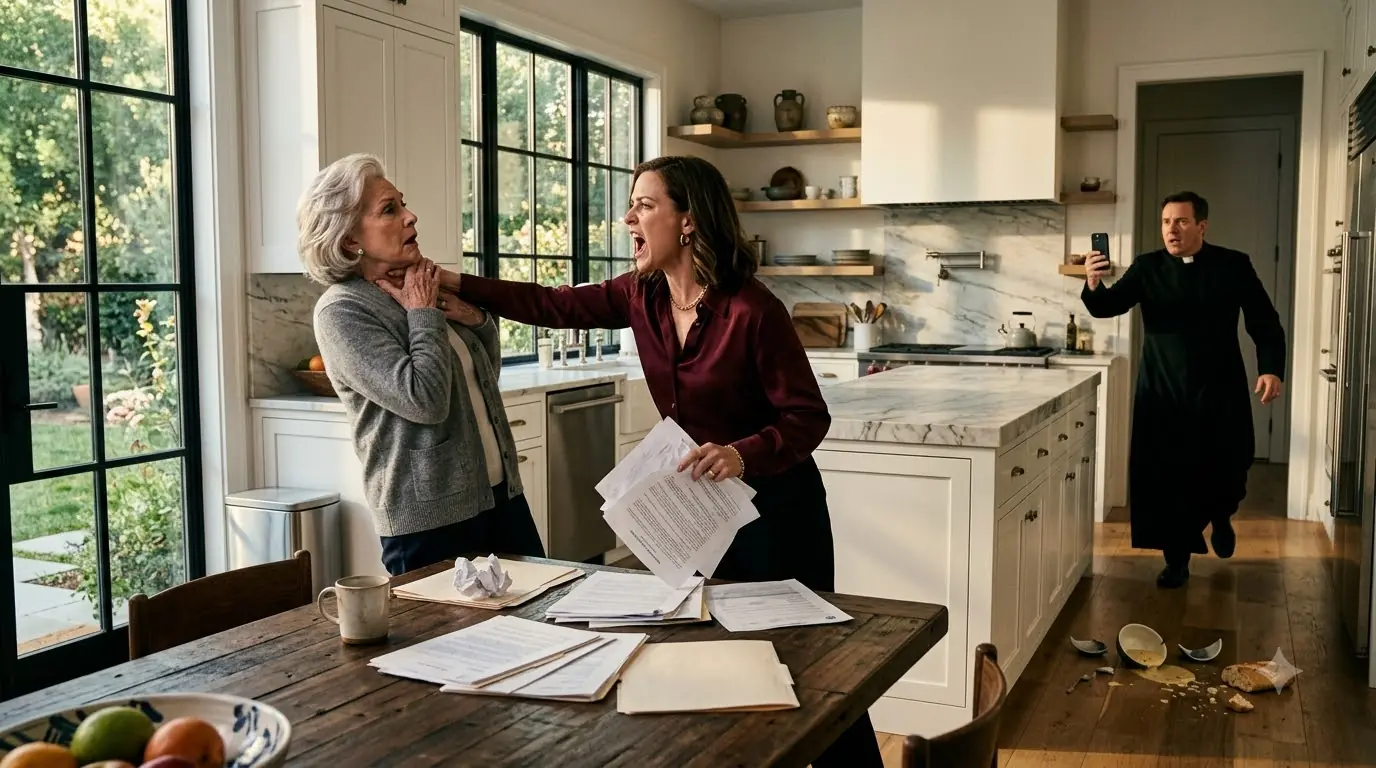
She looked toward the hallway, perhaps hoping her husband would appear and support her. The house remained silent except for Margaret’s breathing and the faint hum of the refrigerator. Vanessa had chosen the afternoon carefully because Daniel was at work and the neighbors on both sides were away.
What she had not anticipated was Margaret forgetting a prayer book.
The house had belonged to Margaret and her late husband, Thomas, for thirty-seven years. They purchased it when Daniel was five and spent nearly every weekend for the first decade repairing it. Thomas replaced the roof himself, Margaret refinished the floors, and together they built the rear porch overlooking the garden.
When Thomas died three years earlier, the house passed entirely to Margaret.
There was no mortgage.
The property was now worth almost seven hundred thousand dollars because the surrounding neighborhood had become one of the most desirable areas outside the city. Vanessa knew that number better than anyone. As a real-estate agent, she had checked recent sales repeatedly and even prepared an estimated listing price without Margaret’s knowledge.
At first, she suggested selling because the stairs might become difficult as Margaret aged. When Margaret refused, Vanessa began talking about assisted-living communities with swimming pools, private dining rooms, and “people her own age.” Daniel joined several of those conversations but insisted afterward that he was only trying to be practical.
Margaret understood what they wanted.
Daniel and Vanessa had accumulated debt far beyond what their salaries could support. Vanessa leased a luxury SUV, renovated their kitchen twice in five years, and spent money promoting an image of success to potential clients. Daniel earned a respectable income as an insurance manager, but much of it disappeared into credit cards, private-school tuition, and payments on a second property they had purchased as an investment.
The investment property had remained vacant for eight months.
Their bank refused to refinance unless they offered additional collateral.
Margaret’s house was the answer.
Daniel first approached the matter carefully. He suggested Margaret place his name on the deed “in case of an emergency.” When she declined, he said the transfer would simplify inheritance and protect the property from taxes. Margaret contacted her longtime attorney, Helen Brooks, who explained that adding Daniel could expose the home to his debts and creditors.
Margaret refused again.
That was when Vanessa’s behavior changed.
She began telling relatives that Margaret forgot appointments, repeated stories, and misplaced money. None of it was true. Margaret still managed the church food pantry twice a week, balanced her own accounts, drove without difficulty, and completed crossword puzzles faster than Father Gabriel.
Yet the rumors spread because Vanessa repeated them confidently.
During family dinners, she corrected Margaret even when Margaret had said nothing incorrect. She took objects from Margaret’s hands and told her to rest. She spoke about her in the third person while she was sitting at the same table.
“Margaret gets overwhelmed now.”
“Margaret doesn’t understand modern finances.”
“Margaret sometimes remembers things differently.”
Daniel rarely joined the insults.
He also never stopped them.
Two weeks before the kitchen confrontation, Margaret found a medical-evaluation form inside an envelope Vanessa accidentally left behind. It requested a competency assessment and listed examples of supposed confusion. One example claimed Margaret had left the stove burning overnight.
Margaret had not used the stove that day.
Another claimed she became lost while driving home from church.
She had stopped for groceries.
Margaret immediately called Helen Brooks. The attorney warned that Vanessa might be preparing to seek guardianship, which could allow Daniel to control Margaret’s finances and property. Helen helped Margaret create a durable power of attorney naming an independent professional rather than any family member.
She also placed the house inside a protected living trust.
Margaret remained the sole beneficiary and retained full control during her lifetime. However, the independent trustee would need to approve any sale, transfer, or mortgage. Even if someone frightened Margaret into signing a deed, the document would have no legal effect because the house no longer belonged to her personally.
Vanessa did not know.
The forged papers on the kitchen table revealed that she believed intimidation alone would be enough. The first document was a quitclaim deed transferring Margaret’s interest to Hale Development Holdings, an LLC created only nine days earlier. The second authorized the LLC to refinance the property immediately.
A third document stated that Margaret was signing voluntarily because she no longer felt capable of managing her affairs.
Father Gabriel read the first page while keeping the camera aimed toward Vanessa.
“Why is your company receiving the house?” he asked.
“It belongs to Daniel too.”
“No,” Margaret said from the chair. “It never did.”
“His father built that home,” Vanessa replied.
“His father and I built it.”
Vanessa turned toward her. “You would have had nothing without Thomas.”
Margaret’s fear shifted into anger. “And Thomas would have lost everything twice without me correcting his accounts.”
Father Gabriel saw something change in her then. The trembling had not disappeared, but beneath it stood the woman who had survived widowhood, grief, debt, and decades of work. Vanessa had expected age to erase that woman.
It had not.
The front door opened.
“Father Gabriel?”
Helen Brooks’s voice carried down the hallway. The priest had called her from the porch before entering, leaving the line open while she contacted police and drove from her nearby office. She entered the kitchen carrying a leather briefcase, followed moments later by two officers.
Vanessa’s confidence collapsed.
“This is a family misunderstanding,” she said quickly.
One officer moved toward Margaret while the other asked Vanessa to step away from the table. Helen went directly to her client, examined the mark on Margaret’s neck, and asked whether she wanted medical assistance.
“Yes,” Margaret said. “But I want the papers preserved first.”
Helen gave the faintest approving nod. “They will be.”
Vanessa pointed toward Father Gabriel. “He entered illegally and recorded us without consent.”
One officer looked around the kitchen. “He entered after hearing an apparent assault through an unlocked door.”
“He misunderstood what he saw.”
“The recording will help determine that.”
Vanessa’s eyes moved toward Margaret. “Tell them.”
Margaret looked back at her.
For years, she had tried to maintain peace for Daniel’s sake. She overlooked rude comments, false concern, and subtle pressure because she feared becoming the mother-in-law who divided a marriage. She now understood that keeping peace with someone committed to taking her home was not peace.
It was surrender.
“She pushed me against the pantry,” Margaret said. “She threw the bowl when I refused to sign. Then she grabbed my throat and threatened to declare me incompetent.”
Vanessa’s face became furious. “You ungrateful liar.”
The officer stepped between them immediately. “Do not address her again.”
Helen photographed the documents and placed each page inside a protective folder. She noticed that one page already carried what appeared to be Margaret’s signature. A notary seal had also been stamped beneath it.
“Margaret, did you sign this?”
“No.”
Vanessa spoke over her. “She signed a preliminary copy last week.”
“I did not.”
Helen examined the signature. “This is copied from her estate-planning file.”
The date beside the signature was three days earlier, when Margaret had spent the afternoon at Saint Matthew’s packing food boxes with Father Gabriel and six volunteers. The priest could verify every hour.
The officers asked Vanessa who prepared the deed.
She refused to answer.
Her phone provided the answer later that evening.
Messages showed that Vanessa had asked a colleague how to transfer property from “a confused older relative” without triggering a lengthy review. She sent photographs of Margaret’s signature and requested advice about finding a cooperative notary.
Another message went to Daniel.
Your mother won’t cooperate. I’m handling it Tuesday. Don’t call until I say it’s done.
Daniel replied:
Do whatever you have to. We cannot lose the financing.
Margaret learned about the message while seated inside the ambulance.
That sentence hurt more deeply than Vanessa’s hands around her neck.
Daniel had not merely remained silent.
He had authorized the ambush.
At the hospital, doctors confirmed that Margaret had bruising along her shoulder and throat but no broken bones. Father Gabriel stayed until Helen arrived, and neither filled the room with empty reassurances. Margaret appreciated that.
After midnight, Daniel appeared.
He entered the room pale and disheveled, still wearing his office clothes. When he saw the bruises on his mother’s neck, he stopped beside the door.
“Mom.”
Margaret said nothing.
Daniel looked toward Helen. “Can I speak with her alone?”
“No,” Margaret replied.
His face tightened. “I didn’t know Vanessa would hurt you.”
“You told her to do whatever she had to do.”
“I meant the paperwork.”
“What did you believe she would do when I refused?”
He rubbed both hands over his face. “We were desperate.”
“For my house.”
“For the loan. We could lose everything.”
Margaret’s voice remained quiet. “So you decided I should lose mine first.”
“That’s not fair.”
“Fair?”
The word came out sharper than she intended.
“You allowed your wife to build a story that I was confused. You gave her access to my documents. You knew she planned to pressure me while you stayed away so you could claim innocence afterward.”
Daniel’s eyes filled with tears. “I never wanted this.”
“You wanted the result.”
He lowered his head.
Helen explained that the house was protected inside a trust and could not have been transferred even with Margaret’s signature. Daniel looked stunned.
“You moved it?”
“I protected it.”
“When?”
“When my own son became a danger to me.”
The words broke something between them.
Daniel sat heavily in the visitor chair. “Are you cutting me out of your life?”
Margaret looked at the man who had once slept against her shoulder during thunderstorms. She remembered teaching him to ride a bicycle, waiting outside his college dorm, and holding his first child in the same house he had now tried to seize.
“I don’t know,” she said honestly. “But I know you are not entitled to remain in my life while helping someone harm me.”
Vanessa was arrested that night for assault, attempted financial exploitation of an older adult, forgery, coercion, and conspiracy. The notary involved in the deed was questioned the following morning. He eventually admitted stamping the document without Margaret present because Vanessa promised him a portion of the real-estate commission after the property was refinanced.
Daniel was not arrested immediately.
Investigators needed to determine how much he knew about the forgery and planned assault. His messages showed participation in the financial scheme, but he insisted he believed Vanessa would persuade Margaret rather than use violence.
The distinction mattered legally.
It mattered less to Margaret.
The case attracted local attention because Vanessa had built a public reputation around luxury home sales, family values, and charitable involvement. Her professional website displayed photographs of her handing ceremonial keys to elderly clients. Several former clients contacted prosecutors after seeing news of the arrest.
One widower claimed Vanessa pressured him to sell below market value after his wife died.
Another older woman said Vanessa repeatedly told her adult children she was becoming confused, then tried to convince them to list her house without her agreement.
The investigation expanded.
Vanessa’s real-estate license was suspended. Her brokerage terminated her after discovering she used office equipment and client records while preparing Margaret’s fraudulent deed. Two civil lawsuits followed from former clients who believed she had exploited their age and grief.
Daniel cooperated with investigators.
He surrendered messages, bank records, and documents showing the family’s financial condition. He admitted Vanessa created Hale Development Holdings to secure the private loan, and he knew Margaret’s house would be used as collateral. He also admitted helping Vanessa obtain a copy of Margaret’s signature from an old insurance form.
He claimed he believed Margaret would eventually agree.
Prosecutors charged him with conspiracy and attempted financial exploitation but not assault.
He accepted a plea agreement requiring probation, restitution, community service, financial counseling, and testimony against Vanessa. His employer placed him on leave and later dismissed him for ethical misconduct.
Vanessa rejected every offer.
She insisted Margaret had exaggerated the assault and claimed Father Gabriel edited the recording. A forensic expert confirmed the video was continuous and unaltered. The kitchen security camera, which Vanessa had apparently forgotten existed, also captured part of the attack from another angle.
At trial, jurors watched Margaret refuse the transfer.
They heard Vanessa threaten to declare her incompetent.
They saw her push Margaret against the cabinet and grip the elderly woman’s cardigan near the throat. They also watched Father Gabriel enter carrying soup, bread, and the blue prayer book that accidentally brought him there at the exact moment the plan collapsed.
Vanessa’s attorney argued that the confrontation resulted from family stress rather than criminal intent. Helen produced the forged deed, notary records, LLC documents, lender correspondence, and messages planning the ambush days earlier.
The jury deliberated less than four hours.
Vanessa was convicted on every major charge.
Before sentencing, Margaret stood before the court wearing a blue suit and pearl earrings. The bruises had disappeared, but the memory remained visible in the care with which she held her shoulders.
“My daughter-in-law did not attack me because she lost control,” Margaret said. “She attacked me because control was the entire plan.”
Vanessa stared straight ahead.
“She wanted my house, my signature, and eventually my legal identity. She believed that if she repeated the word confused often enough, people would stop listening to what I actually said.”
Margaret looked toward Daniel.
“My son helped because he convinced himself desperation made betrayal reasonable. It did not.”
The judge sentenced Vanessa to prison, followed by supervised release and a permanent prohibition against managing property or acting as a fiduciary for a vulnerable adult. She was also ordered to pay restitution for Margaret’s medical expenses, legal costs, and property-security upgrades.
The court revoked the notary’s commission and referred his conduct for prosecution.
Daniel received probation under the plea agreement. Margaret refused to write a letter requesting leniency, though she also refused to ask for additional punishment. His consequences would be determined by law.
Their relationship was different.
For nearly nine months, Margaret did not permit Daniel inside her home. They met only in Helen’s office or at a therapist’s practice specializing in family betrayal and financial abuse. Daniel apologized repeatedly at first, but Margaret told him apologies had become another way of asking her to make him feel better.
“Stop explaining why you did it,” she said during one session. “Show me why you will never do it again.”
Daniel began volunteering with a legal-aid clinic that helped older adults review contracts and protect property. Margaret suspected the work began as a probation requirement, but he continued after completing the required hours. He stopped reporting every good deed to her.
He also sold the investment property that had created the financial crisis.
The sale left him with debt but no illusion of wealth.
A year after the attack, Daniel asked whether he could repair the pantry door Vanessa had damaged. Margaret nearly refused, then agreed on the condition that he come alone.
He arrived Saturday morning carrying tools.
For several hours, mother and son worked quietly. Daniel removed the splintered trim, repaired the frame, and repainted the section. Margaret made coffee but did not prepare lunch until he asked whether she wanted help.
When the work was finished, he stood in the kitchen where the assault had occurred.
“I kept thinking I was protecting my marriage,” he said.
“You were protecting yourself from conflict.”
“Yes.”
Margaret looked toward the repaired cabinet. “Silence can be violence when you know someone else is being harmed.”
Daniel nodded. “I understand that now.”
“No. You are beginning to.”
It was not forgiveness.
It was permission to continue proving he had changed.
Margaret remained in the house.
She added stronger locks, interior cameras, and a security system connected directly to emergency services. The living trust stayed in place, and neither Daniel nor any future relative would gain control without independent oversight.
She also created a small fund through Saint Matthew’s Church to help older residents obtain legal reviews before signing property or financial documents. Father Gabriel joked that forgetting the prayer book had become the church’s most expensive administrative mistake.
Margaret kept the blue book on the kitchen shelf.
Two years later, she hosted a small supper for church volunteers. Three elderly widows, Father Gabriel, Helen Brooks, and several younger members gathered around the dining table. The room once used for coercion filled with conversation, bread, and laughter.
Daniel arrived near the end carrying dessert.
He stopped at the doorway rather than entering automatically.
“May I come in?”
Margaret studied him.
That simple question represented everything Vanessa had refused to understand and everything Daniel was finally learning. A house was not merely wood, money, or collateral. It was consent, memory, labor, safety, and the right to decide who crossed its threshold.
Margaret stepped aside.
“Yes,” she said. “You may.”
Daniel entered without assuming the invitation meant every wound had disappeared. He placed the dessert on the table, greeted the guests, and sat where Margaret directed him.
The house remained hers.
The decision remained hers.
And the woman Vanessa had tried to label confused had never seen her family more clearly.