"My father said you needed a wife."
For a moment, Ethan Brooks thought the woman standing on the other side of his broken farm gate had confused him with somebody else.
The autumn sun lay across the pasture in long strips of gold, a loose hinge squeaked under the weight of the gate, and a sleek black SUV idled on the dusty road behind her.
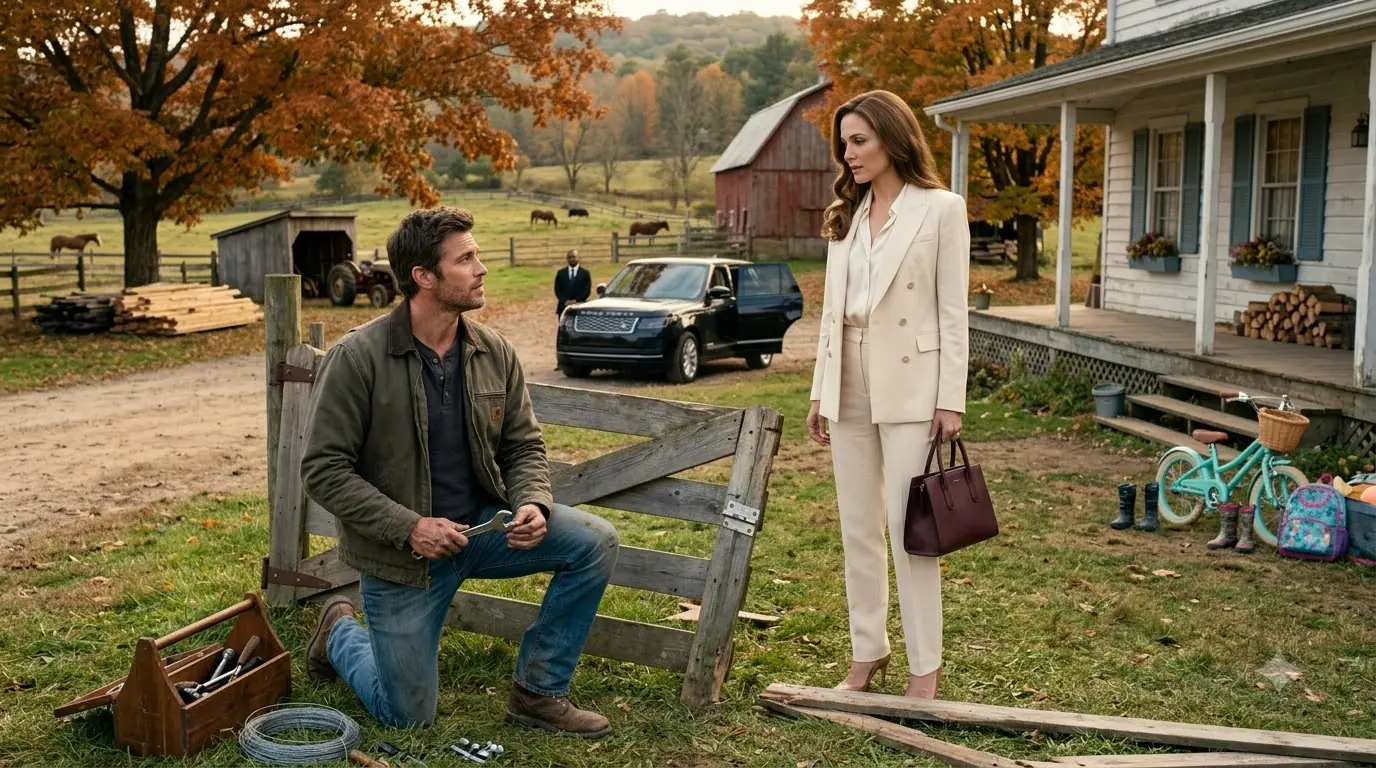
She was dressed in a cream-colored suit that probably cost more than his last three hay deliveries combined. Nothing about her belonged beside a fence post held upright with baling wire.
He looked at the woman, then at the warped gate, then back at the woman. "I'm sorry," he said. "What?"
She took the kind of breath people take before announcing a decision they already regret. "My father said you needed a wife," she repeated, more quietly. "I realize that is an extraordinary thing to say to someone I've never met."
Ethan set his hammer on the fence rail. He was thirty-six, had dirt on both knees, a splinter in his thumb, and a daughter due home from school in forty minutes. There had been days when he thought life had finished surprising him, especially in ways that might be good. Apparently, he had underestimated its ability to become ridiculous.
He laughed once, a short sound that surprised even him. "Lady, I need a gate that closes. If your father knows somebody who sells hinges cheap, that's a conversation we can have."
Her lips pressed together, not quite suppressing an embarrassed smile. "Victoria Hayes."
"I know who you are," he said. "You were on the cover of that business magazine at the feed store."
"Then you know I don't usually visit strangers to discuss marriage."
"That's comforting." Ethan pulled off a work glove and offered his hand through the gap in the fence. "Ethan Brooks. Though apparently you know that part already."
Victoria shook it. Her grip was direct, warm, and unhesitating despite the dust on his skin. She looked past him at the tired farmhouse, the sagging roof of the barn, and the line of apple trees edging the lower meadow. Ethan recognized the particular attention in her eyes: the swift assessment of a person accustomed to finding problems, attaching numbers to them, and deciding what they were worth.
"Before you say another word," he told her, "I don't need a wife. I need more time with my little girl. I need feed that doesn't cost a fortune. I need a tractor that can get through one field without overheating. A wife isn't some missing tool hanging on the wall of my barn."
Victoria's expression changed. He had expected offense, or the stiff smile rich people sometimes put on when their authority was questioned. Instead, she looked at him as though he had said something important that she had been trying to articulate for years.
"You're right," she said.
That answer caught him off guard more effectively than an argument would have. He picked up his hammer, then put it down again because he could see she was still waiting. Behind the windshield of the SUV, a driver kept both hands on the wheel and looked carefully at nothing.