I did not know how clearly my family had ranked me until my mother finally said it out loud.
She was not angry when she said it.
That was the part that stayed with me.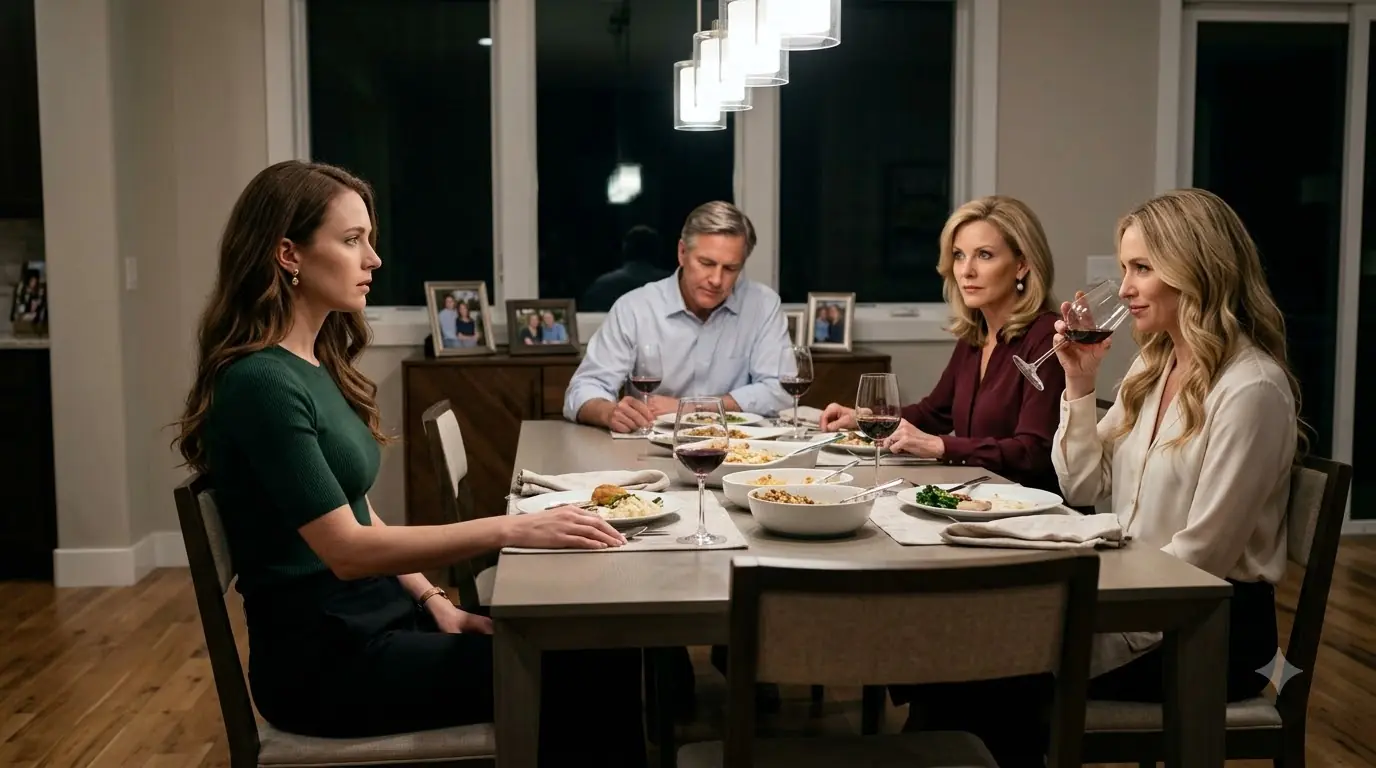
There was no screaming, no slammed glass, no dramatic argument that could later be dismissed as something said in the heat of the moment. We were sitting around the dining table in my parents’ house in Denver, eating a meal we had eaten some version of a hundred times before, when I questioned why another family plan had been rearranged around my sister without anyone bothering to ask whether I could accommodate it.
My mother set down her fork.
She looked directly at me.
Then, in a perfectly calm voice, she said, “Your sister’s family always comes first. You’re always last.”
For a second, I thought I had misheard her.
I looked at my father.
He nodded.
Not reluctantly.
Not apologetically.
He nodded the way someone confirms that two plus two equals four.
My sister lowered her eyes toward her wineglass, but not quickly enough to hide the small smile at the corner of her mouth.
That smile told me she already knew.
They all knew.
Apparently, I had been the only person pretending otherwise.
I did not cry.
I did not yell.
I did not ask my mother how she could possibly say something like that to her own daughter.
I simply leaned back in my chair and said, “Good to know.”
My mother looked almost relieved.
She thought the conversation was over.
In a way, it was.
Something broke in me that evening, but it was not my heart.
My loyalty broke.
The automatic part of me that had spent years stepping forward whenever anyone in that family needed money, time, patience, transportation, childcare, emotional support, or a convenient person to blame finally stopped functioning.
I drove back to my hotel that night with both hands on the steering wheel and almost no memory of the route.
I remember red traffic lights.
I remember snow gathered in dirty piles near the curb.
I remember seeing my own face reflected faintly in the windshield whenever I stopped beneath a streetlamp.
Mostly, I remember feeling strangely calm.
It should have devastated me.
Instead, it clarified everything.
My name is Mia.
For most of my life, nobody had to sit me down and explain where I ranked in my family because they taught me through repetition.
Patterns are more powerful than rules that way.
Rules can be questioned.
Patterns become normal.
I grew up in a comfortable middle-class house in Denver with trimmed grass, beige siding, family photographs arranged carefully near the front door, and the kind of kitchen where my mother always kept fresh flowers in a ceramic pitcher.
From outside, nothing looked wrong.
Inside, attention had a direction.
It flowed toward my sister.
If she was upset, the whole room adjusted.
If she was tired, plans changed.
If she had a problem, it became a family problem.
If she succeeded, everyone celebrated as if the family itself had won something.
With me, everything was quieter.
“You’re so independent.”
“You always land on your feet.”
“You don’t need as much reassurance.”
“You’re the strong one.”
Adults say those things as compliments.
Children hear something different.
You can wait.
You can manage.
Do not make yourself another problem.
My sister was not evil growing up.
That would actually have been easier to understand.
She was simply accustomed to being centered.
If there was one slice of cake left, someone asked whether she wanted it before anyone else reached for it.
If we both had school events on the same evening, hers usually won.
If she needed help with homework, my mother sat beside her for two hours.
If I needed help, I heard, “You’re smart. Try it yourself first.”
By the time I was twelve, I had stopped asking.
That became evidence that I did not need anything.
It happened on birthdays too.
My sister’s birthdays began weeks ahead.
There were discussions about themes, invitations, decorations, cakes, restaurants.
My birthdays often arrived with love, but little preparation.
One year, my mother picked up a supermarket cake on her way home because everyone had been busy.
I remember seeing the plastic dome on the kitchen counter and telling myself I was grateful.
And I was grateful.
That is what made the pattern so difficult to name.
Nobody forgot me completely.
Nobody starved me.
Nobody told me I was unwanted.
They simply gave my sister their best attention and gave me what remained, then praised me for accepting it gracefully.
At fifteen, I became the family babysitter.
At first it was cousins.
Later it was my sister’s children.
“Just for an hour” became an afternoon.
An afternoon became dinner.
Dinner became bedtime.
I loved those kids, so I rarely complained.
If I hesitated, my mother would remind me that my sister was exhausted.
When I was exhausted, I was told to rest when I got home.
At seventeen, I started working part-time.
By eighteen, I had enough saved to help pay some of my own educational expenses.
My parents were proud.