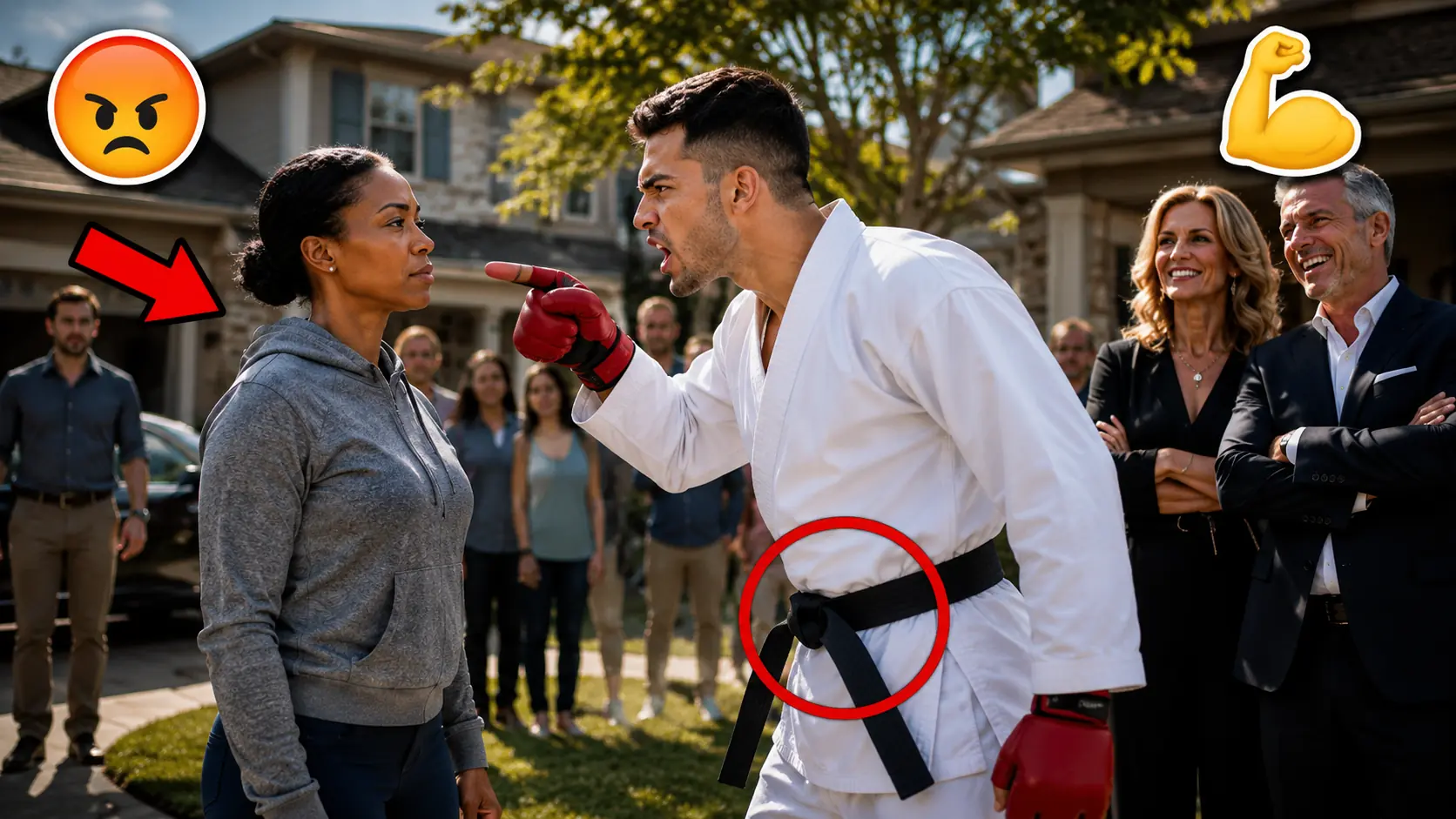
She doesn't even look like she'd survive one round. Say it again. Say what you called me. Why didn't you say anything? Because he wanted a reaction. What about you, Colonel? I bet you think you could take me. Are you sure?
My name is Denise Whitfield. I'm 42 years old. And for most of my grown life, the handful of people who understood my rank called me Colonel. And they meant every syllable of it. But on Hollow Creek Lane, tucked into the tidy manicured cul-de-sacs of Brierwood Estates, Colorado, I was simply the woman at the far end of the street who cut her own grass and drove a Ford pickup with a dent in the tailgate I never got around to fixing.
I'd relocated there in June, right after my son Malik wrapped up 9th grade, chasing exactly what the listing had promised, peace and quiet. 20 years in uniform will do that to a person. It trains you to crave stillness the way other folks crave a good adrenaline rush.
I'd led soldiers in the 75th Ranger Regiment, run night missions where a single heartbeat separated success from disaster, and briefed generals who didn't so much as blink when I corrected their assumptions. None of that carried any weight here, though. Here, I was only Denise, a single mother, a woman who kept to herself, who waved at the mail carrier, and who felt no obligation to explain what she used to do for a living.
I liked it that way. I liked being invisible. The house next to mine belonged to Gregory Sinclair, a real estate developer who'd thrown up half the strip malls on the east end of the county and made absolutely sure nobody forgot it. He drove a white Escalade that he reversed into his driveway every single time, letting the engine idle a beat too long, as though he needed the whole street to clock his arrival.
Son Tyler was 22, home after dropping out mid-semester and fully devoted to what he called his fight career, amateur mixed martial arts. A blue belt that somehow became a purple, then a black in record time, though I never once watched him roll with anybody who could genuinely hurt him. He had 12,000 followers online and a highlight reel set to bass-heavy music that thumped out of his open garage most afternoons.
I clocked him long before he ever noticed me. That's usually how it goes with men like Tyler. They're so preoccupied with being watched that they forget to watch back. He gunned his motorcycle at 6:00 in the morning right beneath my bedroom window. Three mornings running before I'd said a single word to him.
He'd claimed two parking spots by the community mailboxes like they were reserved just for him. I saw him from my porch shoulder-check a delivery driver half his size simply because the man's cart had blocked the sidewalk 4 seconds longer than Tyler liked. Nobody said a thing. That's the nature of neighborhoods like Brierwood. Everybody stays polite right up until politeness costs them something and then the silence turns deafening.
I started running every morning at 5:30 before daylight cracked over the ridge because that hour still belonged to me and nobody else. Old habit from my regiment days where 5:30 already counted as sleeping in. Tyler caught me jogging past his driveway one morning in a faded gray shirt and running shorts and he says something to his buddy loud enough that he clearly wanted me to hear.
She doesn't even look like she'd survive one round. His friend laughed. I never broke stride, never turned my head. There's a specific kind of restraint you learn in this life. The kind that has nothing to do with fear and everything to do with knowing exactly what you're capable of and choosing deliberately not to prove it to strangers.
I smiled anyway, not for him, but for myself, because if he'd understood even a fraction of what I'd lived through, he'd have swallowed those words before they left his mouth. I want to be honest about something. Part of me understood him. I'd seen plenty of young men like Tyler before the army got its hands on them and reshaped what they thought strength actually meant.
Boys raised on money and mirrors who mistake aggression for confidence because nobody ever showed them the difference. Under different discipline in another life, Tyler might have made a solid soldier. He had the aggression. He simply lacked the humility and nobody around him seemed interested in teaching it. Certainly not his father.
Gregory Sinclair treated the whole neighborhood like an extension of his real estate portfolio. Something to manage, curb, and occasionally remind everyone who was really in charge. He was cordial to my face in that particular way wealthy men reserve for people they've already dismissed. A firm handshake, a joke about interest rates, eyes drifting past me before I'd finished a sentence.
I didn't take it personally. I'd met a hundred versions of Gregory in my life, men who confused their bank balance with a chain of command. What I didn't see coming, what genuinely blindsided me that first month was how quickly Tyler's attention would shift from me to my son. Malik was 15 that summer. Quiet, thoughtful the way kids get when they've moved more than most.
When they've learned not to grow too attached to any one school or street because the army doesn't ask permission before reassigning you. He rode his bike up and down Hollow Creek Lane in the evenings, headphones in, minding his own business. He didn't know the first thing about combatives or command presence. He knew video games, a girl in his algebra class, and the new skateboard he was saving up for.
In every way that mattered, he was still just a boy. I watched Tyler watch him one evening from across the street. That same lazy, entitled grin creeping across his face, and something in my chest went very still and very sharp. The same way it used to. Right before a briefing I already knew was headed south, I told myself I was being paranoid.
I told myself boys like Tyler eventually got bored and drifted toward easier targets. I was wrong and it wouldn't take long to find out exactly how wrong. There's a particular dread only parents understand. The kind that doesn't announce itself loudly, but settles in slowly like weather shifting on the horizon.
You feel it before you can name it. By the second week of July, I felt it every time I heard Tyler's motorcycle idle a little too long near our end of the street. Started small, the way these things always do. Tyler would cruise slowly past the cul-de-sac where Malik and a few neighborhood kids played basketball, revving his engine just enough to scatter them off the pavement.
He'd park his truck sideways across the makeshift court they'd claimed, forcing them to relocate, then sit in the driver's seat, scrolling his phone, pretending not to notice the game he just ended. Once or twice, I could chalk it up to carelessness. By the fourth time, I understood it wasn't carelessness at all. It was a message.
This street belonged to him, and everybody else existed on his terms. Then it turned personal. I came home from a long stretch of video conferences with Army Futures Command that ran 2 hours over, the kind of day that leaves your jaw sore from clenching it, and found Malik sitting on our front steps, quiet in a way that put me instantly on alert.
He wasn't crying. My son doesn't cry easily. Hasn't since he was maybe nine. But there's a stillness he gets when something is eating at him. A stillness I recognized because I'd seen it in young soldiers after their first hard lesson about the world.
"Everything all right?" I asked, setting my bag down slowly, giving him room. He shrugged. Tyler called me mama's little soldier in front of everybody at the court today. Said it like a joke. Everyone laughed. I felt something tight and low in my stomach. An old familiar heat I hadn't felt in years.
Not since the last time I'd watched somebody underestimate the people under my command and pay for it. I kept my voice level though because that's the job. That's always been the job. Not the absis anger, but the discipline not to let it steer you. What did you say back? I asked.
Nothing. What was I supposed to say? I sat down beside him on the step close enough. Our shoulders touched. Nothing tonight. That's the right answer. Malik listened to me. Don't fight people who are desperate to prove something. That kind of hunger is bottomless.
You can't satisfy it by reacting. You just feed it. He nodded, but I could tell the words hadn't landed the way I hoped. 15-year-olds don't run on wisdom. They run on humiliation and the desperate need to undo it. I understood that. I'd been 15 once, too, though it felt like a different woman's life by now.
I hoped that would be the end of it. It wasn't. 10 days later, on a warm Saturday afternoon that should have stayed unremarkable, I was in prepping dinner when I heard raised voices as in the street. Tyler's laugh cutting sharp and performative through the open kitchen window, I stepped onto the porch and found Malik standing over his bike, tipped on its side in the middle of the road, front wheel still spinning, chain half off the sprocket.
Tyler stood a few feet away, phone raised, filming, grinning at the screen like he was building toward a punchline. "Say it again," Tyler was saying clearly to the camera and not to Malik. Malik's face was red, jaw tight, hands curled at his sides in that helpless, furious way kids get when they're outmatched and know it.
I didn't run. I didn't shout. I walked the same measured pace I'd use approaching a situation that needed control, not chaos, because chaos is exactly what an aggressor wants from you. Confirms they've gotten under your skin. Pick up the bike, I said. Not loud. I didn't need loud.
Tyler lowered the phone just enough to look at me. That same lazy smirk still hanging on his face. Or what? I didn't answer right away. I just looked at him. Really looked. The way you do in a threat assessment cataloging without judgment, without heat, just information.
His stance was loose, weight forward. The posture of someone accustomed to being the most dangerous person in whatever room he walked into. His eyes, though, flickered for half a second under my gaze. Something involuntary and small. A flash of uncertainty. He probably didn't even register himself.
So, I'd seen that exact flicker in men three times his size right before they decided it was smarter to back down than test the thing standing in front of them. For a moment, I thought he might actually pick up the bike. That's when Gregory's Escalade pulled into the driveway and he stepped out mid phone call, taking in the scene with the mild irritation of a man interrupted during something important.
He didn't ask what had happened. He didn't ask if Malik was okay. He looked at me standing there in my gardening clothes, dirt still on my knees from the flower bed I'd been working, and something about my stillness seemed to amuse him. "You military people," he said, ending his call and slipping the phone into his blazer pocket.
Always think rank matters outside the base. "I could have said a dozen things in that moment. I could have told him exactly what rank had taught me. Exactly what it meant to hold the line when everyone around you wanted to break formation. Exactly how many young men and women I'd watched grow into people far better than the boy currently filming my son's humiliation for likes.
Instead, I said nothing. I picked up Malik's bike myself, set it upright, and walked it back toward our garage while my son trailed behind me, confused and a little embarrassed by my silence. "Why didn't you say anything?" he asked once we were inside, his voice cracking with something between frustration and disappointment.
Because he wanted a reaction, I told him, leaning the bike against the wall. And I don't hand out what people want from me just because they're loud enough to demand it. That night, lying awake long after Malik had gone to bed, I felt the old current stirring beneath my calm, the same current I used to feel the night before an operation, when silences on the surface meant something else entirely was moving underneath.
I understood with total clarity that this wasn't over. Boys like Tyler didn't stop because you walked away. They stopped when the world finally showed them undeniably that walking away had never once been the same thing as being afraid. I just didn't know yet how public that lesson was about to become.
Labor Day in Brierwood was practically an institution. Every year the HOA closed off half of Hollow Creek Lane. Folding tables went up under string lights. Somebody's filled the whole coolest sack with the smell of brisket by noon. And every family on the street showed up whether they liked their neighbors or not.
It was the one day a year the entire community occupied the stretch of pavement. And by 4:00 in the afternoon, that stretch was packed. I almost skipped it. I'd had a rough week, a budget review that ran long, a phone call with a general who liked hearing himself talk. That low hum of exhaustion that never fully leaves you no matter how many years you've done the job.
But Malik wanted to go. Wanted a normal afternoon with normal neighborhood kids doing normal neighborhood things. And after the summer he'd had, I wasn't about to deny him that. We arrived a little after 3. I wore jeans and an old gray henley, hair pulled back, nothing that would draw a second glance.
That was always the point. I brought a bowl of macaroni salad because that's what you bring to these things. And I found a spot near the Delgado's driveway where I could keep half an eye on Malik while he tossed a football with a couple of boys his age. Tyler showed up around 4:00, already a few beers in, moving through the crowd with the loose, expansive energy of a man who knew he was the most physically imposing person at the party and figured that fact entitled him to the floor.
He pulled up his fight highlight reel on somebody's phone at one point, narrating his own knockouts like a sports announcer. And the small cluster around him laughed at all the right moments, the right moments. The way people laugh when they're humoring someone rather than genuinely entertained. I watched it from a distance, sipping lemonade, saying nothing, wanting nothing more than to get through the afternoon without incident.
Around 5, the sun dipping low enough to gild everything gold. Tyler's voice rose above the general chatter of the party. That particular pitch when they've had just enough alcohol to mistake volume for charisma. Anybody here think they can beat me? he called out, arms spread, grinning at the crowd like he already knew the answer.
Come on, anybody. I'll go easy. Nobody answered. A few uncomfortable laughs. Somebody's dad shook his head and turned back to the grill. The silence that followed wasn't respectful. It was the silence of people who found him exhausting, but didn't want the confrontation of saying so out loud.
That silence seemed to bother Tyler more than an outright challenge would have. He scanned the crowd, and I felt it before I saw it. The exact moment his eyes landed on me, standing near the drink table with my lemonade, unremarkable, unbothered. "What about you, Colonel?" he said, and the crowd's attention shifted toward me like a tide changing direction.
He'd taken to calling me that as a joke months earlier, a mocking little nickname because Malik had let it slip once that I served. And Tyler had decided it was funny. A woman with a rank nobody in the neighborhood took seriously. You're always so quiet, so calm. I bet you think you could take me.
I didn't answer. I took a sip of my lemonade. He crossed the pavement toward me, unzipped the small gym bag he'd apparently brought for exactly this moment, and pulled out a pair of MMA gloves, red and worn from use, and dropped them at my feet. They hit the concrete with a soft thud that somehow silenced the entire block.
String lights swayed overhead. Somebody's phone came up, already filming. Felt every eye on that street turn toward us at once. Come on, Colonel Tyler said loud enough for everyone to hear. That same performative grin plastered across his face. Put your money where your mouth is.
I haven't said a word, I said quietly. Exactly. He shot back, playing to the crowd now, feeding off the attention. You never do. You just walk around acting like you're better than everybody. Like you know something the rest of us don't. So show us.
Or is the tough guy act just for civilians who don't know any better? I felt Malik's eyes on me from across the yard, frozen mid throw, football forgotten in his hands. I felt Gregory's presence, too, drifting closer, phone already raised, that same amused superiority on his face. The look of a man who fully expected this to end in his son's favor and wanted documentation of it.
I looked down at the gloves, then back up at Tyler. "Are you sure?" I asked him, calm, even the exact tone I'd have used briefing a room of colonels twice his age about an operation that carried real risk. Something flickered across his face. That same half-second hesitation I'd caught weeks earlier in the street, quickly buried under bravado.
Scared, he said louder now for the crowd. If this story has your attention already, go ahead and hit subscribe now so you don't miss what happens next and drop a like while you're at it. Genuinely helps this channel keep telling stories like Denise's.
I reached up and unclasped my watch, handing it without a word to Mrs. Delgado, standing nearby, who took it with wide eyes and an expression somewhere between alarm and disbelief. I walked to where Malik stood took my phone from my pocket and handed it to him. "Stand behind the fence," I told him, quiet enough that it was just between us.
"Whatever happens, stay there." He looked at me like he wanted to ask a hundred questions at once, but something in my face must have told him this wasn't the moment. He nodded and backed toward the fence line, phone clutched in both hands, eyes wide. The crowd had gone fully silent now, the kind of silence with real weight to it, pressing against your ears.
Somebody cut the music that had been playing from a porch speaker. Gregory stood near the front of the gathered onlookers, phone raised, filming his son's opponent with the confident ease of a man who'd already decided how this story would end. I stepped out of my sandals and onto the warm pavement in bare feet.
The September sun sitting low and orange over the rooftops of Brierwood, casting long shadows across the street, about to learn something about the woman who lived at the end of it. Tyler rolled his neck, bounced once on the balls of his feet, and slid his hands into gloves he'd never get the chance to actually use. I didn't put on gloves I didn't need them.
"Whenever you're ready," I said. The whole block held its breath. Tyler came at me exactly the way I expected. "Cage fighters, even amateur ones, are trained to close distance fast, to lean on aggression before technique ever enters the equation." He lunged with a looping right hand, more show than substance.
The kind of strike built to look devastating on a highlight reel, rather than actually land clean on somebody who knew what they were doing. I'd seen that exact shape of aggression a thousand times before in training rooms and in places far less forgiving than a suburban cul-de-sac strung with lights. I didn't throw a single punch back, not one, not for the entire fight.
That decision wasn't mercy, not yet. It was strategy. A man used to being the most dangerous person in the room reads a counter punch as confirmation he's in a fight worth having. I wasn't interested in confirming anything for Tyler. I was interested in ending this as quickly and cleanly as possible.
Slipped his first strike with a small pivot of my hips, barely more than a shift in weight, and his momentum carried him half a step past me. The crowd made a sound somewhere between a gasp and a murmur. The specific noise people make when their expectations quietly rearranged themselves. Tyler recovered fast, I'll give him that genuine athleticism buried under all the bravado and spun back toward me with a low kick aimed at my thigh.
Stepped inside it instead of away, closing the distance he desperately wanted to control and caught his extended arm in an arm drag that used his own forward momentum against him. It's a simple technique, old as grappling itself, but simple only works if your timing is exact. In 20 years of training, it had given me nothing if not exact timing.
He stumbled forward off balance, and before he could reset his stance, I had my hip against his one arm hooked around his waist in a body lock that stripped away everything he needed. Leverage, the ability to generate power in any strike. He tried to muscle out of it. Tyler was strong. Genuinely strong.
The kind of gym-built strength that looks impressive under fluorescent lighting and video filters. But strength without structure burns itself out fast. And I felt the exact moment his breathing changed. The moment his shoulders started working harder than they needed to because this technique had abandoned him under pressure, swept his lead foot clean and simple, and put him on the ground.
The crowd's murmur sharpened into something closer to shock. Tyler scrambled back up almost immediately, jaw-tight now. All the performance drained out of his face and replaced with something raw, something closer to the truth of what was actually happening. He came at me again, faster this time, more desperate, throwing a combination with real intent behind it.
I felt the first punch graze past my ear, close enough that the air moved. Something in my chest went cold and sharp and entirely calm. The exact stillness I used to feel in the seconds before a breach. When your body already knows what's built to do and simply does it, I stepped behind him. It happened fast enough that I doubt more than a handful of people in that crowd actually saw the mechanics of it.
A rear clinch, hips dropping low, a trip that took his base out from under him before he even registered I'd moved. Hit that pavement hard, the wind audibly leaving him. And I was down with him before he could scramble away. Weight settled across his back, controlling the fight from a position he had absolutely no training to escape.
Every grappling exchange from that point forward was a foregone conclusion. He knew it. I could feel him know it in the way his shifted from strategic to purely instinctive. The flailing of someone who understood on some animal level that he was no longer in control of what happened to his own body. I secured his shoulder, isolated the arm, locked it in place with the kind of control that made further struggle not just useless, but genuinely dangerous for him if he kept fighting it.
Then I shifted to his neck, a controlled hold, nothing designed to hurt, only to communicate with total clarity that this was finished whenever I decided it was finished. I never threw a single punch, not once, the entire fight. I want that understood clearly because it mattered to me in that moment and to everyone watching.
This was never about hurting him. It was about ending something he'd started and refused over and over to end himself. He tapped my forearm twice fast. The universal signal, breath ragged and desperate beneath me. I released him instantly. No hesitation, no lingering, no extra second held just to make a point.
The moment he tapped, it was over completely, the way it should always be. I got to my feet first and extended a hand down to him. And after a long beat, pride, visibly warring with exhaustion on his face, he took it and I pulled him up. The whole street was silent. Not a single phone lowered, not a single word spoken.
75 seconds by the timestamp on somebody's video that circulated later, though it felt both shorter and infinitely longer while it was happening. Tyler stood there in the fading gold light, chest heaving, gloves still on hands that had never once landed a real strike, staring at me like he was seeing an entirely different person than the woman he'd mocked for months.
I leaned in close enough that only he could hear me. "Winning isn't the same as humiliating someone," I said. "I want you to remember that I had a 100 chances to hurt you tonight, and I didn't take a single one. That was a choice. I need you to understand it was a choice."
He didn't say anything back. He just nodded once, something in his face cracking open in a way that had nothing to do with the fight itself. I turned and looked for Malik behind the fence and found him standing frozen, my phone forgotten in his hand, eyes wide with something I hadn't seen on his face in a very long time. Not fear, not shock exactly, but a kind of dawning recognition like a puzzle piece finally sliding into place.
I walked to him, put my hand on his shoulder, said, "Let's go home." Behind us, I heard Gregory's voice cut through the silence. Sharp and furious, already reaching for his phone with a different purpose. That's assault, he was shouting to no one in particular. To everyone at once, somebody called the police. She assaulted my son.
I didn't turn around. I didn't need to. I already knew exactly how this was going to end. And it wasn't going to end the way Gregory Sinclair thought it would. The police arrived within 20 minutes. Two cruisers pulling up quietly at the edge of the cul-de-sac while half the neighborhood still stood frozen in the deepening dusk. Plates of half-eaten barbecue forgotten on the folding tables.
Gregory had called it in himself, breathless and indignant, using words like assault and unprovoked attack before the officers had even stepped out of their vehicles. I stood with Malik near our driveway, arms loosely crossed, waiting, because I've learned that the worst thing you can do in a moment like that is act like you have something to hide. The younger of the two officers approached me first, notepad already out, and asked what happened.
I told him plainly. Tyler had challenged me publicly, thrown gloves at my feet in front of dozens of witnesses, and I'd accepted a fight he initiated, using techniques designed to control and end the encounter without causing harm. I told him I never struck him once, not a single punch. He looked skeptical, understandably. That's not usually how these stories go.
But then people started coming forward, unprompted, phones already in hand. Mrs. Delgado, still holding my watch, played her video without being asked. A neighbor three houses down had a clearer angle, catching the entire exchange from the moment the gloves hit the ground. A teenager who'd been filming for his own social media account had let 11 seconds of Tyler shouting, "Put your money where your mouth is," in crisp, unmistakable audio.
By the time four different videos had been reviewed on the spot, the picture was undeniable. I hadn't attacked anyone. I'd been baited into a fight I'd tried repeatedly to avoid and I'd ended it without ever raising a fist. No charges were filed that night. The older officer, a heavy-set man with kind, tired eyes, actually left, pulled me aside as he was leaving and said low enough that only I could hear.
For what it's worth, ma'am, that was about as clean as I've ever seen someone handle a situation like that. I thanked him and didn't say anything else. There wasn't anything else that needed saying. Gregory, for his part, did not let it go. Not that night, not that week, not that month.
I understood somewhere in the weeks that followed that men like Gregory Sinclair don't experience public humiliation the way most people do. It doesn't register as embarrassment to be absorbed and moved past. It registers as a debt that must be collected, a wound that demands repayment. And he apparently decided very quickly that if the legal system wasn't going to hand him satisfaction, he'd manufacture it some other way.
He hired a private investigator. I found this out secondhand through a neighbor who worked at the same law firm the investigator used to source records, a woman named Renee, who felt enough discomfort about the whole situation to give me a quiet heads up over the fence one afternoon. Gregory wanted everything. My employment history, my financial records, anything that might give him leverage to make my life difficult in ways that had nothing to do with what actually happened at that party.
What the investigation turned up instead was the truth about who I actually was. 22 years of service, multiple deployments, command experience in the 75th Ranger Regiment that most civilians, even well-connected ones like Gregory, had no real frame of reference for understanding. Decorations he'd never heard of and couldn't properly research the significance of. A current posting at Army Futures Command that put me in rooms with people whose names occasionally mentioned it in industry newsletters Gregory actually subscribed to though he'd apparently never made the connection between those names and his quiet neighbor with a dented pickup truck.
I found out later through Renee again that this revelation didn't discourage him. If anything, it seemed to embolden him, feeding some belief that a woman with that kind of career had powerful people to answer to, people who might be persuaded that she'd embarrassed the army by brawling with a civilian at a neighborhood barbecue. He began drafting letters, formal ones, on his company letterhead, addressed to the Department of Defense alleging conduct unbecoming, demanding an official inquiry into my actions.
I learned about the letters before they were even sent because Gregory in his confidence mentioned it to another neighbor at the mailbox, clearly hoping word would spread and reach me, hoping the mere threat would be enough to make me anxious, apologetic, smaller. He wanted to see me sweat. He wanted, I think, some visible confirmation that he still held power over the situation.
Power he'd felt slipping away from him ever since his son tapped out on his own front lawn in front of the whole block. I didn't sweat. I want to be honest about that. Not out of arrogance, but because I understood something Gregory fundamentally didn't. I hadn't done anything wrong. I'd defended myself. I defended my dignity, and I'd done it with more restraint than most people would have managed under the circumstances.
There was no version of an honest inquiry that ended badly for me. The only real question was what an inquiry into Gregory's own motivations might turn up instead. A question I hadn't even thought to ask yet, but one that the universe or something very close to it was already quietly answering. Asked me one night sitting at the kitchen table over dinner whether I was worried.
I remember exactly what I told him because I meant every word of it. To worry is for situations you don't understand, I said. I understand this one completely. Gregory is a man who has never once in his entire life faced consequences for the way he treats people who don't have his money. He genuinely believes that will hold true forever.
I've watched men like that before. Malik, it never holds true forever. He didn't look entirely convinced. He was 15 and 15 doesn't yet believe that patience is its own kind of weapon. But he trusted me enough to let it go, to finish his dinner, to go back to worrying about algebra tests instead of federal complaints.
I trusted something else entirely. Something I'd learned a long time ago in far harder circumstances than this one. When you build your whole life on cutting corners, on leaning on money and influence as if in integrity, that foundation eventually cracks under its own weight. You don't need to push it. You just need to wait and let the structure do what unstable structures always eventually do.
I didn't know yet how quickly or how completely that structure was about to come down, but I had a feeling, and in my experience, feelings like that are rarely wrong. The letter landed on the desk of Lieutenant General Marcus Reynolds on a Tuesday morning in late September, tucked into a stack of routine correspondence his aid had already flagged for review. I only know the specifics of what happened next because Marcus told me himself weeks later over a phone call that started serious and ended with both of us laughing harder than either of us had in months.
Marcus and I went back a long way. We'd served together early in my career before he climbed into the rarified air of three-star command and I settled into the work I do now at futures command. He wasn't just a colleague. He was one of the handful of people who'd watched me grow from a green second lieutenant into someone who could hold a room of colonels silent with a single sentence.
And over the years, he'd developed what I can only describe as a very specific dry sense of humor about anyone foolish enough to underestimate me. He told me later that he read the first paragraph of Gregory's letter, an aggrieved account of conduct unbecoming an officer involving an unprovoked physical assault at a private social gathering and had to set it down for a moment because he was laughing too hard to keep reading.
Denise Whitfield, he told me he'd said out loud to an empty office, got challenged to a fight, and this man is mad she won. But amusement isn't the same as dismissal. And Marcus, whatever else he is, has always been thorough. An inquiry was opened exactly as Gregory had hoped it would be. Statements were requested. Video evidence of which there was an abundance given how many phones had been recording that Labor Day evening was reviewed in full.
Within days, it was clear beyond any reasonable dispute that I had done nothing except respond with considerable restraint to a challenge thrown at me in front of dozens of witnesses. The inquiry into my conduct closed almost as quickly as it opened with a formal note in the record commending the composure I'd shown under public provocation. But inquiries once opened have a way of generating their own momentum.
Somewhere in the process of verifying the basic facts of the incident, someone on Marcus' staff pulled Gregory Sinclair's business background as a matter of due diligence. Standard procedure when a formal complaint involves a private citizen making serious allegations against a serving officer. What they found had nothing to do with me at all and everything to do with the very foundation Gregory Sinclair had built his comfortable life upon.
His real estate development firm had for years been bidding on municipal contracts, including several tied to public infrastructure projects that received partial federal funding. That connection, thin as it might have seemed, was enough to draw the attention of people whose job it is to notice when federal money intersects with irregularities. And once they started looking, they found quite a lot.
Falsified bid documentation on at least three contracts, a network of shell subsidiaries that existed, as far as anyone could determine, for no purpose other than allowing his firm to sidestep local minority contractor requirements while appearing to comply with them on paper. Payments to a county zoning official that once traced through several intermediary accounts looked far less like consulting fees and far more like what they actually were.
I want to be clear about something because it matters to me that this story is told honestly. I did not orchestrate any of this. I made no calls, wrote no letters, pulled no strings. I have never in my entire career used my position to settle a personal grievance. And I wasn't about to start over a neighborhood dispute involving a man who threw gloves at my feet at a barbecue.
What happened to Gregory Sinclair happened because Gregory Sinclair built his empire on a foundation of dishonesty. And he made the singular catastrophic error of inviting official scrutiny into his own life at the exact moment that scrutiny was primed to look closely at everyone involved. The Defense Contract Audit Agency got involved first given the federal funding tied to some of his projects. Then the FBI once the zoning payments surfaced clean enough to warrant a proper investigation.
The IRS followed not long after once his shell company structure came under examination and raised the kinds of red flags auditors dream about. Within 6 weeks of sending a letter meant to destroy my career, Gregory Sinclair found himself the subject of three separate federal inquiries. His development contracts frozen pending review. Tens of millions of dollars in projects suspended indefinitely.
I heard about all of it in pieces. The way you hear about a house collapsing from two streets over. The sound first, then the dust, then eventually the full shape of what happened. Renee, my neighbor with connections at the law firm, kept me loosely updated, always with the same note of disbelief in her voice. He did this to himself, she said to me once, almost in wonder.
He had a legitimate business. He didn't need to cut those corners. He just couldn't help it. Tyler's world apart on a parallel smaller track. The gym where he trained, sensing the shift in his father's reputation and unwilling to be associated with either viral video of his defeat or the mounting federal scrutiny surrounding his family, quietly suspended his membership, citing conduct concerns related to the Labor Day incident, which by then had been viewed close to 2 million times across various platforms.
His sponsors, a regional supplement company and a local gym apparel brand, both issued polite, carefully worded statements distancing themselves from him. Within the same week, the highlight reels stopped. The captions stopped. For the first time since I'd moved to Brierwood, Tyler's garage stayed quiet in the mornings. I felt something complicated watching all of this unfold. Something that wasn't triumph, not exactly.
I'd spent my whole career believing that consequences, real consequences, tend to find people eventually without anyone needing to manufacture them. I hadn't wanted this for Gregory. Not specifically, not at this scale. I'd simply wanted to be left alone to raise my son in peace, to live the quiet life I'd earned after two decades of service. But I also understood, watching it happen, that this wasn't really about me at all.
It never had been. Gregory Sinclair's downfall had been built years before I ever moved onto Hollow Creek Lane. That simply been the thread that once pulled unraveled something that had been fraying all along. Malik asked me one evening in October watching the news cover a local segment about the fraud investigation whether I felt bad about it, I thought about that question longer than I expected to.
No, I told him finally. I feel bad for anyone who has to watch his family fall apart. That's a hard thing to witness even when the person falling built the entire collapse themselves. But I don't feel responsible for it, Malik, and neither should you. We didn't do this. We just stopped absorbing what wasn't ours to carry, and everything else followed its own gravity.
By late November, the Sinclair house sat with a for-sale sign planted crooked in the front lawn. The kind of sign that goes when a family is selling out of necessity rather than choice. I watched it from my porch some mornings, coffee in hand, and felt none of the satisfaction I might have expected back in September when Gregory was still filming my fight with his son and shouting about assault to a police officer who clearly wasn't buying it.
Watching a family lose their whole home doesn't feel like victory. It just feels heavy in a different, quieter way than everything that came before it. The bank foreclosed in early December. I found out from Renee, who'd become something like a genuine friend over those months, that Gregory's legal fees alone had eaten through whatever cash reserves the family had left once the federal investigations gathered speed, and once his development contracts stayed frozen through the fall building season, the income simply stopped coming in fast enough to cover what he owed.
They moved out on a gray Tuesday morning. A moving truck backed into the driveway where Tyler used to rev his motorcycle at 6 a.m. And by that afternoon, the house was empty, and the street was quiet in a way it hadn't been since before I'd moved in. Nobody threw a party about it. Nobody gathered at the mailbox to gossip with any real relish.
I think in the end, most of the neighborhood had simply grown tired of the noise the Sinclairs brought with them everywhere they went, and their absence felt less like triumph and more like an exhale. A street finally allowed to settle back into itself. Tyler came to see me the week before they left. I remember being surprised by the knock on my door, surprised further to find him standing there alone.
No phone in hand, no audience, nothing performative about the way he stood on my porch with his hands deep in his jacket pockets, shoulders drawn in a way I'd never seen on him before. He looked younger than 22 in that moment. He looked honestly like a kid who'd finally run out of road. I wanted to say something before we go, he said, not quite meeting my eyes at first.
I've been thinking about it a lot. The fight, everything before it, too. The stuff with Malik's bike, the way I talked to you, all of it. He paused, jaw working like the words were harder to get out than he'd expected. I should have listened. You tried to tell me something that day at the party, and I was too busy trying to look tough in front of a camera to actually hear it.
I stood in my doorway and looked at him for a long moment. This young man who'd spent months treating our street like his personal stage, now standing there with something genuinely humbled in his posture. I thought about all the ways I could respond, all the things I could say about accountability, about the family he was leaving behind, about the version of himself he'd have to build from scratch somewhere new. In the end, I kept it simple because I found the truest things usually are.
Strength isn't measured by who you can beat, I told him. It's measured by who you choose not to hurt. You had a hundred chances that day to walk away before it ever got to gloves on the ground. And you didn't take a single one of them. That's the lesson here, Tyler, not the fight. What happened before the fight?
He nodded slowly. And for the first time since I'd met him, I saw something behind his eyes that looked like it might actually stick. "Can I say sorry to Malik?" he asked before we go. I called Malik down from his room and I watched from the kitchen doorway as the two of them stood on my porch. Tyler apologizing in a voice stripped of all its old bravado. Malik listening with the particular grace 15-year-olds sometimes surprise you with the grace of someone who never needed revenge to feel whole.
Only acknowledgement shook hands. It wasn't dramatic. It wasn't cinematic. It was just two boys in their own way closing a door that had been left open and swinging too long. Sinclair's moved three states away. Somewhere, Gregory apparently had extended family who could offer him a fresh start once the legal dust settled. I heard secondhand that he eventually pled to a reduced set of charges, paid substantial restitution, and lost his contractor's license permanently.
I didn't feel the need to follow the story much further than that. Some chapters close on their own, and you don't need to read every page to understand how the book ends. Brierwood went back to being exactly what the listing had promised me back in June. Quiet, remarkable, peaceful in the specific way that only comes after storms pass through and clear out.
I still run every morning at 5:30. Same gray shirt, same worn-in shoes, same empty street humming with early light before the rest of the neighborhood wakes up. But something's different now. Something small but real. The neighbors who used to look past me, who never quite registered the woman at the end of the street, stop now. They wave.
Sometimes they walk out to their mailboxes a little early just to say good morning. And I always say it back because that's what neighbors do once the noise finally clears enough to hear each other properly. Malik's doing well. He made varsity soccer that spring and he doesn't talk about that summer much anymore.
Every once in a while when someone at school tries to push him around the way Tyler once did, I notice he doesn't flinch the way he used to. He just watches, calm, unbothered, the exact stillness I spent 20 years learning myself quietly passed down without either of us ever really discussing it. I think about that whole season often, honestly, not with anger anymore, but with something closer to gratitude.
Strange as that sounds, because it taught me all over again, something I'd already learned once in a much harder place under much harder circumstances, that patience isn't passivity, and walking away isn't weakness. And the people who mistake your restraint for fear are always eventually the ones who learn the hardest lesson of all. Bullies mistake patience for weakness.
They never realize the strongest people are usually the last ones looking for a fight. If this story meant something to you, I'd love to know where it found you today. Drop a comment below and tell me which part hit hardest. I read every single one. And if you believe quiet strength always wins in the end, hit subscribe because there are so many more stories like this one waiting for you week after week.
Let's keep this journey going together.