The auction was nearly finished when they pulled the tarp off the last lot, and forty men stopped talking at once. Not because the log underneath was beautiful. It was because the thing looked like a mistake too large for anybody to admit making.
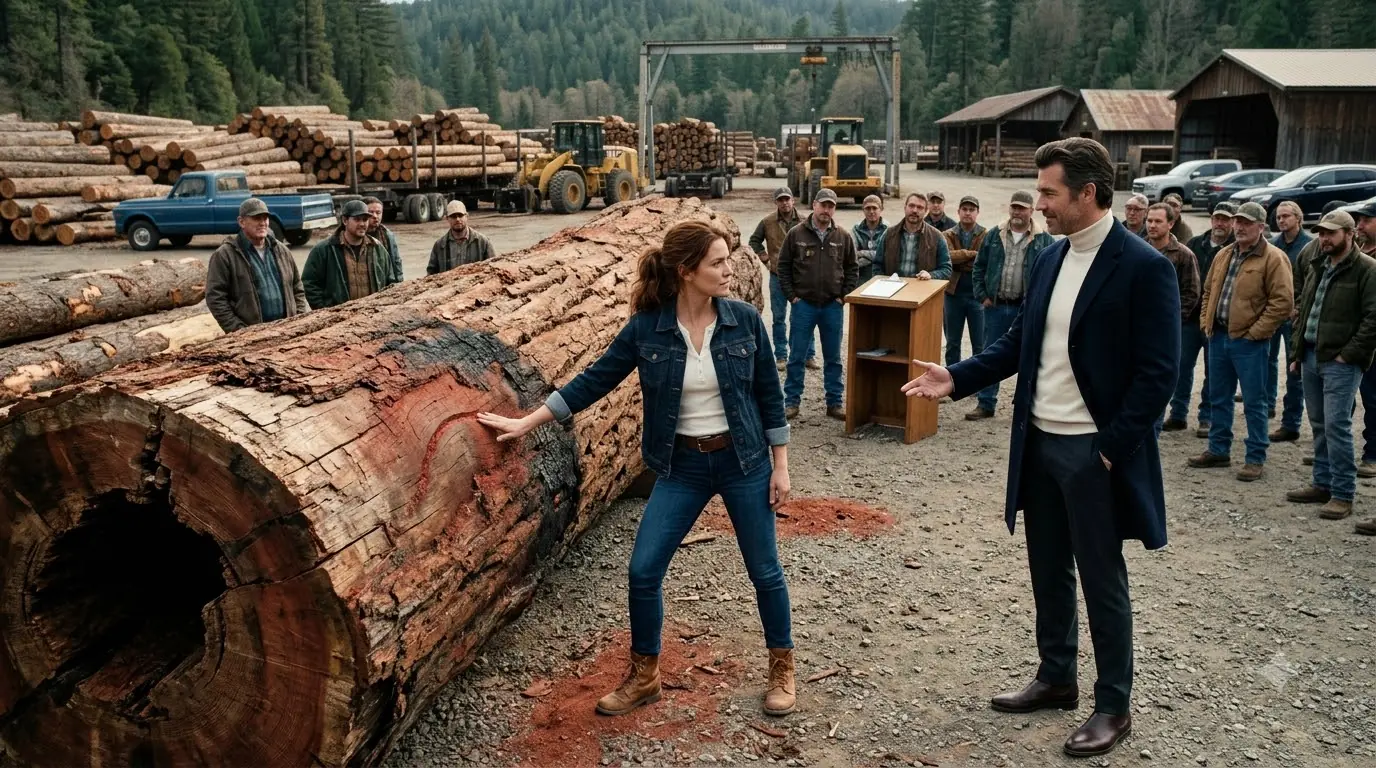
It lay on steel bunks at the edge of the gravel yard, close to forty feet of storm-felled redwood, with a fire-blackened flank, a hollow butt, and a split so dark that even the afternoon sun seemed reluctant to enter it.
Somebody behind me whistled the way a man whistles when he sees a truck turned over on an icy road and knows the insurance adjuster is going to have a terrible day.
Preston Harrington laughed first. He could afford to. Harrington Architectural Timber had eleven production facilities, accounts with hotel developers from San Francisco to Los Angeles, and a warehouse full of stock that men like me would have spent their lives trying to assemble. He walked around the log in polished boots, tapped the char with one knuckle, and announced that the last lot wasn't lumber at all. It was a freight invoice pretending to be a tree.
The other buyers laughed, some because they agreed and some because Preston was the kind of man whose jokes became expensive to ignore. I laughed too, though I don't take much pride in that fact. After nineteen years working salvage yards, I'd learned to recognize an impossible haul and a rotten center before the auctioneer cleared his throat. I also thought I understood why everyone was turning away. I didn't think there was anything left worth seeing.
Then I noticed Maren Winslow hadn't moved. She stood by the far end of the trunk with one hand on her hip and the other holding a small brass hammer from the toolbox she'd carried in. Her boots were gray with dust, her work jacket had a repaired elbow, and her hair was pulled back so tightly that a loose strand stood out like a declaration of independence. She didn't look toward Preston when he spoke. She crouched instead, swept red dust away from a narrow band beside the old burn, and studied the grain with such concentration that the yard might as well have emptied around her.
She pressed her palm against the char, moved an inch, and pressed again. Then she leaned close to a line of growth that bent around the scar, almost disappearing before it returned farther along the trunk. She held her hand there for a long time. When she finally stood, she had the expression of someone who had seen a familiar word in a language everybody else believed was dead.
"What's the opening price?" she asked.
I have known that question for almost two years now, and it still sounds dangerous when I hear it in my head. Not because of the price, which eventually fell to a humiliatingly small number. Because Maren was not asking whether she could afford the log. She was asking whether she could afford the chance to be right about it, and there is a difference between those two questions that can swallow a small business whole.