The blue lights began in the rearview mirror as two faint flashes among the trees. For a moment, Judge Corbin Augustus Vale thought they belonged to a vehicle turning out of the next driveway.
Then the flashes grew brighter, spreading across the black leather headrests and the pale stitching of his Mercedes-Benz S-Class, and a siren gave one brief, impatient cry.
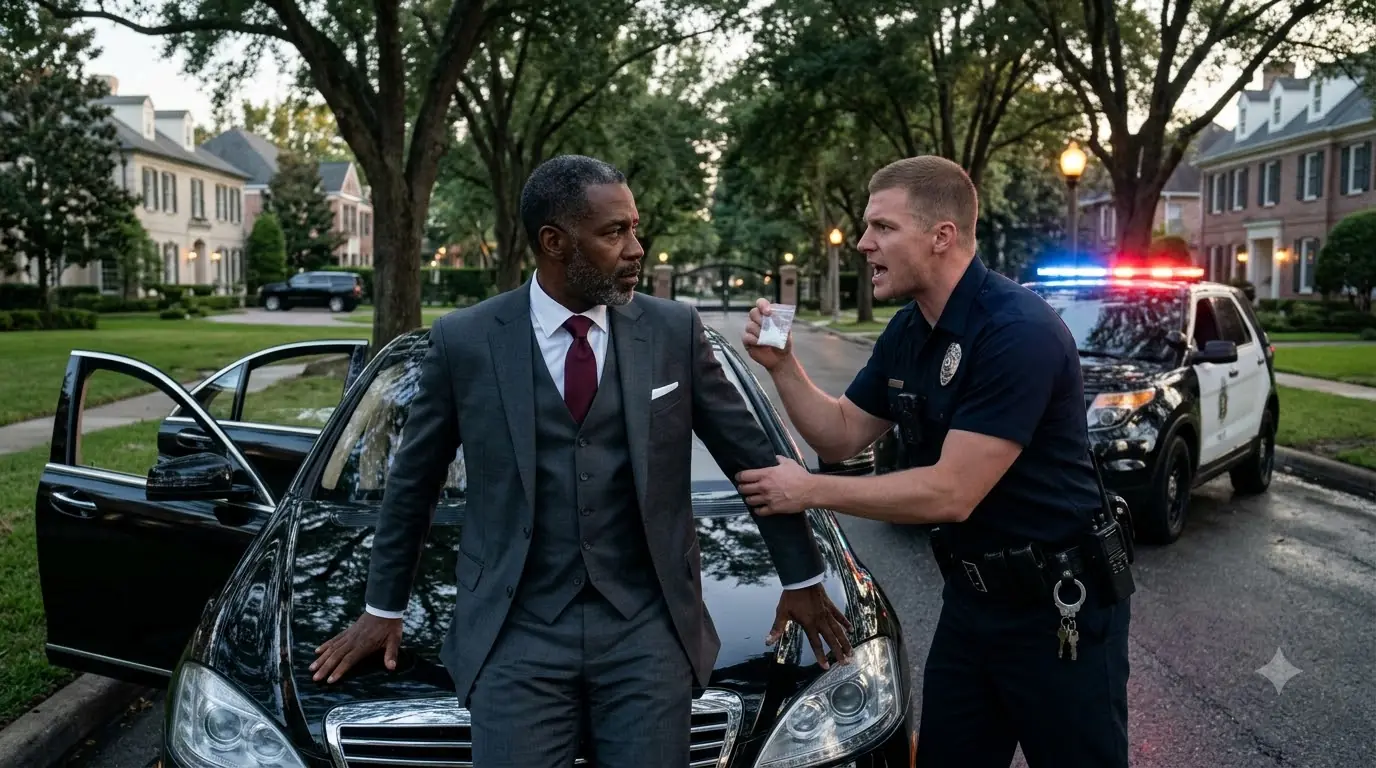
Corbin checked the speedometer, saw thirty-five miles an hour in a thirty-five-mile zone, and felt the familiar weight settle behind his ribs. Whatever reason the officer had for stopping him, Corbin knew he would have to be careful before he learned what it was.
He signaled to the right and brought the car smoothly against the curb, beneath a row of oak trees at the edge of North Fairview. The houses here were large and dark, most set far enough back from the road that their porch lights looked like distant ships. Somewhere a sprinkler turned in a steady arc, striking a stone walkway with a sharp, repeating hiss. Corbin lowered the driver's window, then the others, and placed his hands on the wheel. He had spent six weeks listening to witnesses describe threats, coded conversations, and falsified records in a sprawling racketeering case, but nothing in that courtroom had exhausted him quite like the uncertainty of a traffic stop after dark.
In the cruiser behind him, Officer Dax Ramsey watched the driver wait. Ramsey was twenty-nine, athletic, and proud of the uniform's ability to change the way people moved when he entered a room. He had been reassigned to North Fairview after an excessive-force complaint from his last district, and every quiet shift on these expensive streets felt to him like an insult. His supervisor had called the rotation an opportunity to rebuild trust. Ramsey regarded it as punishment for being willing to do what other officers were too timid to do.
He had noticed the Mercedes three intersections earlier, its polished body sliding past a line of neatly trimmed hedges. An initial plate inquiry had returned a lease associated with a corporate vehicle program, the kind of ordinary arrangement used by executives and professionals across the city. Ramsey saw the lease designation and chose to regard it as evidence of concealment. When the streetlamp illuminated the driver, he saw a Black man in an expensive suit and made the conclusion first. The traffic violation would come later, if he needed to invent one.
He did not tell dispatch that. He gave the plate number, the location, and an invented observation about the vehicle drifting across a lane line. Then he climbed out and approached with his flashlight pointed into the driver's face. His right hand rested near his holster, a posture he knew unsettled people even when he had no immediate reason to draw. Corbin kept his hands on the wheel and waited for the officer to speak.
"License and registration," Ramsey said.
"Good evening, Officer. I'll get those for you," Corbin answered. "May I ask why I was stopped?"
"Because I stopped you. License and registration, now."
Corbin studied the nameplate beneath the officer's badge. D. RAMSEY, it read, bright metal against navy cloth. He made a deliberate effort to keep his voice ordinary, neither deferential nor confrontational. "My wallet is in the inside pocket of my jacket, and the registration is in the glove compartment. I'll move slowly."
"Then move."
The words were delivered with the irritation of a man who believed being asked to explain himself amounted to an attack. Corbin took out his license and placed it where the flashlight could find it. He opened the glove compartment, withdrew the registration, and passed both documents through the window. Ramsey inspected the name, then the photograph, then the name again. Something about the man's lack of fear annoyed him more than an argument would have.
"Corbin Vale," he read. "Where are you coming from in a car like this at this hour?"
"From work."
"What kind of work?"
"At the courthouse."
Ramsey snorted. "Everybody works somewhere. What do you do there?"
"I'm a judge," Corbin said. He did not add the word federal, because he had long since learned that introducing his title could sound like a demand for special treatment. It was a factual answer to a question, nothing more. "My home is a few streets from here."
Ramsey leaned closer, shining the flashlight past Corbin's shoulder. The car smelled of clean upholstery, cedarwood cologne, and the paper cup of coffee Corbin had bought on the way out of chambers. Ramsey made a theatrical movement of his nose. "You been smoking weed in here?"
"No, Officer."
"I smell it."
"There is no marijuana in this vehicle," Corbin said. "I don't smoke."
"You saying my nose doesn't work?"
"I'm telling you the truth."
The exchange felt absurdly familiar. In the courtroom Corbin had spent his career telling lawyers to distinguish a conclusion from the evidence supporting it. On the roadside, he was looking at an armed officer who had decided that his own conclusion was enough. There would be time to challenge it later if Corbin survived the next few minutes without escalating the encounter. He knew enough families who had not been given that opportunity.
"Out of the car," Ramsey ordered. "Face the hood and keep your hands where I can see them."
Corbin unbuckled, opened the door, and stepped onto the quiet street. At fifty-three he stood a head taller than Ramsey, but he made himself smaller by leaving his shoulders relaxed and his palms visible. The officer patted him down with unnecessary roughness, finding a fountain pen, a folded courthouse parking receipt, his phone, and keys. Corbin was wearing a charcoal suit that Mara had picked out for the final day of the trial. She had told him the color made him look less tired than he was.
"What is the basis for searching my vehicle?" Corbin asked when Ramsey turned him toward the rear quarter panel.
"Possible narcotics. You wait right there."
Corbin looked at the dark windows of the nearest houses. A porch light came on briefly and then went out. Nobody emerged, and he could not blame them; the sight of flashing police lights at night had a way of making ordinary people fear that becoming a witness would also make them a target. He kept his hands visible and watched Ramsey move toward the driver's door.
There was another reason Corbin watched. The vehicle had been fitted with a private security package after an incident involving threats to the courthouse two years earlier. The installation was documented through the court's security office, but Corbin had paid for its maintenance himself. Small cameras covered the exterior approaches and parts of the cabin, recording to encrypted storage when the security system detected an intrusion. Corbin did not spend his days thinking about the equipment, yet at that moment he remembered the technician demonstrating a view from the rearview mirror assembly.
Ramsey paused at the open door, glanced toward the cruiser, and leaned into the Mercedes. From the outside, his body screened much of his right hand from his uniform camera. He had learned that the angle of a camera was not the same thing as the truth of a scene, and he thought he understood how to create an image that would support his story. What he had not considered was that someone else's camera might be recording from a different direction. He had been more concerned with blocking his own view than with examining the vehicle he had decided to frame.