“Captain Morrison, I need you in the forward cabin. Now.”
Jessica Martinez had tried to keep the panic out of her voice, but the interphone carried it all the way to the cockpit. Three rows behind her, a teenager lowered her headphones.
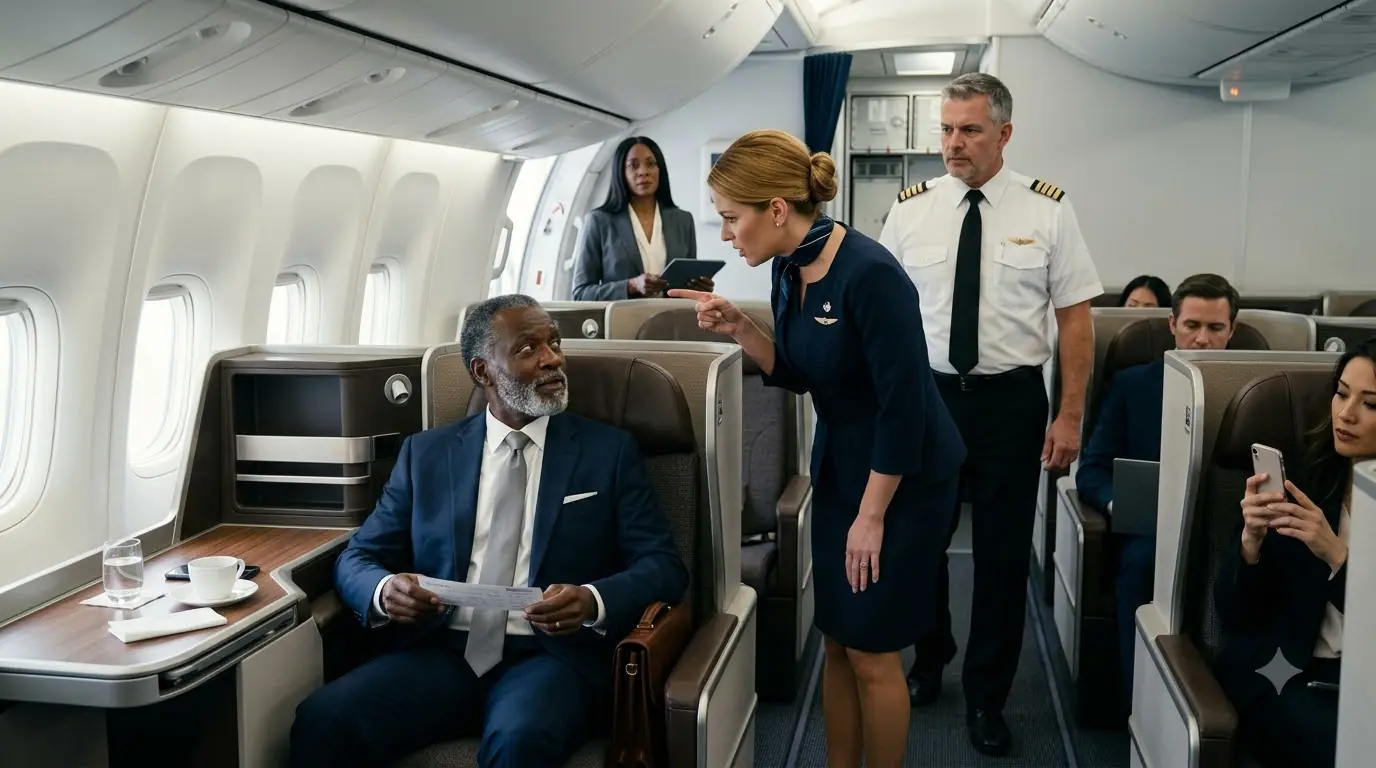
Across the aisle, a businessman who had complained about the boarding delay stopped tapping his watch. Someone farther back whispered that a passenger was refusing to leave. And in seat 2A, Marcus Williams remained perfectly still, his boarding pass resting on the armrest beside an untouched cup of water.
For twelve minutes, Jessica had spoken to him as though she had already decided what kind of man he was. She had questioned his ticket, his presence in the premium cabin, and finally his honesty. She had repeated her accusations loudly enough that strangers leaned into the aisle to see the person causing trouble. Marcus had done nothing more threatening than ask her to verify his reservation before accusing him of fraud.
Now she was calling the captain. She believed the sight of four gold stripes would finally persuade him to surrender his seat. She did not know that Marcus had spent the previous six months studying passenger complaints very much like the one she was creating in front of a cabin full of witnesses. She did not know that his briefcase contained documents prepared for a board meeting in Phoenix. Most of all, she did not know that the quiet Black man she wanted removed held the highest position on the airline’s board of directors.
Marcus checked the time on his Patek Philippe, not because he intended to impress anyone, but because his father had taught him that a precise record could protect a person when memories became convenient. The minute hand passed the eleven. His phone vibrated against his leg with a message from his general counsel, Leah Benton: The executive team is available. Do you want us to intervene?
He typed a reply with one thumb. Not yet. Preserve the records. Please make sure nobody alters a thing.
When the cockpit door opened, Captain Derek Morrison emerged with the tired expression of a man expecting to end a problem in thirty seconds. He looked at Jessica, then at Marcus, then at the phones beginning to rise around them. “What seems to be the difficulty?” he asked.
Marcus looked up and thought, for a brief and surprising moment, of his mother standing in an airport terminal thirty years earlier, holding a cleaning cart while a traveler demanded that she move out of his way. She had moved. She always moved. Her paycheck depended on it. Marcus had spent much of his adult life trying to build a world in which no one had to surrender their dignity simply because another person wore a uniform or carried a title.
“The difficulty, Captain,” he said, “is that your employee has decided I cannot possibly belong in the seat I purchased.”
Four hours earlier, no one at the airport had recognized Marcus Williams. That was exactly how he preferred to travel.