The rain began just after sunset, falling hard over the small town of Briar Glen, Pennsylvania, until the streets looked like strips of black glass beneath the old streetlights. Most shops had already closed. The bakery lights were off, the hardware store had its metal gate pulled down, and the only place still glowing at the corner of Mill Road was Turner’s Diner.
Inside, seventy-two-year-old Henry Turner stood behind the counter, wiping down the same polished wood he had wiped every night for nearly forty years. His diner was small, with red vinyl stools, a cracked jukebox that only worked when it wanted to, and framed photographs of Briar Glen from better days. The sign outside had lost two letters, so at night it blinked unevenly: T RNER’S DINER.
Henry had owned the place since he was thirty-four. Back then, the morning crowd filled every booth. Factory workers came in before sunrise, schoolteachers stopped by for coffee, and families packed the place after church on Sundays. But time had thinned everything. The factory closed. The young people moved away. The diner grew quieter year by year.
Still, Henry opened every morning at six and closed every night at nine. He said routine kept a man from becoming old too quickly.
That evening, his only waitress, Maria Delgado, had already gone home to take care of her sick mother. Henry told her not to worry about closing.
“I’ve been turning off lights longer than you’ve been alive,” he had said with a smile.
Now, as rain hammered the windows, Henry checked the register. The total was low again. Too low. He folded the receipt slowly, placed it in a drawer, and glanced toward the small envelope near the coffee machine.
Rent notice.
He did not open it again. He already knew what it said.
Henry sighed, took off his glasses, and rubbed the bridge of his nose. His hands were still strong, but the veins stood higher now, and the joints ached when storms came through. His gray hair had thinned, his shoulders had rounded slightly, and his steps were slower than they used to be. But his eyes remained gentle, the kind of eyes that noticed when someone was hungry before they asked for food.
He was reaching for the light switch when he heard a soft sound at the front door.
Not a knock.
More like a scrape.
Henry froze and listened.
The rain filled the silence. Then it came again.
Scrape. Tap.
He walked toward the door, squinting through the wet glass. At first, he saw only streaks of water and the blurred glow of the streetlight. Then two small shapes appeared beneath the awning.
Children.
Henry unlocked the door quickly and pulled it open.
A boy stood there, maybe eleven, soaked from head to toe. Beside him was a little girl around seven, clutching the sleeve of his jacket. Their clothes were thin, their shoes muddy, and both of them shivered so hard Henry could see their shoulders trembling.
The boy tried to stand tall, but fear had sharpened his face. The girl kept her eyes down.
Henry’s voice softened instantly. “Lord have mercy. Come in before you freeze.”
The boy hesitated. “We don’t have money.”
“I didn’t ask for money,” Henry said. “I asked you to come in.”
The boy looked at the girl, then stepped inside.
Warm air wrapped around them. The little girl’s lips were pale. Water dripped from her hair onto the floor. Henry closed the door and hurried to the coat rack, pulling down two old sweaters he kept for emergencies.
“Here,” he said. “Put these on. Bathroom’s right there if you need to dry off.”
The boy took the sweaters but did not move.
Henry noticed the way he positioned himself slightly in front of the girl, as if the whole world might try to take her from him.
“What are your names?” Henry asked gently.
The boy swallowed. “Noah.”
“And this is my sister, Lily.”
Lily looked up briefly. Her eyes were large and tired.
Henry nodded as if meeting them were the most normal thing in the world. “I’m Henry Turner. Most people just call me Mr. Henry.”
Noah’s face tightened. “We’ll leave soon. We just needed to get out of the rain for a minute.”
Henry glanced at the clock. Nine fifteen. “A minute won’t warm your bones. Sit down.”
“We really can’t pay,” Noah repeated.
Henry turned toward the grill. “You already said that.”
He moved behind the counter, turned the heat back on, and pulled out eggs, bread, potatoes, and a small container of leftover chicken stew. Noah watched every movement with suspicion and hunger fighting inside him.
Lily sat carefully in a booth near the window, still clutching the sweater around her shoulders. Noah sat beside her but kept his body turned toward the door.
Henry placed two mugs of hot chocolate in front of them first.
Lily stared at hers. “Is it okay?”
Henry smiled. “It’s more than okay. It has extra marshmallows because rainy nights deserve extra marshmallows.”
The girl’s fingers wrapped around the mug. She took one careful sip, and her eyes closed for half a second.
That small expression nearly broke Henry’s heart.
He cooked quickly. Scrambled eggs, toast with butter, fried potatoes, and bowls of stew steaming beneath the diner lights. He placed the plates in front of them without making a fuss.
Noah stared at the food but did not touch it.
Henry understood pride. He had lived long enough to know hunger was not only in the stomach. Sometimes hunger sat beside shame, and shame made even kindness feel dangerous.
So he said, “I made too much. If you don’t eat it, I’ll have to throw it away, and I hate wasting food.”
Noah looked at him, trying to decide if this was a trick.
Lily whispered, “Noah…”
That was all it took. The boy picked up his fork.
For several minutes, they ate in silence. Not the polite kind of eating, but the kind that revealed how long it had been since their last full meal. Lily held her spoon with both hands. Noah forced himself to slow down, but hunger betrayed him.
Henry stayed busy behind the counter, pretending not to notice.
When the plates were almost empty, he placed a small piece of apple pie between them.
Lily looked startled. “For us?”
“Pie doesn’t keep well after a storm,” Henry said.
Noah’s eyes narrowed slightly. “Why are you doing this?”
Henry leaned against the counter. “Because you knocked on my door.”
“We didn’t knock.”
“You were there,” Henry said. “That’s close enough.”
Noah looked away.
Outside, thunder rolled over Briar Glen. The rain grew heavier, rattling the windows like thrown gravel.
Henry refilled their hot chocolate. “Do you have someone I should call?”
Noah’s fork stopped moving.
Lily lowered her gaze.
Henry waited.
Finally, Noah said, “No.”
“No parents?”
“We have a mother,” he said carefully.
Henry heard the carefulness. “Where is she?”
“At home.”
“And where is home?”
Noah’s jaw tightened. “Not far.”
Henry did not push too hard. He had learned that frightened children were like wounded birds. Too much movement, too many questions, and they would fly straight back into danger.
“Does your mother know you’re out tonight?” he asked.
Noah said nothing.
Lily whispered, “She was sleeping.”
Noah shot her a look, but not angry. Scared.
Henry’s voice stayed calm. “Sleeping?”
Lily’s lower lip trembled. “She sleeps a lot.”
Noah cut in quickly. “She works nights sometimes. She gets tired.”
Henry nodded slowly, though he could hear the missing pieces between the words.
“And you two walked here in this rain?”
Noah lifted his chin. “We were fine.”
Lily whispered, “I was cold.”
Noah’s face changed. Guilt passed through it so quickly another person might have missed it, but Henry did not.
He had never had children of his own. His wife, Margaret, had wanted them desperately. They tried for years, lost two pregnancies, and eventually stopped speaking about nurseries, baby names, and little shoes. After Margaret passed from cancer twelve years earlier, Henry often told people the diner was his family. It was easier than explaining the quiet room in his house where a crib had once stood folded against the wall, waiting for a child who never came.
Looking at Noah and Lily now, Henry felt an old ache open inside him.
“You can’t go back out in this weather,” he said.
Noah stiffened. “We can’t stay.”
“I didn’t say forever. Just until the rain lets up.”
“No.”
Henry studied him. “Why not?”
The boy’s eyes flashed. “Because people say that, and then they call someone.”
Henry’s heart sank.
Lily whispered, “Please don’t call him.”
Henry’s voice lowered. “Who?”
Noah stood suddenly. “We should go.”
Lily grabbed his sleeve. “Noah, please.”
Henry did not move toward them. He kept his hands visible on the counter. “Nobody’s going anywhere yet.”
Noah looked ready to run.
Henry said softly, “Son, I don’t know what you’re carrying. But I know a child doesn’t stand in front of a diner in a storm unless the place behind him feels worse than the weather.”
The words landed heavily.
Noah’s eyes filled, but he blinked hard until the tears disappeared.
For a moment, the only sound was rain.
Then Lily said, “Mom’s boyfriend gets mad.”
Noah closed his eyes.
Henry felt something cold move through him.
“He didn’t hit us tonight,” Noah said quickly. “He just yelled. And threw a glass. It broke near Lily.”
Lily lifted one foot beneath the table. Henry saw a small cut near her ankle, dried blood mixing with rainwater.
He took a slow breath.
“All right,” Henry said. “We’re going to clean that.”
“No hospital,” Noah said.
“I didn’t say hospital. I’ve got a first-aid kit.”
Henry brought the kit from the kitchen and knelt near the booth, keeping his movements careful. “May I look?”
Lily nodded.
He cleaned the cut while Noah watched every second. The wound was small, but the story behind it was not.
“What’s your last name?” Henry asked.
Noah hesitated. “Parker.”
“Your mother’s name?”
Noah’s mouth tightened.
Henry did not like what he had to say next, but kindness without protection was not enough.
“Noah, I can feed you and warm you tonight. But I can’t pretend nothing happened. If someone is throwing glass around children, an adult needs to step in.”
Noah shook his head. “They’ll separate us.”
Lily began to cry quietly.
“No,” Noah said, turning to her. “I won’t let that happen.”
Henry’s chest hurt at the way he said it. Too much promise for an eleven-year-old boy.
Henry pulled out the bench across from them and sat down slowly.
“When my wife was alive,” he said, “she used to tell me that a child should never have to be braver than the adults around them.”
Noah stared at the table.
Henry continued, “You’ve done a fine job protecting your sister. Better than anyone your age should have to. But protecting her doesn’t mean doing everything alone.”
Noah whispered, “You don’t understand.”
“Maybe not all of it,” Henry said. “But I understand fear. And I understand that sometimes the right help feels like danger at first.”
Lily wiped her face with the sleeve of the sweater.
Henry reached for the phone behind the counter, but before he picked it up, the diner door opened.
A woman rushed in, soaked and breathless. She was in her mid-thirties, with red eyes, tangled hair, and a coat thrown over pajamas. She stopped when she saw the children.
“Noah! Lily!”
Lily cried, “Mom!”
Noah stood but did not run to her.
The woman took one step forward, then stopped, as if she knew she had lost the right to expect them to come easily.
Henry watched her carefully.
“Are you their mother?” he asked.
She nodded, tears spilling down her face. “Rachel Parker. I’ve been looking everywhere.”
Noah’s voice was hard. “Is Darren with you?”
Rachel shook her head quickly. “No. He’s gone.”
“You always say that.”
This broke something in her. She covered her mouth, then lowered her hand.
“I know,” she whispered. “I know I did. But tonight, after you left, I called the police. I told them everything. He was arrested outside the apartment.”
Noah did not move.
Rachel’s eyes went to Lily’s bandaged ankle, and she let out a small sound of grief. “Oh, baby…”
Henry stood. “Mrs. Parker, your children were cold and hungry. Your daughter had a cut from broken glass. I need to know what kind of situation they’d be returning to tonight.”
Rachel looked at him, and shame filled her face.
“I don’t know,” she admitted. “I don’t know what happens next. I just know I can’t take them back there tonight. The landlord will probably throw us out after the police came. I don’t have family nearby. I don’t…”
Her voice failed.
Noah looked at his mother then, really looked at her, and Henry saw the boy’s anger tangled with love.
Henry could have told himself it was not his problem. He could have said he had already done enough. He could have called the authorities, given statements, and gone home to his quiet house.
Instead, he thought of Margaret.
He thought of the folded crib.
He thought of all the empty mornings when he had cooked too much breakfast because some part of him was still waiting to feed someone.
“There’s an apartment upstairs,” Henry said.
Everyone turned toward him.
He cleared his throat. “Used to be mine when Margaret and I first opened this place. It’s dusty. Small. But dry. There’s a couch, a bed, and a working bathroom. You can stay tonight.”
Rachel shook her head. “Sir, we can’t ask you to—”
“You didn’t ask,” Henry said. “I offered.”
Noah looked suspicious again. “Why?”
Henry gave a tired smile. “You ask that a lot.”
“Because people don’t just help.”
Henry’s face softened. “Some do.”
The upstairs apartment smelled faintly of old wood, soap, and stored memories. Henry unlocked the door and turned on the lights. The rooms were small, but clean enough. He found extra blankets in a closet, towels in a drawer, and a box of Margaret’s old sweaters sealed carefully beneath the bed.
Rachel cried when he handed her one.
“I’ll wash it and return it,” she said.
Henry looked away for a moment. “She would’ve liked knowing it kept someone warm.”
That night, Henry slept poorly in the booth downstairs. He told himself it was because the diner needed watching, but really he stayed because he wanted Noah and Lily to feel safe.
By morning, the rain had stopped. Pale sunlight touched the wet streets.
Henry was making pancakes when Noah came down the stairs.
The boy’s hair was still damp from a shower, and the sleeves of Henry’s old sweatshirt hung past his wrists.
“You’re up early,” Henry said.
Noah sat at the counter. “I don’t sleep much.”
“Pancakes?”
“I can work.”
Henry turned from the grill. “What?”
“For the food. And the room. I can wash dishes or mop.”
Henry studied him. “Noah, you’re eleven.”
“I’m good at working.”
“I believe you. But today, your job is eating pancakes.”
Noah looked uncomfortable. “I don’t like owing people.”
Henry placed a plate in front of him. “Then consider this a loan from the universe.”
Noah frowned. “That doesn’t make sense.”
“Most important things don’t at first.”
Lily came down next, wearing one of Margaret’s sweaters like a dress. Rachel followed, her face pale but clearer than the night before. They ate together at the counter while Henry poured coffee and pretended the sight did not fill the diner with something he had missed for years.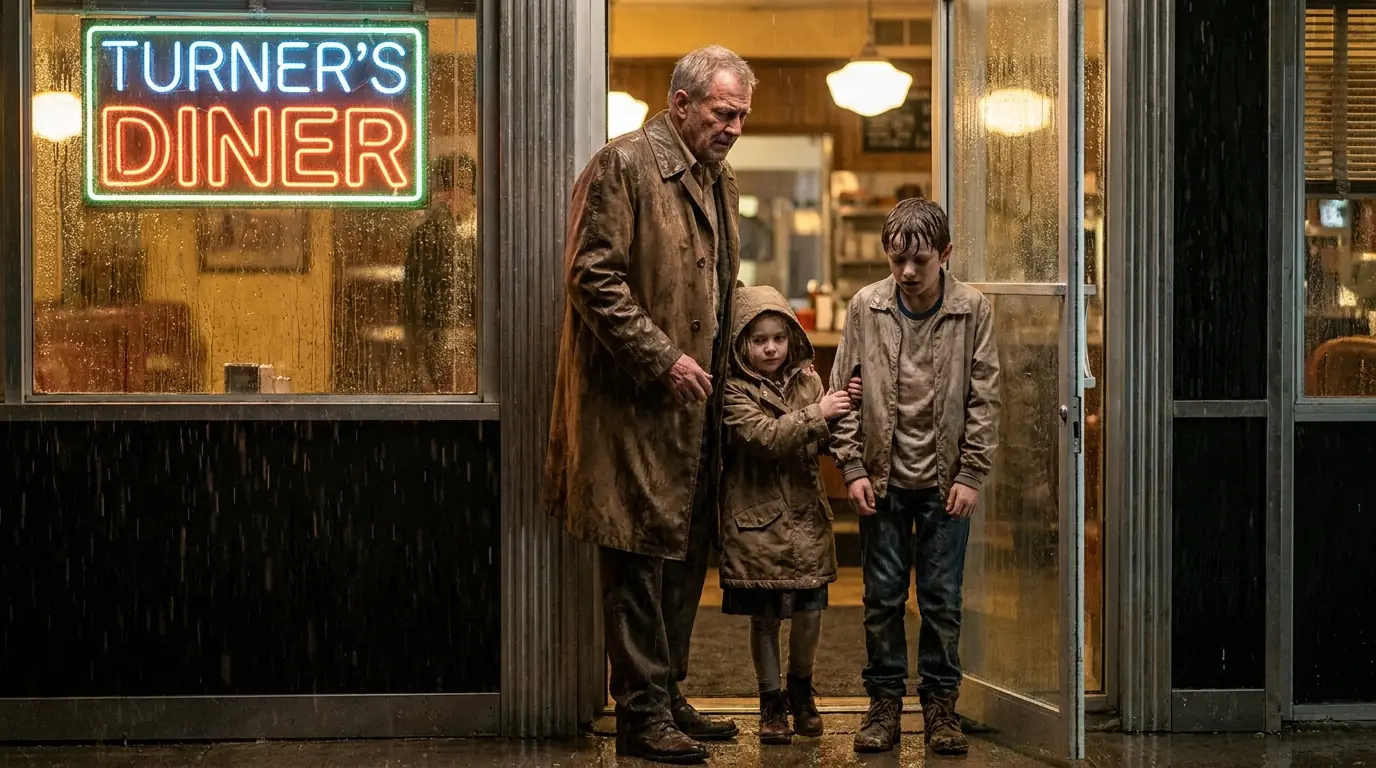
Over the next few days, the situation became clearer.
Darren, Rachel’s boyfriend, had been violent for months. Rachel had tried to leave before but had no savings, no family support, and two children watching her fall apart under fear and exhaustion. The police report helped connect her with a local advocate, but shelter space was limited. Every safe place had a waiting list.
Henry let them stay.
“One week,” Rachel promised.
Henry waved a hand. “We’ll talk after one week.”
One week became two.
Rachel found part-time work at the grocery store. Lily started going back to school. Noah returned too, though he carried himself like someone prepared for disaster at any moment.
Henry gave them breakfast each morning and dinner each night. Rachel insisted on helping clean. Noah still tried to work off every meal, so Henry gave him small tasks: folding napkins, refilling sugar jars, sweeping the sidewalk.
But Henry made one rule.
“Homework first.”
Noah rolled his eyes the first time, but he obeyed.
Slowly, the diner changed.
Old Man Saved 2 Kids in a Blizzard — Then They Returned To Him
Lily drew pictures on receipt paper and taped them behind the counter. Rachel brought fresh flowers from a discounted grocery bin and placed them on each table. Noah fixed the loose leg on booth three after watching a video at the library.
Customers began noticing.
“Place feels alive again,” old Mr. Hanley said one morning.
Henry only smiled.
But not everyone approved.
One afternoon, Gerald Mason, the property owner who had bought several buildings on Mill Road, entered the diner wearing a navy coat and an impatient expression. He was fifty-five, wealthy, and proud of being feared.
Henry saw the envelope in his hand and already knew.
“Gerald,” Henry said. “Coffee?”
“No.” Gerald looked around the diner, his gaze landing on Lily’s drawings, Rachel wiping tables, and Noah carrying a tub of dishes. “I came about your overdue rent.”
Henry’s jaw tightened. “I told your office I’d have half by Friday.”
“That was two Fridays ago.”
“I’ve had some unexpected expenses.”
Gerald’s eyes flicked toward the staircase. “So I hear.”
Rachel froze.
Henry’s voice grew firm. “Careful.”
Gerald smirked. “This is a business property, Henry. Not a charity house.”
Noah stepped slightly in front of Lily.
Henry noticed and hated that the boy still had to do that.
Gerald placed the notice on the counter. “Thirty days. Pay what you owe, or I start eviction.”
Rachel looked stricken. “Mr. Turner, we can leave.”
Henry did not look at her. He looked at Gerald.
“I’ll find the money.”
Gerald buttoned his coat. “I hope so. Sentiment doesn’t pay bills.”
After he left, the diner felt colder.
That night, Rachel packed their clothes.
Henry found her upstairs placing folded sweaters into a paper bag.
“What are you doing?” he asked.
“We can’t be the reason you lose this place.”
“You’re not.”
“We are.”
Henry stepped into the room. “Rachel, this diner was in trouble before you walked through that door.”
She wiped her eyes. “Then we made it worse.”
“No,” Henry said. “You reminded me why it was worth saving.”
She looked at him.
Henry continued, “For years, I thought this place was dying because business slowed down. But maybe it was dying because I stopped letting life into it.”
Rachel shook her head. “Kind words won’t stop eviction.”
“No,” Henry admitted. “But fear won’t either.”
The next morning, Noah did not come down for breakfast.
Henry found him sitting on the back steps behind the diner, staring at the alley.
“You planning to skip pancakes?” Henry asked.
Noah shrugged.
Henry sat beside him with some effort.
For a while, neither spoke.
Then Noah said, “Bad things happen after people help us.”
Henry looked at him. “What makes you say that?”
“At school, a teacher noticed bruises once. She called Mom. Darren got mad. We had to move apartments. Mom cried for two days.” He kicked a pebble. “People help, then they leave. Then we deal with what happens after.”
Henry absorbed this quietly.
“I’m sorry,” he said.
Noah’s voice cracked. “I don’t want Lily to be scared again.”
Henry put his hands together. “Neither do I.”
“You can’t promise that.”
“No,” Henry said honestly. “I can’t promise nothing bad will ever happen. But I can promise you won’t be the only one standing in front of it.”
Noah looked at him then.
Something shifted between them. Not trust fully, but the beginning of it.
As the weeks passed, the people of Briar Glen began to learn pieces of the story. Maria returned to work and immediately treated Rachel like a sister. Mr. Hanley brought winter coats his grandchildren had outgrown. The school counselor helped Rachel apply for assistance. Someone anonymously paid for Lily’s field trip.
Henry suspected half the town had been waiting for a reason to care again.
Then Lily did something that changed the diner.
She made a sign.
It was written in bright marker on cardboard and taped inside the window.
PAY WHAT YOU CAN. EAT WHAT YOU NEED.
Henry stared at it when he came in that morning.
Lily stood beside him, nervous. “Is it wrong?”
Henry read the words again.
A businessman might have taken it down.
A tired man afraid of rent might have taken it down.
But Henry looked at Lily’s hopeful face and left it there.
That sign brought in people who had not entered Turner’s Diner in years.
A single mother paid three dollars for soup and promised to pay more later. A retired teacher paid twenty dollars for one cup of coffee. A truck driver left a hundred-dollar bill beneath his plate with a note: For whoever needs breakfast tomorrow.
The diner did not suddenly become rich. But it became full.
Local newspapers heard about it. A college student filmed a short video of Henry serving meals and Lily helping place napkins at tables. The video spread further than anyone expected.
One morning, Henry arrived to find a line outside.
He stood in the doorway, stunned.
Maria laughed behind him. “Looks like you’re famous, Mr. Henry.”
“I’m too old to be famous,” he muttered.
But fame brought problems too.
Gerald Mason returned two weeks before the eviction deadline.
This time, he looked annoyed by the crowded diner.
“You’ve attracted attention,” he said.
Henry poured coffee into a mug without offering it to him. “People are hungry.”
“People are always hungry. That doesn’t make this a shelter.”
Henry placed the pot down. “What do you want, Gerald?”
“I want the rent paid.”
“You’ll have it.”
Gerald leaned closer. “Or I can sell this building to someone who knows how to turn a profit.”
Henry’s eyes hardened. “This building has served this town longer than you’ve owned your first suit.”
“And yet I own it,” Gerald said.
Noah, now carrying clean cups from the kitchen, heard every word. His face tightened with helpless anger.
That night, Noah sat at the counter after closing, drawing something on notebook paper. Henry came over and saw columns of numbers.
“What’s that?”
“A plan.”
“For what?”
“To save the diner.”
Henry blinked.
Noah showed him the page. “If we sell pies at school events, and if people donate, and if we make shirts with the sign Lily wrote…”
Henry felt his throat tighten.
“You shouldn’t be worrying about this.”
Noah looked up. “You worried about us.”
Henry had no answer.
The deadline came on a cold Friday morning.
Henry counted the money three times. Donations, savings, extra sales, small envelopes left by townspeople. It was close.
But not enough.
He was short by seventeen hundred dollars.
Rachel offered her entire paycheck. Henry refused. Maria offered part of her savings. He refused that too. Mr. Hanley came in with a cigar box of cash, but even then, the total still fell short.
At four in the afternoon, Gerald arrived.
The diner went quiet when he walked in.
Henry stood behind the counter, shoulders squared.
Gerald placed a folder down. “Do you have the full amount?”
Henry did not lie. “No.”
Rachel closed her eyes.
Noah grabbed Lily’s hand.
Gerald looked almost pleased. “Then we proceed.”
Before Henry could speak, the bell over the door rang.
A woman stepped inside.
She was tall, dressed in a dark business suit, with silver-streaked black hair pulled back neatly. Behind her came two men carrying folders and a younger woman with a camera bag. Outside, through the window, a black car idled at the curb.
The woman looked around the diner slowly, then at Henry.
“Mr. Turner?”
Henry frowned. “Yes?”
“My name is Evelyn Brooks. I’m an attorney representing the Whitmore Family Foundation.”
Gerald straightened at the word attorney.
Henry wiped his hands on a towel. “I’m sorry, representing who?”
Evelyn smiled. “The Whitmore Family Foundation. We support community-based food programs, child safety initiatives, and small businesses providing direct care in underserved towns.”
Henry looked completely lost.
Evelyn opened her folder. “Three weeks ago, a video of this diner reached our board. More importantly, it reached our founder.”
She turned slightly toward the door.
An elderly woman entered slowly, supported by a cane. She was in her eighties, dressed simply in a cream coat, with bright eyes that seemed to hold both sorrow and kindness. The room fell silent as she approached the counter.
Henry stared at her, then whispered, “Clara?”
The woman smiled through tears. “Hello, Henry.”
For a moment, Henry was not seventy-two. He was twenty again, standing outside a church basement food line during the hardest winter of his youth. Clara Whitmore had been Clara Bennett then, a young volunteer who handed him soup when he had no job, no home, and no reason to believe he would survive. He had never forgotten her face.
“I thought you moved west,” Henry said softly.
“I did,” Clara replied. “And life was kinder to me than I expected.”
Evelyn explained, “Mrs. Whitmore founded one of the largest private child welfare charities in the state. When she saw your diner, she recognized your name and insisted we come personally.”
Gerald cleared his throat. “That’s very touching, but this is a legal property matter.”
Clara turned her gaze to him. It was gentle but sharp. “Yes. I understand you intend to evict Mr. Turner.”
Gerald adjusted his coat. “He failed to meet his financial obligation.”
Evelyn placed a document on the counter. “The foundation is prepared to pay the outstanding rent in full today.”
A wave of relief moved through the diner.
Henry gripped the counter. “I can’t accept—”
Clara touched his hand. “Yes, you can.”
Gerald reached for the paper, but Evelyn continued.
“Additionally, we are making an offer to purchase this building from you at fair market value.”
Gerald blinked. “This building isn’t for sale.”
Evelyn slid another document forward. “According to county records, Mr. Mason, you have been seeking buyers for several Mill Road properties for the past six months.”
Gerald’s face flushed.
Clara looked around the diner, at Lily’s sign, at Rachel standing near the stairs, at Noah holding his sister’s hand.
“This place should belong to the man who knows what it is for,” Clara said.
Three months later, Turner’s Diner no longer had a broken sign.
The new sign read:
TURNER’S TABLE
Beneath it, in smaller letters:
A Meal, A Chair, A Chance.
The Whitmore Family Foundation purchased the building and transferred ownership of the diner space to Henry through a protected community trust. The upstairs apartment was renovated into temporary emergency housing for families with children. Rachel became the diner’s full-time manager. Maria trained new staff. Lily’s cardboard sign was framed and hung near the entrance.
Noah still did his homework at the counter, but now he smiled more. Not all the time. Healing did not work like a light switch. Some nights, loud sounds still made him flinch. Some mornings, he watched the door too carefully.
But he began to believe in ordinary days.
One spring afternoon, Henry found him outside repainting a bench.
“You missed a spot,” Henry said.
Noah looked at the bench, then at Henry. “Where?”
Henry grinned. “I just wanted to see if you’d argue.”
Noah laughed.
It was the first real laugh Henry had heard from him.
That sound stayed with him all day.
Years passed.
Rachel saved money, rebuilt her life, and eventually moved with Noah and Lily into a small house two streets away. But they never really left Henry. They came every Sunday. Lily helped decorate the diner windows for every holiday. Noah worked there during summers, then through high school, then whenever college brought him home.
Henry grew older. His steps became slower. His hands shook more often when he poured coffee. Eventually, Rachel insisted he stop opening the diner alone.
“You’re not thirty anymore,” she told him.
“I was never thirty,” Henry replied. “I was born tired.”
But age came whether he joked or not.
By eighty-one, Henry no longer worked the grill. He sat in the corner booth beneath the old photographs, greeting customers and telling stories that grew slightly longer each year. Children from struggling families knew him as Grandpa Henry. Some drew pictures for him. Some saved him cookies from their plates.
He always acted surprised.
One October morning, Henry woke in his small house behind the diner and felt a pain in his chest.
He tried to stand, but the room tilted.
He managed to knock over the lamp beside his bed. The crash was heard by Lily, now sixteen, who had come early to drop off a pumpkin pie for the diner. She found him on the floor, pale and struggling to breathe.
The ambulance arrived within minutes.
At the hospital, Rachel held his hand. Lily cried quietly in the hallway. Noah, now twenty and studying social work at Penn State, drove through two hours of rain to reach him.
Henry opened his eyes that evening and saw the young man standing beside his bed.
Noah looked different now. Taller, broader, with clear eyes and a serious face. But Henry could still see the soaked boy from that stormy night.
“You scared us,” Noah said.
Henry’s voice was weak. “Didn’t mean to.”
“You never do.”
Henry smiled faintly.
The doctor said Henry needed rest, medication, and help at home. He would recover, but he could not live alone the way he had before.
Henry hated hearing that.
“I’m not moving into some facility,” he muttered.
Rachel leaned over him. “Nobody said that.”
Noah stepped closer. “You’re coming home with us for a while.”
Henry frowned. “No.”
Lily wiped her eyes and said, “You don’t get to say no.”
Henry looked at her, startled by how much she sounded like him.
Rachel smiled through tears. “You taught us that people don’t have to handle hard things alone.”
Noah added, “So now you don’t.”
Henry turned his face toward the window.
For years, he had given food, shelter, patience, and safety without calculating what might return to him. He had never thought kindness was a transaction. He had not helped two children in the rain because he expected reward.
But now, lying in a hospital bed, surrounded by the family that life had given him late, he understood something.
Sometimes what returned was not money.
Sometimes it was a hand holding yours when your own hand trembled.
Sometimes it was a young man driving through a storm because he could not bear the thought of losing you.
Sometimes it was a girl who once asked permission to drink hot chocolate now telling doctors exactly how to care for you.
Sometimes it was a woman who had arrived broken and frightened now standing strong enough to protect the man who once protected her children.
Henry closed his eyes, and tears slipped down his temples.
Noah squeezed his hand. “Mr. Henry?”
Henry whispered, “I’m all right.”
But he was more than all right.
For the first time in many years, he did not feel like an old man being carried toward the end of his life.
He felt like a father being brought home.
Two days later, a black car stopped outside Turner’s Table.
Henry saw it from the passenger seat of Rachel’s old blue sedan as they pulled up from the hospital. For one strange second, he wondered if another attorney had come, another foundation, another surprise from the outside world.
But then the car doors opened.
Former children stepped out.
Not just Noah and Lily.
Dozens of them.
Young adults, teenagers, mothers holding babies, college students, workers in uniforms, boys and girls who had once eaten free pancakes beneath Lily’s sign. Some held flowers. Some held handwritten letters. Some simply stood with wet eyes.
They lined the sidewalk in front of the diner.
A banner hung over the door.
WELCOME HOME, GRANDPA HENRY.
Henry stared at it.
Rachel parked, and Noah helped him out carefully.
The crowd began clapping.
Henry shook his head, overwhelmed. “What is all this?”
Lily stepped forward, smiling through tears. “You gave everyone a chair when they needed one.”
Noah placed a hand near Henry’s back, not pushing, only steadying. “Now we’re giving you one.”
Inside the diner, Henry’s corner booth had been changed. The old cracked seat was replaced with a comfortable cushioned bench. A brass plaque had been fixed to the wall beside it.
Henry leaned close to read it.
Henry Turner sat here, listened here, fed people here, and taught this town that kindness is not charity. It is home.
He could not speak.
Noah guided him into the booth. Lily placed a mug of hot chocolate in front of him, with extra marshmallows.
Henry looked at it and laughed through tears.
“You remembered.”
Lily sat across from him. “Rainy days deserve extra marshmallows.”
Outside, the repaired sign glowed against the evening sky. Inside, the diner hummed with voices, plates, footsteps, and laughter. Henry looked around at the faces, some familiar, some new, all gathered beneath the roof he had nearly lost.
He had once believed the diner was his family because he had no other.
Now he understood the truth.
The diner had not replaced the family he never had.
It had been building one for him all along.
Kind Elderly Couple Shelters a Freezing Family — Days Later, Dozens of Luxury Cars Show Up