Every morning, Oliver stood at the shelter entrance and stared through the glass doors.
He had been surrendered by the only family he had ever known. When they walked away, Oliver remained beside the door, watching their car disappear from the parking lot.
The next morning, he returned to the same spot.
Every time footsteps approached, his ears lifted. Every time a car stopped outside, his tail moved gently. But when another visitor entered without calling his name, he quietly lowered his head again.
The shelter staff placed a soft bed in his kennel, but Oliver rarely used it during the day. He preferred the lobby, where he could see everyone who came through the door.
For nearly two weeks, he waited.
Then one rainy afternoon, a familiar-looking vehicle pulled into the parking lot. Oliver suddenly stood up, pressed his nose against the glass, and began wagging his tail harder than anyone had seen since his arrival.
We did not know who was inside—or whether Oliver’s long wait was finally over.
Oliver arrived at our shelter on a quiet Tuesday morning.
He was a seven-year-old mixed-breed dog with a faded red collar, a graying muzzle, and gentle brown eyes. His family told us they could no longer keep him after moving into a new apartment.
They filled out the surrender paperwork while Oliver sat beside them.
He did not understand the forms, the signatures, or the quiet conversation taking place over his head. He only understood that he had arrived in an unfamiliar building filled with strange voices and the sound of dogs barking behind closed doors.
Oliver stayed close to his owner’s leg.
Whenever someone walked past, he looked up but did not move away. His tail rested on the floor, occasionally tapping once when his owner spoke to him.
A staff member asked about his health, behavior, favorite food, and daily routine.
His family said Oliver had lived with them since he was a puppy. He was house-trained, comfortable around adults, and especially attached to the person who usually took him on evening walks.
They handed us a bag containing his remaining food, an old blanket, and a rubber toy marked with years of small tooth impressions.
Then it was time for them to leave.
One of our shelter workers took Oliver’s leash while his family walked toward the front entrance. Oliver immediately tried to follow.
When the leash stopped him, he looked back at the worker in confusion.
Then he turned toward the door again.
His owner briefly placed a hand on his head and said goodbye. Oliver leaned into that familiar touch, still believing they were all leaving together.
The glass door opened.
His family walked outside, crossed the parking lot, and entered their vehicle. Oliver stood completely still as the car pulled away.
He did not bark or cry.
He simply stared through the glass until the vehicle disappeared at the end of the road.
Our staff gave him several minutes before gently guiding him toward the kennel area. Oliver followed, but he repeatedly looked over his shoulder.
The farther he moved from the lobby, the slower his steps became.
His kennel had already been prepared with clean blankets, water, and a bowl of food. We placed his old blanket near the bed so that he would have something carrying the scent of home.
Oliver sniffed it carefully.
For a moment, his tail moved.
Then he turned toward the kennel gate and remained there, listening to every sound from the hallway.
Many dogs experience stress during their first days at a shelter. Some bark constantly, while others hide beneath their beds or refuse to make eye contact.
Oliver became unusually quiet.
He allowed the medical team to examine him without resisting. His heart and lungs sounded normal, and no serious injury was found.
However, he was slightly underweight.
His coat was dull, his nails were overgrown, and the skin beneath his collar was irritated. The veterinarian also noticed stiffness in his hips, likely caused by mild arthritis.
None of those problems explained the sadness in his behavior.
Oliver accepted treats but did not seem interested in eating a complete meal. He drank only a small amount of water and ignored the rubber toy his family had packed.
That first evening, a kennel attendant found him sitting beside the gate.
He had not touched his bed.
She entered quietly, sat on the floor, and placed one hand on the blanket. Oliver watched her for several minutes before slowly lowering himself beside her.
He did not ask to be petted.
He rested his head on his front paws and continued looking toward the hallway.
The next morning, a volunteer brought Oliver into the lobby for a quiet walk before the shelter opened. The moment he saw the front doors, his entire posture changed.
His head lifted.
His ears moved forward, and he pulled gently toward the glass.
Oliver stopped at the exact place where he had watched his family leave.
He looked outside for several minutes.
Whenever a vehicle entered the parking lot, he followed it with his eyes. When someone stepped out, Oliver stood taller and waited.
But no one came for him.
The volunteer eventually encouraged him to walk outside. Oliver took a few steps into the grass, relieved himself, and immediately turned back toward the entrance.
He did not want to explore.
He wanted to wait.
That behavior continued throughout the week.
Every morning, Oliver walked directly to the lobby. He stood beside the glass doors and watched visitors move through the parking lot.
Sometimes, his tail began to wag when he saw someone approaching from a distance.
The movement always slowed when the person came closer.
Oliver seemed to search every face.
A tall man wearing a dark jacket caused him to become especially excited on his third day. Oliver pressed both front paws against the glass and released a soft whine.
The man entered the building to meet another dog.
Oliver sniffed his trousers, looked behind him, and then returned to the window. His tail stopped moving.
The man asked why Oliver spent so much time near the entrance.
When we explained, his expression changed.
He knelt and offered his hand, but Oliver turned his head toward the parking lot again.
He was still waiting for one particular person.
At night, shelter life became even more difficult for him.
When the lights dimmed and the front doors were locked, Oliver seemed to understand that no one else would arrive. He walked reluctantly back to his kennel and curled on the old blanket.
The evening staff occasionally heard him release a quiet, breathy whine.
It was not loud enough to disturb the other dogs. It sounded almost as though Oliver was calling for someone he believed might still be nearby.
We contacted his former family during the first week.
We explained that Oliver was struggling to adjust and asked whether they could provide more details about his routine. Familiar words, walking routes, or favorite activities sometimes help surrendered dogs feel secure.
They confirmed that he had spent most of his life following the same schedule.
He woke early, waited beside the kitchen while breakfast was prepared, and walked through the neighborhood every evening. At night, he slept beside the bedroom door.
Oliver had rarely been left alone.
We asked whether they wanted to reconsider the surrender or help arrange another placement with someone Oliver already knew.
They said returning for him was not possible.
Our staff did not allow Oliver to hear the call. Still, that afternoon, he stood at the entrance until the sun began to set.
We moved one of his beds into a quiet corner of the lobby.
At first, he refused to lie on it. He stood with his nose close to the glass, watching every vehicle pass.
Eventually, his legs grew tired.
He lowered himself onto the bed but kept his face pointed toward the doors.
That became his daily place.
Visitors began noticing him before they noticed the dogs whose adoption profiles were displayed on the wall. Some asked to meet him, but Oliver showed little interest once he realized they were strangers.
He was never aggressive.
He accepted gentle touches and walked politely beside anyone holding his leash. But there was a distance in his expression, as though only part of him was present.
Our behavior coordinator explained that Oliver was experiencing grief.
Dogs may not understand surrender in the same way people do, but they recognize separation. They notice when a familiar scent disappears, when a routine suddenly ends, and when the person they trusted does not return.
For Oliver, the entrance was the last place where his old life had existed.
Waiting there gave him something to hold onto.
We did not force him away.
Instead, we began helping him build a new routine around that place.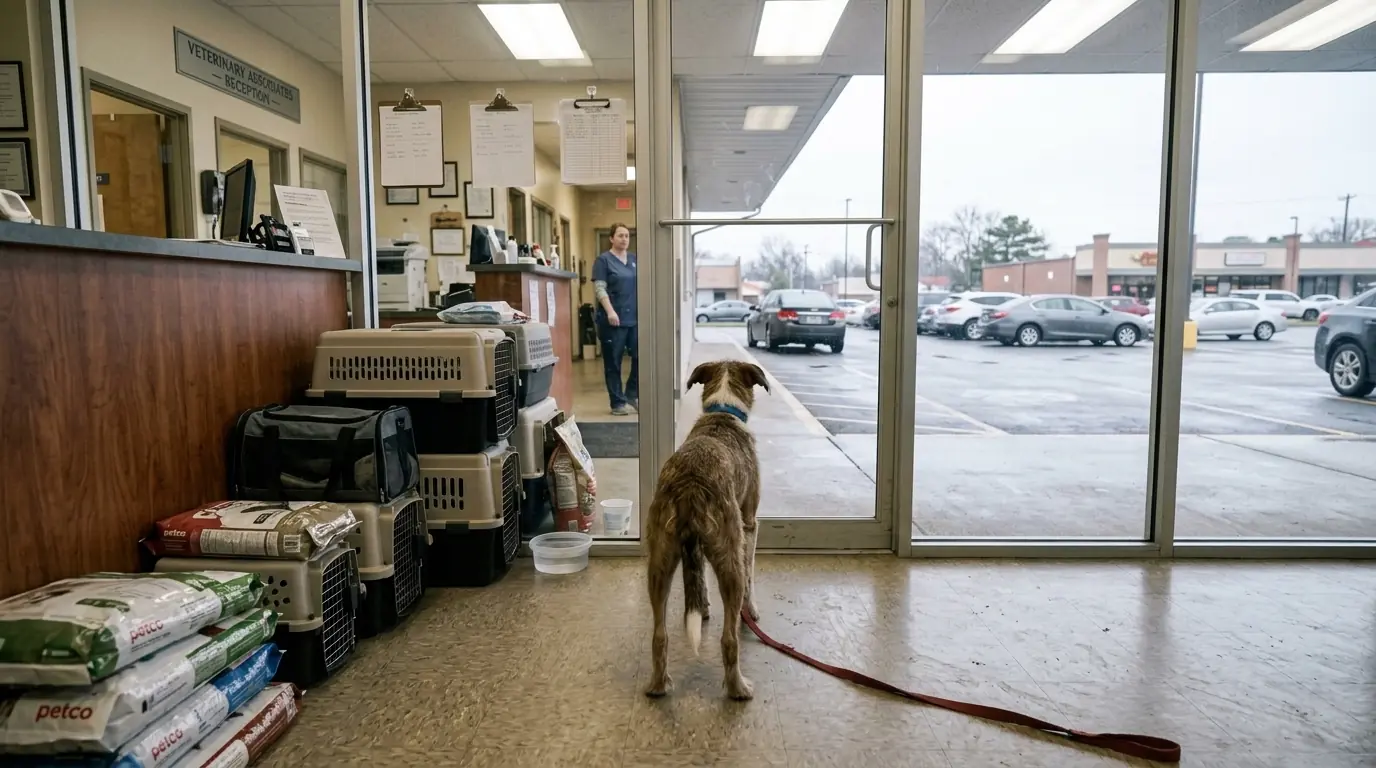
Every morning, a volunteer named Hannah sat beside his lobby bed and read quietly. She did not constantly call his name or attempt to distract him.
She simply remained close.
On the fourth morning, Oliver rested one paw against her shoe.
Two days later, he accepted breakfast while she sat beside him. He ate slowly, pausing whenever he heard a vehicle outside.
Hannah started bringing a soft brush.
Oliver initially moved away when she touched his back, but soon he began leaning slightly into each stroke. Loose fur gathered on the floor as the dull coat around his shoulders slowly regained its softness.
During their walks, Hannah allowed Oliver to choose the route.
For several days, he never went beyond the edge of the parking lot. He inspected each parked car and then returned to the front doors.
One morning, he walked a little farther.
He reached a small patch of grass near the shelter sign and spent several minutes sniffing. His tail remained low, but his attention was finally focused on something other than the entrance.
The next day, he went as far as the trees.
These changes were small, but they mattered.
Oliver also began responding to the sound of Hannah’s footsteps. When she entered the lobby, his ears lifted even if he was looking outside.
By the end of the second week, he greeted her with a cautious wag.
He still checked the door behind her.
But he no longer looked through her as though she were invisible.
The rainy afternoon came thirteen days after Oliver’s surrender.
Dark clouds had covered the sky since morning, and water ran in narrow streams across the parking lot. Few visitors had come to the shelter.
Oliver was lying on his lobby bed when a gray vehicle turned into the driveway.
The tires slowed near the entrance.
Oliver suddenly stood.
His ears rose, his body became tense, and his tail began sweeping rapidly from side to side. He rushed toward the glass and pressed his nose against it.
Everyone in the lobby noticed.
For nearly two weeks, Oliver had reacted to dozens of cars. But this time was different.
He released a sharp, excited cry.
For a moment, we wondered whether his former family had changed their minds.
The driver’s door opened.
A man stepped out wearing a raincoat and hurried toward the building. Oliver’s tail continued moving, but as the man came closer, he hesitated.
It was not his former owner.
The man entered carrying a familiar red leash.
His name was Daniel, and he was a close friend of Oliver’s former family. He had known Oliver since the dog was young and had often cared for him when the family traveled.
Oliver recognized his vehicle and scent.
The moment Daniel knelt, Oliver pushed his head against the man’s chest.
His entire body trembled.
Daniel wrapped both arms around him while Oliver sniffed his jacket, his hands, and the leash. For the first time since arriving, Oliver made a sound that was neither a whine nor a cry.
It was a soft, breathless noise of recognition.
Daniel’s eyes filled with tears.
He had only recently learned that Oliver had been surrendered. He had seen a photograph shared by one of our volunteers and immediately contacted the shelter.
Daniel explained that he would have taken Oliver if he had known the family could no longer keep him.
However, he had not come to remove him that afternoon.
His landlord required documentation before another dog could enter the property, and Daniel wanted to make certain his home would be suitable. He had come to see Oliver, bring something familiar, and begin the adoption process.
Oliver did not understand the delay.
When Daniel stood to leave, the dog followed him toward the door. His excitement turned to panic as soon as the leash changed hands.
He pulled forward and cried.
Daniel knelt again and promised he would return, but promises are difficult for a frightened dog to understand.
Oliver watched him cross the parking lot.
This time, he barked.
It was the first loud bark we had heard from him since his arrival.
After Daniel’s vehicle disappeared, Oliver remained standing at the glass. Hannah sat beside him, expecting him to withdraw into the same silent waiting.
Instead, Oliver turned toward her.
He pressed his shoulder against her legs and stayed there.
The visit had reopened part of his grief, but it had also reminded him that familiar people could return.
Daniel visited every day while the adoption arrangements were completed.
He brought Oliver’s old metal food bowl, a second blanket, and photographs documenting the time they had spent together. In one picture, a much younger Oliver was asleep with his head across Daniel’s boots.
The shelter could not rely on photographs alone.
Every adoption required a proper application, veterinary references, housing approval, and a plan for ongoing care. Oliver’s age and early arthritis also meant that Daniel needed to understand his future medical needs.
Daniel completed every step.
His landlord approved the dog, and a home visit confirmed that the property was safe. The house had a fenced yard, nonslip flooring, and a quiet room where Oliver could adjust gradually.
Daniel also scheduled an appointment with his veterinarian.
While we waited, his visits became part of Oliver’s routine.
They walked around the shelter property together. Oliver moved more confidently beside the familiar red leash, although he tired after long walks.
Daniel never rushed him.
When Oliver stopped to look back toward the building, Daniel waited until he was ready to continue.
On the third visit, Daniel brought a tennis ball.
Oliver sniffed it and walked away.
A few minutes later, Daniel rolled it gently across the lobby floor. Oliver watched the ball stop near his bed.
He approached, picked it up, and carried it back.
The staff became silent.
It was the first time Oliver had played since his surrender.
Daniel rolled it again.
Oliver followed it, this time with a small bounce in his step. His stiff hips prevented him from running quickly, but his tail moved throughout the game.
Afterward, he lay beside Daniel rather than beside the front doors.
The difference seemed simple, but it showed us that Oliver’s world was beginning to expand beyond the place where he had been left.
His medical care continued during this period.
The veterinarian started him on a joint-support plan and recommended controlled daily exercise. His irritated skin improved after the old collar was removed and the area was gently cleaned.
Oliver also began eating complete meals.
Hannah discovered that he preferred to eat after his morning walk rather than before it. Once the shelter adjusted his routine, his appetite improved significantly.
Within three weeks, he had gained a healthy amount of weight.
His coat looked brighter, and the constant tension around his eyes began to soften. He still watched the parking lot, but he no longer reacted to every passing car.
Instead, he learned Daniel’s arrival time.
Each afternoon, shortly before four, Oliver walked to the window.
He seemed to recognize the distant sound of the vehicle before anyone else. When Daniel parked, Oliver’s tail started moving.
And every day, Daniel came inside.
That consistency was what Oliver needed most.
On the morning the adoption was finalized, Daniel entered carrying a new blue harness. He sat on the floor and allowed Oliver to examine it.
The shelter staff gathered quietly nearby.
Oliver stepped into the harness without hesitation. When Daniel attached the familiar red leash, Oliver looked toward the front doors.
For weeks, those doors had represented loss.
This time, they opened for him.
Oliver walked outside beside Daniel.
He paused halfway across the entrance mat and glanced back at Hannah. She knelt, and Oliver returned to touch his nose against her hand.
Then he followed Daniel toward the gray vehicle.
The car door opened.
Oliver placed his front paws on the seat but hesitated. Daniel lifted his back legs carefully, protecting his stiff hips, and settled him onto the blanket.
Oliver turned in a circle before lying down.
He did not stare back at the shelter.
He rested his head near Daniel’s hand.
The first days in the new home were intentionally quiet.
Daniel placed Oliver’s old blanket beside his bed and kept his food bowl in a calm corner of the kitchen. He followed the routine Oliver had known for years but introduced new experiences slowly.
At first, Oliver followed Daniel from room to room.
If Daniel disappeared behind a closed door, Oliver waited directly outside. When he heard keys or saw a jacket being lifted, he became restless.
The fear of being left had not disappeared simply because he had found a home.
Daniel began practicing brief, predictable separations.
He stepped outside for only a few seconds and returned before Oliver became distressed. Gradually, those seconds became minutes.
Oliver learned that the closing of a door did not always mean permanent abandonment.
Daniel also placed a bed near the front window.
Oliver still liked watching vehicles and people pass, but his behavior was different. He no longer stood rigidly or searched every face.
Sometimes he fell asleep while looking outside.
One evening, Daniel took him on the familiar route they had walked years earlier.
Oliver recognized the neighborhood almost immediately. He sniffed the base of an old tree, paused beside a wooden fence, and pulled gently toward a small park.
His body remembered.
At the park, Daniel sat on a bench while Oliver explored the grass. The dog eventually returned and rested at his feet.
There was no door to watch.
There was no car disappearing.
There was only a familiar person sitting beside him.
Oliver returned to the shelter one month after his adoption for a medical check.
The staff wondered how he would react to the building. Some dogs become frightened when they return to the place where they experienced separation.
Oliver walked through the entrance and immediately recognized the lobby.
He looked toward his old bed, then toward the glass doors.
For several seconds, he stood in the same place where he had waited for nearly two weeks.
Then Hannah called his name.
Oliver turned, crossed the lobby, and greeted her with a loose body and a wagging tail. He accepted treats from the staff and allowed the veterinarian to examine him.
He had gained weight.
His skin had healed, and his movement had improved with regular gentle exercise. Daniel reported that Oliver was eating well, sleeping through the night, and beginning to play more often.
The rubber toy packed with him on the day of his surrender had finally become interesting again.
Oliver carried it from room to room and frequently left it beside Daniel’s shoes.
When the appointment ended, Daniel picked up the red leash.
Oliver followed him to the exit without hesitation.
He did not remain beside the window.
He did not turn toward every person entering the lobby.
He walked through the doors because he knew exactly who was taking him home.
Today, Oliver still visits us occasionally.
His muzzle is a little grayer, and he moves more slowly on cold mornings. He continues to receive support for his joints and regular veterinary care.
Emotionally, he has made remarkable progress.
He can remain alone for short periods without panicking. He no longer waits beside the door whenever Daniel leaves the room, although he usually chooses a resting place where he can hear him moving around the house.
Every afternoon, they take a slow walk together.
Afterward, Oliver sleeps near the front window. Cars pass, doors close, and unfamiliar people move along the sidewalk.
He watches them calmly.
He is no longer searching for the family who left him behind.
Oliver waited at the shelter because he believed loyalty meant staying in the last place his people had seen him.
In the end, the person who returned was not the person he expected.
But it was someone who already knew his history, understood his fear, and was willing to prove—day after day—that this time, the door would always open again.