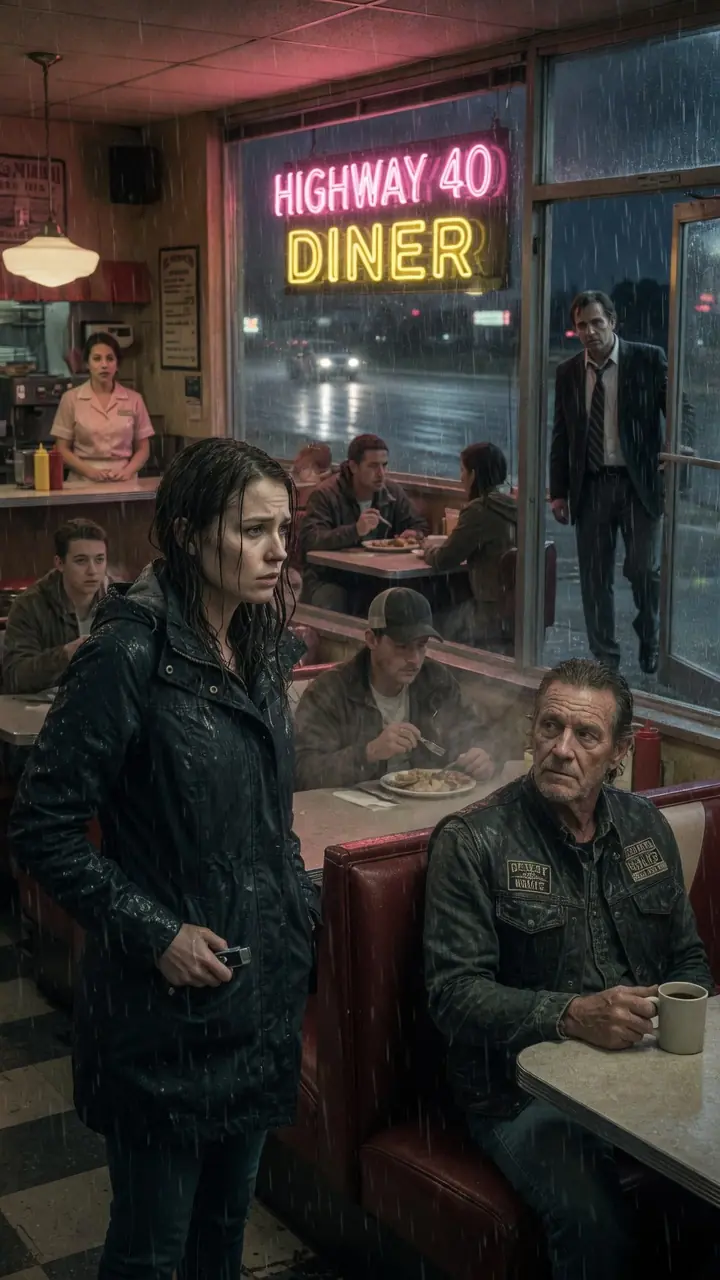
Richard Callaway kicked the diner door open. Every head in the room snapped up. Megan Puit was already inside. 29. An accountant who had found the wrong numbers 3 weeks ago.
She heard the crash behind her and went completely still. He was scanning the room looking for her. She had maybe 10 seconds. Her eyes moved fast and stopped. Corner booth. Back to the wall.
Cole Ironside Harrove, president of the Desert Wolves MC, a man who had walked into a hundred situations exactly like this one and walked out of every single one. Most people in that diner had been carefully avoiding his eyes since he walked in.
Megan walked straight toward him. She leaned down, five words. Please say, "You know me." Cole looked up slowly, looked at her, then looked past her, at Richard, and the expression that crossed his face made three grown men in that diner quietly push their chairs back.
Cole didn't answer right away. He looked at her eyes, not her face, her eyes. Then he looked past her at Richard Callaway standing 15 feet away, chest still heaving from the sprint across the parking lot, suit jacket crooked, hair plastered flat from the rain.
Richard had found her. The question now was what he was going to do about it. Cole reached across the table and pulled out the empty chair across from him. Slow, deliberate, like a man who had all the time in the world. "Sit down," he said.
Megan sat. Richard crossed the diner floor in eight steps. He didn't run. Men like Richard never ran. Running was messy. Running drew attention. Instead, he walked with the careful precision of someone who had learned that calm was its own kind of threat.
He stopped at the edge of the booth. Megan. His voice was low, professional. The same voice he used in board meetings when he wanted someone to understand that the conversation was already over. We need to go.
Megan didn't look at him. She kept her eyes on the table. Richard's gaze moved to Cole. He took in the leather vest, the patches, the size of the hands wrapped around the coffee mug. His expression didn't change.
I apologize, Richard said, smooth as glass. My colleague had a difficult evening. I'm here to take her home. Colleague. Cole took a slow sip of coffee. That right, he said. Not a question. It is.
Richard placed both hands on the edge of the table. Relaxed. Reasonable. Megan, I think we've both said things tonight we didn't mean. The car's outside. We can talk on the way back.
Still, Megan didn't move. Her hands were flat on the table in front of her. Both of them, pressing down like she needed to feel something solid underneath. Richard leaned slightly closer. Don't do this here.
Cole set his mug down. The sound of ceramic on formica was quiet, but something about it made the waitress behind the counter stop moving. She's not going anywhere, Cole said.
Richard straightened. The reasonable smile stayed on his face, but something behind it shifted. A door closing behind his eyes. Sir, he said carefully. I don't know what she told you, but this is a private matter between.
She didn't tell me anything. Richard paused. She didn't have to. Cole said. The diner was completely silent now. The trucker at the counter had set down his fork. The young couple by the window had stopped pretending to look at their phones.
Even the cook had gone still behind the pass through window, dish towel in hand, watching. Richard looked at Megan one more time. When he spoke, his voice had dropped to something just above a whisper. The register he used when there were no more witnesses that mattered.
You have no idea what you're throwing away. Megan's jaw tightened, her hands pressed harder against the table. That was when Cole stood up. He didn't say anything. He didn't need to. He simply unfolded from the booth to his full height.
6'2" of a man who had spent 30 years in rooms where the wrong decision got people killed and looked at Richard Callaway the way a man looks at a problem he has already solved. Richard took one step back. Involuntary. He didn't even seem to notice he'd done it.
You need to think very carefully, Richard said, about what you're getting yourself into. Cole tilted his head slightly. Already did. Outside, the rain hammered the roof. The neon sign above the window buzzed faintly.
Somewhere in the parking lot, a car door opened and closed, and neither of them was the one who had walked in. Richard heard it, too. His eyes moved to the window just for a second, just long enough. When he looked back, Cole was watching him with an expression that had nothing in it.
No anger, no threat, no performance of any kind, just the quiet patience of a man who had already made his decision, and was now simply waiting for the other man to catch up. Megan exhaled, the first real breath she had taken since the parking lot.
She reached into the front pocket of her jacket and closed her fingers around the USB drive she had been carrying for 11 days. The one with the files. The one Richard had turned his entire company upside down looking for.
She hadn't planned any of this. She hadn't planned to end up in a diner off Highway 40 at midnight. Hadn't planned to walk up to a stranger in a biker vest and say five words she had no right to say.
That was the night she stopped planning and started surviving. Richard was still standing there, still calculating. His eyes moved once more to the window to whatever was in the parking lot and then back to Cole. This isn't finished, he said quietly.
Cole didn't answer. He didn't need to because outside, barely audible under the rain, a sound had begun to build at the far end of the highway. Low at first, then lower still. The kind of sound you felt in your chest before you heard it with your ears.
Engines. Not one, not two, many. Megan heard it. Her head turned toward the window. Through the rain streaked glass, she could just make out headlights. Far down the road, moving fast. A line of them stretching back into the dark.
Richard heard it too. The color left his face so quietly it was almost gentle. But that is not where this story starts. To understand what happened next and why a man like Cole Harrove was sitting alone in a roadside diner at midnight and why Richard Callaway had been hunting Megan Puit for 11 days and why a single USB drive was about to bring down one of the largest property development companies in the state of Oklahoma.
We need to go back 11 days to the night Megan found the files. Megan Puit grew up in Claremore, Oklahoma, a small town northeast of Tulsa that most people drove through more than they stopped in. Her father repaired oil pumps for a living. Her mother taught 7th grade math.
They lived in a red brick house on Maple Street with a white fence her father repainted every summer, whether it needed it or not, because according to him, everything worth keeping needed attention before it started to fall apart. Megan learned that early. Watch before there's a problem. Read the numbers before they start lying.
That was why she studied accounting. Not passion, not anyone's suggestion, just the quiet recognition formed somewhere around age 12. That numbers never lied if you knew how to read them correctly. And the person who could read them correctly was never fooled for long.
She graduated from Northeastern State at 23. Honors, no debt, because she had worked every year, weekends at the register of a hardware store on Main Street, Tuesday and Thursday evenings entering data for Mr. Dillard's accounting office on the second floor of the old building near the county courthouse.
Mr. Dillard was the first person who told her she had a particular gift, not for calculation. Computers did that, for seeing what didn't fit, numbers that looked right but felt wrong. Small recurring charges that cycled through quarterly reports in amounts too minor for anyone to question.
Good accountants are everywhere, he told her once. The two of them sitting across from each other over a stack of folders at 8:00 in the evening. People who see what others miss. That's rare. She didn't know then where that sentence would take her.
After graduation, she applied to 12 companies, got called back by eight, received offers from three. She chose Callaway and Vance properties because they paid the most and the office was in Tulsa, close enough to Claremore to drive home on weekends, far enough to feel like a life of her own had begun.
The first year was ordinary. The work matched the description. Bookkeeping for real estate development projects, reconciling construction costs, preparing quarterly reports for the board, friendly colleagues, clean office. The coffee machine worked. Her direct supervisor was a woman named Harkkins, 50 years old, short silver hair, a habit of tapping her pen on the desk when she was thinking, who never said more than necessary, but was always fair.
Richard Callaway was different. She met him for the first time at the companywide meeting in March of her first year. He walked in 5 minutes late, no apology, no explanation, and sat down at the head of the table like he had been sitting there already. Tall hair combed flat suit jacket without a single crease.
He spoke about the company's vision in a low, even voice, never once glancing down at his notes. Every person in the room watched him. Megan couldn't tell if that was charisma or habit. The second time she saw him was 2 weeks later in the elevator. Just the two of them.
He was looking at his phone. She was looking at the doors before they opened. He said without looking up. Puit, right. New accountant. Harkins says, "You're careful." Then the doors opened and he walked out.
She stood in the elevator for 2 seconds before she remembered she also needed to leave. After that, it was small things. He would stop by her desk and set down an invoice. No explanation. Just look at this. She would look and find the error.
He never said thank you, but the following week there would be another one, then another. By June, Megan had been reassigned to report directly to Richard Callaway. Harkins called her into the office to deliver the news. She tapped her pen three times, the familiar rhythm, then said simply, "He asked for you by name. This is a good opportunity."
She paused, tapped once more. "Be careful." Megan asked, "Careful of what?" Harkins didn't answer. She just stood and opened the office door. Megan didn't understand that at the time. Later, she would. Harkins had said exactly what could be said without saying more than was safe.
The 6 months reporting directly to Richard went smoothly enough to be unsettling. He demanded precision, but was always clear. Never raised his voice, never blamed anyone publicly. When she made a mistake once in her first month, a transposed figure in a summary report, he called her into his office, closed the door, and spoke in a voice so low she had to lean slightly forward to hear.
I don't keep people who make the same mistake twice in the same category. Then he pushed the report back across the desk. Do it again. Nothing dramatic, nothing she could have complained about. But when she walked out of that office, her hands were cold.
That was the first time she understood the difference between a demanding boss and a boss who frightened you without you knowing you were frightened. The first incident happened in September. She was reconciling costs for a residential development project in Broken Arrow, 270 units, budget just over $40 million.
Inside the contractor expense table, she found a recurring payment to a company called Vantage Site Solutions. $280,000 a month, consistent across 9 months. She searched for the contract, nothing. Searched for inspection records, nothing. Searched for a company contact, no phone number, no physical address, no website.
She typed the company name into the Oklahoma business registry. No results. She marked the line in red pen and brought it to Richard. He looked at the paper. His expression didn't change. Subcontractor, he said. I handle it directly. Doesn't need to be in the system.
He returned the paper. Keep moving. She went back to her desk. Erased the red mark. Kept moving. But she didn't forget. The second incident came in November. A new project, a commercial development in Sand Springs.
In the consulting fees section, she found another company name, Meridian Consulting Group. $150,000 a month, eight consecutive months. She searched, same result. No physical address, no contract, no documentation of any kind beyond a name and payments flowing out of the company account at steady, unremarkable intervals.
This time, she didn't ask Richard. She quietly copied the data into a separate file and saved it to a personal USB drive she took home that evening. That night, she sat at the kitchen table in her small apartment on Cincinnati Avenue, opened her laptop, and began comparing two projects, two shell companies.
Combined total $3,800,000 across less than two years flowing to addresses that didn't exist for services with no paper trail through line items that would look perfectly ordinary to anyone who didn't look closely. She stared at the screen until 2:00 in the morning.
Then she closed the laptop, washed her face, looked at herself in the bathroom mirror for a long moment. Her father had a saying he repeated whenever she brought something home from outside as a child. Something found on the road. Something that didn't clearly belong. If you don't know whose it is, don't pick it up.
But she had already picked it up. And now she knew exactly whose it was. The third incident, the one she couldn't set aside, happened on a Wednesday afternoon in early December, 11 days before the night at the diner.
She was staying late alone in the office. Richard was at an outside meeting. Harkins had gone home. Just Megan and the fluorescent lights and the steady hum of the air conditioning. She opened the wrong folder on the shared server by accident.
A folder she didn't have clearance for, but the system let her in because someone had forgotten to set the permissions correctly. Inside was a single spreadsheet. She opened it. 17 projects, not two. 17 projects spanning seven years. 17 shell companies with different names but identical payment structures.
The total was not $3,800,000. It was $23,400,000. She sat completely still and looked at the screen. Outside the window, Tulsa was lighting up for the evening. Cars moved along the IDL headed home. Someone on the floor below had turned on country music from a phone speaker, the sound rising faintly through the floor.
Megan closed the folder. Cleared the access trail, turned off her monitor. Then she took the USB drive from her pocket, plugged it into the machine, and copied the entire spreadsheet before she had time to think about what she was doing.
Because part of her, the part that grew up in the red brick house on Maple Street with the father, who repainted the fence every summer, had known for a long time that things which were broken, didn't stop on their own. They kept going until someone decided to stop them.
And right now she was the only person who knew. What she didn't know yet. What would take 10 more days to understand fully was that Richard Callaway also knew someone had opened that folder. The server logged everything. And Richard Callaway read the server log every Thursday morning.
Stay with me because what happened across those next 10 days is the reason Megan Puit walked up to a stranger in a roadside diner at midnight and said five words she never thought she would have to say to anyone. 3 years before the night at the Iron Skillet, Megan's grandmother, Eleanor Puit, sat on the front porch of the red brick house on Maple Street and told her a story she had never told anyone in the family before.
It was late July, the kind of Oklahoma evening where the heat didn't break after sundown, just settled lower and closer, sitting on your shoulders like something with weight. Megan was home for the weekend from her summer job in Tulsa, her second year of college, 20 years old, tired in the particular way that comes from working too hard and sleeping too little.
She had found her grandmother in the rocking chair, a glass of iced tea sweating in her hand, watching Megan's father paint the fence below the porch steps, the slow, steady sound of the brush moving back and forth, the smell of white paint drifting up through the thick evening air.
Eleanor Puit was 71 then, small woman, sharp eyes, the kind of quiet that came from decades of listening to people who had no one else to talk to. She had volunteered at the Claremore Women's Shelter for 15 years. Megan had always known that the way you know a fact about someone, a piece of information that exists in the background of a person without ever becoming a full picture.
Her grandmother drove there on Tuesday and Thursday evenings. Sometimes she came home quieter than she left. That was all Megan had ever known to ask about. That evening on the porch, Eleanor set her glass down on the railing and said, without preamble, I want to tell you about a woman named Carol.
Megan looked up from her phone. Carol came to the shelter on a Tuesday in February. Eleanor said she had driven 40 minutes to get there. She had her two children in the back seat and a paper bag of clothes on the passenger seat and nothing else.
She told me later she had been planning to leave for 11 months. 11 months of waiting for the right moment, packing a little at a time, moving money in amounts small enough not to be noticed. Eleanor paused. Below them, the brush moved back and forth against the fence boards.
What stopped her the first 10 times wasn't fear, Eleanor said. It was practicality. She didn't have enough money, enough time, enough certainty that the moment was right. And every time she decided to wait one more week, she convinced herself that was the smart choice.
Megan put her phone face down on her knee. The 11th time, Eleanor continued, she didn't decide. She just drove. She got the children dressed before he woke up, put the bag in the car the night before, and at 5:40 in the morning, she pulled out of the driveway while he was still asleep upstairs.
She told me she didn't feel brave. She felt sick. Her hands shook the entire 40 minutes. Eleanor picked up her glass again, held it without drinking. The reason I'm telling you this, she said, is because of what happened two weeks before she left.
She was at the grocery store with her youngest, the boy, 4 years old. Her husband was three aisles over. She knew because she could hear him, and she needed to ask someone for help, but she couldn't say the words. Not with him that close. Not in a voice he might hear.
The brush below stopped for a moment. Megan's father set it down, stepped back to look at the fence, then picked it up again. There was a woman in the aisle with her. Eleanor said, a stranger. Carol looked at her and said five words. Just five words.
Quietly like she was commenting on the weather. She said, "Please say you know me." Megan was very still. The woman understood immediately. Eleanor said she didn't ask questions. She didn't look toward the husband. She just said, "Of course. How are you?" and took Carol's arm like they were old friends and walked with her to the front of the store.
And that was enough. Just enough distance, just enough cover. Carol made it to the car, got the boy in the seat, and 2 weeks later, she drove those 40 minutes and came to us. The evening insects had started up somewhere in the yard. A high, steady sound threading through the heat.
Megan said, "Did she know?" the woman in the store. She figured it out. Eleanor said she called the shelter the next day, asked if a woman with a young boy had come in. We couldn't confirm, but she called to say she hoped Carol had made it somewhere safe.
They sat quietly for a moment. Then Eleanor said, "I'm telling you this because you're going out into the world, and I won't always be there. And I want you to know that sometimes the only call for help a person can make is a quiet one to someone who might not even know them. And I want you to know what that sounds like when you hear it.
She looked at Megan directly. Her eyes were the same pale gray they always were, clear and unhurried. And I want you to know what to say if you're ever the one who needs to say it. Megan nodded slowly. Five words, Eleanor said. That's all. And the right person will understand.
Below them, the painting had stopped. Megan's father straightened up, looked at the fence from one end to the other, and nodded to himself. The small private satisfaction of a man who had done a thing the right way. The smell of paint was everywhere, white and clean and sharp in the warm July air.
Megan didn't think about those five words again for 3 years. She didn't think about them when she took the job at Callaway and Vance. Didn't think about them when she was reassigned to report to Richard Callaway. Didn't think about them the night she sat at her kitchen table until 2:00 in the morning looking at numbers that shouldn't exist.
Eleanor Puit passed away the following spring, quietly in the same red brick house in the bedroom at the end of the hall with the window that looked out over the yard and the fence that her son-in-law still repainted every summer without being asked. Megan was with her.
She held her grandmother's hand and listened to the sound of the neighborhood outside the window. Lawnmowers, a dog barking two houses down, a car radio fading as it passed, and thought about the particular quality of a life spent listening to people who had no one else to listen to them.
She thought about Carol about 40 minutes of shaking hands on a steering wheel at 5:40 in the morning. About 11 months of waiting for the right moment that never came until the moment she stopped waiting for it. She did not think about the five words, "Not yet."
That came 11 days before the night on Highway 40 on a Wednesday afternoon in early December when she plugged a small USB drive into a company server and copied a spreadsheet that listed $23,400,000 flowing through 17 Shell companies across 7 years and understood in the particular way she had been understanding things since she was 12 years old that she was now holding something that someone very powerful and very careful wanted no one to ever find.
She drove home that evening with the USB drive in her jacket pocket, ate dinner without tasting it, washed the dishes, dried them, put them away. Then she sat on the edge of her bed in the quiet apartment, and thought about her grandmother on the porch on a July evening with a glass of iced tea and the smell of white paint, and a story about a woman named Carol and five words spoken quietly to a stranger in a grocery store aisle.
She hadn't thought she would ever need them until tonight. The 10 days after Megan copied that spreadsheet were the quietest 10 days of her life. That was what frightened her most. Not confrontation, not accusation, just silence. Richard Callaway came to work every morning at 7:53.
He walked past her desk without stopping. He replied to her emails within the hour, same as always. He said good morning to the office at large in the same low even voice he always used. Nothing changed. Nothing shifted. The ordinary rhythm of the office continued exactly as it had before.
And yet on the Thursday after she copied the files 2 days later, she arrived at her desk to find that her access to the shared server had been quietly reclassified. Not removed, just narrowed. The folders she used every day were still there. But three levels deeper in the directory structure she had accidentally wandered into. A new permission wall had appeared overnight.
Someone had closed the door she had walked through. She didn't mention it to anyone. She opened her daily work files and started reconciling invoices and said nothing. On the following Monday, she noticed the car, a dark blue sedan parked across the street from her apartment building on Cincinnati Avenue.
Different spot each evening, but always the same car. She had memorized the license plate on the second night without intending to. The way you memorize something your body has decided is important before your mind catches up. Tuesday, the car was there. Wednesday, Thursday, Friday morning, it was gone.
And she spent the entire day waiting for something to happen and nothing did. And that was almost worse. She called her mother on Friday evening, talked about nothing, the weather, whether the fence needed painting again this year, a recipe her mother had seen on television.
She didn't mention the car. She didn't mention the USB drive sitting at the bottom of her winter coat pocket wrapped in a thin layer of tissue paper like something fragile, which in a way it was. She didn't mention any of it because she didn't know yet what any of it meant.
She was still telling herself that on Saturday and Sunday. By Monday, she had stopped telling herself anything. Monday was the day Richard Callaway stopped walking past her desk without stopping. He paused at 9:17 in the morning. She knew because she looked at the clock in the corner of her screen when she heard his footsteps slow.
He stood beside her desk for a moment without speaking. She kept her eyes on her monitor. "Puit," he said. "Good morning. My office 4:00." Then he walked on. She spent the next 6 hours and 43 minutes working with complete precision.
Every invoice matched, every figure balanced. She made no errors because she could not afford for anything to look like she was distracted, which she was completely every second of those 6 hours and 43 minutes. At 3:58, she stood up, smoothed her jacket, and walked to his office.
He was behind his desk. The blinds were angled half shut the way he kept them when he didn't want the afternoon light. He didn't gesture for her to sit and she didn't sit. I've been reviewing access logs, he said. He kept his hands flat on the desk. Routine audit.
All right, she said. There was an anomaly in December, a folder accessed outside normal parameters. He looked at her directly for the first time. Do you know anything about that? The room was very quiet. The air conditioning had cycled off somewhere in the last minute.
And the silence it left behind was the particular silence of a place where something was being decided. I may have clicked the wrong directory, she said. I didn't find what I was looking for and backed out. He studied her face.
She had spent 29 years learning to keep her face still when it mattered. Her father taught her poker at age nine and told her the most important thing wasn't the cards. It was making sure no one could read what you were holding. Of course, Richard said finally. His voice gave nothing away.
These things happen. He looked back down at his desk. That's all. She walked back to her desk, packed her bag at 5:00, took the elevator down, walked to her car in the parking garage on the third level. The dark blue sedan was parked one row over.
She sat in her car for 4 minutes without starting the engine, hands in her lap, looking straight ahead at the concrete pillar in front of her. Then she started the car and drove home. That was Monday. Tuesday, she called in sick for the first time in 2 years of employment.
She stayed in her apartment, curtains drawn, and spent the morning going through every file on the USB drive again, not looking for anything new, just making sure she understood exactly what she had. Every company name, every project, every payment date and amount written out by hand in a notebook she bought at the pharmacy on the corner, paying cash.
$23,400,000. 17 projects, 7 years. She thought about going to the police. She opened the non-emergency line on her phone twice and closed it twice. She thought about a lawyer. She thought about a journalist.
She thought about driving back to Claremore and sitting at the kitchen table with her father and telling him everything. She thought about Carol. 11 months of waiting for the right moment. By Tuesday evening, she had made her decision.
She would go to the FBI field office in Tulsa on Wednesday morning. She had the drive. She had the notebook. She had 2 years of employment records that would establish her credibility as a witness. She would walk in at 9:00 and she would hand it all over and let someone with actual authority decide what to do with it.
That was the plan. She was still holding on to it when her phone rang at 11:47 Tuesday night. Unknown number. She almost didn't answer. She answered. Richard Callaway's voice came through the line the same way it always did. Low, controlled, unhurried, as if calling an employee at midnight was an entirely ordinary thing.
I think you took something that belongs to the company, he said. She didn't speak. I'm not angry, he said. I just need it back. Whatever you copied, the drive, any notes you made, I need those returned tonight. A pause. I can be at your building in 20 minutes.
Her heart was hitting her ribs so hard she was certain he could hear it through the phone. I don't know what you're talking about, she said. Another pause. Longer this time, Megan. His voice dropped a half register, the same drop she had heard in his office that first month when he told her he didn't keep people who made the same mistake twice.
Don't make this complicated, she ended the call, stood in the middle of her living room for 10 seconds. Then she picked up her coat from the hook by the door, the winter coat with the USB drive in the pocket, pulled it on, grabbed her keys and her bag, and walked out of her apartment without looking back.
She took the stairs, not the elevator, pushed through the side exit onto the alley. Her car was in the lot on the east side of the building. She walked fast without running because running drew attention, and she had learned in the last 10 days that the most dangerous thing she could do was draw attention.
She got in the car, pulled out of the lot, turned north on Cincinnati. In her rear view mirror, headlights appeared from the direction of her building's main entrance. She turned west. The headlights turned west. She drove for 22 minutes without a destination. Just moving, just keeping distance between herself and whatever was behind her.
The city thinned out. The street lights got farther apart. The road became Highway 40, heading toward the state line, and the rain that had been threatening all day finally broke open overhead, coming down hard enough to make the wipers work at full speed and still not keep up.
She passed a gas station, closed, past a motel, dark except for the office. Then ahead, through the rain, a sign glowed pink and yellow against the black sky. The iron skillet opened 24 hours. She pulled in, sat in the parking lot for 30 seconds with the engine running, watching the rear view mirror.
No headlights followed her in. The highway behind her was empty and dark. She turned off the engine, picked up her phone, thought about calling someone, couldn't think of who, put the phone in her pocket, pushed open the car door, and walked through the rain to the diner entrance.
Inside, the smell of coffee and bacon grease and the low sound of a radio somewhere in the kitchen. A trucker at the counter. A young couple near the window. A waitress behind the register who looked up briefly when the door opened. And in the corner booth, back to the wall, a man in a leather vest with a desert wolves patch across his shoulders, who was looking at no one and nothing in particular.
The way a man looks when he has learned that the safest position in any room is the one where you can see every door. Megan stood just inside the entrance. Her coat was soaked through. Her hands were not shaking. She noticed that with a kind of distant surprise.
She had expected them to shake. Instead, they were very still, hanging at her sides, the way her grandmother's hands had been still on the armrest of the rocking chair on a July evening. When she said five words that Megan had carried for 3 years without knowing she was carrying them, she crossed the diner floor.
She stopped beside his table. She leaned down and in a voice just loud enough to reach him and no one else, she said the only thing she could think of to say, "Please say you know me." Cole Harrove looked up and outside in the rain soaked parking lot, a pair of headlights turned slowly off the highway and into the entrance of the iron skillet.
Cole Harrove had been sitting in that corner booth for 40 minutes before Megan Puit walked through the door. He had stopped at the iron skillet for the same reason he stopped at most places on long rides. Not because he was hungry, but because the body needed to stop moving before the mind could catch up with it.
He had been on the road since 4:00 that afternoon, riding west out of Tulsa on Highway 40 with no particular destination and no particular timeline, which was the only way he knew how to spend the anniversary of the day he lost Danny Briggs. 11 years ago, on a December night, Danny had gone down on a rain slicked overpass outside Sapulpa, 47 years old, 18 years in the Desert Wolves.
He had been riding back from a chapter meeting alone. The same way he always rode because Danny said he thought better on an empty road. Cole had been the one to identify him. Every year since, on the same night, Cole rode west on Highway 40 until the rain or the dark or the weight of it, made him stop somewhere and sit with a cup of coffee and let the quiet do what quiet did.
He was on his second cup when the diner door opened and a woman walked in soaking wet with the particular stillness of someone who had been running and had just stopped. He noticed her the way he noticed everything without appearing to. The coat too thin for the weather. The way her eyes moved across the room before the rest of her did.
The fact that she stood in the entrance for three full seconds before moving, which most people didn't do, which was the kind of pause that meant a person was calculating something. He watched her cross the diner floor. He watched her stop beside his table. And when she leaned down and said five words into the space between them, Cole Harrove set his coffee cup down and looked at her the way his old road captain, Big Ray, used to say, "You should always look at someone who came to you for help. Not at what they were saying, but at what they were holding back."
What he saw in Megan Puit's eyes in that moment was not panic. It was the particular exhaustion of someone who had been holding something alone for a very long time and had just made the decision to stop holding it alone. He pulled out the chair across from him. "Sit down," he said.
She sat. 30 seconds later, the diner door opened again and Richard Callaway walked in. Cole had already texted three words to a number saved in his phone under the name Boon. The message read, "Iron skillet, Highway 40." That was all. Boon would know what it meant. Boon always knew what it meant.
Now, watching Richard Callaway cross the diner floor with the careful precision of a man who believed the situation was already resolved in his favor, Cole reached for his coffee cup again and waited. He had learned a long time ago that the worst thing you could do when a man like Richard Callaway walked into a room was show him anything he could use.
So, Cole showed him nothing. He sat exactly as he had been sitting. He let Richard come to him. Richard stopped at the edge of the booth. He looked at Megan first, then at Cole. He took in the leather vest, the patches, the size of the hands around the coffee mug. His expression went through a quick private calculation.
Cole had seen that calculation on enough faces to recognize it in under a second and came out the other side with a decision to treat this as a manageable complication. I apologize for the interruption," Richard said. The professional smile was in place. The voice was warm and reasonable and completely controlled.
"I believe there's been a misunderstanding. This woman is my employee. She's had a difficult evening, and I'm here to take her home." Cole looked at him, did not speak. The silence stretched 4 seconds. Five. Richard adjusted his footing slightly. Not a step back, just a small shift of weight.
The kind of movement a person made when the ground felt less certain than expected. She may have told you something that concerned you," he said. "I understand that, but this is an internal company matter, and she didn't tell me anything," Cole said. Richard paused.
She didn't have to. Cole said. The diner had gone completely quiet. The trucker at the counter had stopped eating. The young couple near the window had stopped pretending to look at their phones. The waitress, a woman named Darla, who had worked the night shift at the Iron Skillet for 11 years and had seen most things a highway diner at midnight could show a person, stood behind the counter with a dish towel in her hand and did not move.
Richard looked at Megan. His voice dropped to the register he used when he wanted to remind someone of a power arrangement without saying the words out loud. You need to think very carefully about what you're doing right now. Megan's hands were flat on the table. She did not look at him.
Richard looked back at Cole. The warmth was leaving his voice now. Not gone yet, just thinning. The way ice thins before it breaks. Sir, I don't know who you are, but you are inserting yourself into a situation you don't have the full picture of. I'm asking you professionally to let me speak with my employee privately.
Cole tilted his head a fraction of an inch. No, he said one word. Flat and final and carrying no more emotion than a closed door. Richard's jaw tightened. The professional smile was gone now. What replaced it was not anger. Not yet, but the particular expression of a man recalibrating, moving from plan A to the contingency he had brought with him.
He reached into his jacket pocket and produced his phone. Tapped the screen twice. Then he set it face up on the edge of the table. A gesture so deliberate it was clearly rehearsed. I have documentation, he said, that establishes this woman accessed confidential company files without authorization and removed proprietary financial data.
That is a criminal matter. I have already been in contact with our legal team. He looked at Cole steadily. Whatever she told you, whatever she showed you was obtained illegally. I would encourage you to consider your own exposure here before you continue down this road.
The diner was so quiet Cole could hear the rain on the roof. He looked at the phone on the table. Then he looked at Richard Callaway. That's so, he said. It is. Cole nodded slowly. Then he reached into the chest pocket of his vest and produced his own phone.
He didn't look at the screen. He set it on the table beside his coffee cup face up. On the screen was a text from Boon sent 40 seconds ago. It read 23 out 12 minutes. Cole turned the phone so it faced the ceiling and left it there. Richard glanced at it. The number didn't mean anything to him yet.
In 12 minutes it would mean everything. I'm going to ask you one time, Richard said. His voice had gone fully quiet now. The quiet of a man who had decided that courtesy was no longer an efficient use of his time. Step aside, let her come with me, and whatever conversation happened here tonight stays here."
Cole looked at him for a long moment. Then he stood up. He unfolded from the booth slowly. The way a man stood up when he had no need to hurry and came to his full height, 6'2" 230 lb. 54 years of a life lived in places where men like Richard Callaway did not last long.
The desert wolves patch across his shoulders caught the overhead light as he straightened. Richard took one step back. He didn't seem to notice he'd done it. She's not going anywhere. Cole said, "You have absolutely no idea. She's not going anywhere." Cole said again.
Same tone, same volume. The repetition wasn't for emphasis. It was to make clear that the first time had not been an opening position. Richard stared at him. The calculation was running again behind his eyes. Faster now, less certain.
He looked toward the diner entrance, then back at Cole. You're making a serious mistake, he said. Cole said nothing. I have people outside, Richard said. I know, Cole said. That stopped him. Cole picked up his phone from the table, checked the screen once, put it back in his pocket. "I do too," he said.
For the first time since he had walked through the door, Richard Callaway had nothing to say. Outside, the rain was still coming down hard. The highway beyond the diner windows was dark and empty. The neon sign above the entrance buzzed and flickered, pink and yellow light catching the water on the glass.
And then underneath the rain, underneath the hum of the sign, underneath the silence inside the diner, something else began. Low at first. So low it was more felt than heard. A vibration that started somewhere in the chest before it reached the ears.
Darla behind the counter felt it first and looked toward the window. The trucker felt it next and lifted his head. The young couple near the window turned to look at the parking lot. Richard Callaway heard it last. He turned toward the window slowly down the length of Highway 40, cutting through the rain like a line of moving light.
Headlights were coming. Not one, not two, a long, unbroken column of them stretching back into the dark. Pairs of headlights close together, the particular spacing of motorcycles riding in formation. The sound built the way thunder built, steadily, inevitably until it wasn't underneath the rain anymore, but on top of it, filling the diner, filling the parking lot, filling the stretch of Oklahoma Highway in every direction.
23 motorcycles rolled into the lot of the Iron Skillet. In just under four minutes, they came in tight formation and peeled off in pairs, filling the lot from the entrance to the far edge, engines dropping to idle one by one until the roar settled into a low, sustained growl that the diner walls held like a cupped hand.
Chrome caught the neon light. Rain ran off leather vests. 23 men in desert wolves cuts sat on their bikes in the parking lot and did not move. They didn't need to move. Richard Callaway stood at the window and looked at them. His two men, the ones who had been waiting in the sedan in the parking lot, the ones he had called before he walked through the diner door, were visible through the glass.
They were standing beside the sedan with their hands at their sides, not moving, looking at the bikes surrounding them, the way a person looked at a situation that had changed faster than they could process. Richard turned back to the diner. Cole was standing exactly where he had been standing. He had not moved a single inch.
Behind the counter, Darla set down her dish towel, picked up the phone, and dialed. "Sheriff's office," she said quietly when someone answered. The iron skillet on 40. "You're going to want to come out here." The diner door opened. A man walked in removing his helmet, big broad across the shoulders, tattoos covering both forearms, a desert wolves patch identical to Cole's across the back of his vest.
He shook rain from his beard and looked around the room until he found Cole. "Brother," he said. "Boon," Cole said. Boon looked at Richard Callaway, looked at the two men visible through the window, looked at Megan sitting in the booth with her hands flat on the table, and the expression of someone who had been holding their breath for 10 days and had just exhaled for the first time.
He looked back at Cole. "We good?" he said. "Getting there," Cole said. Boon nodded, turned around, leaned against the counter beside Darla with his arms folded and waited. Three more desert wolves came through the door behind him.
They arranged themselves without instruction, two near the entrance, one beside the window, and stood quietly with the patient stillness of men who understood that sometimes the most powerful thing you could do in a room was simply occupy it.
Richard Callaway looked at Cole. The mask was fully gone now. What was underneath it was not what Cole expected, not rage, not desperation, but something older and quieter. The expression of a man who had spent 7 years building something very carefully, and was watching it come apart in a roadside diner off Highway 40 in the rain, and understanding for the first time that he had not built it as carefully as he believed.
"You don't know what you've done," Richard said quietly. Cole looked at him for a long moment. Neither did she," Cole said until she figured it out. Richard said nothing. Outside, the first set of red and blue lights appeared at the far end of the highway.
Two sheriff's cruisers coming fast through the rain, their light bars painting the wet road in alternating color. Megan saw them through the window. She reached into her coat pocket and closed her fingers around the USB drive. Still there, still wrapped in the thin layer of tissue paper, still holding $23,400,000 of evidence against a man who was standing 10 ft away from her and had just run out of moves.
She set it on the table in front of her. I think, she said quietly, to no one in particular, someone should probably hold on to this. Cole reached across the table and picked it up without a word. He turned it over once in his hand.
Then he looked at Richard Callaway one last time. "Sit down," Cole said. And Richard Callaway, for the first time in seven years of building something he believed was untouchable, sat down. The two sheriff's cruisers pulled into the lot of the iron skillet.
At 12:17 in the morning, Deputy Karen Whitfield came through the door first. A woman in her late 30s with the unhurried efficiency of someone who had responded to enough late night calls on Highway 40 to stop being surprised by what she found.
She took in the room in a single sweep. The bikers near the entrance. The man in the suit sitting across from the corner booth. The woman at the table with her hands folded in front of her. The man in the desert wolves vest standing beside the table like a post set in concrete.
She looked at Cole. You call this in? she said. Darla did. Cole said, nodding toward the counter. Whitfield looked at Darla. Darla nodded once without expression. Whitfield's partner, Deputy Hess, younger, still with the look of a man who was cataloging everything for the report he would write later, positioned himself near the entrance without being asked.
The two men from Richard's sedan had come inside when the cruisers arrived, which Whitfield noted and filed away. She pulled a chair from the nearest empty table and sat down across from Megan. "Tell me what happened," she said. Not a command, just a question.
Asked in a voice that had learned over many years that the fastest way to get the truth from someone was to make them feel like the truth was safe to say. Megan told her. She started with the spreadsheet, the 17 projects, the shell companies with names that sounded real and addresses that didn't exist.
She told it in the same order she had written it in her notebook, chronologically, precisely, without embellishment because that was how she had been trained to present financial information, and it was the only way she knew to make sure nothing important got left out. She talked for 11 minutes.
When she finished, Whitfield looked at the USB drive sitting on the table between them. "That's the drive," she said. "Everything is on there," Megan said. The spreadsheet, the payment records, the project files. I also have a handwritten notebook in my bag with dates and amounts.
Whitfield looked at Richard Callaway. He was sitting in the chair Cole had directed him to, straight back, hands on his knees, the posture of a man maintaining the appearance of composure by focusing on the physical mechanics of it. The professional expression was still there, but it had the quality now of a structure being held up from the inside by something that was failing.
"Sir," Whitfield said. "Do you want to respond to any of what she's described?" Richard looked at her. Then he looked at the USB drive on the table. Something moved across his face. It was not the expression Cole had expected. Not anger, not denial, not the smooth redirection of a man who still believed he could manage the situation.
It was something older than all of that. The expression of a man looking at a small plastic rectangle and understanding perhaps for the first time with full clarity the exact weight of what he had built and what it had cost. 7 years, 17 projects, $23,400,000. And a 29-year-old accountant from Claremore, who had learned to read numbers before she learned to ride a bike, sitting across a formica table in a roadside diner at half midnight with her hands folded and her coat still damp from the rain.
He had underestimated her. He had underestimated her from the first day Harkins had sent her file to his desk. And he had kept underestimating her right up until the moment he called her at 11:47 on a Tuesday night and heard the silence on the other end of the line and understood that the silence was not fear. It was a decision already made.
"I'd like to contact my attorney," Richard said. His voice was the same as always, low controlled, but something underneath it had changed. The certainty was gone, and without the certainty, the voice was just a voice. Whitfield nodded. You can do that.
She looked at his two men near the entrance. Your associates are going to need to stay available as well. One of them started to speak. Available? Whitfield repeated in a tone that ended the sentence before it began. She stood up, picked up the USB drive carefully by the edges, and placed it into an evidence bag she produced from her jacket pocket.
She labeled it with a marker, noted the time, and handed it to Deputy Hess. Then she looked at Megan. "Is there somewhere safe you can stay tonight?" she said. "Not your apartment." Megan thought for a moment. "My parents are in Claremore. Can you get there? It's 40 minutes. I'll have a unit follow you to the county line," Whitfield said.
She handed Megan a card, plain white, her name and direct number. You call me when you get there and you don't go back to that apartment until you hear from me. Understood? Megan looked at the card. Then she looked up at Whitfield. Is this going to go anywhere? She said, "Not desperate, just precise. The same way she asked questions about numbers, wanting to know the actual answer, not the comfortable one."
Whitfield held her gaze. "You handed me $23 million of documented fraud on a USB drive," she said. It's going somewhere. Megan nodded once and something in her shoulders changed. A release so small it was almost invisible. The letting go of a weight that had been carried so long it had stopped feeling like a weight and had just started feeling like the shape of things.
Darla came around the counter with a cup of coffee and set it in front of Megan without being asked. She looked at Cole. You want a refill? She said. I'm all right. Cole said. Darla looked at him for a moment. The particular look of a woman who had watched a lot of things happen in this diner over 11 years of night shifts and had formed her own views about most of them on the house.
She said, "Whatever you had," she went back behind the counter. Boon pushed off from where he had been leaning and came to stand beside Cole. He spoke quietly, just loud enough for Cole to hear. "We heading out?" Cole looked at Megan. She was holding the coffee cup in both hands, looking at the table.
Her color was coming back. The particular stillness she had carried since she walked through the door. The stillness of someone bracing for impact had softened into something closer to exhaustion, which was a better thing to be. "Give it a minute," Cole said. Boon nodded and went back to the counter.
Richard Callaway was on his phone now, speaking in a low voice to whoever his attorney was at 12:30 in the morning. His two men sat at a table near the entrance with Deputy Hess standing close enough to make the suggestion clear. Whatever Richard was saying into the phone, his voice had lost the last of its evenness. It was still low, but it was not controlled.
Control, Cole had learned a long time ago, was only ever a surface, and surfaces held until they didn't. At 12:41, a third cruiser arrived. Then a fourth. Whitfield had called for backup, which told Cole that whatever was on that USB drive, she had taken it seriously enough to want more people present before the next hour was done.
She came back to the booth at 12:44. "Mr. Callaway is going to be coming with us," she said to no one in particular. She said it the way she might have said the weather was clearing, "Matter of factly, without theater, his associates as well." Richard stood when Whitfield gestured.
He straightened his jacket, looked once around the diner, at Megan, at Cole, at Boon leaning against the counter, at the desert wolves near the entrance, at Darla, who was wiping down the coffee machine with the same board efficiency she had been demonstrating when this evening began.
Then he looked at Cole. The mask was gone. It had been gone since he sat down. What was in his face now was the unprotected expression of a man who had spent 7 years believing that careful was the same as safe and had just learned in the most concrete possible way that it was not.
He didn't say anything. He didn't need to. Cole looked back at him with the same expression he had worn since Richard walked through the door. Unhurried, unreadable, carrying none of the anger or satisfaction that the moment might have invited and said nothing at all because there was nothing that needed to be said.
Richard Callaway walked out of the iron skillet at 12:46 in the morning with Deputy Whitfield on one side and Deputy Hess on the other, his two men following behind. The diner door swinging shut behind all of them with a sound that seemed in the sudden quiet much louder than it actually was.
The desert wolves near the entrance stood aside without a word. Megan watched through the window as the cruiser's doors closed. As the lights came on, as the convoy pulled out of the lot onto the wet highway and moved east toward Tulsa, the red and blue flickering against the rain until the distance swallowed it.
Then the lot was quiet. 23 motorcycles, 23 men in desert wolves vests standing in the Oklahoma rain without complaint. The way men stood when they had been asked to be somewhere, and being there was sufficient. Boon came to stand beside Cole again. "She good?" he said quietly.
Cole looked at Megan. She had turned away from the window. She was looking at the coffee cup in her hands. "She will be," Cole said. He picked up his jacket from the booth, folded it over his arm, left two folded bills on the table, enough to cover whatever Darla had served and then some, and walked to the booth where Megan was sitting.
She looked up. Deputy's going to follow you to the county line," he said. After that, it's straight road. "You know the way home?" She nodded. He stood there for a moment, jacket over his arm, the desert wolves patch across his shoulders catching the overhead light.
He looked the way he had looked when she first walked through the door, like a man who had settled into his exact right place in the world, and had no particular need to explain himself to anyone. "Thank you," Megan said. Cole looked at her for a moment. Then he did something she didn't expect. He nodded.
A single small nod. The kind you gave when someone said something true and you wanted to acknowledge it without making it into more than it was. Your grandmother sounds like she was something. He said. Megan blinked. She hadn't told him about Eleanor. She hadn't told him about the porch or the July evening or the five words or any of it.
But somehow the look on his face suggested that none of that was particularly surprising to him. He turned and walked to the door. Boon held it open. The desert wolves moved out ahead of them. A quiet, organized departure, engines starting one by one in the parking lot, the sound building back into that deep rolling thunder before settling into the steady idle of machines waiting to move.
Darla came around the counter one more time. She stopped beside Megan's table and looked out the window at the lot. "You all right, hun?" she said. Megan looked at the window, at the bikes in the rain, at the men in the vests, at Cole Harrove throwing one leg over his Harley and settling into the seat with the unhurried ease of a man who had somewhere to be and no need to rush getting there.
Yeah, she said. I think I am. Darla nodded, picked up the empty coffee cup, went back behind the counter. Outside, the desert wolves rolled out of the lot in formation. Not fast, not slow, just steady and turned east onto Highway 40. The sound of their engines rose and held and then faded.
The way thunder faded after the storm had passed, leaving the air cleaner than it had been before. Megan sat alone in the corner booth for a long moment. Then she picked up her bag, pulled her damp coat tighter around her shoulders, and walked to the door.
The weeks that followed moved slowly at first. Then all at once, Deputy Whitfield called on a Thursday morning, 3 days after the night at the diner to say the USB drive had been logged into evidence and referred to the FBI field office in Tulsa. A federal agent contacted Megan the following week.
She gave her statement twice, once by phone, once in person. In a small conference room with fluorescent lights and a paper cup of coffee that went cold while she talked. She answered every question the same way she had always answered questions about numbers, precisely without embellishment.
Starting from the beginning and following the trail to where it ended. 6 months later, in the federal courthouse in Tulsa, Richard Callaway entered a guilty plea on four counts of wire fraud and two counts of money laundering. The investigation ultimately identified 21 shell companies, not 17, and a total of $31 million in fraudulent transfers across 9 years of operation.
Three additional executives at Callaway and Vance Properties were indicted alongside him. Callaway and Vance Properties ceased operations in February. A forensic accounting firm was brought in to trace the funds. The lead investigator on the case, a woman named Patricia Oay from the FBI's Financial Crimes Division, later said in a recorded interview that the initial evidence package was among the most clearly organized she had ever received from a civilian source.
Whoever put that together, she said, knew exactly what they were looking at and exactly how to document it. Richard Callaway was sentenced to 11 years in federal prison. At his sentencing hearing, when given the opportunity to address the court, he stood at the podium for a long moment without speaking.
Then he said something that the court reporter noted verbatim in the official transcript. He said, "I convinced myself for a long time that I was managing risk. I wasn't. I was just choosing not to look at what I was building." He did not look at Megan when he said it, but she heard it.
She was sitting in the third row behind the prosecution's table in a gray blazer she had bought specifically for the hearing. Her hands were folded in her lap. Her face was still. She heard every word. 3 months after the sentencing, Megan Puit accepted a position as a forensic accounting consultant with a firm in Oklahoma City.
Her first case involved a midsized construction company suspected of bid rigging on municipal contracts. She started on a Monday. On the Friday of that first week, she went back to Claremore for the weekend, sat at the kitchen table with her father while her mother made coffee, told them most of it, not everything, but most.
Her father listened without interrupting, which was not his usual approach. And when she was finished, he sat quietly for a moment and then said, "Your grandmother always said you'd be the one." Megan asked what that meant. Her father shrugged, the one who didn't walk past things.
That evening, she sat on the porch in the cold December air. One year almost to the day after the night at the diner, and looked at the fence her father had painted again that past summer, white and clean and straight along the edge of the yard.
She thought about Carol, about 11 months of waiting. She thought about five words spoken in a grocery store aisle to a stranger who understood. She thought about a man in a corner booth with a desert wolves patch across his shoulders who had looked at her eyes and nodded without being asked to explain anything to anyone.
She reached into her jacket pocket. The USB drive was not there. It was in an evidence locker in the federal building in Tulsa where it would remain until the last of the appeals was exhausted. But the notebook was there, the handwritten one from the pharmacy on the corner.
She carried it still, not because she needed it anymore, but because some things you carried, not for their usefulness, but for what they reminded you of. That you had seen something true. That you had not walked past it. That sometimes the most important thing a person could do was the quietest thing.
Five words spoken just above a whisper to someone who was paying attention. There is a kind of courage that nobody talks about. Not the loud kind. Not the kind that announces itself. Not the kind that comes with a moment of clarity and a swelling of music and the certain knowledge that you are doing the right thing and that it will work out.
The kind nobody talks about is the kind Megan Puit carried for 10 days in the pocket of a winter coat. The kind that looks like going to work in the morning and reconciling invoices and saying good morning to the same people in the same hallway and giving nothing away.
The kind that looks like sitting in a car in a parking garage for 4 minutes with your hands in your lap before you trust yourself to drive. The kind that looks from the outside like nothing at all until the moment it becomes everything.
She didn't feel brave the night she walked into the iron skillet. She told Deputy Whitfield that months later when Whitfield called to let her know the indictment had come through. She said she had felt sick the entire drive, that her hands on the steering wheel had been cold, and her mind had been running the same loop over and over.
What if he gets there first? What if no one believes me? What if I did all of this and it doesn't matter? Whitfield listened. Then she said something Megan wrote down afterward in the notebook from the pharmacy on the corner. She said, "The ones who feel brave usually aren't doing anything worth being brave about. Pay attention to the people around you. Not in a suspicious way. Not with vigilance or alarm. Just attention.
The kind Eleanor Puit paid for 15 years on Tuesday and Thursday evenings in a shelter in Claremore. The kind a woman named Carol needed in a grocery store aisle on a February afternoon when the only call for help she could make was a quiet one. The kind Cole Harrove paid in a corner booth on a rainy December night when a woman walked through a diner door with the particular stillness of someone who had been running and had just stopped.
Most people in that diner looked away from him when they walked in. She walked toward him. That decision, five words spoken just above a whisper to a stranger in a leather vest, changed the course of what happened next. Not because of any single dramatic moment, but because one person saw something true and did not walk past it. And one person was paying attention and did not look away.
That is the whole story. Everything else, the motorcycles, the sheriff's cruisers, the federal indictment, the 11 years Richard Callaway will spend in a federal facility outside Oklahoma City. All of it followed from those two things meeting each other in the right place at the right time. A woman who didn't walk past what she saw. A man who was paying attention.
We tell these stories at Heart Tales because we believe something simple and difficult in equal measure. That ordinary people in ordinary places are capable of extraordinary things. Not because they are exceptional, but because they chose in one moment to be present, to notice, to act on what they noticed. That is not a small thing. That is in fact the only thing.
There is a 13-year-old boy somewhere in this country right now whose hand is shaking on a school bus because someone called him a name and he is not yet old enough to know how to answer it. There is a grandmother somewhere praying very quietly that the world will believe in her grandchild before it tries to break him.
There is a courtroom clerk somewhere with an empty notebook in a drawer beside his desk watching something he should not be watching waiting for one good reason to finally write it down. Real ability does not vanish under prejudice. It only waits for the room to grow up.
The boy in this story has a name, Ulysses Daniels. He was 13 years old when he stood at a lectern in a wood-paneled courtroom in Maple County and ended a 30-year career in 10 minutes. He was older in that 10 minutes than the prejudice that had tried to keep him silent.
Real family is built on love, not blood. And real ability does not disappear under prejudice. It just waits quietly, patiently for the room to grow up enough to hear it. Maybe you have been the kid in the oversized suit, underestimated, dismissed, told to sit down before you even spoke.
Or maybe you have been the janitor, the one who saw it happening and quietly handed someone a handkerchief. Both of those people change the world. One just gets the headline.
So, here's what I want you to remember. The boy in this story has a name, Ulysses Daniels. He was 13 years old when he stood at a lectern in a wood-paneled courtroom in Maple County and ended a 30-year career in 10 minutes. He was older in that 10 minutes than the prejudice that had tried to keep him silent.