Wade Greer grabbed a sixty-two-year-old man by the back of his flannel shirt and dragged him off the counter stool.
Saturday morning. Packed diner. Every fork stopped.
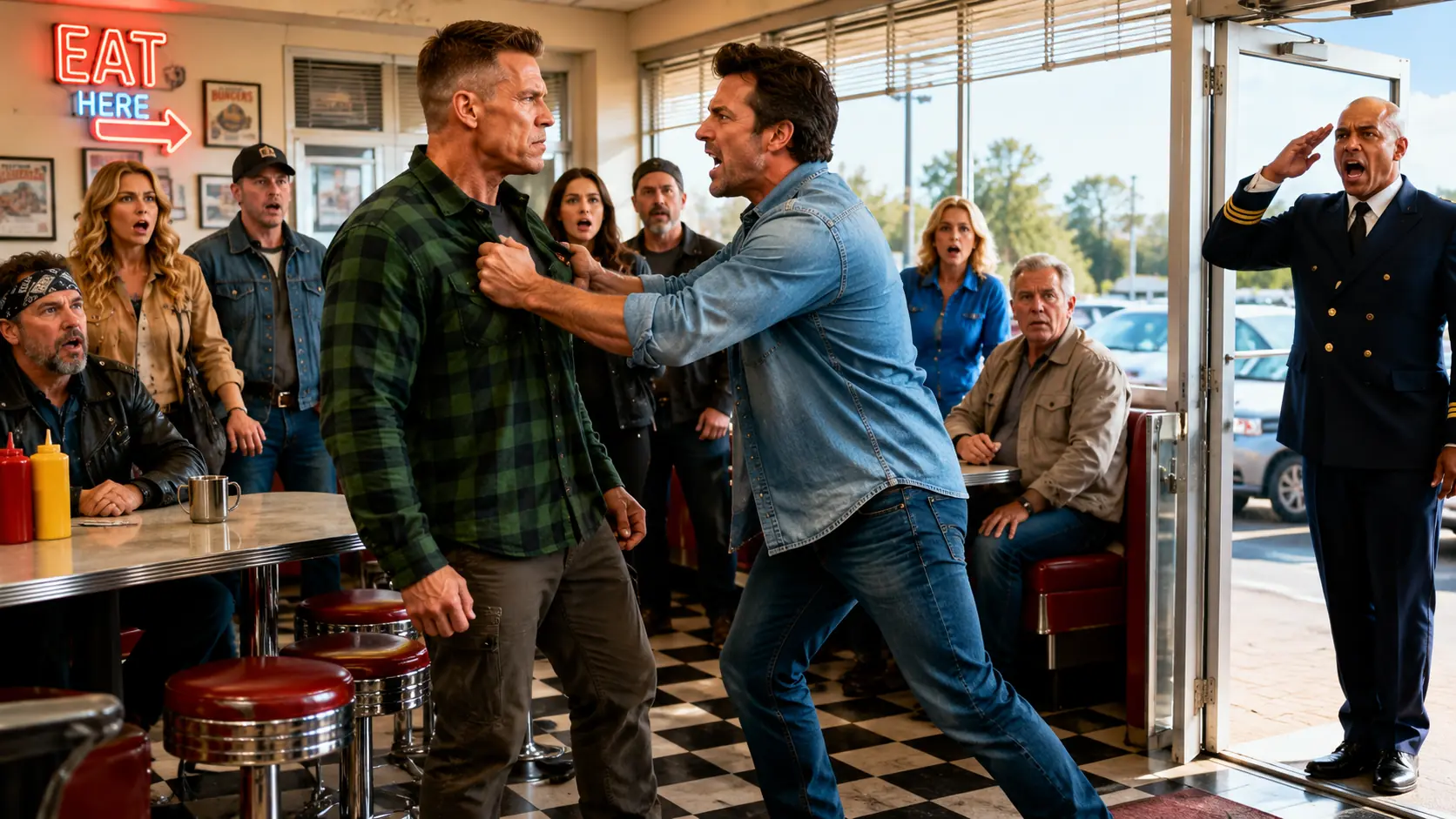
Derek Colt caught the edge of the counter and looked Wade dead in the eye.
“I’ve been sitting on this stool longer than you’ve been shaving, son.”
Wade shoved his face closer.
“You talk back to me? My daddy’s the chief of police. I say men like you eat outside.”
He grabbed Derek’s collar with both hands and dragged him across the tile floor. Chairs screamed. Plates crashed. Twelve people watched. Not one opened their mouths.
Wade threw him onto the sidewalk and laughed.
What he didn’t know—what made him the most dangerous kind of fool, the kind who doesn’t know what he’s done until it’s already too late—was exactly who he had just put his hands on.
The bell above the door jingled behind them, cheerful and completely wrong for the moment. Derek Colt sat on the sidewalk of the town where he was born. His right knee had cracked against the concrete. His palms were raw and pink. The flannel shirt his wife Carol had given him for his birthday last spring was torn at the shoulder seam.
He didn’t yell. Didn’t pound the ground. Didn’t call for help. He took a breath, then another. He pressed his hands flat against the concrete and pushed himself up slowly—the way a man gets up when he wants you to know he’s choosing to rise, not because you told him to.
Norma Watkins came running out the front door, the bell jingling behind her. She had a dish towel in one hand and fury in her eyes.
“Derek—Derek, are you okay?”
“I’m fine, Norma.”
“You are not fine. That boy just—”
“Norma.” He put his hand on her arm, gentle, steady. “I’m fine.”
She looked at him, eyes wet—not from sadness, from the kind of anger that has nowhere left to go. Twenty years she’d built that diner. Every table. Every recipe. Every morning before sunrise. And this kid was standing in the middle of it like he owned the air.
Derek straightened his torn shirt and stood there on the sidewalk, bleeding, carrying the same posture he’d carried through three decades he never talked about.
Inside, Wade Greer sat down at the counter on Derek’s stool. He picked up what was left of Derek’s coffee and took a long sip.
“Norma, how about some fresh bacon over here?”
Norma didn’t answer. She stood at the register with her arms crossed and her eyes on the parking lot.
Derek walked to his truck. It was parked at the far end of the lot—a dark blue Ford F-250, eleven years old, clean but not flashy. The kind of truck a man drives when he doesn’t need anyone to notice him. He opened the driver’s side door. His hands were still raw from the concrete. He reached into the glove compartment for a napkin and pressed it against the scrape on his right knee.
He wasn’t running. He wasn’t hiding. He was removing himself from a situation the way a man with thirty-one years of training knew how to do. De-escalate. Withdraw. Don’t give them what they want.
But Wade wasn’t done.
The diner door swung open. The brass bell jingled. Wade walked out with Deputy Lou Satch two steps behind him—sunglasses on, thumbs hooked in his belt loops, walking slow the way a man walks when he thinks the whole world is his sidewalk.
“Hey. Where do you think you’re going?”
Derek didn’t turn around. He folded the napkin and placed it in his pocket.
“I’m leaving. That’s what you wanted.”
“I didn’t say you could leave yet. I said you could leave the diner.”
Derek turned around. Looked at Wade, then at Lou. Lou’s hand was resting on his belt—not on his weapon, but close enough to send a message. Lou was twenty-six, buzz cut, thick neck, the kind of deputy who laughed at whatever the loudest voice in the room said.
“What do you want, Wade?”
“I wanna know who you are. Show me some ID.”
“You’re off duty. You have no authority to ask me for identification.”
Wade smiled—the same smile from inside the diner, the one that came right before the threat.
“I’m off duty. Lou’s not.” He jerked his thumb toward the deputy. “Lou, ask the man for his ID.”
Lou stepped forward, cleared his throat.
“Sir, I’m going to need to see some identification.”
Derek looked at Lou for a long moment. He could have argued. He knew his rights better than either of these men ever would. But he also knew what happened in small-town parking lots when a man decided to argue with a badge. He reached into his back pocket, slow, deliberate, making sure both hands were visible at all times. He pulled out his wallet and handed over his Kentucky driver’s license.