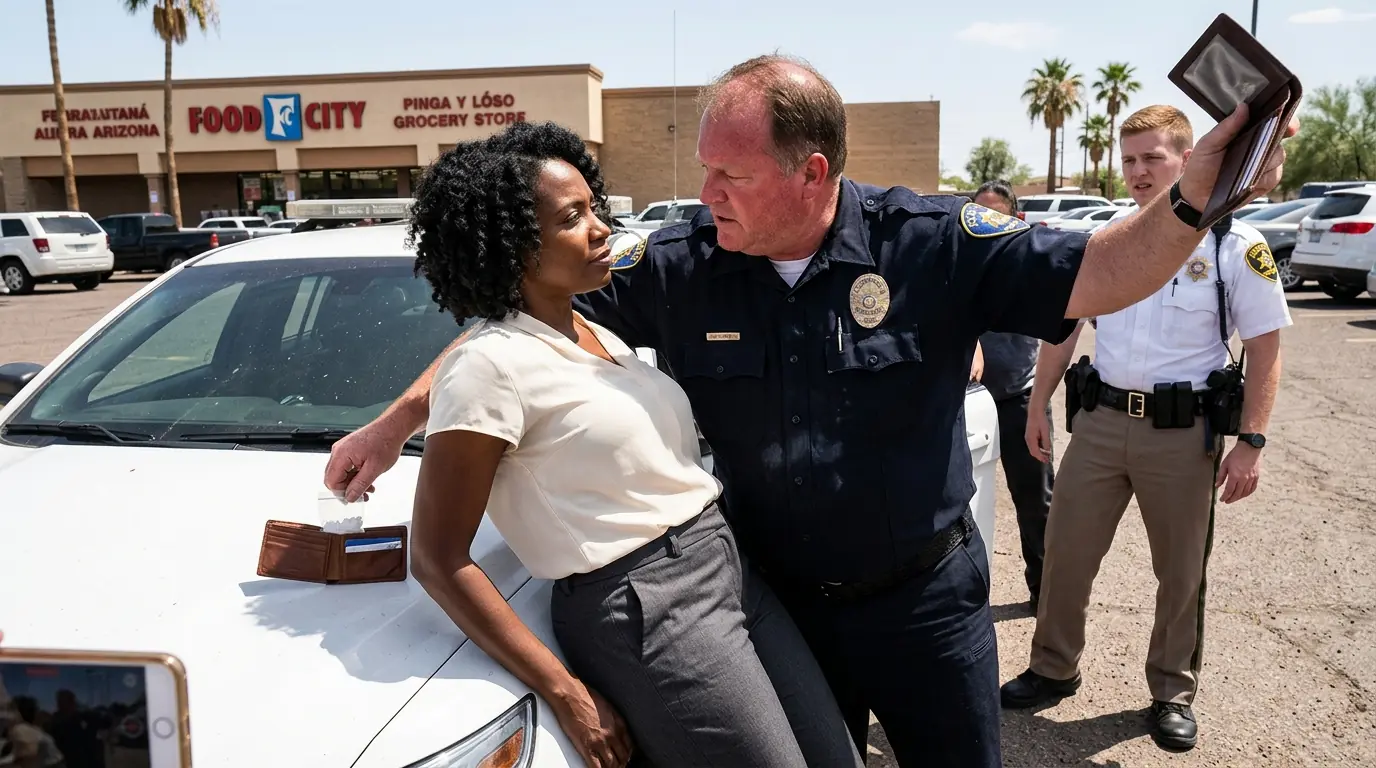
Police Demanded ID From a Black Woman on Her Own Porch — Then Their Captain Recognized the U.S. Attorney They Had Threatened
Reader Theme:
Font Size:
24px
At 7:12 on a quiet Thursday morning, United States Attorney Elena Brooks stood on the porch of her own home holding a white coffee mug while two marked police cruisers blocked part of her driveway. She had not expected visitors, much less a uniformed officer climbing her front steps with one hand resting near his duty belt. Elena wore a faded Georgetown hoodie, gray sweatpants, and house slippers, her black hair pulled into a smooth low bun. She looked like a woman enjoying the first peaceful minutes of her day because that was exactly what she had been doing before Officer Raymond Pike decided she looked like a suspect.
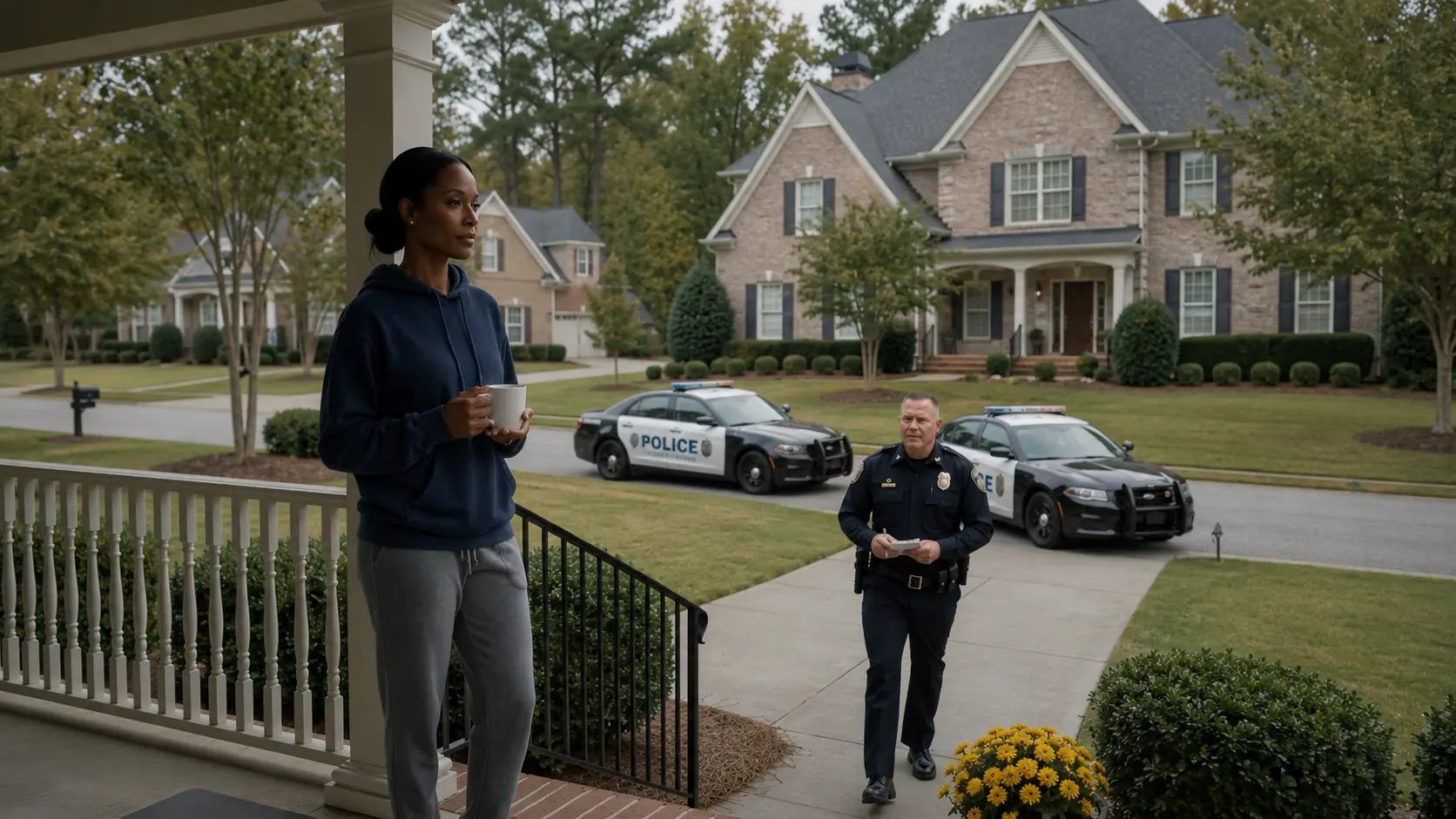
Pike stopped two steps below her and opened a small notepad without introducing himself. He was fifty years old, broad through the shoulders, with a rigid mouth and the impatient expression of a man accustomed to being obeyed before he finished speaking. Behind him, Officer Caleb Morris remained near the first cruiser, watching from beside the driver’s door. Neither officer had activated the emergency lights, but both vehicles had been positioned in a way that made it impossible for Elena to back her car out of the garage.
“We got a report about a suspicious Black woman on this porch, so hand me your ID and tell me why you’re here,” Pike said.
“You’re standing on my property, officer, so fix your tone before you ask me for anything,” Elena replied.
“Don’t get bold with me. I can pull you off these steps in cuffs before you finish that coffee.”
“Then call your captain first and let him explain why his officers are threatening the U.S. Attorney at her own front door.”
For the first time, Pike stopped writing.
Then he laughed.
It was not a nervous laugh or the startled reaction of someone wondering whether he had made a mistake. It was dismissive and sharp, the sound of a man who had already decided Elena was lying because the truth did not fit the picture he had created in his mind. He looked her Georgetown hoodie up and down, glanced at her slippers, and shook his head.
“Of course you are,” he said. “And I’m the governor.”
Elena’s fingers tightened slightly around the mug, but her voice remained level. “What crime are you investigating?”
“We received a call about a possible burglary.”
“Did the caller describe anyone breaking a lock, forcing a door, entering through a window, or carrying stolen property?”
Pike’s jaw hardened. “The caller said a woman who didn’t belong here was standing on the porch.”
“That is not a burglary.”
“That’s not for you to decide.”
Elena held his gaze. “Actually, reasonable suspicion is something both of us should understand before you threaten an arrest.”
Officer Morris shifted beside the cruiser. His body camera was running, and unlike Pike, he had heard the precision in Elena’s language. She had not shouted, stepped toward them, or tried to retreat inside. She had asked the kind of narrow questions that exposed exactly how little information they possessed.
Morris called toward the porch. “Sir, dispatch hasn’t confirmed any forced entry.”
Pike turned sharply. “I’ve got it.”
Elena noticed the exchange. She also noticed that Pike’s body-camera indicator was dark.
“Your camera is off,” she said.
Pike looked down for half a second, then back at her. “It must not have activated.”
“Turn it on.”
“You don’t give me orders.”
“No,” Elena said. “Department policy does.”
Pike climbed the final two steps and entered the porch without invitation. The distance between them disappeared until less than four feet remained. Elena placed her mug on the railing, not because she was afraid of spilling it, but because she wanted both hands visible.
“You’re going to provide identification,” Pike said. “Then you’re going to explain how you got inside this house.”
“I came through the kitchen.”
“Cute.”
“I own the kitchen.”
“Then proving it should be easy.”
Elena’s eyes narrowed. “You have no legal basis to compel identification from a homeowner standing peacefully on private property. You have seen no damaged door, no broken window, no alarm, no witness to an unlawful entry, and no property in my possession that does not belong to me.”
Pike extended his hand. “Identification. Now.”
“No.”
The word was quiet, but it landed harder than a shout.
Pike moved closer. “You want to test me?”
Elena did not step back. “You have been testing yourself since you reached my porch.”
Across the street, curtains moved inside several expensive brick homes. A man walking a golden retriever stopped at the corner. A delivery driver slowed near the curb, saw the police vehicles, and continued without stopping.
Pike reached for Elena’s wrist.
She pulled her arm back before he could grip it. “Do not touch me.”
His face changed immediately. The irritation became anger, not because she had attacked him, but because she had refused to submit to the gesture. He grabbed her forearm a second time, harder, and twisted it toward her back.
Officer Morris left the cruiser. “Pike, wait.”
“She resisted,” Pike snapped.
“I moved away from an unlawful seizure,” Elena said, keeping her balance. “Release my arm.”
Pike reached toward the handcuffs on his belt. “Turn around.”
Elena’s voice dropped colder. “Before you do that, understand that your partner’s body camera is recording an officer entering private property, refusing to activate his own camera, and attempting an arrest without identifying a crime.”
“You think your fake title scares me?”
“My title is not the part that should scare you.”
A radio crackled near Pike’s shoulder.
“Unit Twelve, supervisor is en route,” the dispatcher said. “Captain Holloway is three minutes out.”
Pike tightened his grip. “Tell him the suspect is refusing to identify.”
Morris looked toward the house number mounted beside the door. He repeated it into his radio, then paused as dispatch answered.
“Address returns to Elena Danielle Brooks,” the dispatcher said. “Property owner of record. No burglary history, no active alarm, no protection order. Caller refused to provide a name.”
Morris stared at Pike.
Elena said nothing.
Pike did not release her. “Ownership records don’t prove she’s Elena Brooks.”
“Then ask me a question instead of trying to handcuff me,” Elena said.
“I already asked for ID.”
“And I declined an unlawful demand.”
He pulled one cuff free. “Then we’ll sort it out downtown.”
The first black SUV turned onto the street before he could close the metal around her wrist.
It stopped behind the cruisers, and Captain David Holloway stepped out before the engine had fully settled. Holloway was a tall, gray-haired Black man with twenty-seven years in the department and a reputation for walking into tense situations without raising his voice. He had been reviewing overnight reports at headquarters when the dispatcher mentioned the address, the property owner’s name, and the officer requesting permission to detain her.
Holloway knew that name.
Two weeks earlier, he had sat across from Elena Brooks during a joint federal and local briefing concerning public corruption, civil-rights complaints, and misconduct reporting. She had been wearing a navy suit that day, seated beneath the seal of the Department of Justice, questioning commanders about body-camera compliance and the disappearance of citizen complaints from the department’s internal database.
Now she stood in house slippers while one of his officers twisted her arm behind her back.
Holloway crossed the lawn quickly. “Officer Pike, release her.”
Pike looked over his shoulder. “Captain, she’s refusing to identify and resisting detention.”
“I said release her.”
The tone ended the argument.
Pike removed his hand from Elena’s arm, but he did so slowly, as if obeying had become a personal humiliation. Elena stepped away and rubbed the place where his fingers had pressed into her skin.
Holloway stopped at the bottom of the porch. His expression changed when Elena turned toward him fully.
“Ms. Brooks,” he said.
Pike’s mouth opened.
Holloway climbed one step. “United States Attorney Brooks, are you injured?”
The street seemed to go silent.
Elena glanced at Pike before answering. “Not seriously.”
Pike looked between them. “Captain, she never showed identification.”
Holloway turned to him. “I have been in three federal task-force meetings with her.”
“She could still—”
“Stop talking.”
Pike’s face flushed. “We had a burglary call.”
“You had an anonymous caller saying a Black woman did not belong on a porch,” Holloway replied. “Dispatch found no evidence of forced entry and confirmed that she owns the property. Your camera is off, you entered the porch without consent, and I arrived while you were holding her arm.”
“She resisted.”
Holloway looked at Officer Morris. “Did she strike either of you?”
“No, sir.”
“Did she threaten either of you?”
“No, sir.”
“Did you observe evidence of a burglary?”
Morris swallowed. “No, sir.”
Holloway faced Pike again. “Step away from the porch and place your equipment bag on the hood of your cruiser.”
Pike stared at him. “You’re taking her word over mine?”
“I’m responding to what I can see, what dispatch recorded, and what Officer Morris’s camera captured.”
“Captain—”
“That is a direct order.”
Pike descended the steps with his jaw clenched so tightly that the muscles moved beneath his skin. He walked past Holloway, crossed the lawn, and placed his equipment bag on the hood. Several neighbors were now openly watching from their windows.
Elena picked up her coffee. It had gone cold.
Captain Holloway approached the porch carefully. “I owe you an apology.”
“You owe the public an accurate record,” she said. “The apology comes after that.”
He nodded once. “Understood.”
“I will not use my office to direct the investigation.”
“I expected you would say that.”
“But I will preserve my rights as the person your officer attempted to arrest.”
“You should.”
Elena glanced toward Pike. “And I want the original dispatch audio, every camera recording, the caller’s number if it can lawfully be obtained, vehicle-location data, activation logs for Pike’s camera, and all prior complaints involving similar stops preserved before anyone can modify or lose them.”
Holloway’s eyes sharpened. “I’ll issue the preservation order myself.”
“Put it in writing.”
“I will.”
Officer Morris stood uneasily near the cruiser. Elena looked at him next.
“Your camera was on?”
“Yes, ma’am.”
“Did you turn it off at any point?”
“No.”
“Then keep it that way until a supervisor formally collects it.”
Morris nodded. “Yes, ma’am.”
Pike turned from the hood. “This is ridiculous. Anyone could stand on a porch and claim to own a house.”
Elena looked at him. “Anyone could wear a badge and claim to understand the Constitution.”
Holloway did not rebuke her.
He told Pike to surrender his firearm and placed him on administrative leave pending an immediate review. Morris was directed to remain available as a witness and not discuss the incident with anyone outside the investigative process. Another supervisor arrived to collect the equipment and separate the officers.
Elena watched the procedure unfold without satisfaction. She had spent years prosecuting officials who believed consequences only became real when they reached the person in power. What disturbed her most was not that Pike had failed to recognize her. It was that he had believed recognition should have been necessary.
By 9:00 that morning, Elena was inside her home photographing the bruising on her arm while an attorney from outside her office documented her statement. She recused herself and every member of her federal office from deciding whether Pike’s actions violated federal law. The matter was referred to an independent civil-rights unit in another district, while the state bureau of investigation was asked to review possible unlawful detention and evidence-preservation issues.
Captain Holloway delivered the written preservation order before noon.
It included far more than the morning’s recordings.
During the first review, investigators discovered that Pike’s body camera had not malfunctioned. The activation log showed that he had manually disabled it twelve minutes before reaching Elena’s street. It also showed that he had reactivated it only after Holloway arrived.
His explanation changed twice.
First, he claimed he had pressed the wrong button. Then he said the battery was low. Device records showed the battery had been at eighty-three percent.
Officer Morris’s footage provided the missing account. It captured Pike hearing the dispatch description: “Black female standing on the porch, possibly doesn’t live there.” It recorded him saying, “These people always have an excuse,” before leaving the cruiser. It showed Elena standing calmly, asking legal questions and repeatedly keeping her hands visible.
It also recorded something no one had noticed in the moment.
When dispatch confirmed Elena as the property owner, Pike whispered, “She could still be lying,” before reaching for the handcuffs.
The anonymous call was traced to a prepaid phone, but security footage from a neighborhood entrance revealed who had used it. The caller was Margaret Vale, president of the subdivision’s homeowners association. She lived three houses away and had argued with Elena months earlier about replacing the porch railing without submitting a second architectural request.
Margaret initially denied calling.
Then investigators showed her footage of her vehicle stopping near a pharmacy where the prepaid phone had been purchased. Additional records revealed that she had called police four times in eighteen months about Black contractors, delivery workers, and guests entering the neighborhood. None of the calls had involved a crime.
Still, Elena insisted the inquiry not stop with the caller.
“A biased complaint does not require a biased response,” she told the independent investigators. “Margaret Vale did not order Officer Pike to switch off his camera, enter my porch, dismiss property records, or grab my arm.”
That distinction changed the scope of the investigation.
Internal affairs reviewed Pike’s prior stops and found seven complaints containing remarkably similar language. A Black college professor had been detained while unlocking his own car. A Latino landscaper had been ordered to sit on a curb after a resident claimed his truck “looked out of place.” A Black nurse had been handcuffed outside her mother’s home when Pike refused to believe she had been given a key.
Six complaints had been marked “unsubstantiated.”
The seventh had vanished from the department’s active database.
Captain Holloway requested a full audit. The audit revealed that Lieutenant Warren Dace, Pike’s immediate supervisor, had repeatedly closed complaints without interviewing witnesses or reviewing available video. In two cases, Dace had copied Pike’s written report almost word for word into the official finding.
The pattern had survived because each victim had been treated as an isolated problem.
Elena’s case connected them.
Three weeks after the porch incident, the city council held an emergency public hearing. Elena did not attend as U.S. Attorney. She attended as a homeowner and citizen, seated beside the professor, the nurse, the landscaper, and two other residents who had filed complaints.
Pike sat behind his attorney.
Lieutenant Dace sat at a separate table.
Captain Holloway testified first. He did not minimize the department’s failure or present Pike as a single bad officer who had somehow acted outside the system. Holloway admitted that complaint-review procedures had been weak, supervisors had been permitted to close cases without meaningful oversight, and body-camera violations were treated as technical mistakes instead of warning signs.
When Elena’s turn came, she placed a copy of her property deed, a photograph of her bruised arm, and the dispatch transcript on the table.
A council member asked whether the officers should have treated her differently after learning her title.
“No,” Elena said. “They should have treated me lawfully before learning it.”
The room became still.
She continued. “The danger is not that Officer Pike failed to recognize the U.S. Attorney. The danger is that he believed a Black woman in casual clothes had to prove she deserved to stand on her own porch. My position made the mistake visible. It did not make the mistake wrong.”
Behind her, the Black nurse lowered her head and wiped her eyes.
Pike’s attorney argued that the officer had acted cautiously after receiving a burglary report. But the body-camera footage showed Elena refusing only an unsupported identification demand. It showed no sudden movement, threat, deception, or attempt to flee.
The footage also showed Pike moving onto the porch after Elena told him it was private property.
His union representative advised him to accept an administrative settlement. Pike refused. He believed the department would protect him as it had before.
This time, the missing complaints were no longer missing.
The state investigation resulted in charges for unlawful restraint, official misconduct, and falsification of an incident report. Pike had written that Elena “attempted to retreat inside after being instructed to remain,” but Morris’s video showed her standing in the same position throughout the encounter.
Lieutenant Dace was charged separately after investigators discovered that he had ordered a records technician to alter complaint classifications. Emails showed him describing certain residents as “professional victims” and advising Pike to keep reports vague whenever race-related allegations might attract outside scrutiny.
Margaret Vale faced charges for making a false report and agreed to resign from the homeowners association. The association issued written apologies to the people targeted by her calls and prohibited officers or board members from using vague phrases such as “doesn’t belong here” as a substitute for reporting observable conduct.
Pike’s trial took place eleven months later.
Elena testified for less than an hour. She did not exaggerate his grip or claim fear she had not felt. She described the steps, the language, the inactive camera, and the moment he decided property records were less credible than his assumption.
The defense attorney asked whether she had intentionally withheld her identification to provoke a confrontation.
Elena looked toward the jury. “Exercising a right is not provocation.”
“Wouldn’t showing a driver’s license have ended the situation?”
“Perhaps,” she said. “So would following the law.”
Officer Morris testified next. He admitted that he should have intervened sooner. His honesty cost him comfort but preserved his credibility, and the jury watched his body-camera footage twice.
Captain Holloway was the final major witness.
The prosecutor asked what he had seen when he arrived.
“A homeowner standing on her porch,” Holloway said, “and an officer who had decided she was guilty of not matching his idea of who should live there.”
Pike was convicted of official misconduct and falsifying the report. The jury also found him guilty of unlawful restraint. Lieutenant Dace later pleaded guilty to evidence tampering and obstruction after two records employees agreed to testify.
The consequences continued beyond the courtroom.
The police department adopted automatic body-camera activation tied to vehicle-door sensors and dispatch assignment. Officers could no longer manually disable cameras without generating an immediate supervisor alert. Anonymous property complaints required callers to describe specific conduct rather than race, clothing, or a belief that someone looked unfamiliar.
Complaint reviews were transferred to an independent civilian office with access to dispatch, camera, and vehicle-location records. Closed complaints were audited every quarter. Officers with repeated similar allegations could no longer remain on patrol while each case was considered separately.
Captain Holloway was asked why he had supported reforms that exposed failures under his command.
“Because a badge does not become weaker when it is held accountable,” he said. “It becomes worthy of trust.”
Officer Morris remained with the department. He accepted a formal reprimand for failing to intervene immediately and later volunteered to teach recruits about the duty to stop unlawful conduct by another officer. In his first class, he played the porch footage without hiding his own face or name.
Elena did not sue for millions.
She reached a settlement requiring the city to fund independent monitoring, compensate the other residents whose complaints had been mishandled, and publish annual statistics on stops initiated from suspicious-person calls. A smaller portion covered her legal costs and the injury to her arm.
She donated the remaining amount to a community legal clinic.
Nearly two years after the morning of the confrontation, Elena stood on the same porch with another cup of coffee. The railing had been repainted, the flowers near the steps were blooming, and no police vehicles blocked the driveway.
Captain Holloway approached from the sidewalk in civilian clothes. He had retired the week before and carried a small box under one arm.
“I came without a warrant,” he said.
Elena smiled faintly. “That joke needs work.”
He handed her the box. Inside was a framed copy of the department’s new constitutional-policing policy, signed by every member of the first academy class trained under it.
At the bottom, one recruit had written a sentence from Elena’s testimony:
Exercising a right is not provocation.
Holloway looked toward the porch steps. “I still think about that morning.”
“So do I.”
“I wish I had arrived sooner.”
Elena placed the frame against the wall beside the front door. “Arriving mattered. What you did after arriving mattered more.”
He nodded.
Across the street, a new family was moving into one of the brick houses. A Black father carried boxes from a rented truck while his teenage daughter directed him toward the garage. No curtains shifted suspiciously. No anonymous caller decided they looked out of place.
Elena watched them for a moment, then lifted her coffee.
Officer Pike had demanded proof that she belonged on her own porch. In the end, the investigation proved something much larger: the porch had never been the problem.
The problem was the power of a man who believed his suspicion mattered more than another person’s rights.
And once that power was finally examined in daylight, no badge, title, or closed complaint could hide what it had become.
News in the same category
I Came Home Early from Work and Found My Wife Pouring Ice-Cold Water on My Sick Mother While Shouting
The Hotel Clerk Handed Me a Spare Key Because He Thought I Was My Husband’s “Usual Guest”… Then I Opened the Door
I Rushed to the ICU After My Husband’s Accident… Then Another Woman Told the Doctor, “I’m His Legal Wife.”
At My Husband’s Funeral, Another Woman Wearing My Wedding Ring Walked to His Coffin and Said, “I Lived With Him for Twelve Years.”
I Was Showing Clients an Apartment Listed as “Never Occupied”… Then I Found My Husband’s Wedding Photo in the Bedroom
Our Baby Monitor Connected to the TV During Family Dinner… Then I Saw My Husband With the Woman Sitting Beside Me
I Was About to Give Birth When a Nurse Called My Husband Into the Room Across the Hall… Then I Saw Who Was Inside
My Rich Neighbor's Black Belt Son Mocked Me and Demanded a Fight — Then Everything Changed

They Forced Her to Her Knees Before 600 People — Then She Started Counting
Black CEO Walks Into His Daughter’s School Cafeteria — The First Thing He Hears Makes Him Stop Cold

HOA President Poured Gasoline Into a Black Homeowner’s Private Pool — Then His Security System Exposed Her $2.4 Million Property Scheme

A Cocky Black Belt Thought the Quiet Farmer Was Easy Money — Until He Learned About His Elite Past
Sheriff Threatened to Bury a Black Woman Under Her Father’s Case — Then a Hidden Key Reopened the Crime He Buried

“Easy Money.” A Cocky Black Belt Bet Against a Quiet Farmer — Unaware He Was a Former Elite Officer
Restaurant Manager Called Black Woman "Homeless Trash" — Nearly Fainted When She Owns Entire Chain
Cop Kicks Black Coffee Vendor's Cart In Street His Voice Cracks as She Reads Out a Federal Number

Old Black Mechanic Helps 12 Stranded Riders in the Rain — What Arrives at His Shop Leaves Him in Tears