“Excuse me, officer. Could you tell me why I’ve been pulled over?” “Get out of the car. Now.” “Now?” She reached for her ID. He slammed his hand on the roof. “Did I stutter? Get your ass out. You don’t belong in this neighborhood, and you damn well know it.” He turned to his partner and laughed. “Bet this ride is stolen.”
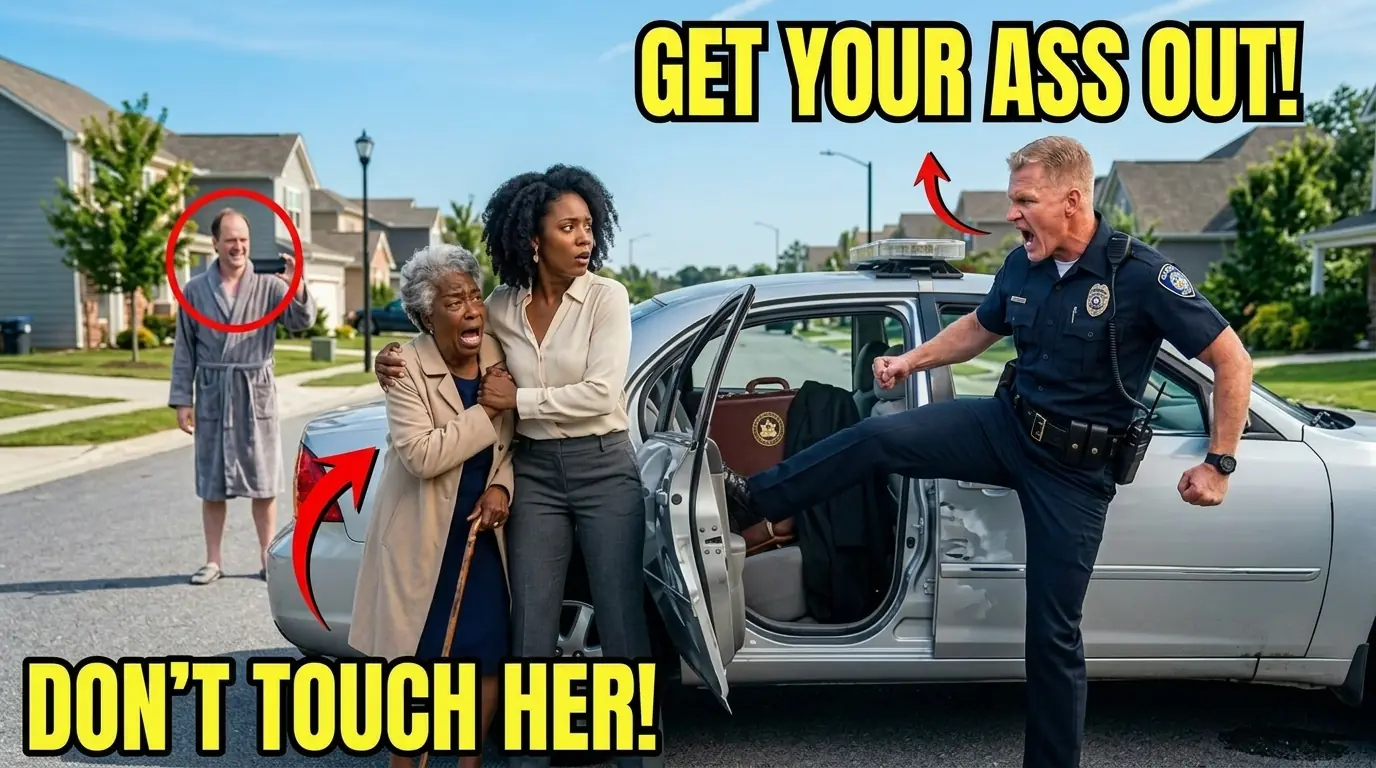
A neighbor across the street held up a phone, recording, grinning. Nobody helped. A sixty-eight-year-old mother sat frozen in the passenger seat, gripping her cane, watching her daughter be humiliated under flashing blue lights. But what Sergeant Prescott didn’t know was that in just a few hours he would be standing at attention while his own chief announced the three words that would destroy his entire career.
Two hours before those blue lights ever flashed, Brenda Williams sat at a corner table inside Magnolia’s, a small southern restaurant on the east side of Richmond, Virginia. White tablecloths. Candles flickering in Mason jars. The smell of brown butter and fresh cornbread drifting from the kitchen.
Across from her sat her mother, Denise Calloway, sixty-eight years old, retired schoolteacher, the kind of woman who still called every young man baby and carried peppermints in her purse for strangers’ children. Tonight was Denise’s birthday. Not a big party. No crowd. Just a daughter and her mama sharing a meal the way they’d done it every year for as long as Brenda could remember.
Denise was telling a story about the waiter, a tall kid, maybe twenty-two, who had called her beautiful when he brought the dessert menu. She was laughing so hard her glasses fogged up. “Mama, he was being polite.” “Polite? Baby, that boy winked at me. Twice.” Brenda shook her head, smiling. She cut a piece of sweet potato pie and slid it across the table. Denise swatted her hand away and pulled the whole plate closer.
This was peace. This was a Friday night. You wouldn’t know, looking at Brenda in that moment, that three days ago she had been confirmed as a federal district court judge for the Eastern District of Virginia. You wouldn’t know that on Monday morning, just sixty hours from now, she would stand in a packed courtroom, raise her right hand, and take the oath that would make her one of the youngest Black female federal judges in the history of the state.
Twenty years she had climbed to get here. Fresh out of law school, she started as a public defender in Norfolk. The cases no one wanted. Drug possession. Petty theft. Kids who reminded her of the boys she grew up with. She fought for every single one of them.
Then she moved into civil-rights litigation. Police brutality. Wrongful arrest. Racial profiling. She spent a decade documenting the exact kind of abuse that most people only saw in headlines. She didn’t just read about it. She held the hands of the people who lived it. From there, the appellate court. And then, three days ago, the call from Washington.
But tonight, none of that mattered. Tonight, she was just Denise’s daughter. Slacks and a blouse. Reading glasses tucked into her collar. No title. No robes. No security detail. Just two women, cornbread, sweet potato pie, and a birthday.
They left the restaurant around 8:30. The autumn air was cool, carrying the faint smell of wood smoke from a neighbor’s fireplace. Crickets hummed in the hedges along the sidewalk. Brenda held her mother’s arm as Denise steadied herself with her cane, stepping carefully off the curb.
She helped Denise into the passenger seat, buckled her in, walked around to the driver’s side. The silver sedan pulled out of the parking lot and turned onto Route 14, heading toward Whitmore Heights, the quiet, affluent suburb where Denise had lived for the past eleven years.
Whitmore Heights. Manicured lawns. American flags on porches. Streets so clean you could eat off them. The kind of neighborhood where people waved at each other but locked their doors the second someone unfamiliar walked by. Brenda turned on the radio. Gospel. Low volume. Denise hummed along, her head resting against the window, eyes half closed.
The dashboard glowed warm amber. The road was nearly empty. It was the kind of night where nothing was supposed to go wrong. Then Brenda noticed the headlights. They appeared about three blocks back, bright, steady, keeping pace. She changed lanes. The headlights changed lanes. She signaled a turn. The headlights followed.
She glanced at the speedometer. Thirty-three in a thirty-five zone. Two miles under the limit. Both taillights working. She had checked them that morning, the way she always did. A habit from her years representing clients who had been pulled over for equipment violations that didn’t exist.
She signaled again, perfectly, deliberately. The headlights stayed right behind her. Denise opened one eye. “Somebody’s following us, baby?” Brenda looked in the rearview mirror. “Probably nothing, Mama.” But her hands tightened on the steering wheel, ten and two, the way she always held them when she saw those lights behind her. Not because she was taught in driving school. Because she was taught by being Black in America.
The blue lights hit the rearview mirror like an explosion. Brenda’s stomach dropped. Not because she was guilty. Because she already knew how this would go. She pulled the sedan to the right, slow and smooth, tires crunching on the gravel shoulder. She put the car in park, turned off the engine, placed both hands on the steering wheel, ten and two, and waited.
Denise sat up straight. Her hand found her cane. “Lord, what now?” “It’s okay, Mama. Just stay still. Don’t say anything.” Brenda watched in the side mirror as the patrol-car door swung open. A tall figure stepped out. Broad shoulders. Slow, deliberate walk. One hand resting on his belt near the holster.
The red and blue lights strobed across the trees, painting everything in sharp, ugly flashes. Sergeant Dale Prescott. Fifteen years on the force. Three commendations on his wall. Fourteen complaints in his file. Every single one from a Black or Latino resident. Every single one dismissed.
He was the kind of cop who believed his badge didn’t just give him authority. It made him untouchable. He didn’t walk to the car the way a normal officer approaches a routine stop. He swaggered, chest out, chin up, like a man walking into a room he already owned. His boots ground into the gravel with each step, slow and deliberate, as if time itself was something he controlled.
He reached the driver’s window and shone his flashlight directly into Brenda’s face. Not at the car. Not at the interior. At her eyes. The beam was blinding, hot and white. She squinted but didn’t flinch. Didn’t look away. Then the beam swung to Denise, held there for a long, uncomfortable second. Denise raised one hand to shield her face, her bracelets clinking softly against each other.