By two in the afternoon, the heat had turned Willow Grove, Alabama, into a place where even the shadows seemed exhausted. The pavement on Main Street shimmered.
The flags outside the county administration building hung without movement. At Hattie Bell's diner, people lifted their water glasses and complained about the weather because complaining was one of the few things a person could do without getting out of a chair.
Officer Rhett Maddox had found a better arrangement. He sat inside his patrol cruiser behind a billboard on the northern approach to town, with the air conditioner aimed directly at his face and a plastic cup of sweet tea wedged between his thighs. The billboard towered over the gravel turnout in cheerful red and white letters: HARGROVE PERSONAL INJURY LAW. INJURED? WE FIGHT FOR YOU.
Maddox looked at the advertisement every day. He had known Silas Hargrove for fourteen years, long enough to recognize the man's expensive smile as the most valuable piece of real estate in Willow Grove. The smile had paid for the billboard, the polished offices downtown, and the lake house whose front gate never stayed unlocked. It had also paid for things that could not be listed on a tax return.
Maddox checked his watch. Two fourteen. The start of the slowest part of his shift.
At forty-six, he had the weary thickness of a man who remembered being athletic and had decided the memory should count as exercise. His shirt pulled at the buttons when he leaned forward. A silver badge rested over his chest. The polished metal had once inspired him to straighten his shoulders; now he took it as permission to let his shoulders slump. People straightened theirs when they saw him, and that was enough.
He had spent nineteen years on the Willow Grove Police Department. For the last eleven, he had been its unofficial test of character. New deputies learned the codes, the radio procedure, the geography of the county. Then they learned Rhett Maddox.
They learned that the wrong word could turn a routine shift into a miserable week. They learned that Chief Malcolm Reeve almost always sided with him. They learned that complaints disappeared into filing cabinets and that citizens who came back twice sometimes found patrol cars idling outside their homes.
At the Rusty Nail, a bar with two pool tables and no windows facing the street, they called him the Hammer. Maddox had repeated the nickname so often that eventually people said it before he did. He liked the sound of something made to strike.
The radio crackled. A dispatcher requested a welfare check on a broken-down pickup near the east bridge. Maddox took a slow drink of tea and allowed another unit to answer. Helping a stranded motorist meant standing in the sun, touching dirty machinery, and listening to someone explain a problem. None of that interested him.
His eyes returned to the road.
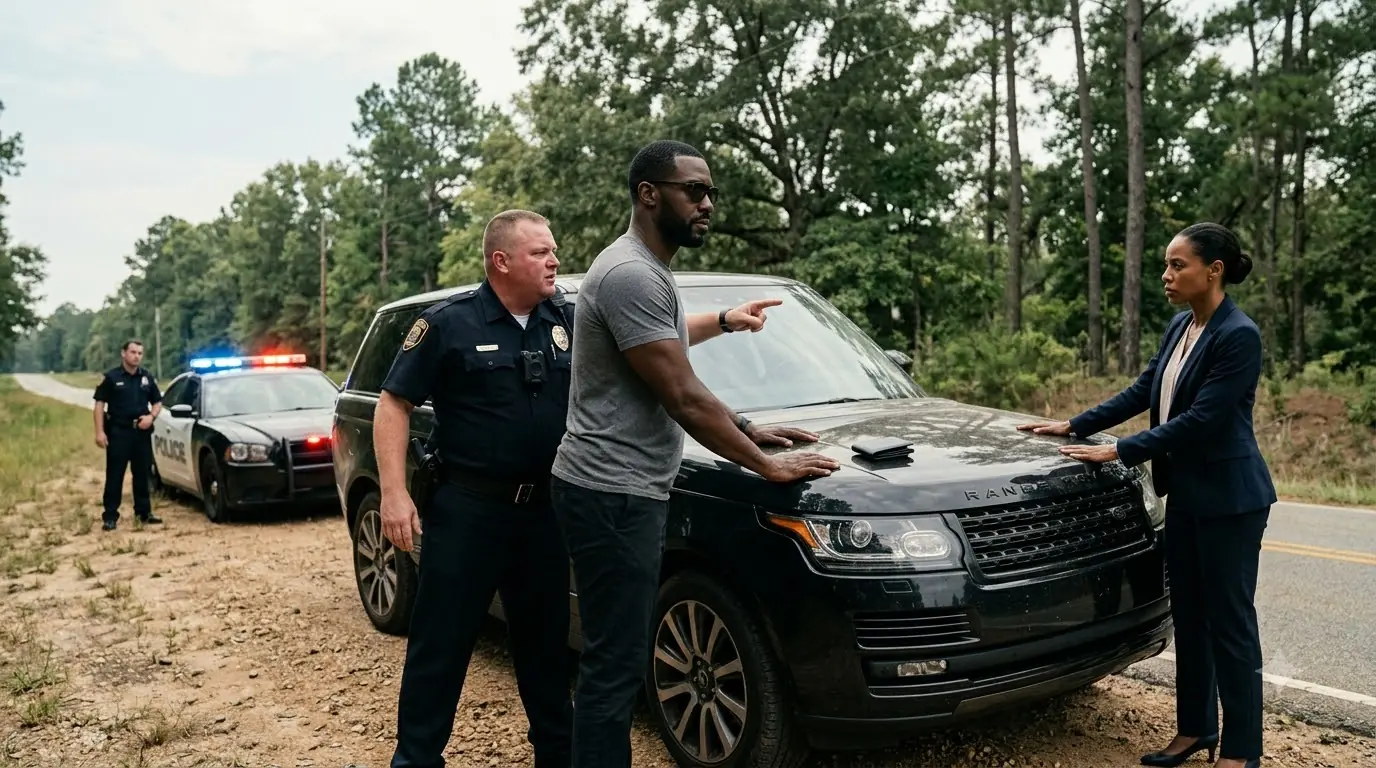
A white delivery van went past. A battered sedan followed. Then a black SUV appeared at the gentle curve beyond the grain elevator, sunlight breaking over its hood. The vehicle moved with unhurried precision. Dark glass, clean paint, expensive wheels. It was a new Range Rover, the sort Maddox saw in television commercials and in the parking lot of the Birmingham hotel where he had attended a three-day police conference years earlier.
He glanced at the radar display. Thirty-five miles an hour. Exactly the posted limit.
That should have been the end of his interest.
Instead, something bitter took hold of him. He had spent two decades working the same roads. He still owed money on his pickup, a truck with a failing transmission and an air conditioner that made a clicking sound. Whoever sat inside that SUV could probably buy the truck with the loose change between the seats.
As it passed the billboard, the afternoon light shifted across the windshield. He saw the driver: a Black man with broad shoulders, dark sunglasses, and an easy grip on the steering wheel. The passenger was a Black woman wearing a navy blazer. She held a phone angled toward the dashboard.
Maddox sat up.