“Get out of my hall, you filthy Blacks. Immediately. Before you soil the furniture.”
Fletcher Owens took his wife’s hand.
“Sir, we just wanted—”
Derek stepped closer. His voice trembled with something that wasn’t fear.
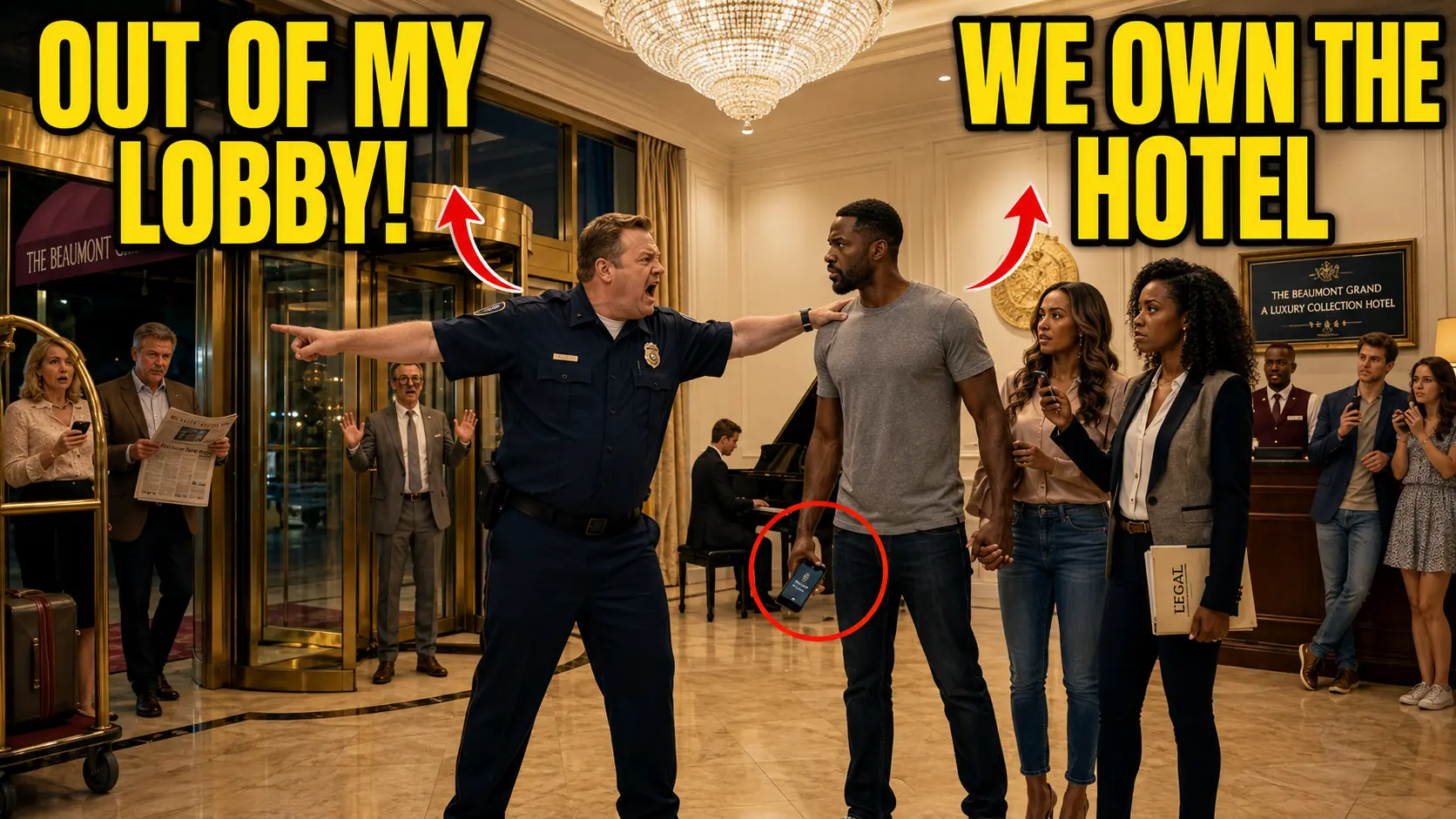
“Did I give you permission to speak? Animals aren’t allowed to speak here. Do you understand, you beasts?”
“Fletcher, let’s go.”
“Yeah, Fletcher. Listen to your sister. Get out. Go find a trash can that matches your outfit.”
He shoved Fletcher’s shoulder—hard. The hall froze. A phone came out, not to help, but to record.
No one in that building knew what was about to happen to Derek Tanner’s entire life.
Three hours before Derek Tanner’s hand touched Fletcher Owens’s shoulder, the evening had been perfect.
Fletcher stood at the kitchen island of their brownstone in Greenwich, Connecticut, slicing lemon for a pitcher of iced tea. Gwendolyn sat cross-legged on the counter stool, scrolling through paint swatches on her tablet. Simone leaned against the fridge, a half-eaten apple in one hand and a legal brief in the other.
“You’re really not going to tell them?” Simone asked, eyebrow raised.
“Not yet.” Fletcher dried his hands on a dish towel. “I want to see it the way a guest sees it. No red carpet. No speeches. Just walk in, look around, and feel what a normal person feels when they step through those doors.”
Gwendolyn looked up. “In sneakers and a T-shirt?”
“Especially in sneakers and a T-shirt.”
That was Fletcher Owens. Forty-one years old. Founder and CEO of Owens Hospitality Group, a boutique hotel chain with eleven properties stretching from Boston to Savannah. He had started with a single bed-and-breakfast in Hartford at twenty-three, borrowed money from his grandmother, and turned it into a two-hundred-million-dollar empire in eighteen years. Forbes had profiled him twice. The Wall Street Journal called him the quiet architect of American luxury.
But Fletcher never walked into a room expecting to be recognized. He wore plain clothes. Drove a ten-year-old Volvo. Tipped thirty percent at diners where nobody knew his name. His philosophy was simple: the best way to understand a business is to experience it from the bottom.
Two weeks ago, Owens Hospitality Group had closed its largest acquisition: the Belmont Grand, a 340-room luxury hotel on Park Avenue. The deal was worth ninety-four million dollars. The previous owner, a Swiss conglomerate, had let the property slide. Occupancy was down. Reviews were slipping. Staff morale had cratered. Fletcher saw potential. He always did.
The acquisition had been handled through a holding company. No press release. No public announcement. The existing staff had been told only that new ownership would introduce itself within the month. Nobody at the Belmont Grand knew that the new owner was a Black man from Hartford who still called his grandmother every Sunday.
The plan tonight was simple. Drive into the city. Walk into the lobby around nine. Sit at the bar. Order a drink. Watch how the staff treated guests. Watch how they treated each other. Then leave. The formal introduction would come Monday morning.
Simone had insisted on tagging along.
“If something goes sideways, you’ll want a lawyer in the room,” she said.
Simone Owens Perry was a civil rights attorney at one of Philadelphia’s top firms. She had a habit of being right about things going sideways.
Gwendolyn came because she always came. Twenty years of marriage had taught her that Fletcher’s quick visits never stayed quick. She grabbed her jacket and a book. Just in case.
They took Fletcher’s Volvo. The drive from Greenwich to Midtown Manhattan took forty-seven minutes. Simone sat in the back reviewing a case on her phone. Gwendolyn controlled the radio, flipping between jazz and a true-crime podcast. Fletcher drove in silence, thinking about the hotel. He had studied the blueprints, memorized the floor plans, reviewed five years of financial statements. But he hadn’t set foot inside the Belmont Grand since the closing dinner three weeks earlier. And at that dinner he had worn a tailored suit and arrived through a private entrance.
Tonight would be different.
They parked three blocks away in a public garage. The night air was cool for September. Manhattan hummed its usual electric hum—taxi horns, distant music, the metallic rattle of a subway grate.
The Belmont Grand rose fourteen stories above Park Avenue. Its facade was limestone and glass, built in 1928, restored in 2014. Two brass revolving doors flanked a set of marble steps. A burgundy awning stretched over the entrance, gold lettering stitched across the fabric.
Fletcher looked up at the building. His building.
“Ready?” Gwendolyn asked.
“Always.”
They climbed the steps. Simone slipped her phone into her back pocket. Gwendolyn tucked her book under her arm. Fletcher pushed through the revolving door first.
The lobby hit them like a cathedral. Thirty-foot ceilings. Italian marble floors polished to a mirror shine. A crystal chandelier the size of a small car hanging above the center atrium. The scent of white jasmine drifted from hidden diffusers. A grand piano played Debussy in the far corner—the pianist in a black vest, no audience.
And standing six feet from the entrance, arms folded, jaw set, was Derek Tanner.
Derek Tanner had worked security at the Belmont Grand for eight years. He knew every inch of the lobby. He knew which guests tipped and which ones complained. He knew the sound of money—the click of Italian loafers, the rustle of cashmere, the quiet confidence of people who belonged.
These three did not belong.
The man wore jeans and sneakers. The woman beside him carried a paperback like she was waiting for a bus. The younger one had her phone out, casual. No handbag. No jewelry worth noting.
Derek’s eyes tracked them from the revolving door to the second step on the marble floor. That was as far as they’d get.
“Hold on.”
He uncrossed his arms and stepped forward.
“Where do you think you’re going?”
Fletcher stopped.
“Good evening. We were hoping to check out the bar.”